Cheese Mites and Mimolette
Cut into an aged Mimolette and the contrast is striking: firm orange cheese beneath a rough, cratered crust.
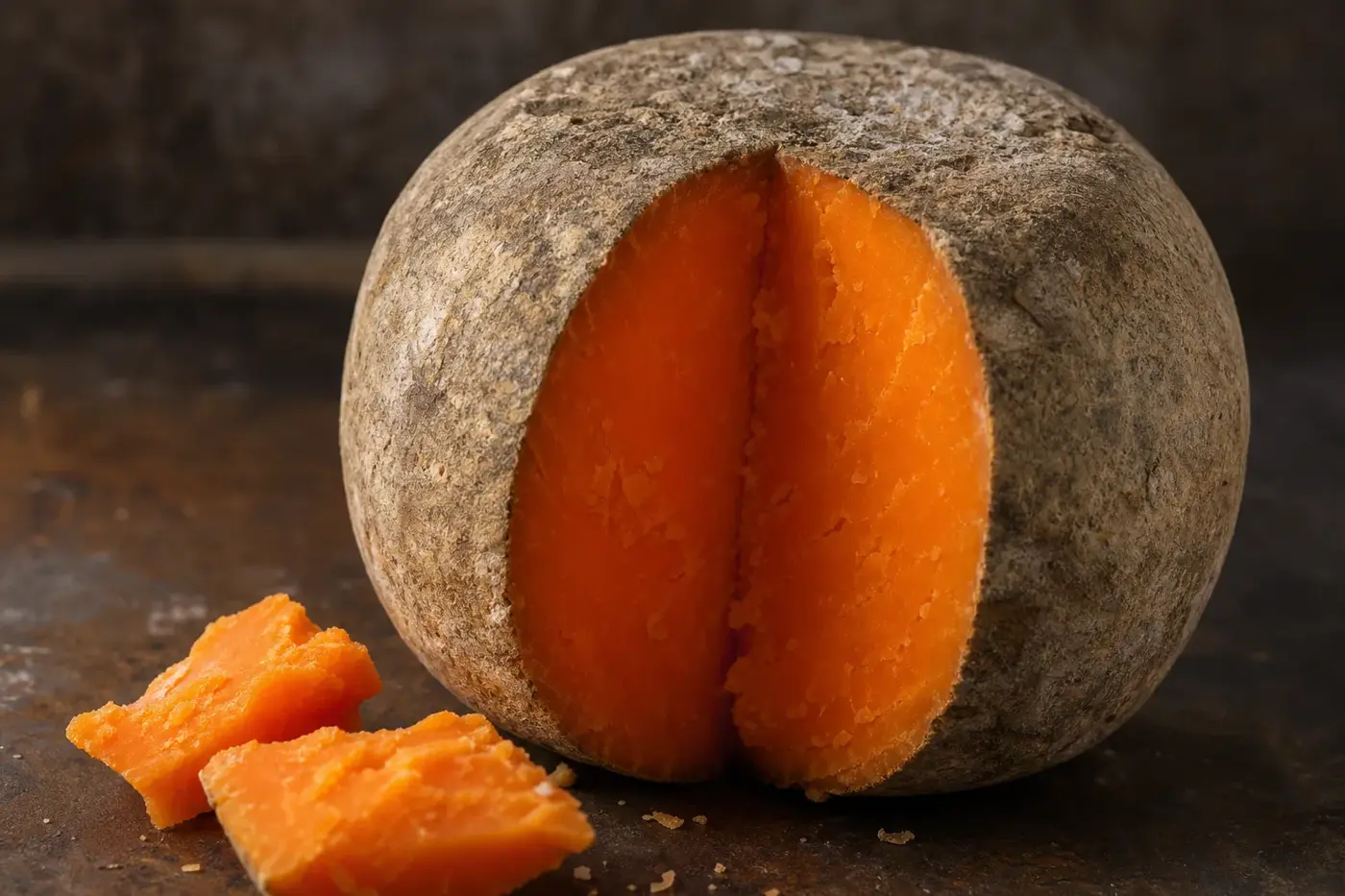
Cut into an aged Mimolette and the contrast is striking: firm orange cheese beneath a rough, cratered crust. Tiny mites graze that surface, helping the affineur, the specialist who matures cheese, shape its distinctive rind. It is quite a busy address for something sitting so still.[1][2]
Their handiwork is well documented; their precise contribution to flavour is less clear. If you are wondering about eating it, food handling and your own allergy concerns matter more than the cheese's name alone.[1][2][3]
Beneath the rugged coat, a flash of orange
Under that greyish, uneven crust, aged Mimolette has a firm orange interior. The round cheese is associated with Lille and French Flanders in northern France. Isigny Sainte-Mère describes its wheels as spheres flattened at the poles, with a mature paste, meaning the cheese's interior, that is firm and brittle.[1][4]
The orange and the craters tell quite separate stories. In its September 2025 account, the cooperative attributes its Mimolette's colour to rocou, or annatto, added to the milk. The mites work outside during maturation.[4]
Nor does that northern French identity tell you everywhere the cheese is made. Isigny Sainte-Mère makes and matures its own Mimolette in Normandy.[4]
Meet the tiny residents of the rind
Cheese mites are minute arachnids, relatives of spiders rather than insects. French accounts often call them cirons. Identifying them takes a much closer look than you get at a cheesemonger's counter.[2][5][6]
A 2010 Mimolette study used cryogenic scanning electron microscopy to examine body shape, hairs and leg structures. This preserved the specimens at very low temperatures, allowing researchers to inspect those tiny identifying details.[5]
That study identified Acarus siro on its Mimolette sample. A later investigation, published in 2022, found Tyrolichus casei in Mimolette from a French Flanders maturation cellar and a Paris specialist shop. Its discussion also records Tyrophagus putrescentiae among mites encountered on Mimolette from different producers.[5][6]
So “cheese mite” describes a role, not a single species. An identification tells you about the sampled cheese and its surroundings, not every wheel bearing the same name. The later paper explicitly suggests that species can differ between producers or geographical locations.[6]
How the rind gets its craters
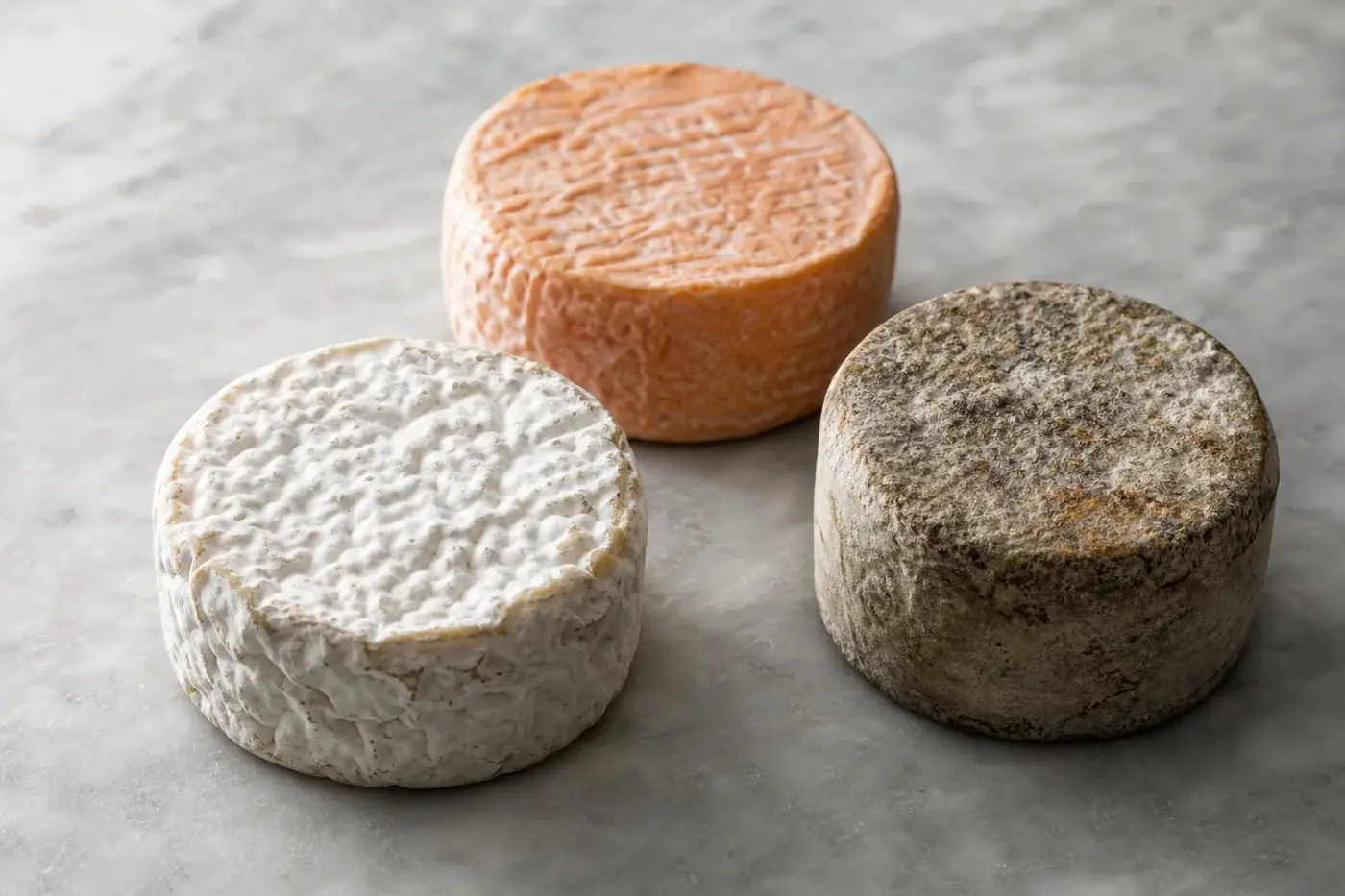
First comes a fine covering of mould. According to Isigny Sainte-Mère, this gives the cirons a surface on which to establish themselves. As they move and feed, they work the rind into an irregular crust; the producer describes their action as stripping it to create its characteristic natural appearance.[1]
Look closely and you can see small pits and loose, fine material left by that activity. You are looking at a worked surface, not a smooth protective coating applied to cheese. Those exterior pits are not cheese crystals, either: a crunchy speck inside the paste has a separate explanation.[1][2]
In the cellar, the affineur keeps watch
The mites do not get the cellar to themselves. Isigny Sainte-Mère describes regular turning, manual sorting and selection, with temperature and humidity kept constant for its extra-old cheeses. Turning helps the rind develop evenly around the wheel, rather than concentrating on one face.[1]
Contemporary reporting on Mimolette maturation also describes brushing, which removes mites but leaves their pitted handiwork visible.[7] Throughout maturation, the wheel is repeatedly handled and assessed. That rough exterior takes care and attention; it is not what happens when someone simply forgets a cheese.[1]
A hint of lemon, but what reaches the cheese?
Mites carry aromatic chemicals of their own. A 2022 study analysed secretions from mites associated with Mimolette, German Milbenkäse and French Artisou, using gas chromatography to separate volatile compounds. It identified neral, a compound with a lemon aroma, as an important component of Tyrolichus casei secretions.[3]
But an aroma carried by mites is not automatically an aroma reaching the cheese. In a separate headspace analysis, researchers examined compounds released into the air above Artisou and Cantal vieux. Compounds originating from mites were absent after the mites were removed.[3]
Those removal results concerned Artisou and Cantal vieux, not a controlled comparison of Mimolette paste matured with and without mites. Their secretions can explain an aroma associated with the organisms, while their feeding helps explain the rind. To measure their specific contribution to the interior's flavour, you would need an experiment separating their effect from the rest of maturation.[3]
Find your Mimolette: supple, firm or brittle
Mimolette changes markedly as it ages. Isigny Sainte-Mère's descriptions, published in September 2025, take you from yielding paste to brittle pieces. These age ranges describe that producer's products, and the tasting descriptions are its own.[4]
| Name on the producer's label | Stated age | What you can expect |
|---|---|---|
| Young | 3 to 6 months | Supple paste; delicate milk notes.[4] |
| Demi-vieille | 6 to 12 months | Increasing aromatic intensity.[4] |
| Vieille | At least 12 months | Firmer paste; hazelnut notes.[4] |
| Extra-vieille | 16 to 24 months | Brittle paste; pronounced, salty notes.[4] |
The rind develops alongside these changes, but that does not make every stronger flavour or firmer texture a mite effect. These descriptions follow an ageing sequence; they do not isolate what the mites do. Choose your piece by the producer's maturity description and the texture you enjoy, rather than the depth of its craters.[3][4]
This page summarises published guidance from the official sources it cites. It is not medical advice. Guidance differs between countries and changes over time, so check the current source for where you live, and ask your doctor, midwife, pharmacist or dietitian about your own circumstances.
Food safety and allergy: keep the questions separate
A deliberately developed rind belongs to a documented maturation process. An unwanted infestation in stored food is a different situation, even when some of the same mite species are involved. Norway's Scientific Committee for Food and Environment assessed mite exposure in a plant protection setting, not exposure from eating Mimolette.[8]
If you have questions about allergic reactions to mites in Mimolette, seek advice specific to your circumstances. Milk allergy needs its own consideration. The UK NHS lists cows' milk among common food allergens and advises seeing a GP if you think you or your child may have a food allergy.[9]
Discuss a suspected reaction with a clinician, including any history of reactions to mites. The guide to cheese allergy and lactose intolerance explains the distinction between those conditions.[9]
For urgent symptoms, follow the official emergency advice where you live. In the UK, the NHS says to call 999 for symptoms including sudden swelling of the lips, mouth, throat or tongue, or struggling to breathe. For the full warning signs and instructions, consult its food allergy guidance; the guidance date for this page is November 2026.[9]
Once you get it home: trimming and storage
A university research account reports that Mimolette's exterior is removed before eating.[2] Do not treat removing the rind as an allergy control measure. For official food safety advice on handling this particular rind, ask your local food safety authority.
Keep your cheese refrigerated and follow its packaging. Food Standards Agency guidance for England, Wales and Northern Ireland recommends a fridge temperature between 0 and 5 °C (32 to 41 °F), checked with a fridge thermometer. It also says to refrigerate dairy products and follow the storage instructions and dates on packaging. Check your particular piece for directions after opening.[10]
Keep the maker's label or cheesemonger's information with the cheese, so you can identify it if you need advice. If mites appear on other food, record which foods are affected and retain the product details. Ask your local food safety authority for advice on a household infestation.
For your wider storage routine, turn to how to store cheese at home. If unexpected mould is your concern rather than mites, mould on cheese explains the separate guidance on when cutting is appropriate and when food should be discarded.
At the US border: what happened in 2013?
Mimolette's American import dispute dates to 2013. In an article published on 17 April 2013, DairyReporter described reports of consignments stopped in March over mite infestation. What happened to those shipments and whether Mimolette as a category could be imported are two different questions.[7]
Responding directly to the publication, the FDA said there was generally no ban on importing Mimolette. It explained that surveillance sampling could lead to refusal of entry when an imported product breached US requirements. This was enforcement against imports that failed those requirements, not a prohibition attached to the cheese's name.[7]
The episode was a 2013 dispute over consignments bearing mites, accompanied by an FDA denial of a general import ban. Calling it a continuing blanket ban loses both the date and the agency's distinction. For current commercial import decisions, you need the current FDA record for the product and exporter concerned.[7]
Read the rind, then look inside
Mimolette's rind tells a different story from its interior. Cheese Rinds Explained gives you the wider context for recognising a rind's purpose, alongside the hub's coverage of rind microbes. Mites are animals; the mould on which they establish belongs to a different living community.[1][6]
Cheese crystals, meanwhile, belong to the interior's story, not that busy, cratered surface. Once you know which part you are looking at, the wheel becomes a little easier to read.[1][6]
A few more paths for the cheese curious
- How Cheese Is Made: From Milk to Cheese: follow the wider journey from milk to maturation.
- Raw Milk, Thermised and Pasteurised Cheese: explore milk treatment as a separate question from rind development.
- Cheese Food Safety: The Complete Guide: find the broader official guidance and its country-specific limits.
Questions people ask
Why are there mites on Mimolette?
Mites establish themselves on a fine covering of mould and graze the outside of the cheese. Their activity leaves the rind pitted and irregular.
Can you eat the rind of Mimolette?
A university research account reports that the exterior is removed before eating. The page says verified official food safety guidance on handling the rind is unavailable and that removing it should not be treated as an allergy control measure.
Do cheese mites give Mimolette its flavour?
Mite secretions contain aromatic compounds, but their precise contribution to Mimolette's flavour is less clear. An experiment separating their effect from the rest of maturation would be needed to measure it.
How should Mimolette be stored?
The Food Standards Agency recommends refrigerating dairy products and following the storage instructions and dates on the packaging. Its guidance for England, Wales and Northern Ireland recommends a fridge temperature between 0 and 5 °C, checked with a fridge thermometer.
Is Mimolette banned in the United States?
In 2013, the FDA told DairyReporter that there was generally no ban on importing Mimolette. It said surveillance sampling could lead to refusal of entry when an imported product breached US requirements.
Sources
[1] Isigny Sainte-Mère. La Mimolette. Undated producer account, retrieved November 2026. Sections on maturation, organoleptic characteristics and product formats. Commercial source, used for the cooperative's own practices and descriptions. Source.
[2] Hosei University. Three Distant European Cheese Manufactures Traditionally Use Mites for Ripening Cheese Discover that the Mites, Not Yeast, Are the Same Kind of Cheese Mites. Research announcement, 10 August 2022. Institutional account accompanying the two 2022 papers, including the distinction between Mimolette's removed exterior and other mite-ripened cheeses. Source.
[3] Experimental and Applied Acarology, Springer Nature. Mite secretions from three traditional mite-ripened cheese types: are ripened French cheeses flavored by the mites (Acari: Astigmata)? Volume 87, pages 309 to 323, published 19 August 2022. DOI: 10.1007/s10493-022-00734-7. Abstract and indexed study summary retrieved. Publisher record.
[4] Isigny Sainte-Mère. Communiqué de presse septembre 2025. September 2025, pages describing colour, maturation and the four maturity stages. Commercial source, used for attributed product descriptions. Source.
[5] Journal of Dairy Science, American Dairy Science Association. Identification of cheese mite species inoculated on Mimolette and Milbenkase cheese through cryogenic scanning electron microscopy. Volume 93, issue 8, pages 3461 to 3468, August 2010. DOI: 10.3168/jds.2009-2937. Indexed abstract retrieved. PubMed record.
[6] Experimental and Applied Acarology, Springer Nature. Do ‘cheese factory-specific’ mites (Acari: Astigmata) exist in the cheese-ripening cabinet? Volume 87, pages 49 to 65, published 11 July 2022. DOI: 10.1007/s10493-022-00725-8. Publisher record and author-provided full text retrieved. Publisher record.
[7] DairyReporter. FDA dismisses reports of US import ban on French mimolette cheese. Published 17 April 2013; page records an update on 18 March 2017. Original reporting containing a direct FDA response, distinguished here from its separately attributed shipment reports. Source.
[8] Norwegian Scientific Committee for Food and Environment. Environmental and human health risk assessment of the mites Acarus siro and Suidasia pontifica in the product POWERfood 3.0. VKM Bulletin 2025: 15, 20 June 2025. Human health assessment and exposure-specific conclusions. Source.
[9] NHS. Food allergy. Current online guidance retrieved November 2026. Sections on medical help, emergency symptoms and common food allergens. Source.
[10] Food Standards Agency. How to chill, freeze and defrost food safely. Published 18 December 2017; current online text retrieved November 2026. Applies to England, Northern Ireland and Wales. Source.
[11] Food Standards Agency. Alerts. Live official alert index, retrieved November 2026 for the editorial recall check. Source.
[12] US Food and Drug Administration. Recalls, Market Withdrawals, & Safety Alerts. Live official index, retrieved November 2026 for the editorial recall check. The FDA states that the index does not contain every recall. Source.
This piece was researched from published microscopy and chemical studies, attributed producer accounts, official health and storage guidance, and contemporary reporting containing an FDA response.
Last checked: November 2026
Last checked November 2026.
The editors suggest you read next