Mimolette
Cut into Mimolette and the surprise is waiting: vivid orange beneath a rough, pitted rind.
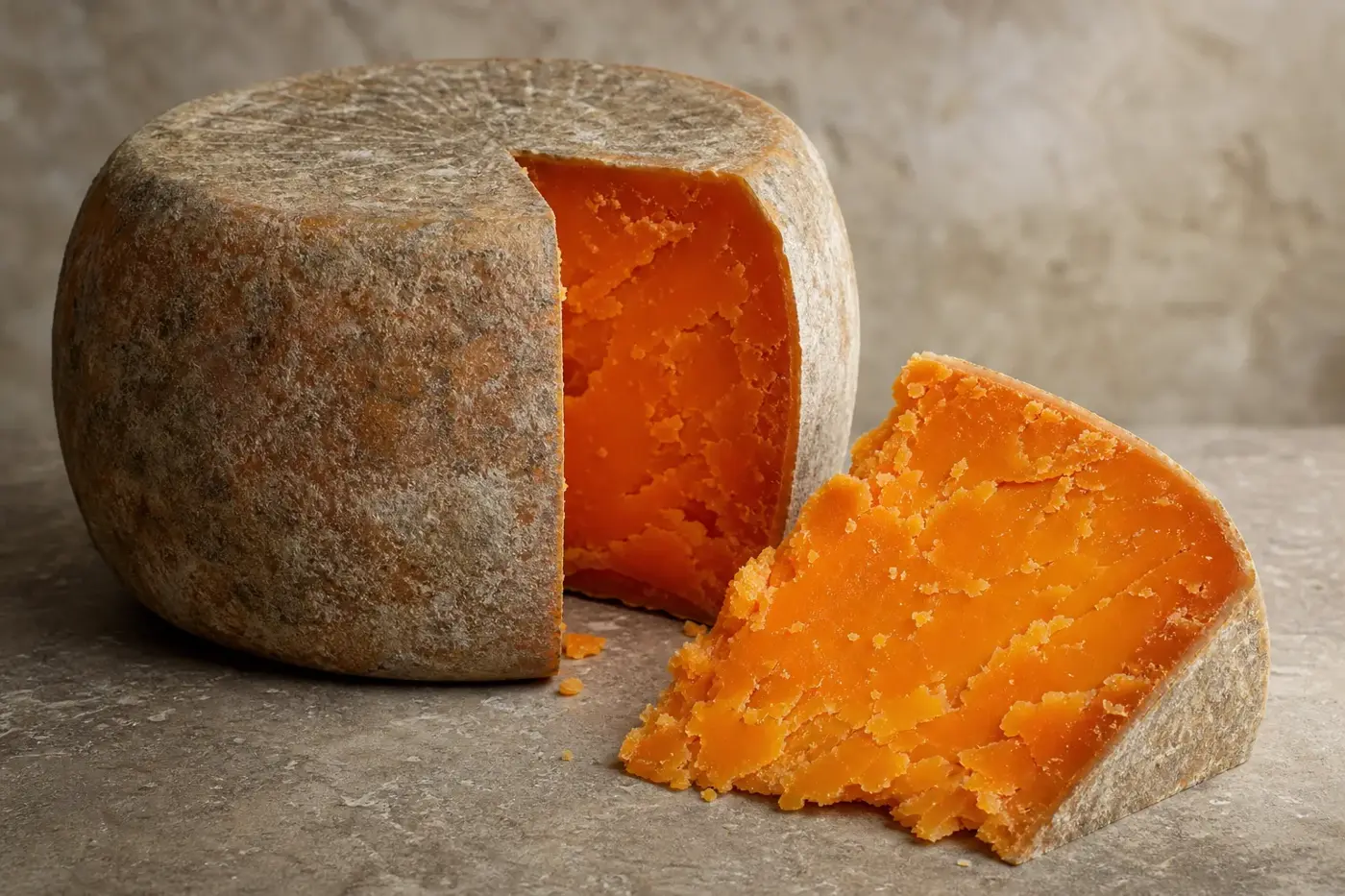
Cut into Mimolette and the surprise is waiting: vivid orange beneath a rough, pitted rind. As this cows’ milk cheese ages, its shell darkens towards grey-brown, shaped by cellar care and cheese mites. Annatto supplies the orange. Northern France, particularly Lille, supplies its strongest associations, but there is much more to this cheese than its looks.[2,4,5]
Inside that weathered orange ball
A whole Mimolette gives you quite a contrast: a thick, weathered-looking shell around bright orange paste. The French standard describes a semi-hard to hard cheese, with a dry, hard rind that may carry grey patches. But cut cheeses of different ages and you will find different characters: Isigny Sainte-Mère describes young Mimolette as supple and milky, older cheese as craggy, brittle and increasingly intense.[1,2]
Follow the cheesemakers from Lille to Normandy
Mimolette carries its northern roots in another name: boule de Lille, or Lille ball. Its Norman story has a firm landmark in 1951. That year, according to Isigny Sainte-Mère’s published history, the cooperative recruited cheesemakers from northern France who brought Mimolette, and their cheesemaking knowledge, with them.[4]
You may encounter the familiar story that Mimolette was France’s answer to Dutch cheese during seventeenth-century trade restrictions. It remains an origin tradition, not an established account of the cheese’s creation.[8] Isigny Sainte-Mère also records Edam and Gouda production at Chef-du-Pont in 1909, before Mimolette arrived there. That earlier cheesemaking does not establish where Mimolette began or its relationship to Edam.[4]
So keep both places in mind when you taste it. This is a cheese with northern associations and a substantial Norman production tradition.[4]
Follow the milk into the cellar
The producer specification starts with milk reception, then moves through pasteurisation, coagulation, curd cutting, stirring and lactose removal. Draining, pressing, brine salting and cellar ripening follow.[3] Step by step, liquid milk becomes a coherent cheese.
If you picture curd as the milk’s set protein network, whey is the liquid draining away from it. Pressing draws those curd grains together and pushes drainage further.[7] Starter cultures are added bacteria that acidify the milk. The Label Rouge specification calls for mesophilic lactic bacteria, suited to moderate temperatures, and animal rennet, the enzyme preparation that sets the milk.[7]
Washing the curd means replacing some whey with water. That removes lactose and moderates the acidification to come.[7] You can follow the wider journey in how cheese is made.
Next comes a brine bath, which brings salt into the cheese, followed by drying and ripening. The documented Isigny Sainte-Mère product uses pasteurised cows’ milk and animal rennet.[3] Check those declarations on the piece you actually buy.
That orange is not an age label
Annatto gives Mimolette its unmistakable colour. In French, it is called rocou. Isigny Sainte-Mère lists the colouring ingredient as annatto norbixin, E160b(ii), and describes rocou in its consumer information as a plant-derived colour.[3,5]
Enjoy the orange, but do not ask it to tell you the cheese’s age. A deeper-looking wedge cannot reveal how long it has spent in the cellar. Read the stated age, examine the texture and turn to the producer’s age-specific tasting notes. Stronger orange does not automatically mean stronger cheese.[2,5]
Meet the tiny workers on the rind
Traditionally ripened Mimolette has some very small cellar companions: mites called cirons. Isigny Sainte-Mère describes fine mould developing first, then mites arriving on the surface. Repeated turning and individual inspection help the rind develop evenly.[2] Behind that care is the affineur, the person or business responsible for maturing cheese.
For Label Rouge Mimolette, brushing and turning are specified care operations. Controlled cellar conditions are part of the requirements too.[7]
Cirons is an everyday name, not a precise species identification. In a 2022 study, researchers used morphological and genetic analysis on mites from ripening facilities and purchased cheeses. They identified Tyrolichus casei in their Mimolette material, a finding about those samples rather than every wheel.[9]
The flavour story needs equal care. Another 2022 study analysed mite secretions using gas chromatography, with tests on Artisou and Cantal vieux finding particular mite-derived aroma compounds absent after the mites were removed. Those results concern Artisou and Cantal vieux, not a sensory finding for Mimolette. They do not support a simple claim that mites directly flavour the whole paste.[10]
Choose your age, then discover the difference
Read the months as well as the name. Some age descriptions have precise French regulatory meanings; others need the producer’s explanation. Even vieille has different thresholds under the national standard and Label Rouge specification, so certification matters.[1,7]
| What the label says | What the age means |
|---|---|
| Mimolette or mimolette jeune | French standard: at least six weeks.[1] |
| Demi-vieille | French standard: at least six months.[1] |
| Vieille | French standard: at least twelve months; Label Rouge: at least thirteen months.[1,7] |
| Extra-vieille Label Rouge | At least eighteen months under LA/26/89.[7] |
| Producer range | Isigny Sainte-Mère documents cheeses aged from three to twenty-four months.[2] |
For a yielding slice, choose younger Mimolette. For a harder, more brittle bite, go older. Isigny Sainte-Mère describes flavour developing from milky notes towards greater intensity, saltiness and hazelnut notes.[2]
Want to make those months mean something? Ask for two ages from the same maker and taste them side by side. Record firmness, fracture, salt and the length of the finish. You will give the age statements a texture and flavour you can remember.
Ask better questions at the cheese counter
Start with the age in months, then look at milk treatment and ingredients. The documented pasteurised example uses animal rennet, so if you choose vegetarian food, ask about the actual coagulant rather than trusting the cheese’s name.[3] The guide to milk treatments explains the terms.
Ask when the wheel was cut and how the portion has been kept. Buy a size you can use within its storage instructions, and keep the label or the shop’s written advice. For your first tasting, request a young portion and an older one, with the maker and age identified for each.
Let the texture choose the cut
Younger Mimolette lends itself to slices; older cheese to thin shavings or small broken pieces. There is no need to wrestle every age into identical cubes. Plain bread, apple or pear gives you a simple starting point without crowding out the comparison. These serving suggestions follow the documented differences in texture.[2]
For a comparison tasting, put the portions on separate areas of the same plate and start with the younger cheese. Take a plain bite before adding bread or fruit. Does it bend or snap? Notice how readily it breaks down as you chew, and which flavours linger after swallowing.
Keep the accompaniments identical for both ages. That helps you describe what you find, rather than what the label has encouraged you to expect. Sparkling water or an unsweetened apple drink are options alongside them. You will find more ideas in cheese and wine pairing.
In the kitchen, try younger Mimolette in sandwich fillings or small dice in a salad. Grate an older piece over vegetables or pasta, making use of that brittle texture. Add it gradually and taste before adding more salt: the producer describes salty notes in its extra-mature cheese.[2]
Serve it cool rather than fridge-cold, putting out a small portion shortly before eating and returning the rest to the fridge. In the US, the FDA advises keeping cold buffet food at 4.4 °C (40 °F) or below. Discard perishable food left at room temperature for more than two hours unless kept hot or cold. Above 32.2 °C (90 °F), the limit is one hour.[11]
Keep your piece well, rind and all
At home in England, Wales and Northern Ireland, the Food Standards Agency advises a fridge temperature of 5 °C or below. Follow the pack’s instructions after opening, including any shorter limit. Keep your cheese covered and separate from raw foods; storage guidance takes you through the general handling routine.[12]
Before deciding what to do with the rind, read the product’s instructions. Label Rouge Mimolette must have a natural rind without plastic or paraffin.[7] Wax, plastic and cloth are not food. Trimming rind is a separate question from dealing with spoilage or a recall.
Follow any recall notice for the named product and batch.[14] If unexpected mould appears on the cut face, consult the relevant national guidance and mould on cheese. Do not mistake it for part of Mimolette’s normal pitted rind.
This page summarises published guidance from the official sources it cites. It is not medical advice. Guidance differs between countries and changes over time, so check the current source for where you live, and ask your doctor, midwife, pharmacist or dietitian about your own circumstances.
Take milk allergy and mite questions seriously
Mimolette contains milk, as the producer specification confirms.[3] The NHS in the UK distinguishes food allergy, an immune reaction, from food intolerance. If you think you or your child may have a food allergy, it advises seeing a GP.[13] You can explore the distinction in cheese allergy and lactose intolerance.
The NHS advises avoiding foods you are allergic to and seeking medical advice for a suspected food allergy.[13] If your question concerns Mimolette and mite allergy, discuss the product and your circumstances with your doctor or allergy specialist.
Keep exploring the cheese counter
- How to Read a Cheese Label: make sense of milk treatment, ingredients and maturity information.
- Cheese: The Complete Guide: discover where Mimolette fits within the wider families of cheese.
Questions people ask
Why is Mimolette orange?
Its colour comes from annatto, called rocou in French. Isigny Sainte-Mère describes rocou as a plant derived colour.
Are there mites on Mimolette?
Tiny mites called cirons work on the surface of traditionally ripened Mimolette. Isigny Sainte-Mère says fine mould develops first, followed by the mites.
How does Mimolette change as it ages?
Isigny Sainte-Mère describes young Mimolette as supple, with milky notes. Older cheeses become brittle and more intense, with salty and hazelnut notes.
Is Mimolette vegetarian?
The documented Isigny Sainte-Mère product uses animal rennet. Ask about the coagulant used in the particular cheese you buy.
How should I store Mimolette?
For homes in England, Wales and Northern Ireland, the Food Standards Agency advises a fridge temperature of 5 °C or below. Follow the pack’s instructions after opening, keep the cheese covered and separate it from raw foods.
Sources
- Légifrance. Décret n° 2007-628 du 27 avril 2007 relatif aux fromages et spécialités fromagères, consolidated text retrieved November 2026, annex, “Mimolette ou mimolette jeune”. Official text.
- Isigny Sainte-Mère. La Mimolette, undated producer account, retrieved November 2026. Source for the cooperative’s own maturation practices and sensory descriptions. Producer account.
- Isigny Sainte-Mère. Mature mimolette, specification FT-0349, version 5, 21 August 2025, manufacturer-authored document hosted by a distributor. Specification.
- Isigny Sainte-Mère. Mimolette, English-language producer account, undated, retrieved November 2026, historical section. Producer history.
- Isigny Sainte-Mère. Questions / Réponses, FAQ, undated, retrieved November 2026, answer concerning rocou in Mimolette. Producer FAQ.
- Institut national de l’origine et de la qualité. Mimolette vieille et extra-vieille (LA/26/89), official product record, retrieved November 2026. INAO record.
- French Ministry of Agriculture. Cahier des charges du label rouge n° LA 26/89 “Mimolette vieille et extra-vieille”, approved by the order of 18 November 2024, published in the ministry’s official bulletin on 28 November 2024. Specification.
- Wikipedia contributors. Mimolette, version retrieved November 2026, history section. Used solely to document circulation of the trade-restriction origin story, not to establish the historical event. Retrieved account.
- Experimental and Applied Acarology. Do ‘cheese factory-specific’ mites (Acari: Astigmata) exist in the cheese-ripening cabinet?, 2022, DOI 10.1007/s10493-022-00725-8; accompanying Hosei University research account dated 10 August 2022. Research paper.
- Experimental and Applied Acarology. Mite secretions from three traditional mite-ripened cheese types: are ripened French cheeses flavored by the mites (Acari: Astigmata)?, volume 87, pages 309 to 323, published 19 August 2022. DOI 10.1007/s10493-022-00734-7. Research paper.
- US Food and Drug Administration. Serving Up Safe Buffets, retrieved November 2026, “Chill Out” section. US serving guidance.
- Food Standards Agency. How to chill, freeze and defrost food safely, guidance for England, Northern Ireland and Wales, retrieved November 2026. Official storage guidance.
- NHS. Food allergy, current page retrieved November 2026. UK allergy guidance.
- Official recall services. Food Standards Agency, food alerts; FDA, recalls, market withdrawals and safety alerts; French government, RappelConso. Retrieved November 2026.
Researched through French legislation, the current Label Rouge specification, manufacturer technical information, published mite research and official consumer guidance, with producer descriptions distinguished from independent findings.
Last checked: November 2026
Last checked November 2026.
The editors suggest you read next