Cheeses of the Jura and Franche-Comté
Milk arrives at the fruitière, the village dairy, brought in by farmers.
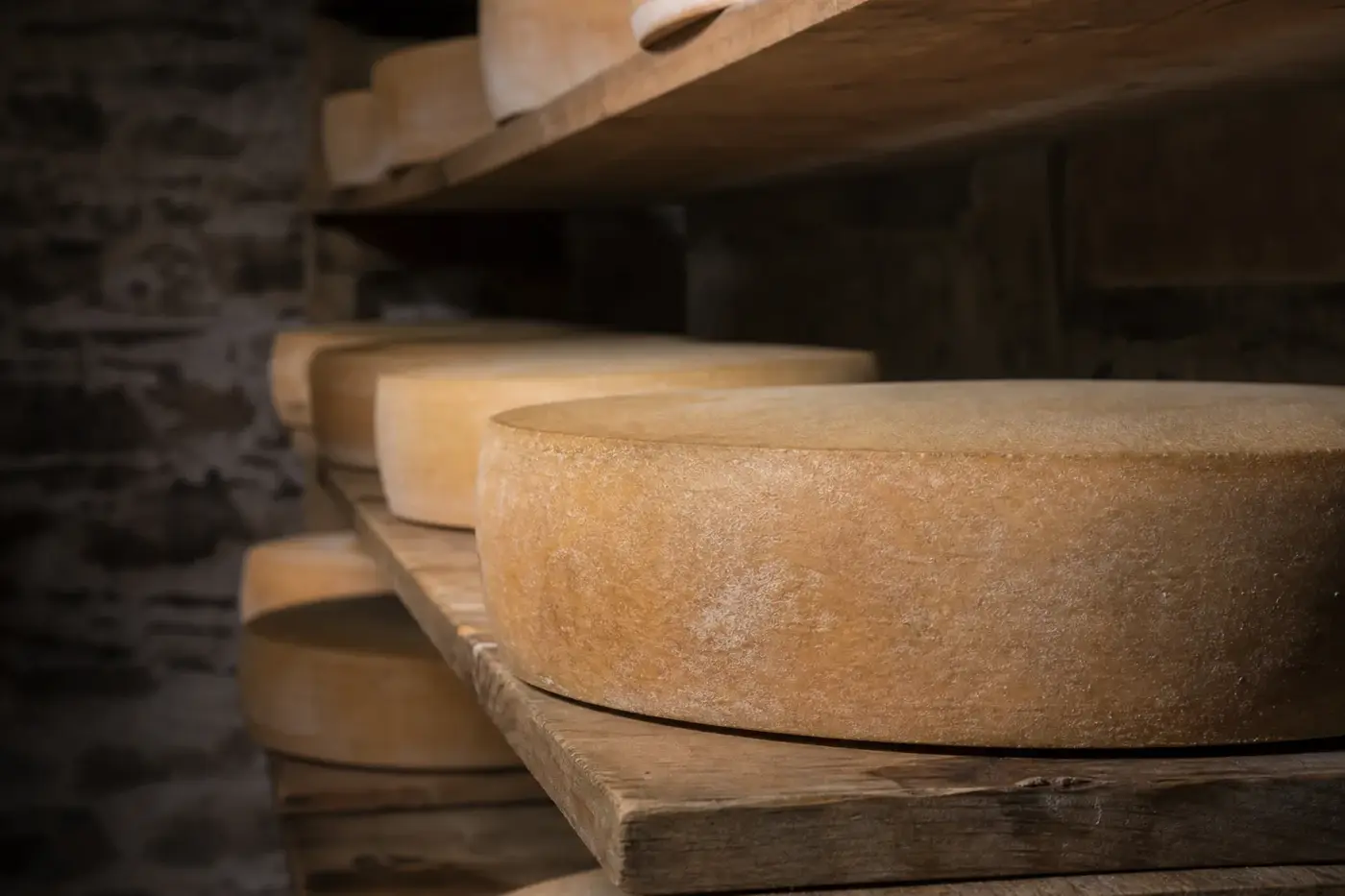
Milk arrives at the fruitière, the village dairy, brought in by farmers. Later comes a Comté wheel weighing 32 to 45 kilograms, the shared milk transformed by patient cellar work and the affineur’s care. This is not a cheese you casually tuck under your arm. Around it gather dark-lined Morbier, seasonal, spruce-bound Mont d’Or, mountain blue Bleu de Gex and cancoillotte: cheese country worth taking your time over. [1, 2, 3]
Get your bearings, then head for the counter
The Jura mountains follow the French and Swiss border. Historic Franche-Comté sits in eastern France, taking in lowlands as well as part of the mountain range. Each protected cheese has its own legally defined production area, so one tidy regional boundary cannot gather them all in. [2, 4, 5]
Comté helps you see why those distinctions matter. Its specification lists the communes authorised for milk production, cheesemaking and maturation, principally across Ain, Doubs and Jura. French Mont d’Or comes from a more concentrated area in Doubs, while Morbier has its own separately defined area. A mountain address alone does not entitle a cheese to any of these names. [2, 4, 5]
At the counter, look for overlapping traditions rather than a single regional style. There are large cooked-curd wheels, softer pressed cheeses, seasonal boxed cheeses and blue cheese. Their differences begin with the treatment of the milk and deepen in the cellar. You have plenty to explore before the bread runs out. [1, 2, 4, 5]
Follow the milk back to the pasture
Behind the region’s best-documented cheese traditions, there is grass. INAO describes the Comté area as plains and limestone plateaux with pronounced seasons. Its specification ties production to local forage and particular cattle: Montbéliarde, French Simmental and certified crosses between the two. Those are the permitted animals. [1, 2]
The feeding rules are equally precise. Dairy cows must consume at least 95% forage from the geographical area, measured on a dry-matter basis. Comté’s specification also prohibits silage and other fermented feeds, including wrapped bales, within the production system it defines. Local pasture is a requirement here, not simply an attractive scene for the label. [2]
Fresh grazing and conserved winter fodder each have their place in the cheesemaking year. The season changes what reaches the dairy, then the cheesemaker and affineur shape what follows. INAO identifies production place, season and age among the reasons Comté’s aromas vary from wheel to wheel. [1, 2]
Ask when your cheese was made, as well as how old it is. Both questions can open up a useful conversation at the counter. Two pieces with the same stated maturation can have quite different characters if they come from different production seasons or different fruitières.
Meet the hands behind the wheel
At the fruitière, farmers’ milk comes together for cheesemaking. INAO explains the name through this pooling of the farmers’ work, their milk. It describes Comté production as a chain linking milk producers, cheesemakers and affineurs. Each has a distinct part to play in the cheese you take home. [1]
A wheel this large makes sense of that shared effort. Comté’s specification sets its weight at 32 to 45 kilograms, well beyond an individual household’s daily needs. INAO connects the format with the historical need for cheese that would keep and travel. Its impressive size began with a thoroughly practical purpose. [1, 2]
Then comes the affineur’s work: affinage, or maturation, developing the cheese through cellar conditions and surface care. Comté’s specification treats maturation as a distinct, regulated production stage, which must happen within the authorised geographical area. The cellar helps make the cheese what it is. It does much more than hold the stock. [2]
You need not memorise fruitière and affineur for a vocabulary test. Use them to begin a conversation instead: which dairy made this cheese, who matured it, and how would the seller describe this particular wheel? The answers tell you more about your piece than its age alone.
Comté: let your taste lead the way
Comté rewards a return visit. Its specification identifies fruity, milky and roasted notes; INAO offers familiar examples including hazelnut, honey, caramel, vanilla and vegetal notes. Origin, production season and age help explain the differences. Treat those descriptions as possibilities to explore, not a checklist your piece must complete. [1, 2]
How it is made matters, too. Comté uses raw cow’s milk and a cooked, pressed curd. “Cooked curd” describes a manufacturing stage, not pasteurisation of the original milk. The current specification requires at least 120 days of maturation before commercialisation. [2]
For a first tasting, ask the cheesemonger for two contrasting pieces and the thinking behind the choice. One might favour milky or vegetal notes; another might lean towards roasted or caramel-like qualities. Follow whichever character you enjoy. There is no obligation to work your way towards the oldest piece.
Keep the tasting simple: cheese alone first, then cheese with plain bread. Let the bread support your impression rather than steer it. When you want to explore the making and identity in more detail, turn to the Comté guide.
Morbier: there is more beyond the black line
Cut into Morbier and you meet its unmistakable feature: a continuous horizontal black line through the centre. Around it is a raw cow’s milk cheese with an uncooked, pressed curd. The line and surrounding paste give you a particularly clear view of its structure. [4, 6]
That dark material is often called ash, but the specification identifies it as vegetable charcoal. It is deliberately added during manufacture, not formed by blue mould growing through the paste. Morbier must mature for at least 45 days, counted from the day of manufacture. [4, 6]
The specification describes a supple paste and connects aromatic variation with pasture flora and the seasons. Taste it alongside Comté and you discover another treatment of the region’s milk, with its own structure and character. Give it your attention on those terms, rather than treating it as a smaller relation of the great cooked-curd wheel. [6]
Ask for a slice with the central line and a little rind, and talk to the seller about its current maturity. In a small selection, Morbier offers a clear structural contrast with Comté. You do not need elaborate accompaniments to appreciate the difference.
Mont d’Or: settle in for spruce and cream
A spruce band wraps around French Mont d’Or, and a spruce box holds it. The wood belongs to the cheese’s identity: its specification describes woody spruce notes alongside mushroom and lactic aromas, with a creamy, white-to-ivory paste. At a soft maturity, you can spoon it. That makes a lovely change of pace from the region’s cut wedges. [5]
You may also meet it under its specification’s other name, Vacherin du Haut-Doubs. French Mont d’Or is made exclusively from whole raw cow’s milk, with a soft, uncooked paste. Its washed, wrinkled rind ranges from pale yellow to pinkish brown. [5]
Its season has firm boundaries. Manufacture runs from 15 August to 15 March inclusive, while sale to consumers is permitted from 10 September to 10 May. These dates govern production and marketing. What you find in a particular shop still depends on its stock. [5]
Tell the cheesemonger when you want to serve it and ask whether it will be ready. Keep it supported in its box, and ask how to handle that particular cheese. Bread and boiled potatoes are straightforward serving suggestions. If you bake it, follow a recipe with its own specific cooking instructions.
Bleu de Gex: make room for the mountain blue
Look for “Bleu de Gex haut Jura ou Bleu de Septmoncel”, the designation recorded in INAO’s product search. Knowing the name helps you venture beyond the more familiar Comté and Morbier counters. This is another branch of the regional selection, and your introduction to its mountain blue. [7]
For your first purchase, talk about texture and intensity rather than choosing by colour alone. Ask the cheesemonger to describe the piece available. Say whether you prefer something gentle or more assertive, and whether you will eat it on its own or with food. Those details give the seller something useful to work with.
Taste a small piece separately before deciding where it belongs among your other cheeses. A blue need not automatically follow every washed-rind cheese on the assumption that it will taste stronger. Let the cheese in front of you set the order.
Cancoillotte: a different pleasure for your table
Cancoillotte takes you beyond the wheel cut into wedges. INAO includes it among the region’s recorded products, broadening a selection otherwise dominated by matured cheeses. Give it a conversation of its own at the counter. It need not fit into the same tasting as everything else. [7]
Begin by finding out exactly what is on offer. Is it a finished preparation, which ingredients does it contain, and how does the producer suggest serving it? If you choose a flavoured version, read the complete ingredient list. A familiar product name cannot tell you everything.
Then consider what you want it to do at your table. A preparation for spreading, spooning or accompanying a meal needs a different place from a wedge chosen for comparison. Ask the seller to explain its use, especially if it is unfamiliar. You will get more from that than from simply collecting another regional name.
Put together a selection worth lingering over
Two contrasting Comtés can give you an absorbing introduction to the region. For more methods and textures, choose Comté, Morbier and a seasonal Mont d’Or. Add another cheese because it offers something you want to discover. An empty corner on the board is not, in itself, an emergency. [1, 2, 4, 5]
Ask about the production dairy, maturation and character of the actual piece being sold. Before deciding how much to take home, read its storage instructions and date marks. The guide to reading a cheese label helps you distinguish the food’s name from the other information on its packaging.
For a bread comparison, start with a plain country loaf and offer walnut bread separately. Adults of legal drinking age who choose wine could try a small serving of Jura white with Comté or Morbier. People who are pregnant, driving, taking medicines that interact with alcohol or recovering from alcohol dependence should not drink. Water offers an alcohol-free alternative.
Think of those accompaniments as starting points, not fixed regional rules. Change one at a time and notice what you prefer, keeping the cheese at the centre of the comparison. For a fuller framework, explore the cheese and wine pairing guide.
This page summarises published guidance from the official sources it cites. It is not medical advice. Guidance differs between countries and changes over time, so check the current source for where you live, and ask your doctor, midwife, pharmacist or dietitian about your own circumstances.
Take it home safely: storage and French raw milk advice
Keep the cold chain intact: that is France’s agriculture ministry’s advice for dairy products. Follow the product’s storage temperature, date mark and after-opening instructions. If you buy a cut portion, ask the cheesemonger for written guidance specific to your cheese. [8]
France’s agriculture ministry published guidance on 18 February 2025 for young children, particularly those under five, pregnant people and immunocompromised people. It advises them to choose cooked pressed cheeses such as Comté, processed spreading cheeses or pasteurised milk cheeses instead of raw milk and other raw milk cheeses. [8]
This is French guidance, so check the official advice where you live when deciding what to eat. Seek individual guidance from your healthcare professional rather than relying on a cheese name alone. For background on the language you encounter at the counter, see the explanation of milk treatments.
Know the protected name, then choose your favourite
A protected name gives you a geographical identity backed by defined rules. AOP is the French abbreviation corresponding to PDO, protected designation of origin; IGP corresponds to PGI, protected geographical indication. Under the EU framework, a PDO requires all production steps to take place in the defined area. A PGI requires at least one production step there and a qualifying geographical link. [9]
The individual specification explains what sits behind the designation. Comté’s covers authorised communes, milk production, manufacture and maturation. Mont d’Or’s also sets out its spruce presentation and seasonal limits. The logo is your introduction; the specification supplies the detail. [2, 5, 9]
Choose by the exact name, then ask about the character of the cheese in front of you. Origin rules establish what it is. Your pleasure lies in finding the dairy, production season and maturity that give you the cheese you most enjoy.
Questions people ask
What is a fruitière?
A fruitière is a village dairy where farmers bring their milk to be made into cheese. INAO explains the name through the pooling of the farmers’ work and milk.
When is French Mont d’Or in season?
French Mont d’Or is made from 15 August to 15 March inclusive. Sale to consumers is permitted from 10 September to 10 May, although availability at a particular shop depends on its stock.
What is the difference between Comté and Morbier?
Both are made from raw cow’s milk, but Comté has a cooked, pressed curd while Morbier has an uncooked, pressed curd. Morbier also has a central black line of vegetable charcoal.
Can pregnant people eat Comté?
France’s agriculture ministry advises pregnant people to choose cooked pressed cheeses such as Comté, processed spreading cheeses or pasteurised milk cheeses instead of raw milk and other raw milk cheeses. See the ministry’s guidance published on 18 February 2025 [8], check the current official advice where you live and seek individual guidance from a healthcare professional.
What do AOP and IGP mean on cheese?
AOP corresponds to PDO, protected designation of origin, while IGP corresponds to PGI, protected geographical indication. Under the EU framework, a PDO requires all production steps to take place in the defined area; a PGI requires at least one production step there and a qualifying geographical link.
Sources
[1] INAO. Comté. Official product overview, undated, retrieved November 2026. Sections “Le produit”, “Arômes et saveurs”, “Un produit, un territoire” and “Le saviez-vous”.
[2] French Ministry of Agriculture. Cahier des charges de l’appellation d’origine « Comté ». Homologated by the order of 18 December 2025, published in the Journal officiel on 7 January 2026 and Ministry Bulletin 2026-02 on 8 January 2026. Sections 2, 3 and 5.
Read at info.agriculture.gouv.fr
[3] INAO. Morbier. Official product and regulatory record, retrieved November 2026. Includes the January 2026 specification and May 2026 EU amendment communication.
[4] French Ministry of Agriculture. Cahier des charges de l’appellation d’origine « Morbier ». Specification published in Ministry Bulletin 2026-02, 8 January 2026.
Read at info.agriculture.gouv.fr
[5] French Ministry of Agriculture. Cahier des charges de l’appellation d’origine « Mont d’Or » ou « Vacherin du Haut-Doubs ». Homologated by the order of 18 December 2025, published in the Journal officiel on 9 January 2026 and Ministry Bulletin 2026-03 on 15 January 2026. Copy hosted by the interprofessional syndicate.
Read at mont-dor.com
[6] INAO. Cahier des charges de l’appellation d’origine « Morbier ». Version dated 20 February 2013. Used only for the descriptive material identified in the evidence log, not as the current legal specification.
Read at extranet.inao.gouv.fr
[7] INAO. Rechercher un produit. Filtered official product search result listing Bleu de Gex haut Jura ou Bleu de Septmoncel and Cancoillotte, retrieved November 2026. The individual records and specifications were not successfully retrieved.
[8] French Ministry of Agriculture. Consommation de fromages à base de lait cru : rappel des précautions à prendre. Published 18 February 2025.
Read at agriculture.gouv.fr
[9] European Parliament and Council. Regulation (EU) 2024/1143. Adopted 11 April 2024, published 23 April 2024. Original published text retrieved.
Read at eur-lex.europa.eu
Research combined retrieved official product records, specifications and French public-health guidance; outstanding verification is recorded below.
Last checked: November 2026
Last checked November 2026.
The editors suggest you read next

French Cheese: The Complete Guide
Picture Normandy’s pastures, then follow the milk towards the Loire’s goat dairies, the Jura’s shared cheesemaking traditions and the sheep country of the Pyrenees.


