Cornish Kern
Your knife passes through Cornish Kern’s black coating and reveals gold: the reward for 16 to 22 months at Lynher Dairies in Cornwall, England.
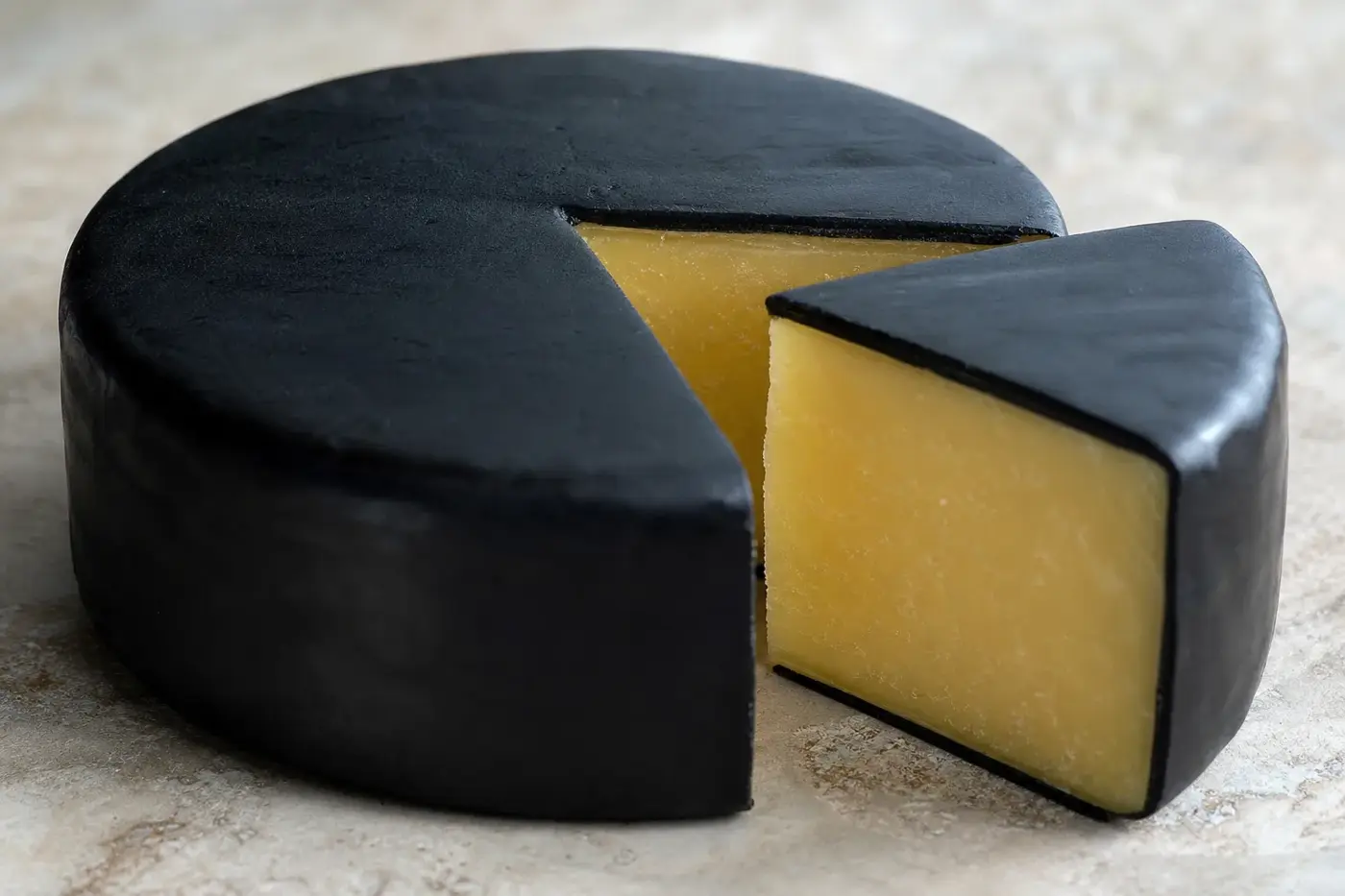
Your knife passes through Cornish Kern’s black coating and reveals gold: the reward for 16 to 22 months at Lynher Dairies in Cornwall, England. This hard cow’s milk cheese starts with a Gouda-inspired recipe and Alpine starter cultures. Local milk, the dairy’s own methods and a considerable exercise in patience make it something distinct from either influence. [1, 2, 5]
| At a glance | Cornish Kern |
|---|---|
| Who makes it, and where | Lynher Dairies, near Truro, Cornwall, England. [1, 3] |
| The milk | Pasteurised cow’s milk from the maker’s own Ayrshire herd. [2] |
| The rennet | Traditional rennet; the maker states that Kern is not suitable for vegetarians. [4] |
| Style and cultures | Hard, long-maturing cheese; Gouda-style recipe with Alpine starter cultures. [1] |
| The usual wait | 16 to 22 months in current maker information. [2] |
| The black coat | Breathable black wax coating. [5] |
| A whole wheel | Approximately 3.8 kg, 22 cm across and 8 cm high; handmade dimensions vary. [4] |
| Protection status | Not verified for the EU, Great Britain, Northern Ireland, Switzerland and the US |
Get to know the cheese beneath the coat
Sweet, savoury and nutty: those are Lynher’s words for finished Kern. You can expect a close texture, rather than an open, airy one. Its character begins with a Gouda-style recipe and Alpine starter cultures, the microorganisms added during cheesemaking. [1, 5]
Those influences offer useful bearings among other long-aged cheeses. But Kern belongs to Lynher’s recipe and Cornish milk, rather than either comparison alone. Explore the wider family through Gouda, then come back to the maker and its methods for the fuller picture of Kern. [1, 2]
Even the name gives you something to picture. According to Lynher, kern means “round” in Cornish, and the cheese goes into large round moulds for pressing. The dark exterior makes a whole wheel instantly recognisable; cut into it and the body and texture take their turn. [5]
Follow the morning milk near Truro
Kern begins with Lynher’s own Ayrshire cows at Gadles Farm. A short journey away is the maker’s small rural dairy near Truro, where, according to Lynher, milk arrives each morning. Farm and cheesemaking are close neighbours here. [1, 2, 3]
Look along the dairy’s range and you will find Cornish Yarg, Wild Garlic Yarg and Stithians too. Lynher’s account includes open-vat cheesemaking and describes a wider milk supply from its own herd and selected Cornish farms. For Kern specifically, the product information names the dairy’s own Ayrshires. [1, 2]
Kern was intended to follow a different path from the younger Yarg. In a November 2016 development account, Lynher described its ambition to make a markedly different cheese. Early batches were already being assessed, with a wider launch planned for early 2017. Long maturation was central to that plan. [6]
Before you buy, know the milk and rennet
Two details matter straight away when you choose Kern for your table: it uses pasteurised cow’s milk, and it is not suitable for vegetarians. Lynher confirms that all its milk is pasteurised. Its FAQ names Kern’s coagulant as traditional rennet, explicitly distinguishing it from the dairy’s vegetarian Yargs. [4]
Rennet sets milk into curd, the solid material from which cheese is formed. That distinction matters when you put together a board for guests. A dairy can use different coagulants for different cheeses, so a vegetarian option elsewhere in its range tells you nothing certain about Kern. [4]
You can explore the different coagulant types in rennet explained. For this cheese, the shopping advice is straightforward. Pasteurised milk, yes; vegetarian rennet, no. [4]
Gouda roots, Alpine cultures, unmistakably Cornish
Think of Gouda as the starting point for Kern’s recipe, with Alpine starter cultures bringing another influence. Lynher links those cultures to the close texture and developing flavour. The dairy also identifies its treatment of the curd as important to the finished cheese. [1, 5, 7]
Neither comparison quite contains it. Gouda helps you understand where the recipe begins; Alpine cultures explain another part of how it is made. Keep both in mind, rather than trying to squeeze Kern into a single tradition. [1]
Then comes the wait. Kern’s current maturation window stretches well beyond a year, while Lynher’s leaf-wrapped Yargs mature over weeks. Here, “long-aged” is more than a broad style description. It marks a substantially different approach within the same dairy. [2, 8]
This page summarises published guidance from the official sources it cites. It is not medical advice. Guidance differs between countries and changes over time, so check the current source for where you live, and ask your doctor, midwife, pharmacist or dietitian about your own circumstances.
Warm curd, round moulds and plenty of patience
Lynher’s accounts take you through the making: Alpine cultures, scalded curd, moulding, pressing, brining and coating, followed by maturation. Scalding means heating the curd during the make. The dairy connects that stage with Kern’s caramelised notes. [5, 7]
Once the curd is in its round moulds, pressure is applied slowly. Next comes a brine bath, simply a salt-water bath. Only then does the cheese receive its distinctive black coating. [5]
That coat is not just there to look handsome. Lynher describes it as breathable, part of the maturation system during the long wait in store. It goes on before ageing begins. [5]
How long is that wait? The maker’s current product information gives a usual maturation period of 16 to 22 months. This is not a cheese inclined to rush things. [2]
At the counter, ask your cheesemonger how old the wheel being cut is, using that current maker description as your reference. The age of your particular piece tells you more than the broad description alone. For the underlying steps shared by many cheeses, turn to how cheese is made.
Cut through the black to the gold
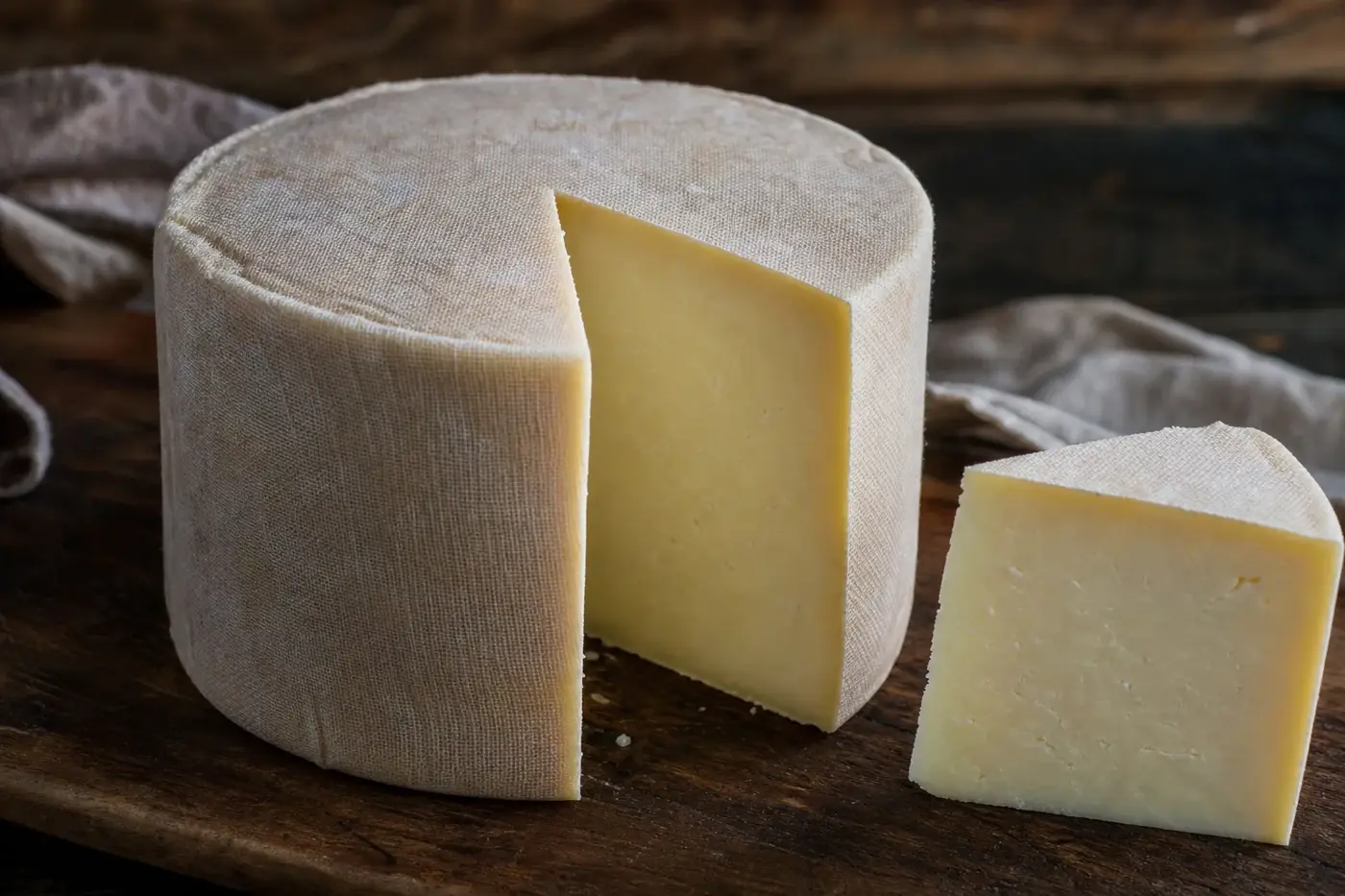
A whole Kern is broad and relatively low; those approximate dimensions help you picture your wedge. Beneath the thin-looking dark exterior, you get a substantial cut face. In Lynher’s published image, the golden paste, meaning the body of the cheese, stands out sharply against its black coating. [4, 5]
When you serve it, keep coating and cheese separate. Remove the applied wax from the portion you intend to eat. The paste is then ready for slicing or breaking into smaller pieces. [5]
Lynher describes Kern as firm when cut, with some flakiness towards the middle. Its product profile also compares the texture to fudge. Think dense and resistant, rather than brittle throughout: there is as much to notice in the texture as in the flavour. [2, 5]
Before you reach for anything else, try a thin slice alongside a small broken piece. A clean cut and a natural fracture give you different ways into the same cheese. Tasting them together makes those differences easier to spot.
Let caramel, fruit and savoury notes unfold
Caramel runs through the savoury aroma in Lynher’s current profile. Its flavour description allows for differences between batches: sweeter examples can suggest pineapple and dried fruit. More savoury ones can recall broth and umami, that deeply savoury quality associated with stock. [2]
That gives you rather more to look for than simply “strong cheese”. Notice the balance between sweetness and savouriness, then ask which comes forward in your piece. The maker’s description leaves room for both ends of the range.
Start with Kern alone. Take a small piece, notice its resistance and flakiness, then pay attention to the finish. Is it fruity, caramel-like or savoury? Add bread afterwards, keeping that first impression in mind so you can return to it.
A 2017 champion, and your next wedge
Cornish Kern was Supreme Champion at the World Cheese Awards in 2017, as recorded by Lynher. That is the award attached to this black-coated wheel. [5]
It followed the dairy’s development account published in 2016. Back then, the new cheese was already being assessed ahead of its wider launch. [6]
Choosing a piece today, you can let the conversation move from the award to the cheese in front of you. The maker’s descriptions of maturation and batch character give you useful questions for the cheesemonger. Ask whether the wheel being cut leans sweeter or more savoury, especially if you already know which you prefer. [2]
Bring Kern to the table, a little at a time
Lynher recommends serving Kern at room temperature, without giving a numerical serving-temperature target. Take out only what you plan to serve and let that portion lose its refrigerator chill shortly before eating. There is no need to try to warm the whole wedge. [2]
If your household follows Food Standards Agency guidance in England, Wales and Northern Ireland, keep chilled food outside the fridge for the shortest possible time during preparation. The maximum is four hours. [10]
Start with a few thin slices or small broken pieces per person. Replenish as needed, giving guests a taste while keeping the remaining piece off the board.
Honey and walnuts are Lynher’s suggested accompaniments. [2] The other ideas below are serving suggestions chosen to keep the cheese’s character clear.
| What to put alongside it | What it brings to your plate |
|---|---|
| Plain bread or restrained crackers | A mild base that keeps your attention on the cheese. |
| Apple or pear | Fresh fruit to contrast with the firm texture. |
| Honey and walnuts | The maker’s suggested pairing. [2] |
| Water or unsweetened tea | Neither adds sweetness that could obscure the cheese. |
Keep everything separate to begin with. Taste Kern alone, then try the contrast of fruit or the sweetness of honey. You may find that bread is all the company it needs, however ambitious your original plans for the board.
Wrap the cut face and save the rest
Lynher recommends wax paper for wrapping cut Kern to retain moisture. Once you have cut your serving portion, wrap the rest. Do not leave it exposed while you settle down to eat. [2]
Follow the packaging’s storage and opening instructions, along with any use by date. For households in England, Wales and Northern Ireland, the FSA advises a fridge temperature of 5 °C or below. [10]
Keep the routine simple: cut what you need, wrap what remains and follow the pack. For the broader handling routine, you will find practical guidance in storing cheese at home.
Put Kern beside Cornish Yarg
You can spot the first difference before cutting either cheese. Kern wears an applied black coating; Cornish Yarg is wrapped in nettle leaves. Lynher describes Yarg’s leafy rind as edible, with a fresh, mushroom-like character and a crumbly centre. [5, 8]
The timing takes them further apart. Kern develops over many months, while Lynher describes Yarg as taking about six weeks from field to finish. You have the same dairy, but different recipes, surfaces and intended characters. [2, 8]
For a comparison tasting, give yourself small pieces without accompaniments first. Start with texture: Kern’s dense, firm body beside Yarg’s crumbly core makes the contrast immediate. Then return to each and notice how its character develops as you eat. [2, 8]
Questions people ask
What is Cornish Kern made from?
Cornish Kern is made from pasteurised cow’s milk from Lynher Dairies’ own Ayrshire herd. It uses a Gouda style recipe and Alpine starter cultures.
Is Cornish Kern suitable for vegetarians?
No. Lynher says Kern is made with traditional rennet and is not suitable for vegetarians.
How long is Cornish Kern matured?
Lynher’s current product information gives a usual maturation period of 16 to 22 months. The cheese receives its breathable black wax coating before ageing begins.
How does Cornish Kern differ from Cornish Yarg?
Kern has a black wax coating, while Cornish Yarg is wrapped in nettle leaves. Kern matures for 16 to 22 months, whereas Yarg takes about six weeks from field to finish.
How should Cornish Kern be served and stored?
Lynher recommends serving Kern at room temperature with honey and walnuts, and removing the wax coating from the portion you intend to eat. The maker recommends wrapping cut Kern in wax paper to retain moisture.
Sources
[1] Lynher Dairies. Our Cheeses. Undated maker’s range overview, retrieved November 2026.
Read at lynherdairies.co.uk
[2] Lynher Dairies. Cornish Kern. Current product information, undated, retrieved November 2026. Sections “About”, “Profile”, “Pairings” and “Storage Tips”.
Read at lynherdairy.co.uk
[3] Lynher Dairies. Our Herd. Undated maker’s account, retrieved November 2026.
Read at lynherdairies.co.uk
[4] Lynher Dairies. FAQ’s. Undated current FAQ, retrieved November 2026. Questions on dimensions, vegetarian suitability, pasteurisation and opened cheese.
Read at lynherdairy.co.uk
[5] Lynher Dairies. Cornish Kern. Undated maker’s cheese profile, retrieved November 2026.
Read at lynherdairy.co.uk
[6] Lynher Dairies. Cornish Kern, we made it!. 6 November 2016. Maker’s development account, retrieved November 2026.
Read at lynherdairy.co.uk
[7] Lynher Dairies. How We Make Our Cheese. Undated maker’s process account, retrieved through the search service in November 2026; direct page retrieval failed.
Read at lynherdairy.co.uk
[8] Lynher Dairies. Cornish Yarg. Undated maker’s cheese profile, retrieved November 2026.
Read at lynherdairy.co.uk
[9] Guild of Fine Food. WCA: Winners of World Champion Cheese 1988-2025. Historical winners record, retrieved November 2026.
Read at gff.co.uk
[10] Food Standards Agency. How to chill, freeze and defrost food safely. Published 18 December 2017, current retrieved version, November 2026. Applies to England, Northern Ireland and Wales.
Read at gov.uk
This piece was researched from the maker’s published descriptions, the award organiser’s historical record and official household refrigeration guidance.
Last checked: November 2026
Last checked November 2026.
The editors suggest you read next
West Country Farmhouse Cheddar Cheese
Large pieces of curd turn and stack under the cheesemaker’s hands.