Cowgirl Creamery
Picture yourself in a converted hay barn in Point Reyes Station, California, in 1997.
Picture yourself in a converted hay barn in Point Reyes Station, California, in 1997. Sue Conley and Peggy Smith are starting a cheesemaking venture, and local food has found a meeting place. Organic agriculture, distribution and distinctive cheeses are all on the agenda. The barn has rather more to do than store hay.[1]
That combination would shape Cowgirl Creamery’s contribution to American artisan cheese. The founders helped farmers and other producers reach chefs and customers while developing cheeses of their own. Later, the business became part of Switzerland’s Emmi.[1][7]
| Your quick reference | What to know |
|---|---|
| Founded | 1997, by Sue Conley and Peggy Smith.[1] |
| Where it began | Renovated hay barn in Point Reyes Station, California, United States.[1] |
| Where the cheese is made now | Cader Lane Creamery, Petaluma, Sonoma County, California, according to the producer, November 2026.[2] |
| Cheeses to know | Mt Tam, a bloomy-rind triple cream, and Red Hawk, a washed-rind triple cream.[3][4] |
| Milk | Locally sourced organic cows’ milk; both cheeses also contain organic pasteurised cream.[3][4] |
| Acquisition | Recorded by Emmi on 31 May 2016.[8] |
| Business status | Formal registry status unconfirmed |
| Production status | Producing, according to the current producer website, November 2026.[2] |
| Planning a visit? | Visitor access unconfirmed; the producer says its former shops and cafés have closed.[1] |
First, learn what a kitchen needs
Before they made cheese, Smith and Conley knew the business of getting good ingredients into a kitchen. Smith spent 17 years at Chez Panisse. Conley co-owned Bette’s Oceanview Diner in Berkeley. Both understood what cooks needed, and how producers might reach them.[1]
In Point Reyes Station, they established Tomales Bay Foods to distribute products from West Marin farms and dairies. Cheesemaking grew alongside that work, in a small production room inside the converted barn. Fromage blanc, crème fraîche and clabbered cottage cheese were among the early cheeses.[1]
The order matters. Cowgirl did not make cheese first and leave the question of customers until later. Its founders were learning their craft while building the connections that help specialist food find an audience.
Making and distributing belonged to the same enterprise. Selling was part of the craft, rather than something to leave at somebody else’s door. It is one reason this barn’s story reaches well beyond the cheeses made inside it.
Meet the friend behind the first encouragement
A friend helped get the cheesemaking started. Ellen Straus, of the family behind Straus Family Creamery, was both friend and mentor to the founders. Cowgirl’s own history places her encouragement at the beginning of its cheese story.[1]
This was already dairy country. Straus Family Creamery describes a milk supply drawn from small certified organic farms in Marin and Sonoma counties. Cowgirl’s current product information identifies locally sourced organic milk and cream, while its creamery account describes deliveries from nearby dairy partners.[2][3][4][6]
You can trace three separate strands here: the early friendship with Ellen Straus, the surrounding organic dairy network and Cowgirl’s present sourcing. Today, the producer emphasises partnerships with local dairies. It does not describe the cheeses as coming from its own herd.[2]
Those relationships connect the milk story across changes of ownership and premises. Production is now in Petaluma. Northern California dairy partners remain central to the way Cowgirl describes its work.[2]
How a good cheese finds its way to you
Cowgirl built connections as well as cheeses. Farms, a distributor, restaurant kitchens and retail customers formed its founding network. Fresh cheeses could travel through farmers’ markets and restaurants, then reach specialist shops and wider retail distribution.[1]
A distinctive cheese needs more than a place to be made. Someone must explain it, transport it and introduce it to a customer who has never heard of its maker. Tomales Bay Foods gave the founders a way to do that for producers beyond their own creamery.
When Emmi acquired Cowgirl, its account explicitly included the affiliated Tomales Bay Foods business. Distribution joined the larger group too. It was part of the story, not a footnote beneath the cheesemaking.[7]
That model helps explain Cowgirl’s influence without assigning it any measured share of American cheese culture. Cheesemaking provides the product; knowledgeable selling gives you a reason to choose it. Distribution makes the next encounter possible, and each part supports the others.
Mt Tam or Red Hawk: choose your first taste
Mt Tam and Red Hawk start with an enriched milk base, then take soft-ripened cheese in different directions. Current producer information lists organic pasteurised cows’ milk, organic pasteurised cream, salt, cultures and enzymes for both. Microbial rennet is identified separately.[3][4]
| How the producer describes them, November 2026 | Mt Tam | Red Hawk |
|---|---|---|
| Style | Triple cream, bloomy rind, washed curd.[3] | Triple cream, washed rind.[4] |
| Milk treatment | Pasteurised milk and cream.[3] | Pasteurised milk and cream.[4] |
| Flavour | Cultured cream, salted butter and white mushrooms.[3] | Cured meats, roasted peanuts and ocean brine.[4] |
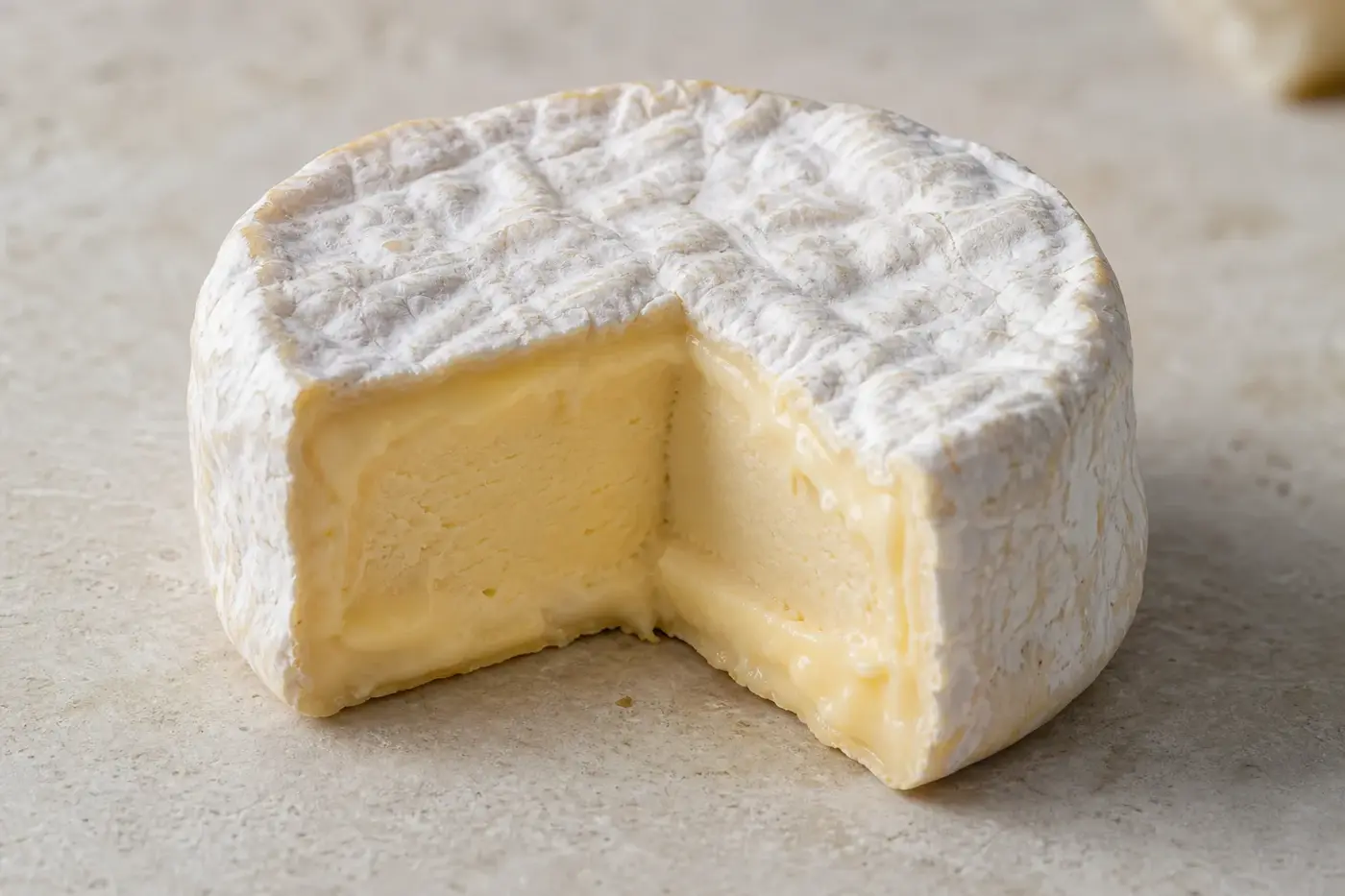
Named after Mount Tamalpais, Mt Tam offers a contrast between its firmer centre and the softening cheese beneath the rind. Cowgirl describes flavours moving from bright cultured dairy towards mushrooms as it develops. There is more going on here than creaminess alone.[3]
Red Hawk takes its name from the local red-tailed hawk. The producer describes a pungent, savoury character, with cured meat and brine among its flavour notes.[4]
Those descriptions give you a useful starting point. Cultured cream and mushrooms on one side; a more pungent, meaty profile on the other. Choosing both is, of course, the cheese lover’s familiar solution to a difficult decision.
Read the rind, find the character
Look beneath Mt Tam’s white bloomy rind and you find its texture changing. The rind is the white mould growth on a soft-ripened cheese. Cowgirl calls the softening process proteolysis: proteins break down to create the softer layer immediately beneath the rind, known as the creamline.[5]
The maker’s maturity guide helps you follow that progression. Young Mt Tam has a firmer, more crumbly interior. As it develops, the creamline thickens and the texture becomes fudgier. At greater maturity, Cowgirl describes a softer paste and a more pronounced mushroom character.[5]
Red Hawk follows the washed-rind route instead. Washing the surface during ripening helps develop a different rind community and character. In Cowgirl’s current account, the result is pungent and meaty, contrasting with Mt Tam’s bloomy-rind character.[4]
One small word on the labels deserves your attention: Mt Tam has washed curd; Red Hawk has a washed rind. Washing curd treats the curds during cheesemaking, while washing a rind treats the surface during ripening. For the broader distinctions, explore milk, rind, texture and method.
A new owner, a new creamery, a different shopfront story
Emmi records its acquisition of Cowgirl Creamery on 31 May 2016. Its corporate history includes Tomales Bay Foods and places the purchase within its expansion in speciality cheese in California. The founder-led business had become part of an international dairy group.[7][8]
Emmi’s stated strategy combined international growth with strengthening existing businesses. It also included managing operations over the longer term. Cowgirl’s next chapter belonged within that larger plan.[7]
Today, the production address is Cader Lane in Petaluma. Cowgirl identifies this creamery as the place where cheesemakers form curds, shape wheels and carry out affinage, the controlled maturation of cheese. Both Mt Tam and Red Hawk appear explicitly on its production list.[2]
The shopfront story has taken a different turn. Cowgirl’s history says its former shops and cafés have closed. Its present website directs you towards a stockist locator and online purchasing channels, with a separate contact for wholesale customers.[1][12]
If you are planning a visit, keep those two stories apart. A closed shop does not mean cheese production has stopped. Older accounts of visiting Point Reyes may describe premises that no longer welcome customers, so consult the producer’s current visitor information before travelling.
What still feels familiar when a business changes?
A distinctive cheese can make a producer recognisable while keeping regional milk suppliers in view. Cowgirl’s present creamery account brings those elements together. Nearby dairy partnerships sit alongside space to make and mature a wider range of cheeses.[2]
Its history also shows how the parts of an artisan business can separate. Production, distribution and public-facing retail do different jobs. A shop introduces you to cheese directly; a larger production site gives cheesemakers room to make and mature it.
Cowgirl’s continuing production and closed former shops show those functions moving apart as the business changes.[1][2] You can still encounter the cheeses without encountering the places customers once knew. A familiar cheese does not necessarily mean a familiar shop door.
Acquisition adds another layer to the picture. A founder-led enterprise can join a larger organisation while retaining its product names and its account of regional sourcing.[1][7] To understand that transition, look separately at the cheeses, milk relationships, operating business and former customer destinations.
There is a useful lesson here for the wider artisan sector. Continuity need not happen everywhere at once. One part of a business can remain recognisable while another changes substantially.
Bring home the cheese you have in mind
Start with the producer’s current stockist information, then ask the seller about the particular cheese you want. Mt Tam and Red Hawk are listed in Cowgirl’s range in November 2026. Local stock and delivery arrangements can change.[3][4][12]
For Mt Tam, ask about maturity, rather than simply whether it is ready to eat. The maker’s guide gives you useful language: younger cheese is firmer and tangier. Further ripening brings a thicker creamline and more developed mushroom notes.[5]
For storage, follow the package instructions. In England, Northern Ireland and Wales, FSA consumer guidance recommends a fridge temperature between 0 and 5 °C and refrigerating dairy products. Its Listeria guidance also stresses use-by dates and instructions after opening.[9][10]
You will find the fuller method in storing cheese at home. Keep your starting point simple: put out a modest portion and leave the rest refrigerated.
Under the cited FSA guidance, ready-to-eat food should be eaten shortly after removal from refrigeration. That means within four hours, or two hours on a very warm day. Keep it away from direct sunlight too.[9]
This page summarises published guidance from the official sources it cites. It is not medical advice. Guidance differs between countries and changes over time, so check the current source for where you live, and ask your doctor, midwife, pharmacist or dietitian about your own circumstances.
Look beyond pasteurisation when considering safety
Cowgirl currently describes both cheeses as made with pasteurised milk and cream.[3][4] Food safety guidance also considers the type of cheese and the person eating it. The FSA identifies soft mould-ripened cheeses among ready-to-eat foods associated with Listeria risk, and notes that Listeria is present in the environment.[9]
Official advice differs between countries. It also distinguishes cheese categories, so those details matter when you are choosing what to eat.
| Country and group, November 2026 | What the official advice says |
|---|---|
| UK, pregnancy | NHS guidance says white-rinded mould-ripened soft cheeses require thorough cooking, whether made with pasteurised or unpasteurised milk. Cheese cooked until steaming hot is among its permitted choices.[11] |
| United States, pregnancy | CDC guidance lists soft cheeses made with pasteurised milk as a safer choice. It also lists soft cheeses made with unpasteurised milk if heated to 74 °C (165 °F), or until steaming hot.[13] |
The FSA identifies pregnancy, weakened immunity and increasing age as factors in higher Listeria risk.[9] Follow current official advice for your country and circumstances. For further context, see Listeria and cheese safety.
Questions people ask
What is the difference between Mt Tam and Red Hawk?
Both are triple creams made with pasteurised cows’ milk and cream. Mt Tam has a bloomy rind and notes of cultured cream, salted butter and white mushrooms. Red Hawk has a washed rind and a more pungent profile, with notes of cured meats, roasted peanuts and ocean brine.
Where is Cowgirl Creamery cheese made, and can I visit?
Cowgirl says its cheese is made at Cader Lane Creamery in Petaluma, California. Visitor access is unconfirmed, and the producer says its former shops and cafés have closed. Check its current information before travelling.
Who owns Cowgirl Creamery?
Switzerland’s Emmi acquired Cowgirl Creamery, with the acquisition recorded on 31 May 2016. The purchase included the affiliated Tomales Bay Foods business.
Can I eat these cheeses during pregnancy?
UK NHS guidance says soft cheeses with white mould rinds require thorough cooking during pregnancy, whether made with pasteurised or unpasteurised milk. US CDC guidance lists soft cheeses made with pasteurised milk as a safer choice. See the current NHS or CDC guidance for your country and ask your doctor or midwife about your circumstances.
How should I store Cowgirl Creamery cheese?
Follow the package instructions. In England, Northern Ireland and Wales, the FSA recommends refrigerating dairy products and keeping the fridge between 0 and 5 °C. Its guidance also stresses use by dates and instructions after opening.
Sources
- Cowgirl Creamery, The Cowgirl Story, undated current producer account, retrieved November 2026.
- Cowgirl Creamery, Our Creamery, undated current production account, retrieved November 2026.
- Cowgirl Creamery, Mt Tam, current product information, retrieved November 2026.
- Cowgirl Creamery, Red Hawk, current product information, retrieved November 2026.
- Cowgirl Creamery, Secret Life of Mt Tam, undated maturity guide, retrieved November 2026.
- Straus Family Creamery, current website, section Organically Farmed. Freshly Crafted., retrieved November 2026.
- Emmi Group, New organisation reflects internationalisation, corporate history, including the 2016 Cowgirl Creamery acquisition, retrieved November 2026.
- Emmi Group, Annual Report 2017, Income statement, acquisition dated 31 May 2016, published 2018, retrieved November 2026.
- Food Standards Agency, Listeria, current downloadable guidance, retrieved November 2026.
- Food Standards Agency, How to chill, freeze and defrost food safely, current GOV.UK edition, retrieved November 2026. Applies to England, Northern Ireland and Wales.
- NHS, Foods to avoid in pregnancy, current guidance, retrieved November 2026.
- Cowgirl Creamery, current homepage and Contact Us, product navigation, stockist locator and wholesale contact, retrieved November 2026.
- Centers for Disease Control and Prevention, Safer Food Choices for Pregnant Women, 31 January 2025, retrieved November 2026.
This piece combines desk research from producer accounts, Emmi corporate records and official food safety guidance, with business interpretation identified in the text.
Last checked: November 2026
Last checked November 2026.
The editors suggest you read next
Farmhouse, Artisan and Industrial Cheesemakers Explained
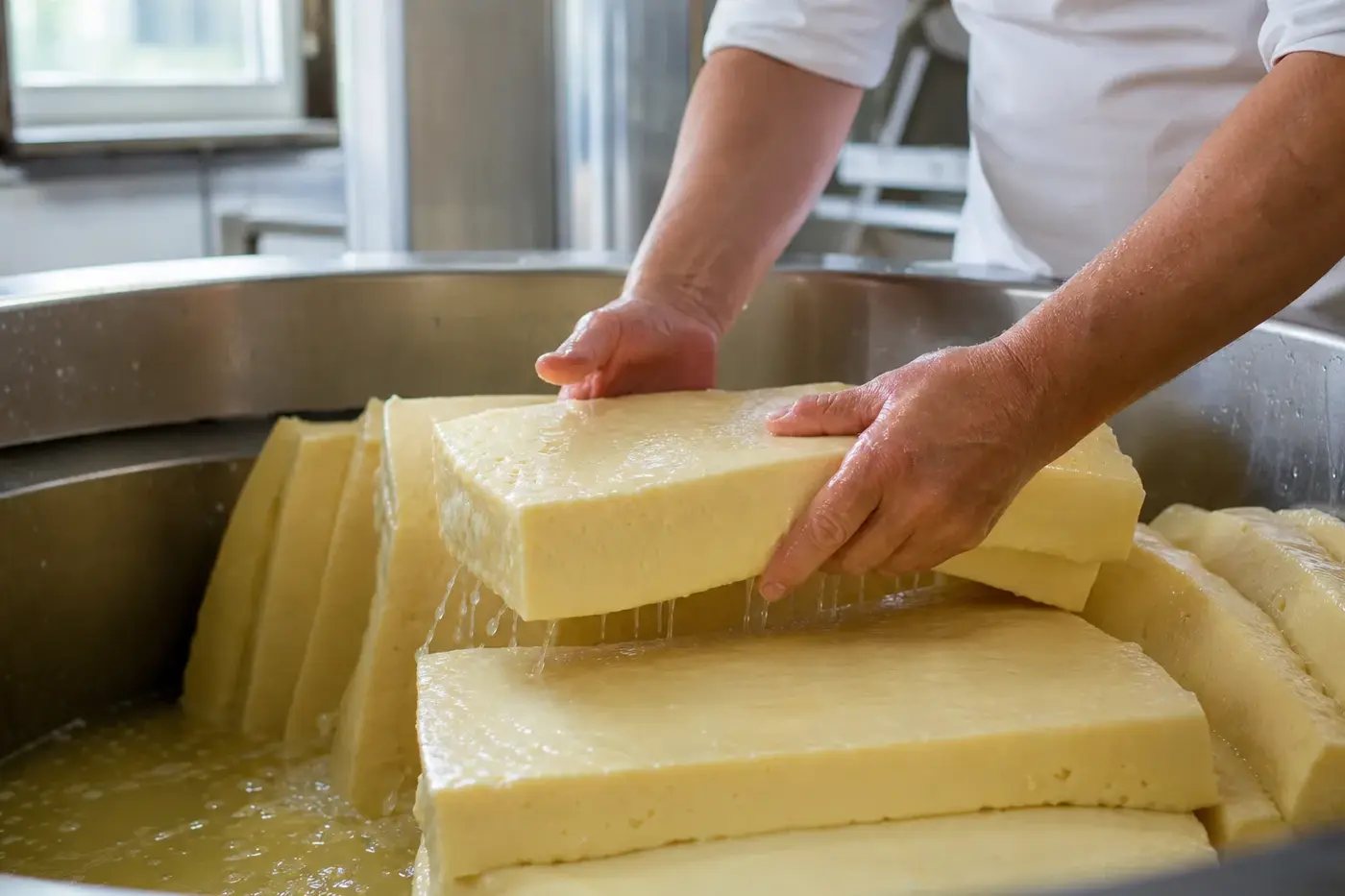
Slabs of curd are turned and stacked by hand.