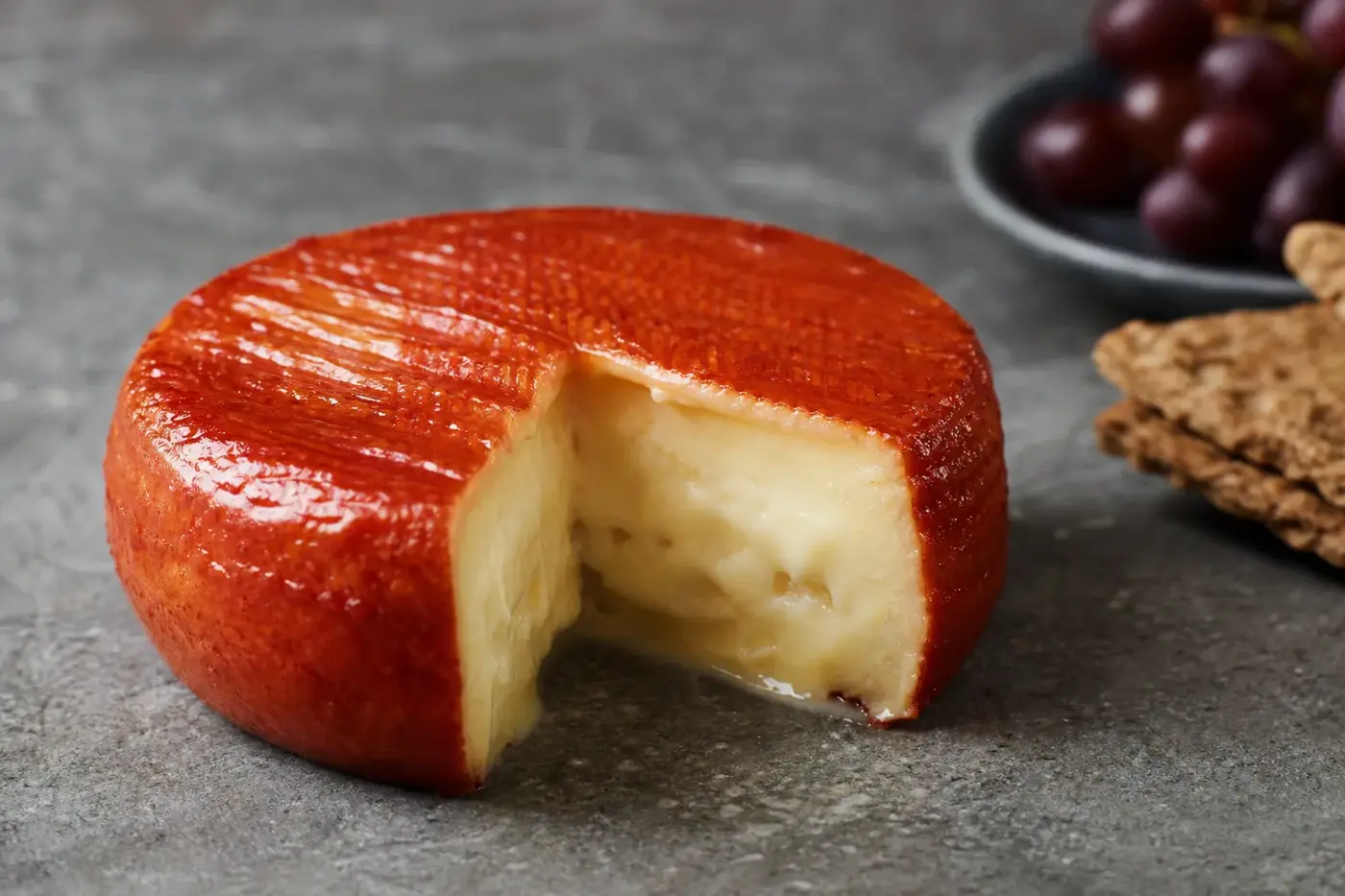
The white mould would not come back. At Cowgirl Creamery in coastal Point Reyes Station, a cheese had developed a sticky red rind instead. Set aside and tasted later, it revealed a pungent aroma and a texture worth pursuing: according to its co-founder’s discovery account, Red Hawk had begun.[2]
Today, you get a Californian washed-rind triple cream with a striking contrast: a pungent exterior wrapped around a rich, savoury centre. Pasteurised cow’s milk and added cream provide that enriched interior. A community of microbes encouraged on the surface helps give the cheese its character.[1][2]
| Get to know Red Hawk | The essentials |
|---|---|
| Who makes it | Cowgirl Creamery.[1] |
| Where it is made now | Cader Lane Creamery, Petaluma, Sonoma County, California, according to the maker’s production information, November 2026.[4] |
| Style | Small-format, washed-rind triple cream.[1] |
| Milk and cream | Organic pasteurised cow’s milk and organic pasteurised cream, declared by the maker.[1] |
| What sets the milk | Microbial rennet, described by the maker as vegetarian.[1] |
| Typical maturation | No established period available here. |
| Looking after the rind | Washed rind; current washing details are not available here.[1] |
| Declared ingredients | Milk, cream, salt, cultures and enzymes.[1] |
| Where the milk comes from | Locally sourced organic milk; current maker information does not identify an individual supplying dairy.[1] |
A Point Reyes surprise worth keeping
Red Hawk’s story begins with Cowgirl Creamery’s white-rinded Mt Tam and some unwelcome visitors. In an account published in 2020, the creamery’s co-founder recalled mites reaching its surface from a neighbouring cheese. Washing failed to restore the white mould; the rind turned sticky and red instead.[2]
The cheese was put to one side. Tasted later, what had looked like a failed batch offered a pungent aroma and promising texture. This is the maker’s retrospective discovery story, rather than a surviving production record from the time.[2]
Picture a renovated hay barn in Point Reyes, with a small cheesemaking room inside Cowgirl Creamery’s headquarters. Two college friends established the business in 1997. Their earlier wholesale business had already brought West Marin producers together with Bay Area restaurants.[3]
Red Hawk has since moved house. Cowgirl Creamery lists it among the cheeses made and matured at its Cader Lane creamery in Petaluma. Point Reyes Station is its birthplace; Petaluma is its documented production location today.[4]
Follow the cream into the centre
Added cream is central to what you taste and feel in Red Hawk. The maker declares both cow’s milk and cream, so extra milk fat joins the mixture before the cheese takes shape.[1]
First comes coagulation, which turns the liquid into a gel. A protein network traps fat and water, while drainage removes some liquid as whey. The fat becomes part of the cheese’s structure, rather than something spread through it afterwards.[6]
That helps explain why a refrigerated piece can feel quite different from one brought briefly towards serving temperature. Milk fat contains a mixture of fats that soften progressively as they warm. Your cheese can therefore feel firmer when cold without having changed in maturity.[6]
Give cream and ripening their own share of the credit. Cream supplies richness; maturation develops the rind, aroma and changing texture. To follow the journey from liquid milk to ripened cheese, explore how cheese is made.
Get acquainted with that red rind
Washing helps create surface conditions where a characteristic community of organisms develops during ripening.[7] Red Hawk belongs to the washed-rind family. Details of its current washing method are not available here.
That red surface is not one bacterium’s solo performance. Cowgirl Creamery’s historical explanation names Brevibacterium linens among the organisms involved in Red Hawk’s development.[2] Research describes cheese rinds as interacting populations of bacteria and fungi, with the cheesemaker’s surface care helping determine which thrive.[7]
Adding organisms is one thing; encouraging them is another. Washing changes the surface environment and moves material around the rind. Salt, moisture and the organisms’ interactions all help shape the community you eventually encounter.[7]
In 2014, researchers examined 137 rind communities from cheeses made in ten countries. DNA sequencing and laboratory reconstruction experiments showed that recognisable community types could develop in different geographical locations. Change the conditions, and their composition changed too.[7]
For you, the useful point is that a washed rind needs repeated care. Its colour and aroma develop through ripening itself. They are not finishing touches added once the cheese is ready.
Look beyond the red to the centre
Red Hawk is a small format cheese whose red rind and soft texture feature in the maker’s discovery account.[1][2] Surface and centre bring different things to your mouthful. Give yourself a moment to notice each.
At the counter, colour is just your starting point. Ask how that particular cut piece is eating: will the centre hold a clean slice, yield readily to your knife, or spread more happily? The answer helps you choose for the way you want to serve it.
Begin your tasting with a little paste, the cheesemaking word for the interior. Follow it with a piece that includes the surface, noticing how the texture and aroma change. This small comparison lets you distinguish what the centre contributes from what the rind brings.
Give the first sniff a fair hearing
Cowgirl Creamery describes Red Hawk as rich and savoury, with cured-meat, roasted-peanut and ocean-brine notes behind its pungent aroma.[1] If you are wondering whether it belongs on your plate, those descriptions offer a useful starting point.
The smell arrives first, but it need not chair the entire meeting. An assertive aroma can claim your attention before the cheese reaches your mouth. Richness, salt, texture and savoury flavours deserve their turn too.
Give each sensation a moment. How forceful is the aroma, how yielding is the texture, and what remains after you swallow? Separating those impressions helps you understand a washed-rind cheese without letting the first sniff decide everything.
Be equally curious about “buttery”. Do you mean a soft, spreading texture, a flavour reminiscent of butter, or both? Added cream explains Red Hawk’s enrichment, while the maker’s published flavour profile emphasises its savoury qualities.[1][6]
Ask the cheesemonger how it eats
“How is this batch eating now?” is a useful opening question. With no established current usual maturation period or washing method available here, tell the cheesemonger when you plan to serve it. Explain whether you prefer a more structured cheese or one that yields more readily.
The maker’s current information specifies pasteurised milk and cream, plus microbial rennet described as vegetarian.[1] Rennet is the milk-setting enzyme that helps form curd, and different sources produce different types. For the distinctions between animal, microbial and fermentation-produced options, turn to rennet explained.
Bring the label home too
Start with the cheese in front of you, rather than a general promise about how long opened cheese lasts. Read the maker’s name, date marking and storage instructions. At a staffed counter, ask about the piece’s condition and buy a quantity you can comfortably handle and serve.
For England, Wales and Northern Ireland, Food Standards Agency guidance recommends a fridge temperature between 0 and 5 °C. It also tells consumers to refrigerate dairy products and follow the storage instructions and date information on the packaging.[8]
Keep those details with your cheese after opening. If you are buying a cut portion, ask the seller for the relevant instructions. They should not disappear with the original wrapping.
For more help with wrapping and arranging your refrigerator, see how to store cheese at home. Keep the practical details close to the cheese, ready for when you need them.
Let your knife guide serving
A short spell out of refrigeration can help you appreciate Red Hawk’s texture as its milk fat softens.[6] Bring out only the portion you intend to eat. This avoids repeatedly warming the whole cheese.
In England, Wales and Northern Ireland, the Food Standards Agency advises keeping chilled food out of the fridge for the shortest possible time during preparation.[8] Get your bread, plates and accompaniments ready first.
Then bring out the cheese and test its texture with a clean knife. A cool room and a warm one produce different results. Let the cheese’s condition guide you rather than a fixed serving time.
Cut portions that include both rind and centre. That gives everyone the chance to explore the contrast between the aromatic surface and the interior.
Give Red Hawk room on your plate
Begin with plain bread, Red Hawk and one accompaniment. You will have space to notice the rind, texture and savoury flavours before adding more contrasts. The cheese does not need an entourage.
Try fresh pear or apple if you fancy a crisp mouthful alongside. Keep the fruit separate so you can compare bites with and without it. For a more savoury plate, Cowgirl Creamery recommends pickles, onion jam or shallot confit.[1]
The maker also suggests the drinks below.[1] Choose one direction rather than assembling the entire line-up. Taste the cheese alone first, then discover what your chosen pairing brings to it.
| What to pour | Where to begin |
|---|---|
| Riesling or Gewürztraminer | Start with the paste, then try a bite with rind. |
| Pinot Noir | Compare its effect on the savoury centre and aromatic surface. |
| Amber or dark ale | Begin with plain bread before adding accompaniments. |
| Barrel-aged sour beer | Taste separately from pickles so you can distinguish what each brings. |
| Root beer, alcohol-free | The maker’s alcohol-free suggestion; offer water alongside. |
Alcoholic pairings are for adults of legal drinking age; keep servings small. For the broader principles behind your choices, explore cheese and wine pairing.
This page summarises published guidance from the official sources it cites. It is not medical advice. Guidance differs between countries and changes over time, so check the current source for where you live, and ask your doctor, midwife, pharmacist or dietitian about your own circumstances.
Pregnancy guidance goes beyond rind colour
In the UK, the NHS advises thoroughly cooking pasteurised or unpasteurised mould-ripened soft cheeses with a white coating, and soft blue-veined cheeses. It says cheese cooked until steaming hot can be eaten, including soft or blue cheese.[9]
If you are discussing a particular soft-ripened product with your midwife or another appropriate clinician, refer to the current NHS guidance. Its categories and exceptions matter more than a judgement made from rind colour alone.
Red Hawk’s declared ingredients include milk and cream.[1] For ingredient checks, use the current pack and the information supplied with the particular product you are buying.
Return to Mt Tam for another taste
“Washed rind” and “triple cream” tell you two different things about Red Hawk. One describes its surface treatment; the other identifies its enriched character.[1] Keep them separate and your comparisons become more revealing than simply asking which cheese smells strongest.
Put Red Hawk beside another washed-rind cheese and compare milk, enrichment, texture and rind treatment before looking for shared flavours. Beside a white-rinded cheese, give the surface particular attention. What does it contribute to each mouthful?
Cowgirl Creamery describes Mt Tam as having a white bloomy rind and a texture that changes through maturation.[10] Taste the two side by side and you can explore different approaches to ripening an enriched cheese. You have come back to the cheese from which Red Hawk’s story began.
For the wider regional picture, continue with Cheeses of the Americas, the parent hub.
Questions people ask
What does Red Hawk taste like?
Cowgirl Creamery describes it as rich and savoury, with cured meat, roasted peanut and ocean brine notes. It also has a pungent aroma.
What kind of cheese is Red Hawk?
Red Hawk is a small format, washed rind triple cream cheese. Its enriched interior and ripened surface both contribute to its character.
Is Red Hawk pasteurised and vegetarian?
The maker declares organic pasteurised cow’s milk and organic pasteurised cream. It uses microbial rennet, which the maker describes as vegetarian.
Can I eat Red Hawk during pregnancy?
The NHS advises thoroughly cooking certain soft cheeses, including mould ripened soft cheeses with a white coating, and says cheese cooked until steaming hot can be eaten. Refer to current NHS guidance and discuss a particular soft ripened product with your midwife or another appropriate clinician.
How should I store Red Hawk?
Check the storage instructions and date information on the pack, or ask the seller for them when buying a cut portion. For England, Wales and Northern Ireland, the Food Standards Agency recommends a fridge temperature between 0 and 5 °C and advises refrigerating dairy products.
Sources
[1] Cowgirl Creamery, Red Hawk, current product page, undated. Ingredients, milk treatment, rennet, style, sourcing description, tasting notes and pairings. Retrieved November 2026.
[2] The Cheese Professor, Accidental Cheeses, 10 August 2020. Contains a first-person retrospective account from Cowgirl Creamery’s co-founder and an explanation from its production manager. Used as evidence of their accounts.
[3] Cowgirl Creamery, The Cowgirl Story, current company history, undated. Retrieved November 2026.
[4] Cowgirl Creamery, Our Creamery, current production-location statement, undated. Retrieved November 2026.
[5] Cowgirl Creamery manufacturer product information, 94331, Red Hawk, undated trade sheet hosted through Attribytes for Gourmet Foods International. The retrieved search extract states four weeks of ageing and brine washing. Full document requires confirmation before publication.
[6] American Society for Microbiology, The Basics of Cheesemaking, Microbiology Spectrum, 31 October 2013, DOI 10.1128/microbiolspec.CM-0002-2012. Milk chemistry, coagulation and temperature-dependent fat behaviour.
[7] Cell, Cheese rind communities provide tractable systems for in situ and in vitro studies of microbial diversity, volume 158, issue 2, 2014, pages 422 to 433, DOI 10.1016/j.cell.2014.05.041. Original sequencing and laboratory reconstruction study.
[8] Food Standards Agency, How to chill, freeze and defrost food safely, published 18 December 2017, current retrieved version. Applies to England, Northern Ireland and Wales.
[9] NHS, Foods to avoid in pregnancy, current retrieved version, November 2026.
This desk-researched article combines current maker information, an attributed historical account, published cheese science and official UK handling and pregnancy guidance.
Last checked: November 2026
Last checked November 2026.
The editors suggest you read next
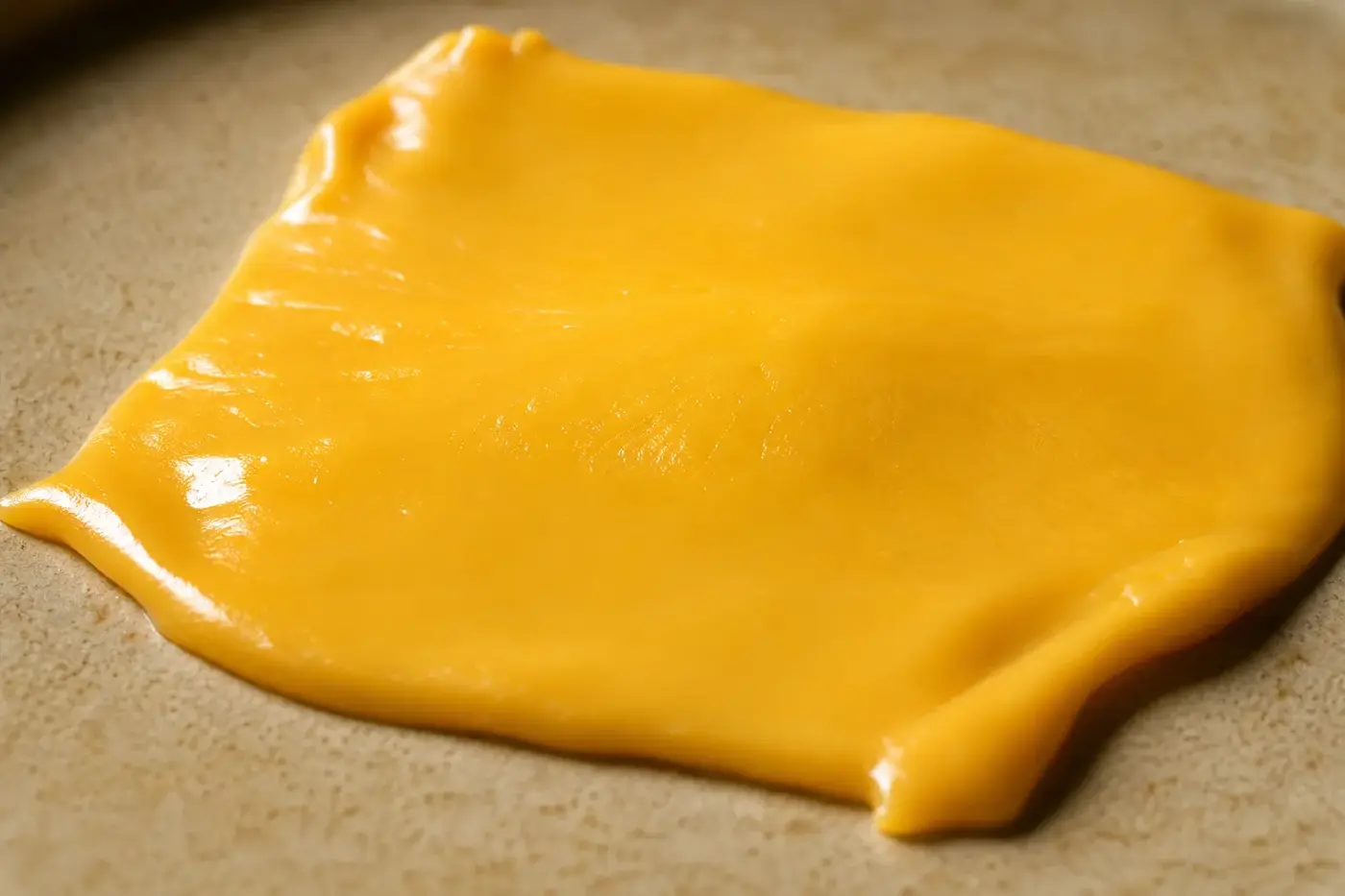
American Cheese: The Processed Slice Explained
Watch a slice of American cheese soften over your burger.