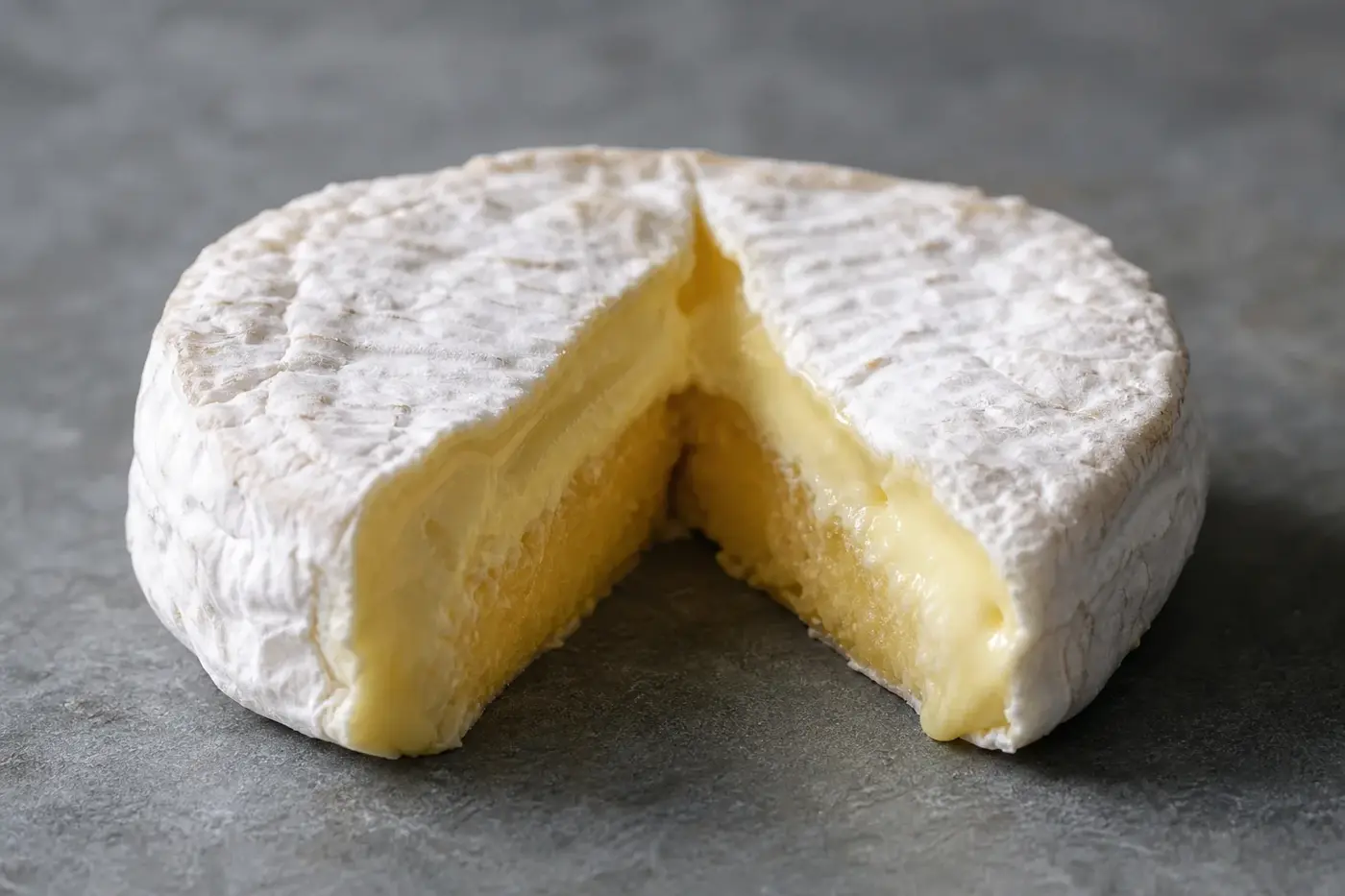
Your knife slips through Mt Tam's pillowy white rind. Beneath it, you might find a buttery centre or a heart still holding its fudge-like texture. Cowgirl Creamery packs that richness into a small wheel, made in Northern California from pasteurised cow's milk and cream. This soft, mould-ripened triple cream rewards a little lingering, so perhaps leave the cracker waiting.[1]
Meet the wheel before you cut
| What you'd like to know | The detail |
|---|---|
| Name | Mt Tam.[1] |
| Who makes it | Cowgirl Creamery.[1] |
| Where it's made | Cader Lane Creamery, Petaluma, California.[4] |
| Milk and cream | Pasteurised cow's milk and cream.[1] |
| What's in it | Milk, cream, salt, cultures and enzymes.[1] |
| What sets the milk | Microbial rennet, described as vegetarian by the maker.[1] |
| Shape and size | Small round wheel, 198 g (7 oz).[14] |
| Milk allergen | Present.[1] |
Find your moment: crumbly, fudgy or buttery
Mt Tam changes as it ripens, right down to its coat. That pale white rind moves from pillowy to something Cowgirl likens to birch bark. In the maker's product photograph, you'll see a squat, circular wheel, with pale yellow paste, the cheese's interior, beneath its fine white covering.[1,14]
The ripening guide lets you choose the texture that appeals. Young Mt Tam is firm and crumbly, with a narrow creamline, the softer layer just beneath the rind. In the middle stage, that layer thickens around a fudgy centre that may retain some crumble. A mature wheel softens throughout, becoming what Cowgirl compares to soft butter at room temperature.[2]
Flavour travels alongside texture. Cowgirl describes the young cheese as tangy and lactic, reminiscent of cultured milk; later, buttery richness comes forward and the rind's mushroom notes grow stronger. At maturity, its description brings together brown butter, cultured cream and savoury depth, with a little rind bitterness.[2]
Try the centre first, then take a bite with both paste and rind. Give the cheese a moment without its cracker companion. A firmer heart and a fully softened centre offer different pleasures, so choose your wheel for the one you fancy.
Meet the cooks who started in a hay barn
Sue Conley and Peggy Smith brought years of Bay Area food experience to Cowgirl Creamery. The company dates its beginnings to 1997. In its account, Smith had spent 17 years at Chez Panisse, while Conley had co-owned Bette's Oceanview Diner in Berkeley.[3]
Their first joint venture, Tomales Bay Foods, connected West Marin farms and dairies with restaurant kitchens. Its headquarters occupied a renovated hay barn in Point Reyes Station, with a small cheesemaking room tucked inside. Cowgirl credits Ellen Straus with encouraging them to make cheese; fromage blanc and crème fraîche were among their early products.[3]
This is a story of cooks, farmers and people bringing food to market. Those restaurant roots and local relationships give Mt Tam a particular home. When you cut into a wheel, you're tasting something with a place in Northern California's food network.[3,4]
Follow the name to Mount Tamalpais
Look towards Mount Tamalpais in Marin County, rising above San Francisco Bay, and you have Mt Tam's namesake. Cowgirl explicitly identifies the mountain as the source of its name. The wheel claims a recognisable North Bay landmark, although the cheese itself is made across the county boundary in Sonoma.[1,4]
Northern California milk, with cream for company
Today, Mt Tam's production home is Cader Lane Creamery in Petaluma. Cowgirl sources milk from farmer partners in Northern California and describes its local supply as pasture-based. Both cheesemaking and affinage, the controlled maturing of cheese, happen at the creamery.[4,5]
Read the ingredients and you'll find milk and cream side by side. The cream enriches the milk mixture before cheesemaking, helping explain Mt Tam's place in the triple-cream family. Its geography is practical as well as cultural: a local name, nearby milk and a working Sonoma County creamery.[1,4,7]
Watch the softness work its way in
Mt Tam follows the broad cheesemaking sequence of culturing, setting, separating curd from whey, shaping and ripening. Cowgirl confirms pasteurised milk and cream, plus microbial rennet, the enzyme preparation that sets the milk. Cultures, the microorganisms used in cheesemaking, also appear in the published ingredients.[1,5]
The 2025 edition of the US soft-ripened cheese standard explains the wider process. Bacteria act on milk before a clotting enzyme forms a semi-solid mass. The solid curd is separated from liquid whey, then collected and shaped. As ripening progresses, surface microorganisms help the cheese mature towards its centre.[7]
That soft layer beneath the rind has some science behind it. Cowgirl calls the protein breakdown that creates the creamline proteolysis, explaining why the changing cross-section is especially noticeable there. The creamline develops around the heart; you can follow the wider sequence in how cheese is made.[2]
Triple cream, and what that percentage means
Triple cream describes enrichment, but its familiar fat percentage isn't measured on the cheese sitting on your plate. In France, Article 13 of Décret n°2007-628 reserves triple crème for cheese or cheese speciality containing at least 75 g fat per 100 g after complete drying. That's 75% fat in dry matter.[6]
Dry matter is what remains after the water has gone. Fat in the whole cheese uses the weight as you eat it, water included. One percentage describes the solids; the other describes your portion.[6]
The French rule explains the terminology, while Mt Tam is made in the United States. If you're comparing foods, use total fat on their nutrition labels and keep the serving basis the same. A dry-matter percentage cannot stand in for a nutrition figure per 100 g of cheese.[1,6]
Find the family resemblance to Brie
Bloomy rind tells you how a cheese ripens at its surface. Triple cream tells you about its enriched composition. Mt Tam brings both together, but each term has its own job.
Cowgirl's Triple Cream Brie offers a useful comparison. It too has pasteurised cow's milk and cream, microbial rennet and a bloomy rind. The maker also describes a fudgy core and mushroom notes.[2,8]
Those shared details give you a closer reference point than assuming every Brie behaves alike. A name such as Brie and a description such as bloomy rind tell you different things about a cheese. Keep exploring through brie and how to tell cheese styles apart.
Give that first bite a little space
Start with plain baguette or an unsweetened cracker, with a little preserve to one side. Taste the cheese alone before bringing in sweetness. You'll notice the contrast between paste and rind, then decide how much company it needs.
For a drink, Cowgirl suggests drinking chocolate.[1] Water gives you another alcohol free option, if you'd rather keep things simple.
Let only the portion you intend to eat lose its refrigerator chill. Under US FDA handling guidance, total time out of refrigeration should stay within two hours, or one hour above 32 °C (90 °F). Return the rest promptly to a fridge kept at 4 °C (40 °F) or below.[9]
Cut small wedges through the centre so everyone gets both paste and rind. On a mixed board, try Mt Tam before the more forceful cheeses. You can always return with bread or a drink; a second visit hardly needs an excuse.
Keep the wrapping, and watch the dates
Keep unopened Mt Tam refrigerated. Once you've opened it, Cowgirl recommends rewrapping it in its original cheese paper, covering the cut surface so it doesn't dry out. For quality, the maker suggests eating opened cheese within a few days. UK NHS advice is to use opened food within two days unless the packaging says otherwise, and to follow the use-by date.[5,11]
That bloom belongs to the cheese's ripened surface, where Cowgirl describes mushroom notes and changing texture.[1,2] Remove all wrapping before serving.
This page summarises published guidance from the official sources it cites. It is not medical advice. Guidance differs between countries and changes over time, so check the current source for where you live, and ask your doctor, midwife, pharmacist or dietitian about your own circumstances.
At higher risk? Start with the guidance
The NHS's UK pregnancy guidance, as of November 2026, says mould-ripened soft cheeses with a white coating should be thoroughly cooked until steaming hot. That applies whether the milk is pasteurised or unpasteurised, and Mt Tam fits the description. Follow the NHS pregnancy guidance for current UK advice.[10]
The NHS also identifies older people and people with weakened immune systems as being at greater risk of serious listeriosis. Its practical advice includes keeping your fridge at 5 °C or below, separating raw and ready-to-eat foods, and following label instructions. Consult its listeriosis guidance and your healthcare professional about your circumstances.[11]
In the United States, the FDA's higher-risk food guidance lists cheeses made with pasteurised milk, other than queso fresco-type cheeses, as lower-risk choices. CDC also records outbreaks involving soft cheeses and explains that contamination can occur in these foods. Read the FDA guidance for its US advice, as of November 2026.[12,13]
A little more for your cheese notebook
- How to Store Cheese at Home: practical help with wrapping and refrigeration.
- Listeria and Cheese Safety: more on the organism, higher-risk groups and official guidance.
Questions people ask
What does Mt Tam taste like?
Young Mt Tam is tangy and lactic, with a firm, crumbly centre. As it ripens, it becomes softer and more buttery, with stronger mushroom notes in the rind.
Is Mt Tam vegetarian?
Cowgirl Creamery describes its microbial rennet as vegetarian. Mt Tam contains cow's milk and cream.
Can you eat the rind of Mt Tam?
The white rind is part of the cheese's ripened surface and develops mushroom notes. Cowgirl's explicit advice on eating the rind has not been verified.
Can you eat Mt Tam during pregnancy?
The NHS advises that soft cheeses with a white mould coating should be thoroughly cooked until steaming hot during pregnancy, whether made with pasteurised or unpasteurised milk. Mt Tam fits that description. Check the current guidance at https://www.nhs.uk/pregnancy/keeping-well/foods-to-avoid/.
How should Mt Tam be stored once opened?
Cowgirl recommends rewrapping it in its original cheese paper, covering the cut surface, and eating it within a few days for quality. The NHS advises using opened food within two days unless the packaging says otherwise, and following the use by date.
Sources
- Cowgirl Creamery, Mt Tam, undated current product information, accessed November 2026. Ingredients, milk treatment, coagulant, sensory description, namesake and suggested pairings.
- Cowgirl Creamery, Secret Life of Mt Tam, undated, accessed November 2026. Young, ripe and mature descriptions; definitions of bloom and proteolysis.
- Cowgirl Creamery, The Cowgirl Story, undated, accessed November 2026. Producer's account of its founding, founders' careers, Tomales Bay Foods and early cheesemaking.
- Cowgirl Creamery, Our Creamery, undated, accessed November 2026. Cader Lane production, nearby dairy partners and producer's description of pasture-based milk.
- Cowgirl Creamery, FAQ, undated, accessed November 2026. Northern California milk supply, pasteurisation, microbial rennet and cheese care.
- French Republic, Décret n°2007-628 du 27 avril 2007 relatif aux fromages et spécialités fromagères, Article 13, version effective from 1 January 2014, retrieved through Légifrance in November 2026. Paragraph 6 defines triple crème by fat after complete drying.
- US Government Publishing Office, Code of Federal Regulations, Title 21, § 133.182: Soft ripened cheeses, edition revised 1 April 2025. Paragraphs (b) and (c) describe the general manufacturing sequence and permitted dairy ingredients.
- Cowgirl Creamery, Triple Cream Brie, undated current product information, accessed November 2026. Composition, rind and producer's texture description.
- US Food and Drug Administration, Safe Food Handling, current online guidance, accessed November 2026. Refrigeration and time limits for perishable foods.
- NHS, Foods to avoid in pregnancy, current online guidance, accessed November 2026. Mould-ripened soft cheeses, pasteurisation and the steaming-hot cooking exception.
- NHS, Listeriosis, current online guidance, accessed November 2026. Higher-risk groups, refrigeration, opened foods and use-by dates.
- US Food and Drug Administration, What You Need to Know About Preventing Listeria Infections, current online guidance, accessed November 2026. Higher-risk groups and the agency's food-choice table.
- US Centers for Disease Control and Prevention, How Listeria Spread: Soft Cheeses and Raw Milk, current online guidance, accessed November 2026. Soft-cheese contamination and outbreak context.
- Cowgirl Creamery, Mt Tam product photograph, undated image retrieved from the producer's product page, November 2026. Wheel shape, interior colour and photographed packaging showing 198 g (7 oz). Publication permission has not been obtained.
This piece was researched from producer records, official food-safety guidance and primary regulatory texts, with editorial serving suggestions distinguished from the producer's descriptions.
Last checked: November 2026
Last checked November 2026.
The editors suggest you read next
American Cheese: The Processed Slice Explained
Watch a slice of American cheese soften over your burger.