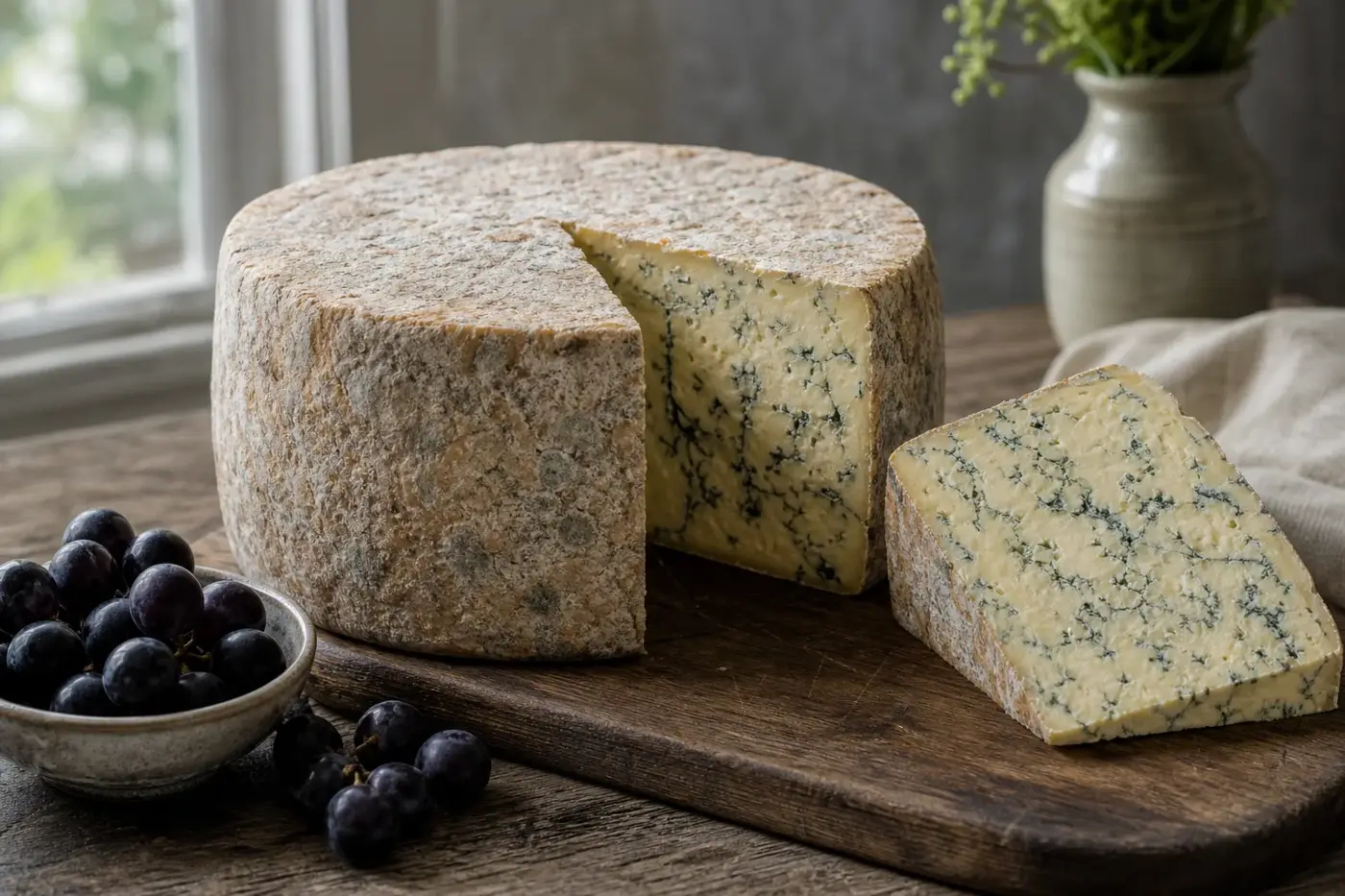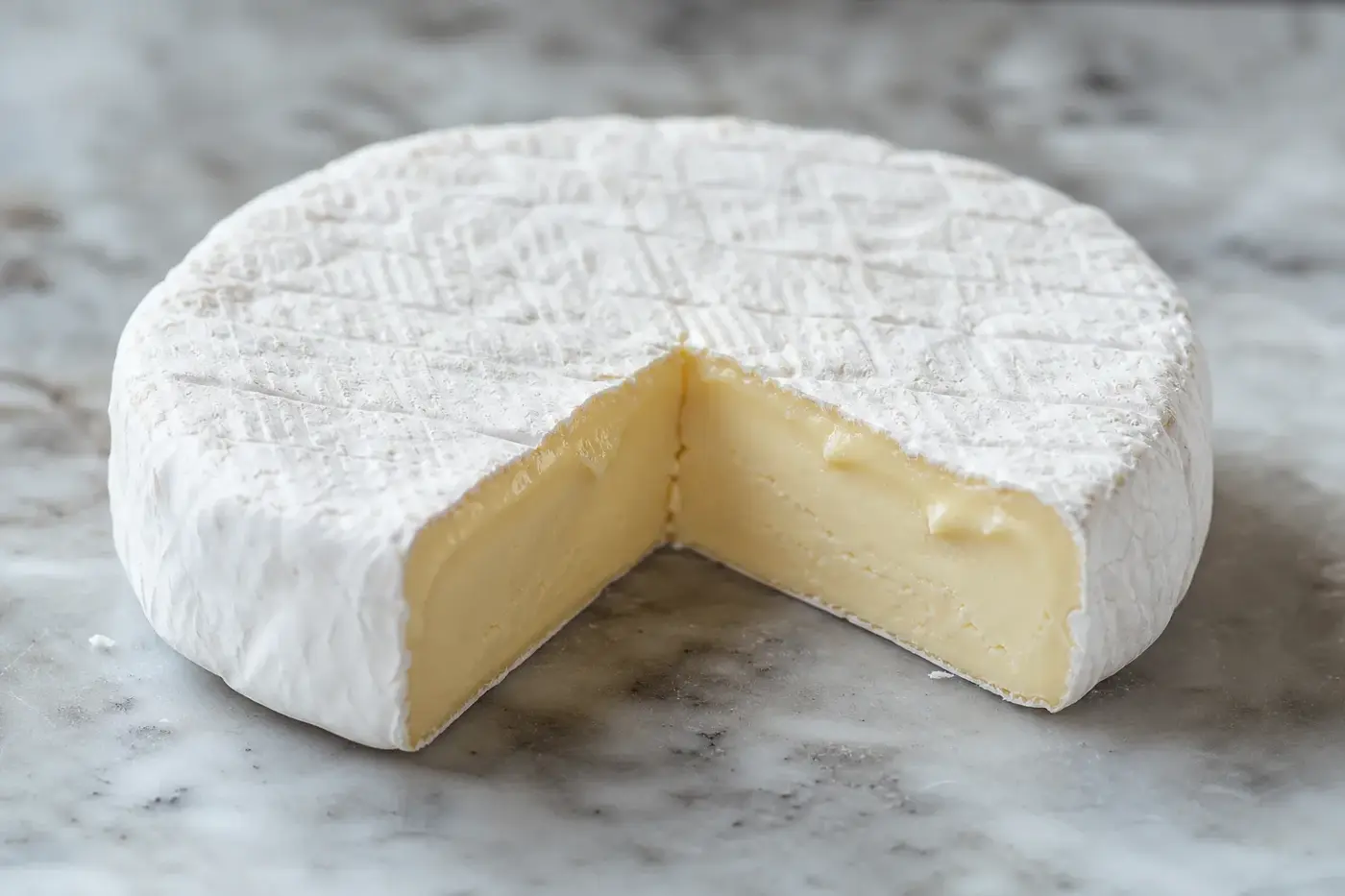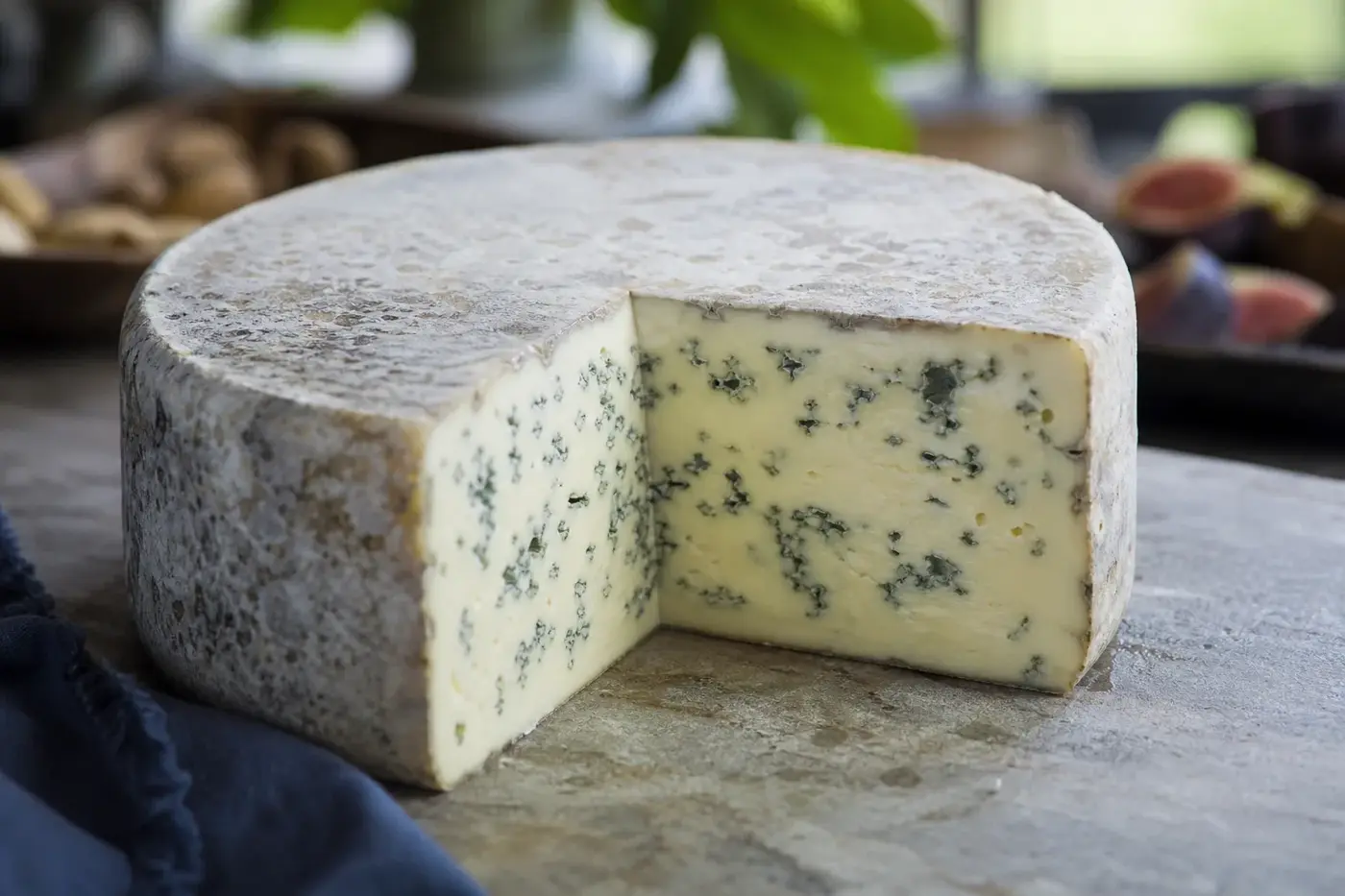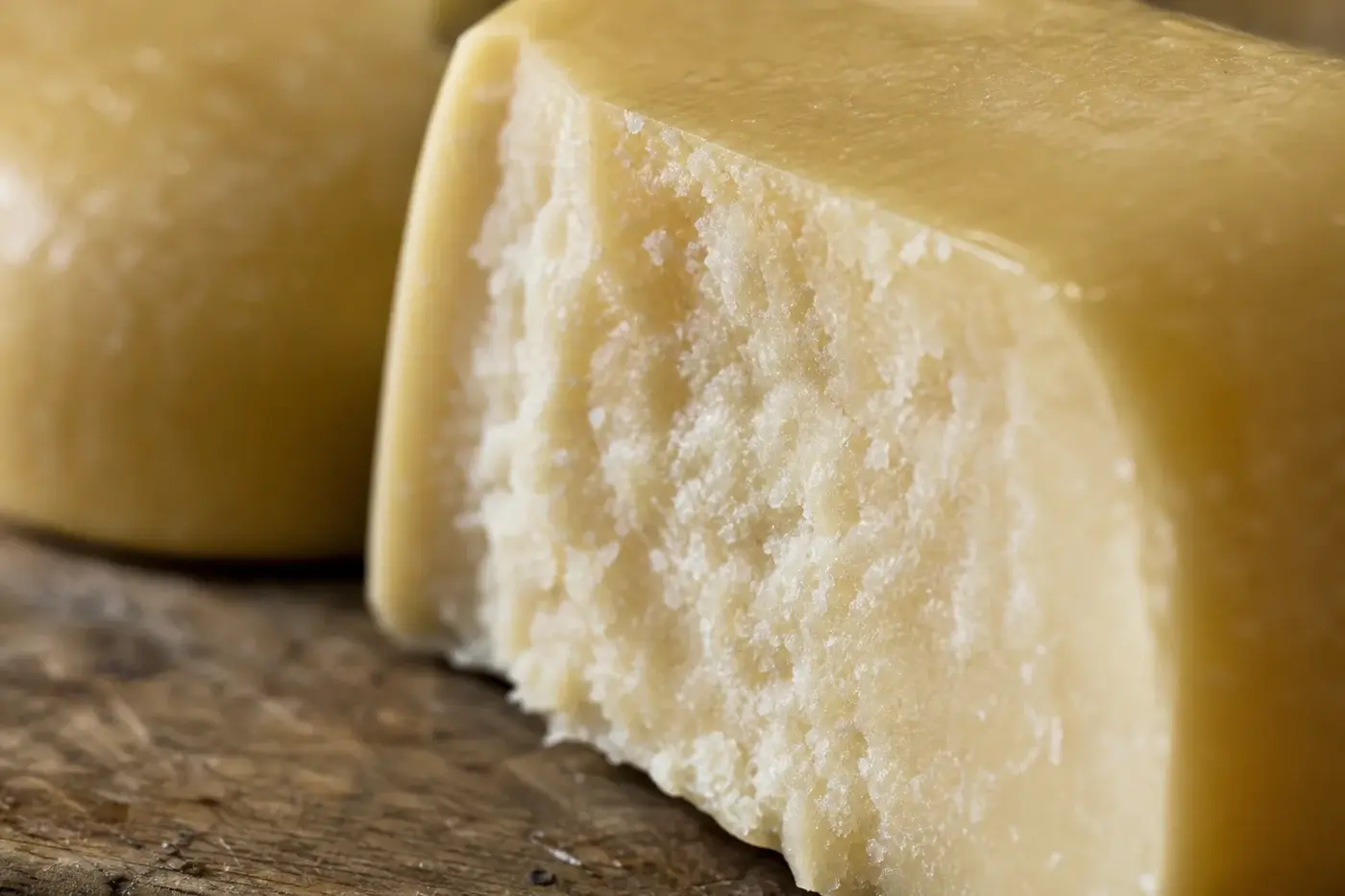
A sweet smell reaches you first. Then comes a mild fruity tang, with a yeasty aftertaste bringing up the rear. At Pant Mawr Farmhouse Cheeses in Pembrokeshire, local honey mead is sprayed onto Drewi Sant, a soft cows’ milk cheese with a glossy, straw-coloured surface.[1][2][3][5] Your first clue to its character is right there on the outside.
Get acquainted with Drewi Sant
| What to know | A closer look |
|---|---|
| Name | Drewi Sant.[1] |
| Maker | Pant Mawr Farmhouse Cheeses.[1] |
| Place | Rosebush, Pembrokeshire, Wales.[2][3] |
| Milk | Cows’ milk.[4] |
| Milk source | Locally produced, according to the maker.[2] |
| Coagulant | Vegetarian rennet, declared by the maker.[2] |
| Style | Soft, mead-washed cheese.[1] |
| Appearance | Glossy and straw-coloured.[1] |
Start with the soft centre and the mead-treated surface
Before you take a bite, notice two things: Drewi Sant’s soft body and its mead-treated surface. Pant Mawr lists it among its cows’ milk cheeses and describes its texture simply as soft.[1][4] The surface treatment tells you about the rind; the texture describes the paste, the cheese inside.
That distinction is useful at the cheese counter, especially when your shopping list has become more of a suggestion. Knowing what happens to a rind won’t tell you everything about the body beneath it, or how it will sit on your cheeseboard. For help choosing and comparing, start with milk, rind and texture.
The description “mead-washed” deserves a moment of your attention. Pant Mawr says it sprays the cheese with mead, giving you a more precise picture than “washed” alone.[1]
Find the name on the label
Look for Drewi Sant on Pant Mawr’s product page, where it appears alongside the description “Mead Washed”.[1] The intended meaning and origin of the name remain open questions, pending an account from the maker or a primary Welsh language source.
Visit the family dairy in the Preseli foothills
Picture a traditional Welsh hill farm in Rosebush, in the foothills of the Preseli Mountains. That is home to Pant Mawr Farmhouse Cheeses, whose contact address places it in Pembrokeshire, Wales.[2][3] The maker describes a family operation, using locally produced milk and recipes developed through its own cheesemaking experience.[2]
That setting has a place in the cheese itself. Alongside the locally sourced milk, Pant Mawr identifies the honey mead used on Drewi Sant as local.[2][5] You have more than a place name to remember: there is a connection between the people making the cheese and the ingredients they choose.
Get to know the milk and rennet
Drewi Sant starts with cows’ milk, and Pant Mawr says the milk for its cheeses is locally produced.[2][4] The supplier and pasteurisation status remain open questions. The maker does state that it uses vegetarian rennet and that all its cheeses are suitable for vegetarians.[2]
Think of rennet as the ingredient that gets the curd going. This coagulant helps milk proteins form a curd, separating the developing cheese from the liquid whey.[6] A vegetarian-rennet declaration tells you about that setting ingredient, not about the milk itself.
If production methods guide your choice, keep three questions separate. Which animal supplies the milk, how is that milk treated, and what sets it? For the coagulants, see rennet explained; for milk treatments, turn to raw, thermised and pasteurised milk.
Follow the mead onto the rind
Pant Mawr sprays Drewi Sant with mead.[1] In its description of a cheese selection, the maker calls that liquid a local honey mead wine.[5] Curd handling, moulding, wash frequency and maturation time remain open questions.
A cheese’s surface, though, is much more than a wrapper. The University of Wisconsin’s Center for Dairy Research explains that bacteria, yeasts and moulds on surface-ripened cheeses contribute to aroma, flavour and texture.[7] Enzymes break down proteins and fats, with changes that can work from the surface towards the centre.
This surface life has a sequence. A review of cheesemaking in Microbiology Spectrum describes washed-rind development as a succession of organisms: early yeasts can reduce surface acidity, making conditions more favourable for other ripening organisms.[6] The washing liquid plays a part, while the maturing cheese and its surface community also help shape the result.
For Drewi Sant, Pant Mawr attributes the sweet smell, fruity tang and yeasty aftertaste to the local honey mead wine treatment.[5] Use those as tasting prompts rather than a checklist. You’re exploring a cheese, not asking it to impersonate a glass of mead.
Let your eyes and nose go first
Glossy, straw-coloured and soft: that is Pant Mawr’s opening picture of Drewi Sant. The maker’s fuller description adds a sweet smell and yeasty aftertaste to its mild fruity tang, linking them to the honey mead treatment.[1][5] You have something more useful to look for than the catch-all word “strong”.
Start with the cut face and smell the cheese before adding bread or fruit. Notice how it feels under the knife, then compare the centre with the area just beneath the rind. Surface-ripened cheeses can soften from the outside in as proteins break down, so that small comparison deserves your attention.[7]
Follow a mouthful from beginning to end. Does the fruity character arrive first, or linger afterwards? Is the yeasty note clearest in the aroma or after swallowing? Put those distinctions in a tasting note and you’ll have something specific to return to next time.
Serve a little and keep the rest cool
Begin with a small piece of cheese, plain bread and water. Cut only what you expect to eat, then divide it into manageable pieces on the plate. If you’re sharing a whole round, cut wedges towards the centre so each serving gets some outer edge and inner paste.
Keep the main piece refrigerated and serve your small portion promptly. The UK Food Standards Agency’s advice is to keep a home fridge at 5 °C or below (November 2026).[8] Use a fridge thermometer rather than trusting the dial setting alone.
Save the wrapping and label so the storage and date instructions stay with the cheese. If you’re buying a cut piece, ask the cheesemonger to retain those details for you.
Follow the pack’s directions about removing or eating the rind. If there are none, ask the maker or seller rather than guessing. You’ll find broader handling advice in storing cheese at home.
Bring bread, fruit and a glass to the table
Let Pant Mawr’s mild fruity tang and yeasty finish guide what you serve alongside.[1][5] These suggestions offer simple ways to explore those qualities without crowding the cheese out. Try one accompaniment at a time, noticing what changes with a crisp bite, fresh fruit or a sip.
| Alongside your cheese | Give this a try | What to look for |
|---|---|---|
| Bread | Plain sourdough or an unsweetened oat biscuit | A restrained base keeps the cheese in focus; a crisp biscuit adds textural contrast. |
| Fruit | Sliced pear or apple | Try the fruit beside a separate bite of cheese to explore the maker’s fruity description. |
| Alcohol-free drink | Sparkling water | A simple starting point when you want to concentrate on aroma and finish. |
| Alcohol-free alternative | Unsweetened apple juice diluted with sparkling water | Compare this fruit-led option with your plain-water tasting. |
Take your cheese curiosity a little further
- How Cheese Is Made: From Milk to Cheese: follow the wider journey from milk to curd and ripening.
- How to Read a Cheese Label: bring together the maker, milk information and handling instructions when you’re choosing a piece.
General information only, not medical advice: follow the official guidance where you live.
Questions people ask
What is Drewi Sant cheese?
Drewi Sant is a soft cows’ milk cheese made by Pant Mawr Farmhouse Cheeses in Pembrokeshire. Its surface is sprayed with local honey mead.
What does Drewi Sant taste like?
The maker describes a mild fruity tang and a yeasty aftertaste. It also says the cheese has a sweet smell.
Is Drewi Sant vegetarian?
Pant Mawr says it uses vegetarian rennet. The maker states that all its cheeses are suitable for vegetarians.
Is Drewi Sant made with pasteurised milk?
Whether its milk is pasteurised has not been verified. The maker says it uses locally produced milk for its cheeses.
How should Drewi Sant be stored?
Keep the main piece refrigerated and save the wrapping and label so the storage and date instructions stay with it. The UK Food Standards Agency advises keeping a home fridge at 5 °C or below and checking the temperature with a fridge thermometer.
Sources
- Pant Mawr Farmhouse Cheeses, Drewi Sant, undated product page, retrieved November 2026. Maker’s product description.
- Pant Mawr Farmhouse Cheeses, About Pant Mawr Farmhouse Cheeses, undated, retrieved November 2026. Maker’s account of its location, milk and vegetarian rennet.
- Pant Mawr Farmhouse Cheeses, Contact, undated, retrieved November 2026. Farm contact address.
- Pant Mawr Farmhouse Cheeses, Cows Milk Cheese, undated category page, retrieved November 2026. Cows’ milk cheese category.
- Pant Mawr Farmhouse Cheeses, Gold Hamper, undated product-selection description, retrieved November 2026. Maker’s description of the local honey mead treatment.
- American Society for Microbiology, The Basics of Cheesemaking, Microbiology Spectrum, published 31 October 2013, DOI 10.1128/microbiolspec.CM-0002-2012. Scientific review.
- University of Wisconsin-Madison, Center for Dairy Research, Environmental Conditions for Aging Surface-Ripened Cheeses, Dairy Pipeline, volume 34, number 2, summer 2022. Technical publication.
- Food Standards Agency, Storing chilled foods at incorrect temperatures, research guidance, retrieved November 2026. Recommended refrigeration range.
- Food Standards Agency, Alerts, live official recall and allergy-alert index, retrieved November 2026. Official alerts.
Researched through the maker’s published descriptions, dairy-science references and official food-handling information; sensory descriptions are attributed to the maker and pairings are editorial suggestions.
Last checked: November 2026
Last checked November 2026.
The editors suggest you read next
Caerphilly
Your knife meets a rind-ripened Caerphilly, and one wedge offers two pleasures: a fresh, crumbly centre and a softer, creamy layer just beneath the rind.