Dunlop
Your knife passes through a thin, hard, golden rind into pale yellow cheese.
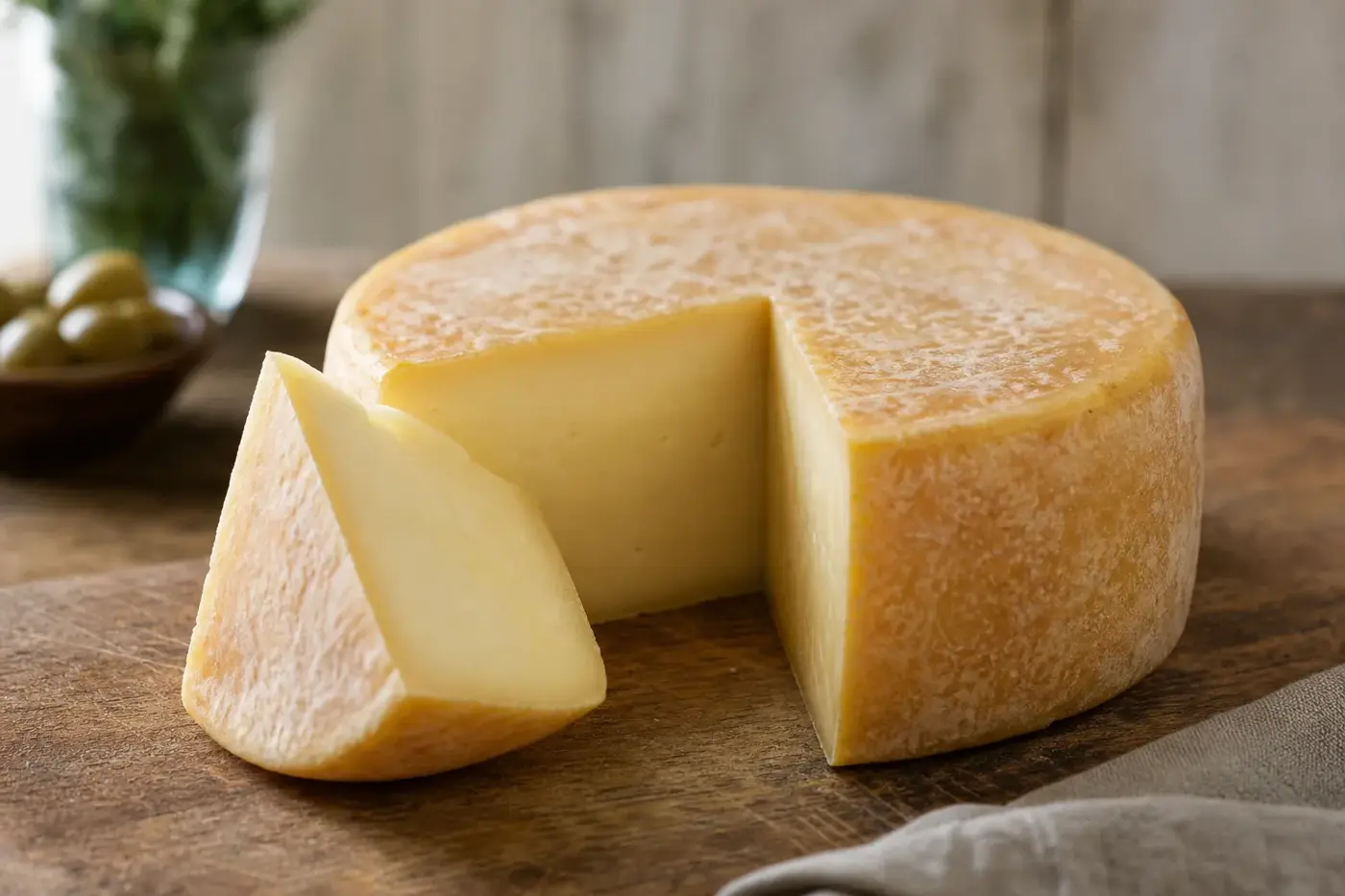
Your knife passes through a thin, hard, golden rind into pale yellow cheese. In protected Traditional Ayrshire Dunlop, the cut face is moist, the texture close and smooth. You have a little Ayrshire dairy tradition on your plate, named for the Scottish village where its story took root. [1][2][3]
Before you claim your wedge, give the label a moment. Dunlop is the wider cheese style; Traditional Ayrshire Dunlop is the protected name. Its Great Britain PGI specification requires whole milk from Ayrshire cows and production within a defined area. Those extra words earn their place. [1][2][3]
Your quick introduction to Dunlop
| What you want to know | The useful details |
|---|---|
| Name | Dunlop. [4] |
| Registered name | Traditional Ayrshire Dunlop. [1] |
| Authority and identifier | Defra, UK GI register; current register identifier: Not verified. Original EU application identifier: UK-PGI-0005-0889-30.8.2011. [1][3] |
| Great Britain status | Registered PGI; UK scheme registration 31 December 2020 at 23:00; status date November 2026. [1] |
| EU and Northern Ireland status | Current register status: Not verified. Founding registration act: Regulation (EU) 2015/581. [9] |
| Where it is made | Around the traditional parish of Dunlop. [2] |
| Milk for the protected cheese | Whole cows’ milk, Ayrshire breed. [2][3] |
| Permitted milk treatment | Not verified. [2][3] |
| Minimum time to mature | Six months. [3] |
| Ages to look for | Mild, 6 to 10 months; mature, 10 to 12 months; extra mature, 12 to 18 months. [3] |
| A current producer | Dunlop Dairy, West Clerkland Farm, near Stewarton. [4][5] |
| The maker’s milk and rennet declaration | Dunlop Dairy: pasteurised milk; vegetarian rennet. [5] |
Meet Barbara Gilmour, with a little historical caution
Barbara Gilmour sits at the heart of Dunlop’s story. Alexander Ramsay’s 1879 history of Scotland’s agricultural society reproduces a parish report attributed to Thomas Brisbane in 1793. It credits Gilmour with introducing whole-milk cheesemaking locally, bringing the method home from Ireland after religious exile. You are reading a story preserved in later accounts, rather than Gilmour’s own words. [7]
There is a dissenting voice in the record, too. Ramsay records that agricultural writer William Aiton questioned whether the method was peculiarly Irish and called the account a family story. Gilmour’s place in local cheese history rests on firmer ground than a precise invention date, or an unchanged recipe making its way across the Irish Sea. [7]
For a more tangible connection, turn to The Hill. Historic Environment Scotland identifies it as Gilmour’s home, with a datestone bearing her initials and those of her husband, John Dunlop. Its building record also links her to cheesemaking learnt in Ireland, preserving that connection as a heritage attribution. [8]
Get to know the cheese beneath the rind
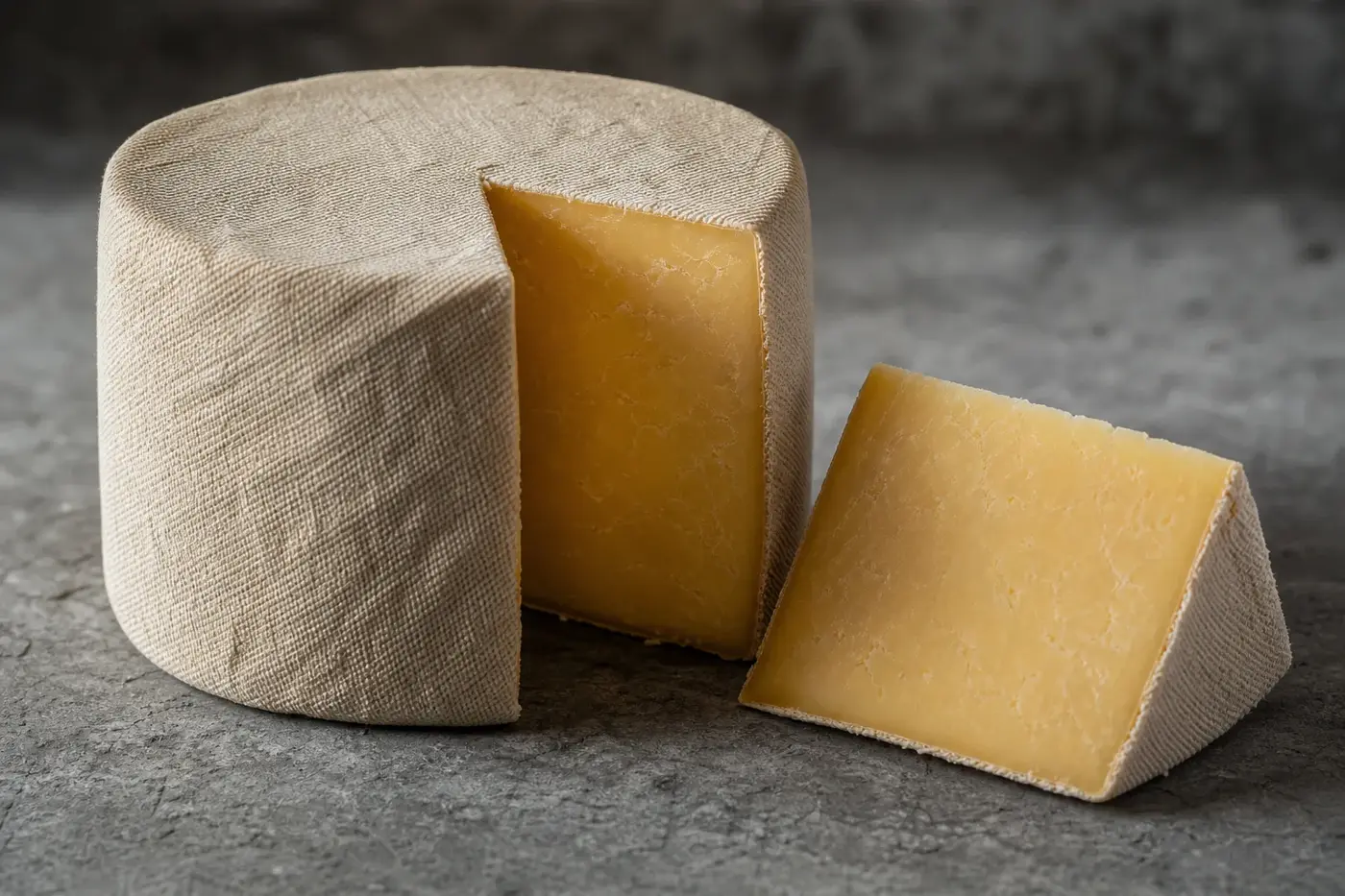
Traditional Ayrshire Dunlop has a clearly defined appearance. Picture a cylinder with a thin, hard, golden rind, slight mottling and a naturally pale yellow interior. The paste, the cheese beneath the rind, is close and smooth, with a moist cut face. Traditional sizes include approximately 3 kg and 20 kg cheeses and a smaller 350 g version, although other sizes are allowed. [2][3]
Age gives you a different experience. The specification describes younger cheese as mild and nutty, becoming stronger and drier as it matures; Dunlop Dairy also describes a slight sharpness developing. Ask how old your wedge is, then ask for the maker’s tasting notes. “Dunlop” alone cannot do all the talking. [2][4]
The wider name leaves other questions open, too. Milk treatment, rennet and maturation deserve a closer look, especially when you compare makers. For help untangling those details, start with milk treatments and rennet. [4][5]
Read the full name before you choose
Traditional Ayrshire Dunlop holds Protected Geographical Indication status, usually shortened to PGI. The UK register lists it as registered, and the UK scheme protects the name in Great Britain. For EU and Northern Ireland status, distinguish the current register entry from the founding EU registration act, Commission Implementing Regulation (EU) 2015/581. [9]
The production area surrounds the traditional parish of Dunlop. Its boundary is set out in the registered specification, rather than extending across Scotland or even all of Ayrshire. Whole milk from Ayrshire-breed cows, the prescribed cheesemaking method and at least six months of maturation are central requirements. [2][3]
Look for every word on the label: Traditional Ayrshire Dunlop. Dunlop Dairy distinguishes it from Dunlop, and the application expressly sought protection for the full wording. “Dunlop” alone tells you less about origin and method. For the distinction between a geographical indication and a brand, see protected names explained. [2][5][6]
The PGI is not the applicant dairy’s exclusive possession. Producers can use it if they meet the specification and undergo verification. The registered name and the maker’s identity answer different questions: what is this defined product, and who made the cheese you are buying? [6]
Follow the cheesemaker from milk to shelf
Hand-cut curd, sea salt, an overnight pressing: the registered method gives you plenty to picture. First, starter culture goes into the milk, followed by rennet to help it set. The resulting curd is the solid portion of the future cheese. Cutting and stirring separate it from whey, the liquid released during cheesemaking. [2][10]
The cheesemaker cuts the set curd by hand, then warms, stirs and drains it. Slabs of drained curd are cut and turned before being milled into smaller pieces. Sea salt is mixed through, and the pieces go into cylindrical moulds. Overnight pressing brings them together into a coherent cheese. [2][10]
Next, the surface receives a hot water treatment. The cheese is cloth-bound, pressed again, dried and moved to wooden shelves, where it is regularly monitored as it matures. Those finishing stages help explain the traditional rind and cylindrical shape. The specification’s age bands take you from mild through mature to extra mature. [2][10]
Dunlop Dairy declares pasteurised milk that is neither homogenised nor standardised, alongside vegetarian rennet. These are that dairy’s product declarations, so consult the current information for your particular cheese. The distinction matters when another maker uses the wider Dunlop name. [5]
Find the living tradition on a working farm
Near Stewarton, Dunlop Dairy includes Traditional Ayrshire Dunlop in its published range. The dairy says cheesemaking began on the farm in 1989, with sheep’s and goats’ milk cheeses. The cows joined the story later. [4][11]
Its account gives the modern revival a setting you can picture. Farm buildings were adapted for cheesemaking, with a range shaped around the animals being milked. Today’s Ayrshire connection belongs to a working farm as well as a protected name. When you choose a wedge, the maker behind the label is part of the story. [4][11]
Make room for Dunlop beside Cheddar
If Cheddar is your familiar starting point, you have a useful comparison. Dunlop Dairy describes its Traditional Ayrshire Dunlop as a hard-pressed cheese resembling Cheddar, but more moist. Its tasting notes describe young Dunlop as smooth and close in texture, with strength increasing as it matures. [4]
Cheshire and Wensleydale belong in this conversation, too. The dairy places Dunlop alongside both in its historical account of the cheese’s reputation. For a territorial-cheese tasting, let the actual wedges speak rather than asking regional stereotypes to do the work. [4]
Notice how each cuts, whether it bends or crumbles, and how quickly its flavour builds. Give Dunlop its own space on the board. A comparison is useful; making every cheese audition for the role of Cheddar is less so. Follow the neighbouring tradition through the cheddar guide. [4]
Ask three questions at the cheese counter
Who made it? What is its exact name, and how old is it? For the geographically defined cheese, you want Traditional Ayrshire Dunlop in full. Those questions give your cheesemonger something useful to work with. [1][3]
Ask for a younger cheese if you fancy a gentler introduction. For more developed flavour, ask how the current mature batch tastes rather than choosing by age alone. The age categories in the fact box give you a good starting point for that conversation. [1][3]
Look at the pack or ask the maker about milk treatment and rennet. Vegetarian suitability is separate from cow breed or geographical origin. Keep the producer’s storage instructions with your cut wedge; if it is wrapped to order, ask the counter to supply them. The cheese label guide helps you separate the food’s name from the other wording on the pack. [5][6][12]
This page summarises published guidance from the official sources it cites. It is not medical advice. Guidance differs between countries and changes over time, so check the current source for where you live, and ask your doctor, midwife, pharmacist or dietitian about your own circumstances.
Bring your wedge home and store it well
For household storage in England, Wales and Northern Ireland, the Food Standards Agency advises keeping your fridge at 5 °C or below. Follow the packaging instructions, too. Consult its current guidance before serving chilled food. [12]
Cut the portion you intend to serve and leave the rest refrigerated. Keep the label, dates and instructions with the cheese rather than relying on memory once the wrapping comes off. For more on wrapping and organising the fridge, see storing cheese at home. [12]
Let Dunlop settle into your board and kitchen
Start with Dunlop, plain oatcakes and a slice of apple or pear. Taste the cheese alone first, then try the oatcake’s restrained base and the fruit’s contrasting bite. You can judge what each adds without losing the cheese among its companions. These serving and cooking ideas draw on published descriptions rather than a site tasting. [3][4]
For an alcohol-free drink, begin with water alongside your first mouthful. Then try unsweetened tea or a little apple juice if you fancy a stronger contrast. On a larger board, put a younger Dunlop before a more forceful cheese. Leave assertive chutney to one side, giving the milder flavours room before sweetness or spice arrives. [3][4]
In the kitchen, try Dunlop on toast, folded into a potato filling or stirred into a cheese sauce. Choose the age for the flavour you want, and taste before adding more salt. If you are adapting a dish usually made with Cheddar, make the swap deliberately. The maker’s description of Dunlop’s moisture and strength is your guide, not a promise of identical results. [4]
Questions people ask
What is the difference between Dunlop and Traditional Ayrshire Dunlop?
Dunlop is the wider cheese style. Traditional Ayrshire Dunlop is a protected name in Great Britain, requiring whole milk from Ayrshire cows, production in a defined area around the traditional parish of Dunlop and at least six months of maturation.
What does Dunlop cheese taste like?
Younger Traditional Ayrshire Dunlop is described as mild and nutty, becoming stronger and drier with age. Mild cheese matures for 6 to 10 months, mature for 10 to 12 months and extra mature for 12 to 18 months.
Is Dunlop cheese vegetarian and made with pasteurised milk?
Dunlop Dairy declares that it uses pasteurised milk and vegetarian rennet. The wider Dunlop name does not establish milk treatment or rennet, so check the details for the cheese you buy.
Is Dunlop similar to Cheddar?
Dunlop Dairy describes its Traditional Ayrshire Dunlop as a hard pressed cheese resembling Cheddar, but more moist. Its flavour becomes stronger as it matures.
How should I store Dunlop cheese?
For household storage in England, Wales and Northern Ireland, the Food Standards Agency advises a fridge temperature of 5 °C or below and following packaging instructions. Check the agency’s current guidance before serving chilled food.
Sources
- Department for Environment, Food & Rural Affairs. Traditional Ayrshire Dunlop, UK geographical indication register entry. Published 4 January 2021; current entry retrieved November 2026.
- Department for Environment, Food & Rural Affairs. Traditional Ayrshire Dunlop product specification. Specification linked from the current UK register; 2014 document.
- European Commission. Traditional Ayrshire Dunlop, single document, 2014/C 417/10. Official Journal C 417, 21 November 2014, pages 13 to 17.
- Dunlop Dairy. Cheese. Undated producer account and product descriptions, retrieved November 2026.
- Dunlop Dairy. Frequently asked questions. Undated producer declarations, retrieved November 2026.
- Department for Environment, Food & Rural Affairs. Protected geographical food and drink names: UK GI schemes. Updated 8 March 2024; retrieved November 2026.
- Alexander Ramsay. History of the Highland and Agricultural Society of Scotland, with notices of anterior societies for the promotion of agriculture in Scotland. 1879, discussion and footnote on printed pages 65 to 66. Digitised historical source.
- Historic Environment Scotland. The Hill with ancillary buildings, boundary walls, gates and gatepiers, LB5184. Listed-building record, retrieved November 2026.
- European Commission. Commission Implementing Regulation (EU) 2015/581 of 26 March 2015. Official Journal L 97, 14 April 2015, page 3; EUR-Lex records the act as in force.
- Ministry of Agriculture, Forestry and Fisheries, Japan. Traditional Ayrshire Dunlop, designation notice No. 145. 29 February 2024; product characteristics and production-method account, in Japanese. Used to corroborate the published production sequence.
- Dunlop Dairy. About us. Undated first-party farm history, retrieved November 2026.
- Food Standards Agency. How to chill, freeze and defrost food safely. Published 18 December 2017; current retrieved guidance applies to England, Northern Ireland and Wales.
- Food Standards Agency. Alerts. Live alert index, retrieved November 2026 for the editorial recall check.
- Food Standards Scotland. Official website and current alert listings. Retrieved November 2026 for the editorial recall check.
Researched through official registration records, published specifications, historical accounts and the maker’s own descriptions, with serving suggestions identified as editorial judgement.
Last checked: November 2026
Last checked November 2026.
The editors suggest you read next
Shropshire Blue
Cut into Shropshire Blue and you get quite a colour scheme: orange crossed by blue-green veins.