Emmental de Savoie
Look into a cut wheel and you might think of small cherries.
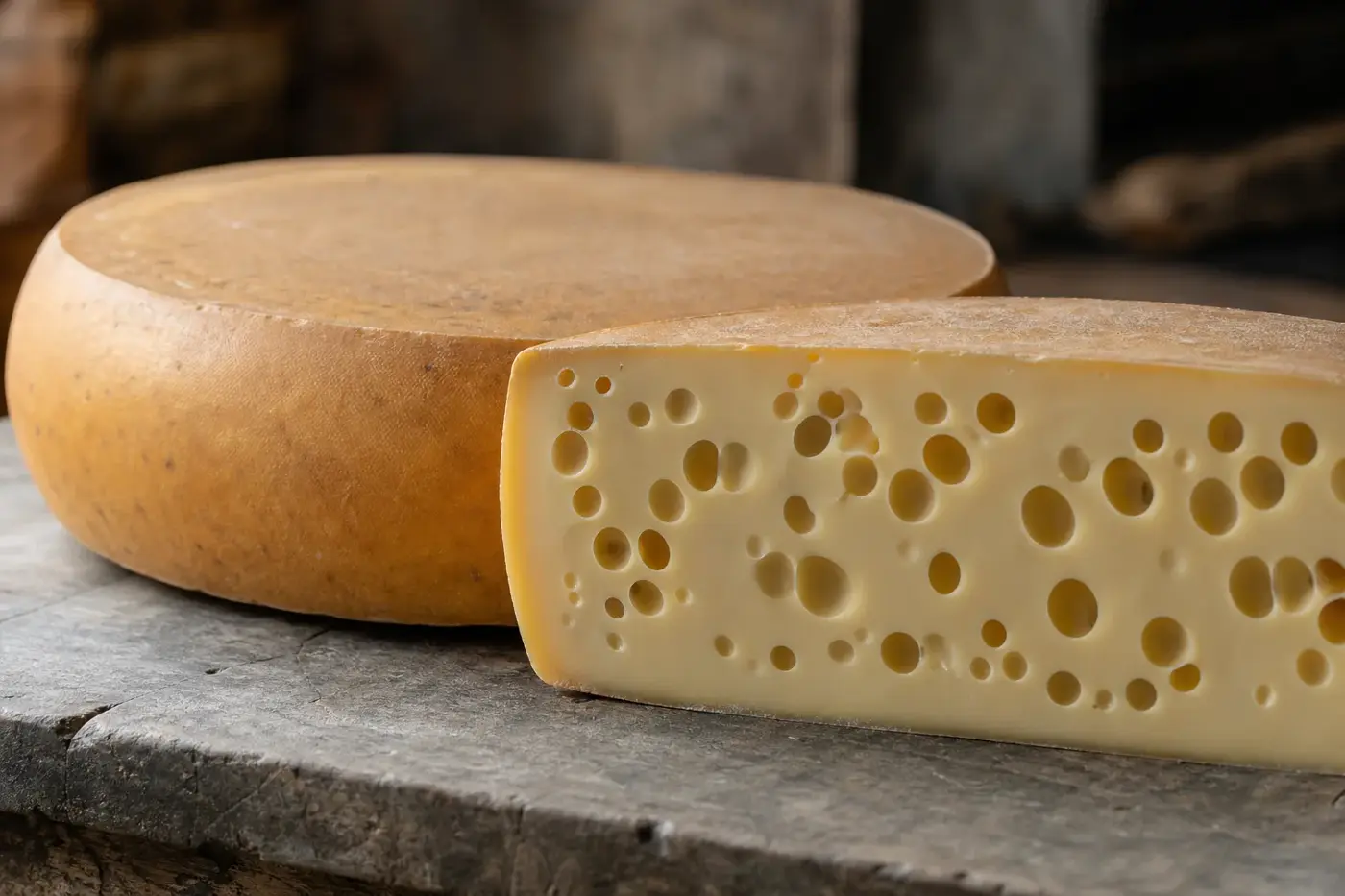
Look into a cut wheel and you might think of small cherries. Or walnuts. Those are the comparisons for the holes in Emmental de Savoie, a wheel weighing at least 60 kg that does not believe in travelling light. Warm cellar maturation gives it those characteristic eyes, turning local raw cow’s milk into a French Alpine cheese with protected geographical indication, or PGI, status in the EU and Great Britain as of November 2026. [1][2][4]
Meet Emmental de Savoie, a wheel with presence
| Field | What you need to know |
|---|---|
| Name | Emmental de Savoie, its familiar and registered name. [1][3] |
| EU status | PGI, recorded by INAO; November 2026 position. [1] |
| EU authority and identifier | European Commission; amendment dossier PGI-FR-0179-AM03. Register ID: Not established here. [3] |
| EU legal instrument | Regulation (EU) 2017/1136, approving a specification amendment. [13] |
| EU specification | Published amended single document 2020/C 180/12; French specification effective 11 April 2020. [2][3] |
| Great Britain | Registered PGI from 31 December 2020, 23:00; November 2026 position. [4] |
| Northern Ireland | Status not established here. |
| Milk | Raw cow’s milk. [2] |
| Production area | Named communes in Savoie, Haute-Savoie, Ain and Isère, France. [2][3] |
| Wheel | Diameter 72 to 80 cm; height 14 to 32 cm; matured weight at least 60 kg. [3] |
| Minimum maturation | 75 days, including at least 21 days in the warm cellar. [2] |
| Typical ageing | No typical period established here. |
| Rind and paste | Yellow-brown rind; firm, supple paste with distinct eyes. [3] |
| Milk allergen | Present. Look at your product’s label for other ingredients. [2] |
| Pregnancy guidance | UK NHS: Foods to avoid in pregnancy, November 2026 guidance reference. [10] |
At the counter, ask for the whole name
Picture Alpine foothills, rather than exclusively high summer pastures. Emmental de Savoie’s legally defined territory follows named communes across Savoie and Haute-Savoie, reaching into neighbouring Ain and Isère. Milk production, collection, cheesemaking and maturation must all take place within that area. [3]
At the counter, all three words earn their place. “Emmental” tells you the wider cheese family; “Emmental de Savoie” identifies this particular geographical product. EU labelling rules require the name and PGI symbol together, alongside operator information and the certifying body’s name. [3]
You can explore the distinction between PGI and PDO in the guide to protected names. Here, the connection to place begins on the farm. The specification links production to local forage and the Abondance, Montbéliarde and Tarentaise breeds. [3]
Big wheels and the chalets that brought milk together
A wheel this size calls for a formidable quantity of milk. Communal cheesemaking chalets could gather that milk together, and the EU geographical account connects Emmental de Savoie’s development with those chalets. It also records Emmental’s dominance in Savoyard cheesemaking until the 1980s. [3]
The name came from Switzerland, according to INAO, which describes its spread into neighbouring French territories. Savoyard production then developed an identity of its own within that shared family. “French Emmental” is accurate, but “Swiss cheese made across the border” gives you little sense of the local history or production rules. [1]
European PGI recognition came in 1996, according to INAO. The Great Britain register gives you the precise original EU registration date: 21 June 1996. [1][4]
Look between the holes
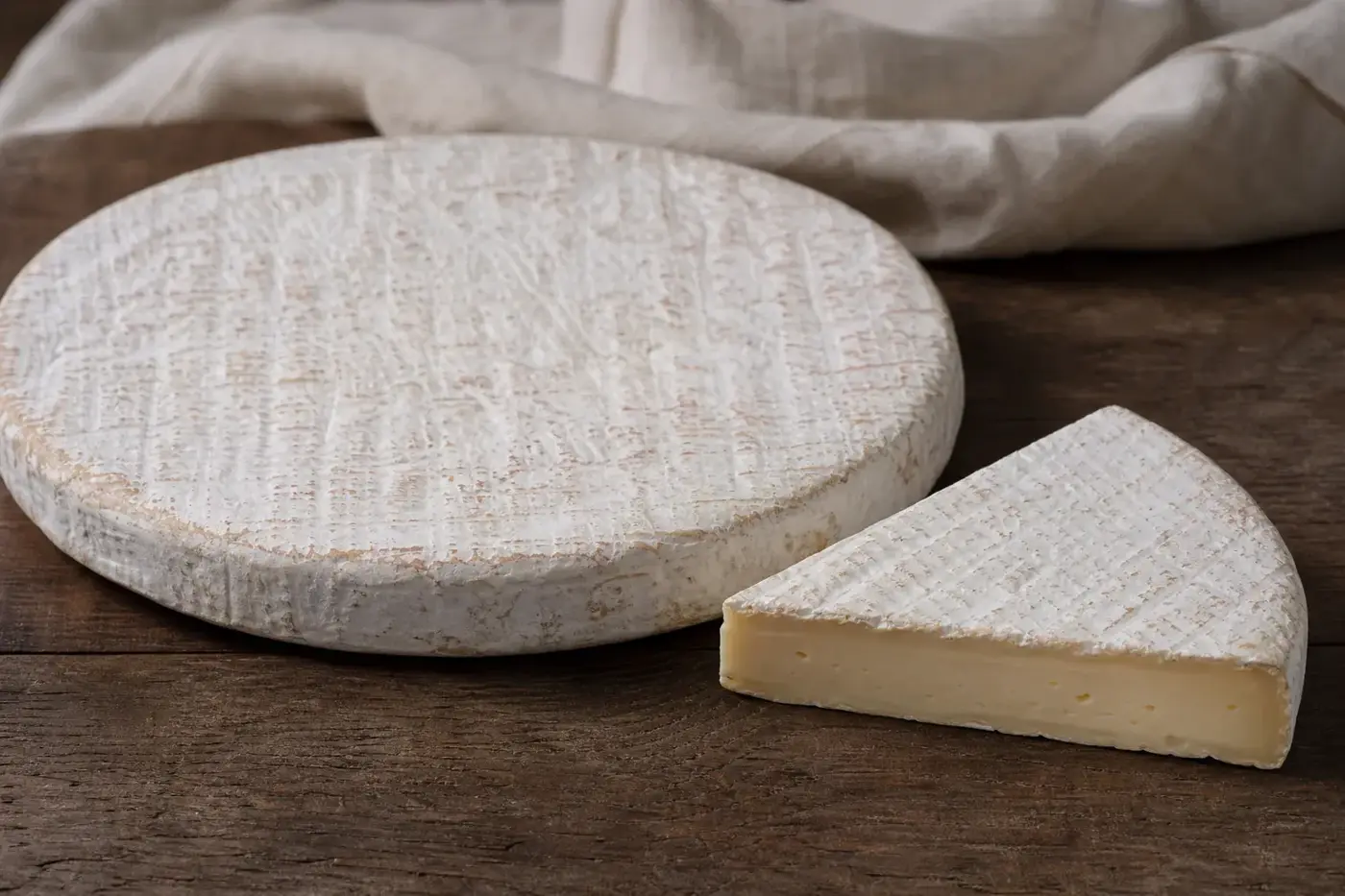
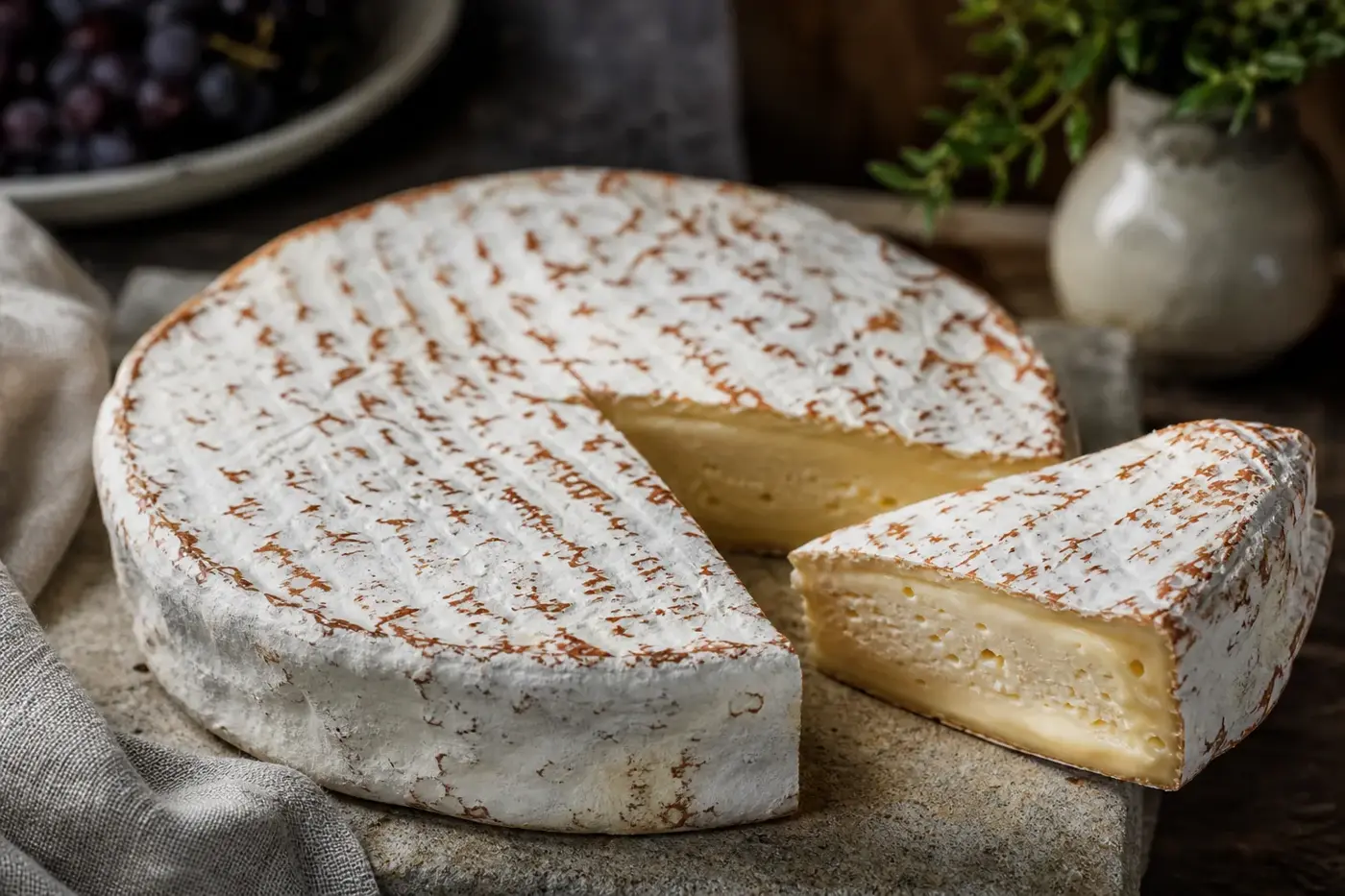
First, take in the scale: a mature wheel must weigh at least 60 kg. Its broad faces may bulge gently, and its rind ranges from yellow to yellow brown. Inside, you find evenly coloured paste interrupted by separate, regular openings. [2][3]
Those eyes, compared in the specification with small cherries and walnuts, belong to the cheese’s defined identity. They are not just there for the photograph. Look between them, too: you want paste firm enough to slice, yet still supple. [2]
Follow the milk from farm to warm cellar
The process described by Savoicime, the industry organisation behind the cheese’s promotional website, starts with daily milk collection. Starter cultures and rennet follow: selected microorganisms drive fermentation, while the enzyme preparation sets the milk into curd. Cutting that curd into fine grains allows whey, the liquid portion, to drain away. [7]
Here is a distinction worth taking to your next cheese counter. Emmental de Savoie belongs to the cooked, pressed family, but it remains a raw milk cheese. “Cooked” describes heating the curd during cheesemaking; “raw milk” describes the starting material. Pressing is another stage again. [2][7]
For the wider sequence, turn to how cheese is made. Once this cheese has been pressed and salted, it enters a carefully controlled sequence of cellars. An initial cool phase comes before at least 21 days in a warm cellar at no more than 25 °C (77 °F), followed by further cooling. [2]
Total maturation must reach 75 days, excluding any additional cold-storage holding period. These are cheesemaking temperatures and timings. They are not instructions for keeping your wedge at home. [2]
A tiny starting point for those generous eyes
Something as small as a particle can help determine where an Emmental’s eyes begin. An Agroscope-led research team explored this with experimental cheese made using microfiltered milk. They added measured traces of powdered hay and followed ripening for 130 days. [6]
The particles gave gas cavities starting points and encouraged eye formation. This was experimental Emmental, rather than commercial Emmental de Savoie batches. [6] For a detailed account of bacterial activity in forming the holes, you would need the full research text.
Let your first taste be a plain piece
INAO describes the flavour as mild but distinctly fruity, with a firm, supple paste. Savoicime adds notes of butter, yoghurt and sweetened condensed milk. [1][8] Start with a plain piece and use those descriptions as pointers, not a tasting exam.
Notice the dairy aromas first. Then look for sweetness, acidity and the way the slice yields as you chew. There is plenty to discover before you add anything else to the plate.
At the counter, ask who made the cheese and how old your piece is. Minimum maturation is only the beginning: the actual ripening programme and cultures help shape the result. Comparing two identified pieces tells you more than expecting every wheel to offer identical intensity. [2][3]
Make room for Beaufort beside it
For a revealing regional comparison, bring Beaufort to the board. Its producers describe another Savoyard cooked, pressed cheese made from raw whole milk, but one associated with the high mountains. Emmental de Savoie’s official geographical account instead emphasises the Alpine foothills. [3][12]
Taste them side by side and explore that contrast for yourself. For a factual comparison with Comté and Swiss Emmental, turn to their respective specifications.
Find your wedge, then give it good care
Begin with the complete protected name. Ask when the wedge was cut and how it has been kept, then look for an identifiable producer and maturation history. Those details give you something useful to return to, or compare with your next piece.
Do not let the format make the decision for you. Wedges, slices, grated cheese and diced cheese are all permitted by the PGI specification. The bag of grated cheese needs the right name just as much as the handsome wedge. [3]
Wrap each cheese separately, even if you keep them together in a cheese box. Savoicime recommends food wrapping paper or food film. [9] You can find the wider routine in the cheese storage guide.
For household handling, follow UK NHS advice: keep chilled foods at 5 °C (41 °F) or below and follow the label. Use opened food within two days unless the packaging says otherwise. Eat, cook or freeze food by its use-by date. [11]
Give your cheese a moment at the table
Savoicime suggests taking the cheese out at the start of the meal so its texture and aromas become more apparent. Take out only what you intend to serve. Follow the UK NHS limit for chilled ready-to-eat foods: eat them within four hours of removal from the fridge. [9][11]
Try a piece alone before reaching for bread, fruit or nuts. Savoicime suggests crusty bread, grapes, walnuts and dried apricots, bringing crust, juiciness, crunch and sweetness to the plate. [8] Plain sparkling water makes a simple alcohol-free accompaniment while you explore the cheese.
Keep a slice for yourself before grating
Grating is an officially recognised format, but save a piece for the table first. [3] Then try a toasted sandwich, onion soup or vegetable gratin. Start with an established recipe and use the cheese for its dairy flavour, rather than expecting it to disappear into the background.
You can also let it share a dish with other cheeses. Compare the result with a version made using Comté or Beaufort, paying attention to flavour, salt and texture. The names are not interchangeable instructions.
If you follow higher-risk food guidance, follow the relevant agency’s cooking instruction. That includes heating until steaming hot throughout where advised. [10][11]
This page summarises published guidance from the official sources it cites. It is not medical advice. Guidance differs between countries and changes over time, so check the current source for where you live, and ask your doctor, midwife, pharmacist or dietitian about your own circumstances.
Understand the raw milk and pregnancy guidance
Emmental de Savoie begins with raw milk, even though its curd is subsequently cooked. UK NHS pregnancy food guidance lists pasteurised or unpasteurised hard cheeses among foods that can be eaten. Particular soft and blue cheeses must be thoroughly cooked; cheese cooked until steaming hot is also listed as an option. [10]
Consult the current guidance for the particular product you are considering. Pregnancy and weakened immunity are circumstances the NHS associates with a higher risk of serious listeriosis. Its listeriosis page uses broader wording about avoiding unpasteurised dairy in pregnancy, while its pregnancy food page expressly permits hard cheeses. [10][11]
Ask your healthcare team about your circumstances, including weakened immunity, and read the cited official sources, with November 2026 as this page’s reference point. For more on the distinction between milk treatments, visit the raw milk cheese guide.
Questions people ask
Where is Emmental de Savoie made?
It is made in listed communes across four French departments, including Savoie and Ain. Milk production, collection, cheesemaking and maturation must all take place within the defined area.
Is Emmental de Savoie made from raw milk?
Yes, it is made from raw cow’s milk. Although it is a cooked, pressed cheese, cooked refers to heating the curd during cheesemaking rather than to the treatment of the starting milk.
How long is Emmental de Savoie matured?
It must mature for at least 75 days, excluding any additional cold storage holding period. This includes at least 21 days in a warm cellar at no more than 25 °C.
What does Emmental de Savoie taste like?
INAO describes it as mild but distinctly fruity, with a firm, supple paste. Savoicime also notes flavours of butter, yoghurt and sweetened condensed milk.
Can you eat Emmental de Savoie during pregnancy?
The UK NHS pregnancy food guidance lists hard cheeses made from pasteurised or unpasteurised milk among foods that can be eaten. Its listeriosis page uses broader wording about avoiding unpasteurised dairy in pregnancy. Check the current NHS page titled Foods to avoid in pregnancy at https://www.nhs.uk/ and ask your healthcare team about your circumstances.
Sources
-
INAO. Emmental de Savoie (IG/53/94). Current official product record, retrieved November 2026. Product, geographical account, history and sensory description. Official record.
-
French Ministry of Agriculture and Food. Cahier des charges de l’indication géographique protégée « Emmental de Savoie ». Specification approved nationally by the order of 16 December 2019; associated approval notice states that this version entered into force on 11 April 2020. Published in Bulletin officiel 2020-18. Specification and approval notice.
-
European Commission. Publication of the amended single document following the approval of a minor amendment: “Emmental de Savoie”. 2020/C 180/12, Official Journal C 180, 29 May 2020, pages 18 to 22. Dossier PGI-FR-0179-AM03. Official single document.
-
Department for Environment, Food & Rural Affairs. Emmental de Savoie. Protected food and drink names register, published 4 January 2021; current entry retrieved November 2026. Great Britain register entry.
-
French government, Légifrance. Arrêté du 11 septembre 2026 relatif à la modification temporaire du cahier des charges de l’indication géographique protégée (IGP) « Emmental de Savoie ». JORF No 0218, 18 September 2026, text 14, Article 1. Official order.
-
Agroscope-led research team, International Dairy Journal. Mechanism and control of the eye formation in cheese. Volume 47, August 2015, pages 118 to 127. DOI: 10.1016/j.idairyj.2015.03.001. Publisher abstract and experimental summary retrieved; full article access was unsuccessful. Publisher record.
-
Savoicime. Fabrication de l’Emmental de Savoie IGP. Undated industry account, retrieved November 2026. Savoicime represents and promotes the product. Production account.
-
Savoicime. Déguster l’Emmental de Savoie: conseils et accords. Undated industry guidance, retrieved November 2026. Its tasting descriptions and suggested accompaniments are attributed to the organisation. Tasting and pairing guidance.
-
Savoicime. Conseils pour bien conserver l’Emmental de Savoie IGP. Undated industry guidance, retrieved November 2026. Used for wrapping and flavour-related serving suggestions, with NHS handling limits supplied separately. Storage and serving suggestions.
-
NHS, United Kingdom. Foods to avoid in pregnancy. Current web edition, retrieved November 2026, section “Cheese, milk and other dairy”. Official pregnancy guidance.
-
NHS, United Kingdom. Listeriosis. Current web edition retrieved November 2026, including “How to avoid listeriosis”, higher-risk circumstances and storage instructions. Official listeriosis guidance.
-
Syndicat de Défense du Beaufort. Beaufort. Current industry website, retrieved November 2026. Used only for its description of Beaufort’s milk, cheese family and mountain setting. Producer organisation’s account.
-
European Commission. Commission Implementing Regulation (EU) 2017/1136 of 14 June 2017 approving non-minor amendments to the specification for a name entered in the register of protected designations of origin and protected geographical indications (Emmental de Savoie (PGI)). Official Journal L 164, 27 June 2017. Official legal record.
This desk-researched draft brings together official product documents, published dairy research, attributed industry descriptions and UK NHS guidance; outstanding verification and review requirements are recorded below.
Last checked: November 2026
Last checked November 2026.
The editors suggest you read next