Emmental vs Jarlsberg
Cut into a wheel of Swiss Emmentaler AOP and the knife reveals elastic paste dotted with round or slightly oval holes, mostly 2 to 4 cm across.
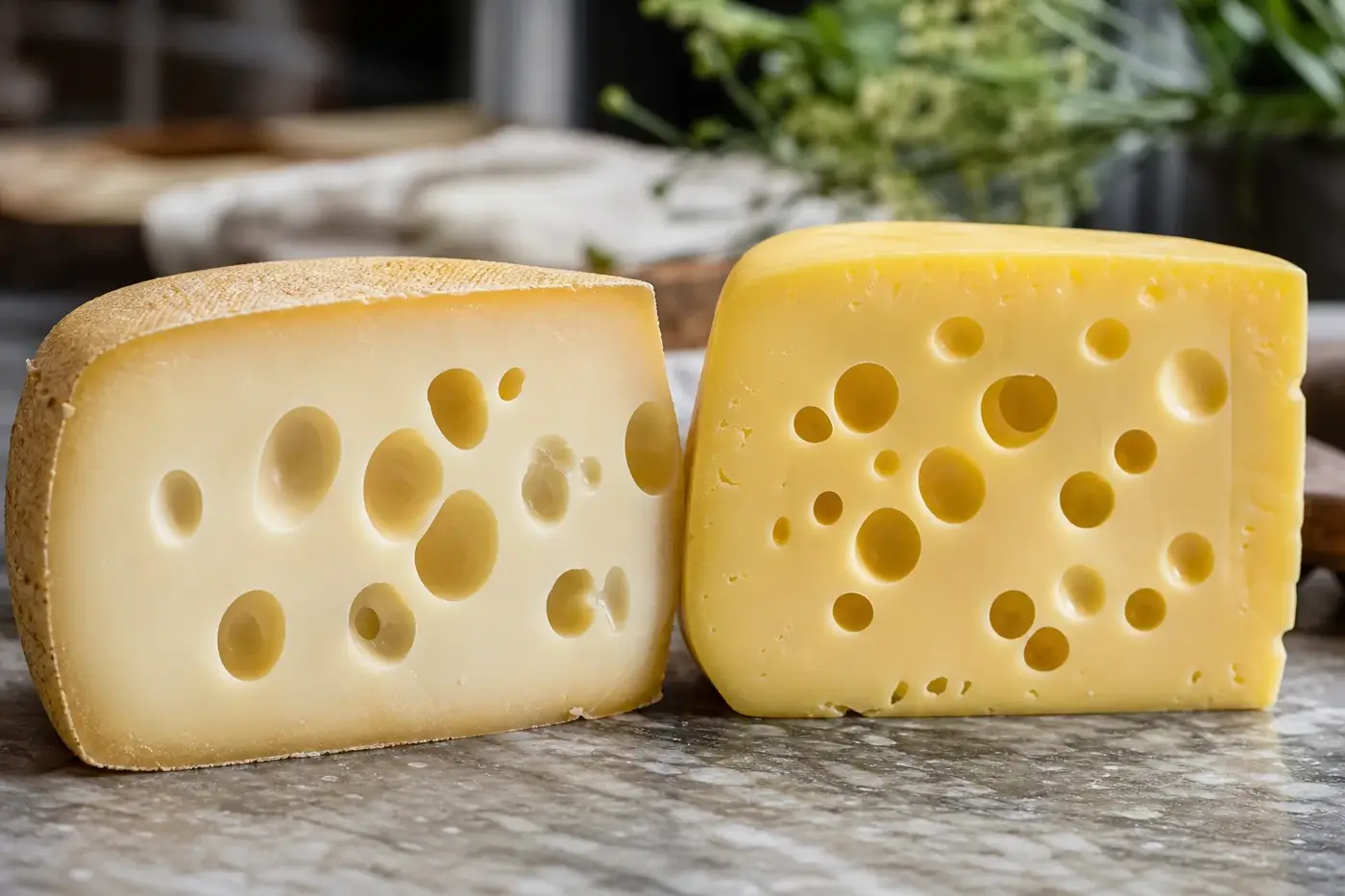
Cut into a wheel of Swiss Emmentaler AOP and the knife reveals elastic paste dotted with round or slightly oval holes, mostly 2 to 4 cm across. The whole wheel can weigh 75 to 120 kg, so this is not an impulse purchase for the fridge door. Those eyes make it look like Jarlsberg: both owe them to gas produced by bacteria during ripening. Taste them, though, and the family resemblance loosens: Emmentaler AOP is hard and becomes more assertive with age, while Jarlsberg’s maker describes Original as softer, mild, sweet and nutty.[1,3,4,5]
Two familiar names, two different journeys
An Emmental label will not necessarily lead you to Switzerland. Emmental is a broad cheese name used in different countries, while Emmentaler AOP identifies the Swiss protected product. Its registered name is Emmentaler, and AOP means appellation d’origine protégée, or protected designation of origin.[2,3]
Switzerland’s Federal Office for Agriculture lists Emmentaler in the Swiss register. The registration publication was on 6 October 2006; the recorded status dates to November 2026. For the wider picture, explore protected names explained.[2,3]
The defined area reaches beyond the Emme valley into several Swiss cantons, including Bern, Lucerne and Zürich. The specification requires raw milk and at least four months’ maturation as whole wheels within that area. Maturation duration is assessed against the average age of a month’s production. These are the rules for Swiss Emmentaler AOP, not every pack labelled Emmental.[1,2]
Jarlsberg takes you along a different route: it is a brand with Norwegian origins. Its producer traces the modern recipe to work begun in 1956 at the Agricultural University of Norway in Ås, bringing together elements of Gouda and Emmental cheesemaking. Today, it lists manufacture in Norway, Ireland and the United States, using local milk and a culture made in Norway. Norwegian heritage does not necessarily mean Norwegian manufacture, so check the origin on your pack.[5]
Look past the holes and meet the cheese
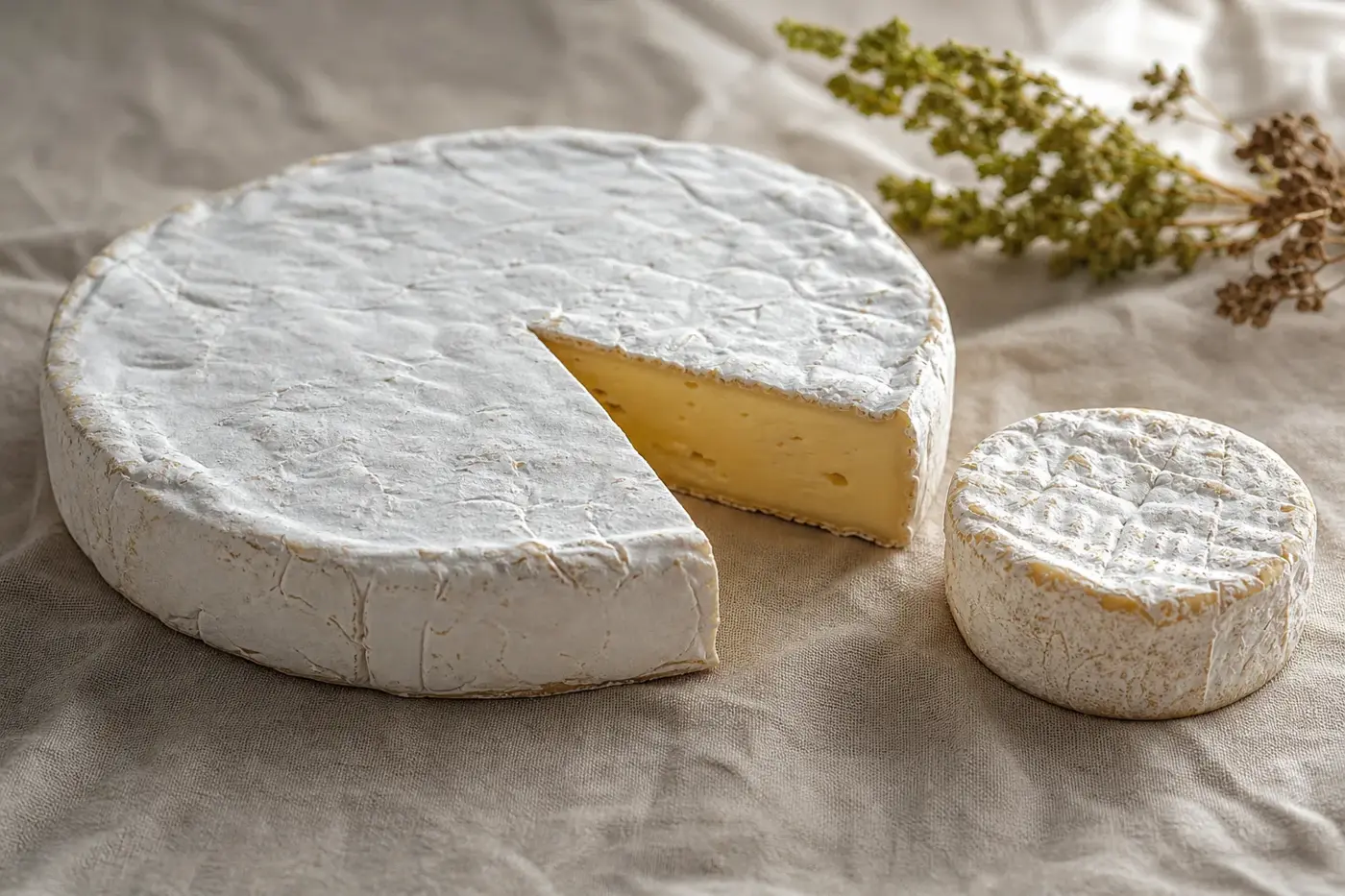
A whole Emmentaler AOP is an unusually broad wheel with a firm yellow-brown rind. Humid maturation can leave its exterior with a brown to black patina. Inside, you can see the seasons’ influence: the specification describes ivory paste in winter and light yellow in summer.[1]
Jarlsberg has yellow paste and prominent round holes. You will find it in wheels, blocks and slices, with Original available both with and without rind. A rindless piece is simply another normal product format, not a different cheese in disguise.[1,4,6]
| What you will find | Swiss Emmentaler AOP | Jarlsberg Original |
|---|---|---|
| Milk treatment | Raw milk required [1] | Producer declares pasteurised cow’s milk [6] |
| Whole wheel | 75 to 120 kg [1] | A 10 kg format is listed [4] |
| Those distinctive holes | Mostly 2 to 4 cm, round to slightly oval [1] | Producer describes large, round holes [4] |
| Feel and texture | Hard cheese with elastic paste [1] | Described as semi-soft on the US product page [6] |
When you buy a cut piece, look at the paste, the body of the cheese inside the rind, rather than judging by holes alone. Their size reveals less than you might think. Ripening conditions, bacterial activity and the paste’s ability to stretch around expanding gas all help shape those eyes.[3,7]
How a tiny cavity becomes a generous hole
The holes begin with fermentation. First, lactic acid bacteria turn milk sugar into lactic acid. Propionic acid bacteria can then metabolise lactate, producing propionic acid, acetic acid and carbon dioxide. That gas enlarges cavities in the developing cheese, while the same microbial activity helps build this family’s sweet, nutty character.[3]
Even microscopic hay particles have a role in the story. In research reported by Agroscope and EMPA, scientists followed experimental cheeses for 130 days using X-ray computed tomography. Changing the quantity of those particles changed eye formation: tiny cavities associated with them gave gas somewhere to gather. Bacteria alone cannot account for everything; a growing hole needs a starting point.[7]
Choose your flavour by following its age
If you want a useful guide to flavour, start with maturity. Jarlsberg’s published descriptions emphasise sweetness and a mild, nutty character. The Swiss specification describes Emmentaler AOP as sweet, slightly acidic and lightly spicy. Emmentaler Switzerland, the industry organisation, gives you a more evocative picture of its four month Mild/Classic: dried grass and milky caramel.[1,4,8]
Move on to Réserve/Surchoix, matured for at least eight months, and the organisation describes a tang resembling sweet-tart yoghurt, with hay and herbal nuances. Its cave-aged version is firmer, slightly dry and more sharply savoury. Jarlsberg has an older expression too: the producer specifies at least twelve months’ ageing for Special Reserve. Expect a stronger, more developed character than Original.[4,9,10]
Treat those published descriptions as signposts, rather than expecting every piece to taste alike. Keep any description of fruity notes tied to a named product and maturity, rather than applying it to either cheese as a whole. Sweetness, nuttiness and fruit-like aromas can overlap in tasting language; age and the producer’s stated profile offer clearer distinctions. For your board, compare similar maturities before choosing your favourite.
A supple slice changes as it matures
Young Emmentaler AOP can be firm yet elastic, rather than crumbly. Jarlsberg’s producer describes its cheese as softer and less dry than Emmental. Both can suit slicing, but neither keeps the same texture forever. Agroscope explains that protein breakdown during ripening gradually reduces elasticity in Emmental-type cheeses, eventually making them more crumbly.[1,3,5]
In your kitchen, moisture, fat and the protein network work together. Moisture helps keep cheese supple, while ageing changes the network holding it together. A drier, older piece can behave differently from a younger, more flexible one bearing the same name. Choose age for the flavour you want, not because you expect older cheese to make a smoother sauce.[3,11]
Once your cheese has melted, avoid unnecessary prolonged heating. A dairy-science experiment with Cheddar and mozzarella found that prolonged holding after heating reduced measured meltability, with a greater effect in older cheeses. For Emmental and Jarlsberg, the practical inference is straightforward: follow a suitable recipe. More heat is not a persuasive argument to a reluctant cheese.[12]
Find your sandwich favourite, then set the board
Jarlsberg Original is a straightforward sandwich choice when you want mild flavour and flexible slices. Young Emmentaler AOP gives you a firmer bite, with the milky, slightly sweet profile described for Mild/Classic. If your fillings are assertive, choose a more mature version of either cheese so its flavour has enough presence alongside them.[4,6,8,9]
On a cheese board, give yourself a deliberate contrast. Put Original beside mature Emmentaler AOP to explore supple sweetness against a more developed tang. Or choose young examples of both and get to know their related styles.[4,8,9]
Keep bread and fresh fruit alongside them for a simple comparison. Serve separate pieces, rather than letting elaborate bites hide the differences you have chosen to explore.[4,8,9]
Bring them into sauces, bakes and fondue
Both cheeses have plenty to offer in the kitchen. Emmentaler Switzerland publishes recipes for gratins, macaroni cheese and toasted sandwiches. Jarlsberg’s producer recommends Original for melted sandwiches, macaroni cheese and fondue. Those documented uses make them related cooking options, with maturity helping determine how clearly the cheese flavour comes through.[5,13]
For a sauce, start with a recipe designed for a melting cheese. Check the consistency before adding more cheese or liquid. In a bake, keep the recipe’s balance of sauce, starch and cheese, especially when swapping supple Original for a drier mature cheese.
Give fondue the same attention. Follow a recipe that specifies the cheese mixture and liquid. On your first attempt, replace only the Emmental component.
Make a thoughtful swap and keep the flavour
For an ordinary sandwich, toastie or baked topping, begin with equal weights of mild Emmental and Jarlsberg Original. That practical starting point draws on their related styles and documented uses. Match maturity first: replacing strongly matured cheese with Original changes the flavour more substantially than replacing a young cheese does.[4,8,9,13]
Jarlsberg in place of mature Emmental gives you a gentler result unless you choose its aged version. Taste before adjusting the seasoning. If you use mature Emmental instead of Original in a sauce, grate it finely and add the recipe’s liquid gradually. Let the consistency in your pan guide you, rather than deciding on a fixed extra quantity in advance.[4,9,10]
Keep reduced-fat Jarlsberg outside this comparison: the producer specifically says Lite has different melting properties from Original. If a recipe depends on a particular mature cheese, that cheese remains your closest choice. Name your finished dish accurately, too. If you have used Jarlsberg, describe it as made with Jarlsberg.[4,6]
Read the pack for the details that matter
Milk treatment gives you a clear distinction. Swiss Emmentaler AOP requires raw milk, while Jarlsberg Original ingredients published for the US and UK specify pasteurised cow’s milk. For other cheeses labelled Emmental, read the individual declaration. The guide to raw, thermised and pasteurised cheese explains the treatments and their differences.[1,6,14]
Rennet is the coagulant that helps milk form curd. Jarlsberg’s published Original ingredients name microbial rennet, a declaration belonging to those products rather than every cheese with holes. For Emmental, consult the maker’s information if the coagulant matters to your choice. Rennet explained takes you through the main types.[6,14]
Jarlsberg’s producer reports less than 0.01 g lactose per 100 g cheese. That figure belongs to Jarlsberg, not to an unidentified Emmental. Use your chosen product’s current pack and the manufacturer’s declaration. For the wider subject, turn to lactose in cheese.[5]
For salt, compare both packs on the same declaration basis. “Mild” describes flavour, not measured salt content. Season your sauce according to the particular cheese and the other ingredients already in the pan, rather than the cheese’s reputation. How to read a cheese label helps you make those comparisons.[1,14]
Questions people ask
What is the difference between Emmental and Jarlsberg?
Emmental is a broad name used for cheeses from different countries, while Jarlsberg is a brand with Norwegian origins. Swiss Emmentaler AOP is a hard cheese that becomes more assertive with age; Jarlsberg Original is described by its maker as softer, mild, sweet and nutty.
Why do Emmental and Jarlsberg have holes?
Bacteria produce carbon dioxide during ripening, and the gas enlarges cavities in the cheese. Ripening conditions and the paste’s ability to stretch around the gas also help shape the holes.
Can I substitute Jarlsberg for Emmental?
For a sandwich, toastie or baked topping, the page suggests starting with equal weights of mild Emmental and Jarlsberg Original. Match their maturity where possible, as Original will give a gentler result than mature Emmental.
What milk and rennet are used in Emmental and Jarlsberg?
Swiss Emmentaler AOP requires raw milk, while the published US and UK ingredients for Jarlsberg Original specify pasteurised cow’s milk and microbial rennet. For other Emmental cheeses, check the individual milk declaration and consult the maker if the coagulant matters to you.
How much lactose is in Jarlsberg?
Jarlsberg’s producer reports less than 0.01 g of lactose per 100 g of cheese. The page says that figure should not be applied to an unidentified Emmental and advises checking the current pack and manufacturer’s declaration.
Sources
- Swiss Federal Office for Agriculture. Pflichtenheft Emmentaler. Text incorporating the Federal Administrative Court judgment of 2 April 2025. Articles 2 to 8. Specification examined.
- Swiss Federal Office for Agriculture. AOP / IGP Ursprungsbezeichnungen und geografische Angaben. Emmentaler register entry, including amendments listed through 4 November 2025. Official register.
- Agroscope. Käse Typ Emmentaler: Überblick über die Arten von Hart- und Halbhartkäse mit Propionsäuregärung und über spezifische Aspekte ihrer Herstellung, ihrer Qualität und der Ernährung. Agroscope Science, 134, 2022. Research publication and report.
- Jarlsberg. Products. Global producer information for Original, Lite and Special Reserve, undated. Product information. Commercial source used for its own product descriptions.
- Jarlsberg. Q&A. Producer information on origins, manufacture, texture, uses and lactose, undated. Producer questions and answers.
- Jarlsberg. Products. US product declarations for Original and Lite, undated. US product information.
- Agroscope and EMPA. Riddle of Hole Formation in Cheese Solved. Research announcement and explanatory supplement, 28 May 2015. Research announcement.
- Emmentaler Switzerland. Emmentaler AOP Mild/Classic. Industry organisation’s product and sensory account, undated. Mild/Classic.
- Emmentaler Switzerland. Emmentaler AOP Réserve/Surchoix. Industry organisation’s product and sensory account, undated. Réserve/Surchoix.
- Emmentaler Switzerland. Emmentaler AOP Cave-aged. Industry organisation’s product and sensory account, undated. Cave-aged.
- Utah State University. Texture Profile Analysis and Melting in Relation to Proteolysis as Influenced by Aging Temperature and Cultures in Cheddar Cheese. Master’s thesis, 2007. Institutional research record.
- University of Wisconsin-Madison research, published in Journal of Dairy Science. Effect of heat treatments on the meltability of cheeses. Volume 84, issue 9, pages 1937 to 1943, 2001. Published abstract.
- Emmentaler Switzerland. Emmentaler AOP. Published recipe listings, undated. Producer organisation’s recipe examples.
- Jarlsberg. Products. UK ingredient and product declarations, undated. UK product information.
This desk-researched comparison brings together Swiss official records, dairy research and attributed producer descriptions, with practical substitutions identified as editorial guidance.
Last checked: November 2026
Last checked November 2026.
The editors suggest you read next
Cheddar vs Gouda: Taste, Texture and How to Use Each
Bite into a long-aged Gouda and, beneath your teeth, something crunches.