Fromage Fort
Taste a spoonful, and that little piece of blue cheese announces itself across the whole bowl.
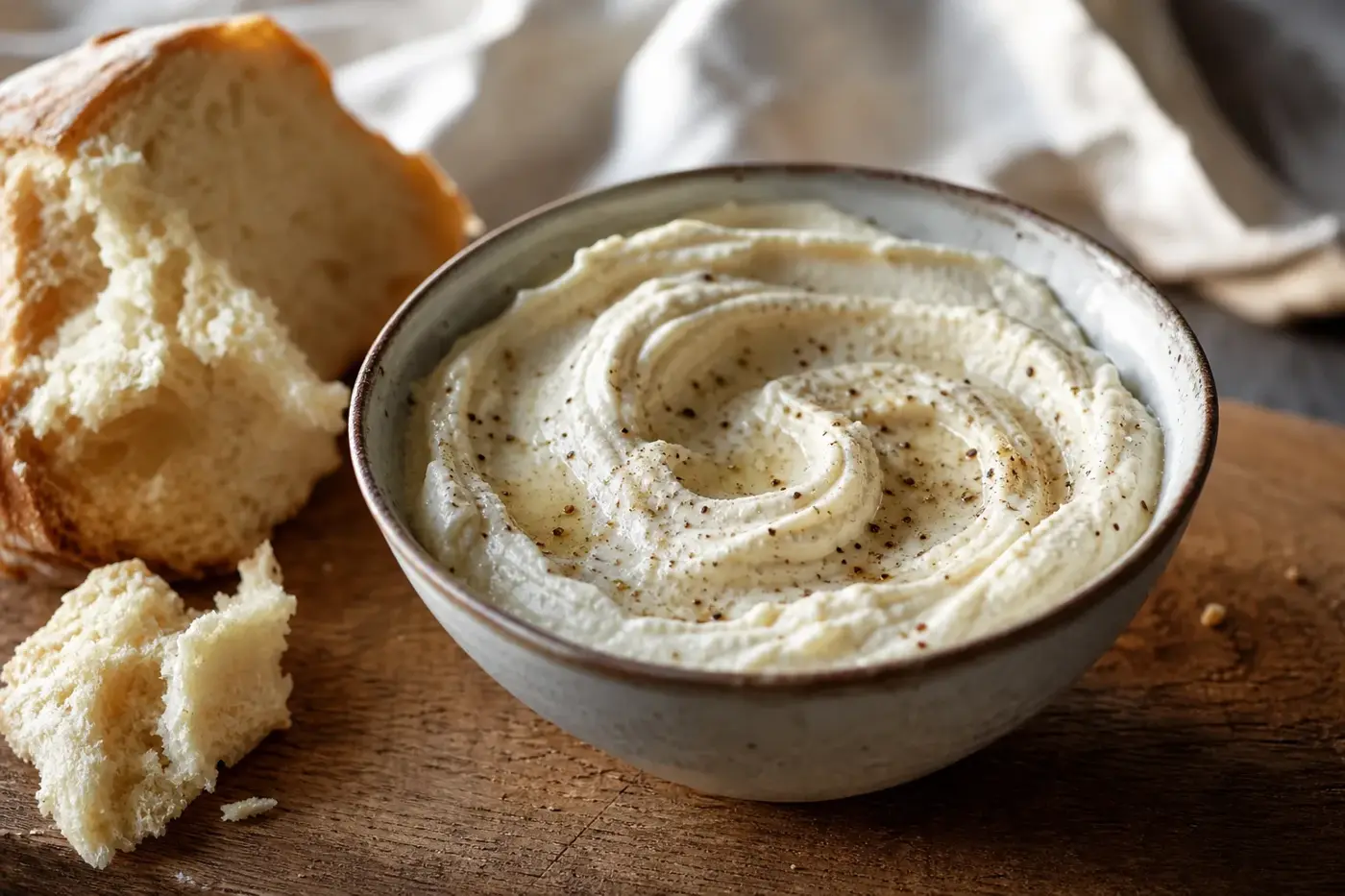
Taste a spoonful, and that little piece of blue cheese announces itself across the whole bowl. Subtle entrance? Not its style. Garlic, dry white wine and black pepper draw your cheese remnants together: firm cheese gives body, softer cheese makes the spread yielding, and the strongest pieces supply the character.[1,2]
Strong cheese, with two stories to tell
The name means “strong cheese”, and the freshly blended version gets straight to the point. Put your cheese pieces into a processor with wine, garlic and pepper. Soon you have a spread for bread, or for toast that is heading under the grill.[1,2]
Fromage fort has an older, slower story too. A 1953 USDA handbook describes a version from Ain that ripened both before and after other ingredients were added. That is a different process from the quick refrigerator spread you will make below.[3]
Keep that distinction firmly in mind. Blending already ripened cheeses for prompt eating is not the same as deliberately managing another fermentation. Follow the fresh recipe and its refrigeration instructions; do not leave the mixture at room temperature to develop.
Around Lyon, the cheese remnants had a purpose
Different cheeses, different households, no single fixed recipe. A Lyon cheese specialist’s published account places fromage fort among the practical ways people around Lyon, the surrounding region and Dauphiné used cheese remnants. Alcohol and aromatics brought those pieces together.[4]
The foundation recipe used here has a family preparation behind it too. Cheese pieces were softened with bouillon and wine, then crushed with garlic.[1] What the household had helped decide what went into the mixture.
You are looking at a tradition of adaptation, rather than one settled invention story. Your modern food processor makes lighter work of the job. The central idea stays beautifully simple: choose cheeses that belong together, then add enough liquid to unite them.
Give your cheese mixture a little thought
Start with approximately half hard cheese and half soft cheese, as the foundation suggests. If you do not have enough soft cheese for a smooth mixture, its notes suggest adding cream cheese.[1]
For your first batch, choose one familiar firm cheese and one relatively mild soft cheese. These are editorial suggestions to help you find your feet, not fixed regional recipes:
- Start simply: cheddar with plain cream cheese.
- Go softer: a modest amount of firm cheese with more cream cheese, using less liquid initially.
- Add some strength: a mild base with a small portion replaced by blue cheese.
- Gather the cheese board: choose pieces you want to taste together, holding the strongest in reserve.
Go gently with blue cheese or a particularly pungent washed-rind cheese. Blend and taste before adding your reserved portion. Once one flavour takes over, your only way to dilute it is to make a larger batch, which is quite a commitment to one assertive little wedge.
Not sure what you have? Use how to tell cheese styles apart to identify your pieces. Note your combination if you would like to make it again.
Trim carefully, and leave doubtful pieces out
Remove the rinds before weighing your cheese, and take off wax, plastic and cloth completely. This keeps tough rind fragments out of your spread and gives you a straightforward starting mixture. The source method likewise calls for trimming hard and soft cheeses as needed.[1]
Spoiled pieces and cheese with unwanted mould have no place in this bowl. The Food Standards Agency’s guidance for England, Northern Ireland and Wales says obviously rotten or mouldy food should not be eaten. Cutting away visible mould does not guarantee that unseen toxins have gone too.[5]
Intentional mould in a cheese you have chosen for the recipe is a separate matter. If you cannot confidently tell it apart from unwanted growth, leave that piece out. The guide to mould on cheese helps you make that decision.
Look at dates and instructions for opened packs too. UK government guidance says food must not be eaten after its use-by date, even when it still looks and smells acceptable.[6]
Your bowl of fromage fort starts here
Recipe basis: adapted from the published, demonstrated foundation recipe and the published cookbook version reproduced by The Splendid Table.[1,2]
Independent testing by fromage.co.uk: none for this metric adaptation or its alcohol-free variation.
Serves: 6 to 8 as a shared starter, an editorial serving suggestion
Preparation: allow about 10 minutes
Cooking: none; optional grilled toast below
Equipment: scales, measuring jug, knife, chopping board, food processor, spatula and clean covered containers
Gather your cheese, garlic and wine
- 450 g suitable cheese, weighed after trimming
- 12 g peeled garlic, an editorial weight replacing the source’s four cloves
- Up to 120 ml dry white wine
- Freshly ground black pepper, to taste
- Bread, crackers or washed vegetables, to serve
Alcohol-free variation: replace the wine with up to 120 ml cold, unsalted vegetable stock. This editorial adaptation draws on the documented use of bouillon.[1] Check the stock’s ingredients and storage instructions.
Blend a little, taste a little
- Cut the firm cheese into small pieces, keeping it separate from the softer cheese.
- Chop the garlic in the processor. Add the firm cheese and process until finely broken down.
- Add the soft cheese and 60 ml of your chosen liquid. Blend, stopping the machine before scraping down the bowl.
- Add the remaining liquid gradually. Stop when your mixture spreads easily; you may not need the full quantity.
- Add pepper, blend briefly and taste before deciding whether it needs any salt.[1,2]
- Transfer to clean covered containers and refrigerate promptly, following the storage instructions below.[7]
Try your first spoonful on plain bread. Let that mouthful guide you before adding more garlic, pepper or strongly flavoured cheese.
Changing cheeses and serving your guests
A different cheese makes a different spread. Hold back more liquid when you substitute a softer cheese; for a firmer mixture, add liquid gradually until the consistency feels right. Your mixtures will also melt and brown differently on grilled toast.[1,2]
The spread contains milk. Lactose free dairy is not suitable for someone with milk allergy. Consult current NHS advice and a healthcare professional about individual circumstances.
Check every cheese, stock, wine and accompaniment label for other allergens, including egg, celery, sulphites and cereals containing gluten where relevant. UK government guidance explains how allergens appear on packaged foods.[8] Keep that ingredient information available when you serve others.
Find the texture your bread deserves
You want your spread to stay on bread, not run off it. The published cookbook method describes a smooth mixture that is not excessively soft. The foundation method adds wine only as needed.[1,2]
These editorial adjustments follow that same gradual approach. Add a little, blend, then see where you are.
| What needs changing? | Your next move |
|---|---|
| Too thick | Blend in a little more of your chosen liquid, checking after each addition. |
| Too thin | Add suitable firm cheese in small amounts and blend again. |
| Too salty | Make a separate, unsalted mild mixture and combine gradually. Stop adding salty ingredients. |
| Too pungent | Blend a little into a larger mild mixture, tasting as you go. |
These adjustments improve ingredients that were suitable to eat at the start. They cannot rescue spoilage: if your spread develops unwanted mould or other spoilage, discard it in line with FSA guidance.[5]
For your next batch, change one thing at a time. Holding back the strongest cheese and half the liquid gives you more control than trying to correct a finished bowl.
Wine or stock? Make your choice first
Wine remains alcoholic in this uncooked spread. Whenever you need the food to be made without alcohol, use the stock version.
A brief spell under the grill does not reliably remove alcohol either. USDA retention data show that alcohol can remain after cooking, with the amount retained depending on the preparation method.[9] Those data cannot establish the alcohol content of your particular toast.
Stock also leaves wine’s flavour out of your cheese mixture. Choose unsalted stock so you stay in control of the seasoning, and add it gradually. You may not need the full stated quantity to reach the texture you want.
Bring out the bread, or go golden under the grill
Bread and toast accompany fromage fort in both source recipes.[1,2] Put a small bowl beside your sliced bread, and keep the rest of the spread refrigerated.
For a change, try plain crackers, cucumber batons, radishes or carrot sticks. These are editorial suggestions; choose sturdy pieces that can carry your spread. Wash vegetables before preparing them, using running water or fresh water as the FSA recommends.[5]
For grilled toast, spread fromage fort over bread and put it under a preheated grill until melted and browned, watching closely.[2] Grill settings vary, so judge by appearance rather than a universal temperature. Where pregnancy guidance requires cheese to be thoroughly cooked, it must be steaming hot throughout.[10]
Let your cheese lead you to a drink
Taste your finished spread before choosing what to pour. These editorial starting points aim to complement your mixture, not compete with it:
- A mild, firm-cheese mixture: dry white wine without a pronounced oak flavour, or sparkling water alongside apple slices.
- A tangier soft-cheese mixture: a fresh-tasting dry white wine, or sparkling water with lemon.
- A blue-cheese mixture: a small serving of sweeter white wine, or an alcohol-free apple or pear drink.
Your most assertive cheese and the amount of garlic matter more than the recipe’s name. For more possibilities, explore the cheese and wine pairing guide.
Alcoholic options are for adults of legal drinking age. Choose the alcohol-free option when driving, avoiding alcohol, taking interacting medicines or recovering from alcohol dependence. The NHS advises avoiding alcohol during pregnancy.[10]
Keep your spread chilled, and your guests in mind
Keep your refrigerator between 0 and 5 °C, refrigerate the spread promptly and use leftovers within 48 hours, or freeze them sooner. This advice follows the FSA for England, Northern Ireland and Wales, as of November 2026.[6,7] Any earlier ingredient use-by date or opening instruction still applies.
Blending does not give an ingredient a fresh start on storage life. Label your container with the preparation date, and bring small portions to the table rather than repeatedly taking out the whole batch. You will find fuller guidance in how to store cheese at home.
Freeze portions promptly in suitable covered containers. The FSA advises defrosting food in the refrigerator and using it within 24 hours of complete defrosting.[7] Cool and refrigerate cooked toast leftovers within two hours; if reheating, heat thoroughly and reheat only once.[7]
If you are choosing cheese during pregnancy, NHS guidance distinguishes between categories. Both pasteurised and unpasteurised hard cheeses are listed as suitable. Unpasteurised soft cheeses, mould ripened soft cheeses and soft blue cheeses should be avoided unless thoroughly cooked until steaming hot throughout.[10]
The NHS also identifies older people, newborn babies and people with weakened immunity as being at higher risk of serious listeriosis.[11] Check its current guidance before choosing ingredients for higher-risk guests, and ask the relevant healthcare professional about individual circumstances.
General information only, not medical advice: follow the official guidance where you live.
Questions people ask
What is fromage fort?
The name means “strong cheese”. The fresh version blends cheese pieces with wine, garlic and pepper into a spread that can be eaten straight away.
Which cheeses can I use for fromage fort?
The foundation recipe suggests starting with approximately half hard cheese and half soft cheese. It suggests adding cream cheese if there is too little soft cheese to make the mixture smooth.
Can I make fromage fort without alcohol?
The page suggests replacing the wine with up to 120 ml of cold, unsalted vegetable stock. This adaptation has not been independently tested by fromage.co.uk.
How long can I keep fromage fort in the fridge?
The Food Standards Agency advises keeping the fridge between 0 and 5 °C and using leftovers within 48 hours, or freezing them sooner. Earlier ingredient use by dates or opening instructions still apply, so check the current FSA guidance.
Can I eat fromage fort during pregnancy?
The NHS lists both pasteurised and unpasteurised hard cheeses as suitable during pregnancy. It advises avoiding unpasteurised soft cheeses, mould ripened soft cheeses and soft blue cheeses unless thoroughly cooked until steaming hot throughout. Check the current NHS guidance and ask your healthcare professional about your circumstances.
Sources
- Jacques Pépin Foundation, Fromage Fort, published recipe, demonstration and family preparation notes, undated.
- The Splendid Table, Fromage Fort, 30 June 2007, authorised excerpt from Chez Jacques: Traditions and Rituals of a Cook, 2007.
- United States Department of Agriculture, Cheese Varieties and Descriptions, Agriculture Handbook No. 54, December 1953, “Fromage Fort”, page 47.
- Les Fromagivores, Fromage fort, undated culinary account published by a Lyon cheese business. Its geographical and household-tradition descriptions are attributed to that business.
- Food Standards Agency, Home food fact checker, updated 21 August 2026, sections on mould, date markings and washing produce; applies to England, Northern Ireland and Wales.
- UK government, Understanding food labelling: Best before and use-by dates, current online guidance retrieved November 2026.
- Food Standards Agency, How to chill, freeze and defrost food safely, published 18 December 2017, current online guidance retrieved November 2026; applies to England, Northern Ireland and Wales.
- UK government, Understanding food labelling: Allergen labelling, current online guidance retrieved November 2026.
- USDA Agricultural Research Service, USDA Table of Nutrient Retention Factors, Release 6, December 2007, introductory discussion of alcohol-retention research and retention tables.
- NHS, Foods to avoid in pregnancy, reviewed 15 June 2026, sections on dairy foods, alcohol and produce.
- NHS, Listeriosis, current online guidance retrieved November 2026, sections on implicated foods and higher-risk groups.
- Food Standards Agency, Alerts, live food and allergy alert index, retrieved November 2026.
Researched from published culinary methods, an attributed French culinary account, a historical handbook and current official UK food-safety guidance; recipe variations and pairing suggestions are identified as editorial adaptations.
Last checked: November 2026
Last checked November 2026.
The editors suggest you read next