Grilled Cheese Sandwich
The knife breaks through golden bread, and soft, molten cheese gives way beneath it.
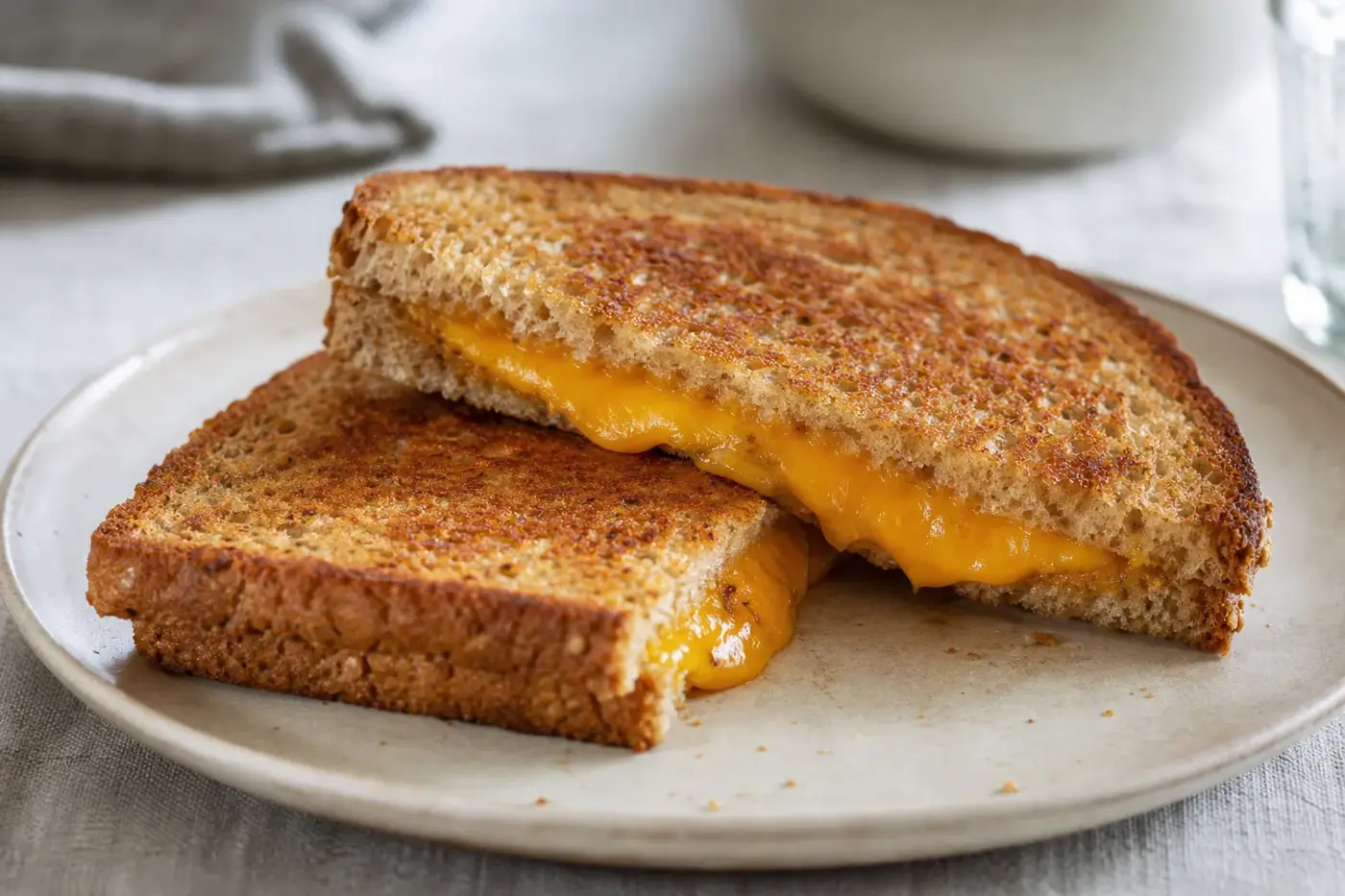
The knife breaks through golden bread, and soft, molten cheese gives way beneath it. That is your moment. Getting there before the crust turns too dark takes readily melting cheese, reasonably thin bread and gentle heat. The outside and inside need to arrive together. [2,3]
Get to know the sandwich beneath the crust
Tuck cheese between two slices of bread, then brown them in a frying pan or on a flat griddle until the filling melts. Despite its name, a grilled cheese sandwich needs no overhead grill. A British cheese toastie is a close relative, although a sandwich toaster presses the bread between hot plates. [3,9]
The sandwich’s American associations come with a paper trail. In March 2022, American baking company King Arthur published consecutive articles on the basic sandwich and variations in bread, cheese and fillings. Sharp Cheddar with pickle and Gruyère with caramelised onions were among them. They capture an established American cooking repertoire, rather than identify a single inventor. [2,4]
Find the cheese you want to come home to
For a pronounced cheese flavour, start with mature Cheddar. Gruyère, recommended by King Arthur for its onion sandwich, is another inviting starting point. You can also keep Cheddar as the main flavour and replace some with another melting cheese. Producer Tillamook combines sharp and medium Cheddar in its own product-promoting recipe. [3,4]
More heat does not necessarily mean softer cheese. A 2025 laboratory study used controlled heating and rheological measurements, which measure flow and deformation, on one commercial six-month Cheddar. It softened at first, then stiffened as heating continued, a change the researchers linked to protein aggregation and the expulsion of fat and water. Your practical cue is simple: stop once the filling melts. [5]
Try Gruyère instead of some or all of the Cheddar, or add Havarti, as Publix does in its sandwich. Keep the total cheese quantity unchanged for your first attempt. Moisture, salt, melting and flavour vary between products, so think of a substitution as an exploration, not a guaranteed result. [4,9]
Give your cheese the right bread
Soft sandwich bread is an easy place to begin. Whole Foods uses soft wholemeal bread; Tillamook chooses sourdough. Either can work if you choose two similarly sized slices and spread the cheese evenly, rather than pile it into a small hill in the middle. [1,3]
Save the doorsteps for another day. The pan heats the outside first, so very thick bread can brown while the centre stays lukewarm, a problem King Arthur specifically identifies with overfilled sandwiches. If your loaf is unusually thick, use a shallower filling and cook more gently for longer. [4]
Butter or mayonnaise? Watch the crust
Butter brings its own flavour; mayonnaise spreads easily into a thin, continuous coating. King Arthur favours mayonnaise for even browning, crispness and a slight tang. Whichever you choose, spread it right into the corners. Dry edges and a heavily coated centre will not brown evenly. [2,6]
The Kitchn’s side-by-side trial offers a different experience. Using the same bread, cheese, pan and heat setting, mayonnaise gave disappointing browning and crispness, while butter browned before the filling was ready. Its favourite combined the two. Choose the coating you enjoy, then give heat control most of your attention. [6]
Make yourself one properly golden sandwich
Recipe basis: An independently untested fromage.co.uk adaptation of Whole Foods Market’s published recipe, with gentler heat informed by the other cooking sources. Whole Foods Market is a food retailer with a commercial interest in its recipes. [1,2,6]
Makes: One sandwich.
Time: Allow about 15 minutes, including 6 to 8 minutes cooking.
Heat: Medium-low hob heat. No oven required.
Equipment: Heavy frying pan with lid, fish slice, spreading knife, chopping board and serrated knife.
Gather the good things
- 2 slices soft wholemeal sandwich bread
- 85 g (3 oz) mature Cheddar, thinly sliced
- 15 ml (1 US tablespoon) mayonnaise
- 7 g (about ½ US tablespoon) unsalted butter
Let the pan do its work gently
- Spread mayonnaise evenly over one side of each bread slice. Arrange the cheese on the uncoated side of one slice, leaving a small border. Close with the other slice, mayonnaise facing outwards.
- Melt the butter in the pan over medium-low heat. Swirl it around, add your sandwich and cover with the lid.
- Cook for about 3 to 4 minutes, checking underneath before the end. Look for golden bread, not a dark crust. Lower the heat if it colours quickly.
- Turn with the fish slice. Cook uncovered for another 3 to 4 minutes, until the second side is golden and the cheese has melted throughout. Let those cues guide any changes to heat and timing.
- Transfer to the board, cut in half and serve immediately. For leftovers, follow the Food Standards Agency advice for England, Wales and Northern Ireland in the leftovers and reheating section below. [1,7,8]
Butter-only variation: Replace the mayonnaise and pan butter with about 15 g softened butter, spread across both outside faces. This follows the coating approach in The Kitchn’s comparison. Watch the browning closely. [6]
Allergen check: Cheese and butter contain milk. Before choosing substitutions, check the bread, mayonnaise and any additions for their own ingredient and allergen information.
Take your cue from the first side
The first side tells you how your pan and hob are behaving. If the bread darkens before the filling starts to soften, lower the heat. Briefly lifting the pan off the hob gives you time to respond. Tillamook also starts low and increases the heat only as needed. [3]
Keep the lid on for the first stage to trap heat and help warm the filling. Following the source recipe, remove it for the second side so the sandwich finishes uncovered. Before serving, look for both things: browned bread outside and melted cheese inside, with no firm slices tucked away in the centre. [1,2]
Rescue the filling without sacrificing the crust
Judge the crust and filling separately, rather than letting a handsome exterior distract you. These four common problems affect cooking quality, and each needs its own adjustment. [1,2,5,6]
| What needs attention? | Likely cause | Your next move |
|---|---|---|
| Unmelted cheese, a quality defect | Filling too thick or heat too high | Lower the heat and cover briefly. Next time, spread thinner slices more evenly. |
| Greasy filling, a quality defect | Fat separating during heating | Stop once the cheese melts. Use gentler heat next time. |
| Burnt bread, a quality defect | Pan too hot | Start again over lower heat. Burnt bread cannot return to golden. |
| Soggy sandwich, a quality defect | Excess liquid from fillings | Drain additions, finish uncovered and serve promptly. |
Make room for mustard, onions or pickle
A thin smear of mustard adds distinct seasoning without adding bulk. Spread it on an inside face before the cheese goes in. For a sweeter contrast, borrow King Arthur’s pairing of Gruyère and caramelised onions. Use onions already cooked down, rather than a layer of raw slices. [4]
Pickles bring acidity and crunch, but their liquid needs attention. Drain them, pat away surface moisture and slice thinly so the bread can close around the filling. You can also serve the pickle alongside for contrast without extra liquid inside. King Arthur suggests sharp Cheddar with pickle or chutney. [4]
Keep cheese as the main event; the supporting cast need not fill the stage. Several wet ingredients make the sandwich slower to warm and harder to turn neatly. Start with one addition in a thin layer, leaving a little clear space at the edges. That makes the change easier to judge next time. [4]
Give hot cheese a cool, crisp companion
With tomato soup alongside, you can alternate a spoonful with a bite of sandwich, or dip a cut corner just before eating. For something lighter in texture, try a crisp green salad with a sharp dressing. Keep it beside the sandwich, not underneath. That carefully browned crust deserves to stay crisp.
Sparkling water, unsweetened iced tea or an alcohol-free apple drink offer a cool, less weighty contrast to hot bread and melted cheese. That contrast is the thinking behind these serving suggestions. If you have mustard or pickles in the filling, a plain drink lets their seasoning stay in focus.
This page summarises published guidance from the official sources it cites. It is not medical advice. Guidance differs between countries and changes over time, so check the current source for where you live, and ask your doctor, midwife, pharmacist or dietitian about your own circumstances.
Keep leftovers safely, then reheat once
For your November 2026 reference, the Food Standards Agency advice for England, Wales and Northern Ireland is to cool cooked food and refrigerate it within 1 to 2 hours. Keep your fridge between 0 °C and 5 °C, and eat leftovers within 48 hours or freeze them. Follow any shorter applicable storage instructions on the ingredients. [7]
To restore the texture, try reheating gently in a pan, turning the sandwich to warm both sides and uncovering it to finish. For England, Wales and Northern Ireland, the Food Standards Agency advises reheating leftovers only once and until “steaming hot all the way through”. [8]
Give the rest of your cheese a good home
- How to Store Cheese at Home: find wrapping and fridge arrangements for cheese left after cooking.
- How to Read a Cheese Label: get to know product information as you choose cheese and substitutions.
Questions people ask
How do you make a grilled cheese sandwich?
Spread mayonnaise on the outside of two slices of soft wholemeal bread and put thinly sliced mature Cheddar between them. Cook in a covered frying pan with melted butter over gentle heat for about 3 to 4 minutes, then turn and cook uncovered for another 3 to 4 minutes, until golden and melted throughout.
What cheese is best for a grilled cheese sandwich?
Mature Cheddar gives a pronounced cheese flavour, while Gruyère offers another starting point. You can also keep Cheddar as the main flavour and replace part of it with another melting cheese.
Do you need an overhead grill to make a grilled cheese sandwich?
No. The sandwich is browned in a frying pan or on a flat griddle, and the name does not require an overhead grill.
Why is my grilled cheese sandwich brown outside but unmelted inside?
The filling may be too thick or the heat too high. Lower the heat and cover briefly, and next time spread thinner cheese slices more evenly.
How should you store and reheat a leftover grilled cheese sandwich?
For England, Wales and Northern Ireland, the Food Standards Agency advises cooling cooked food and refrigerating it within 1 to 2 hours, keeping the fridge between 0 °C and 5 °C, and eating leftovers within 48 hours or freezing them. It advises reheating leftovers only once and until steaming hot all the way through; see the Food Standards Agency guidance.
Sources
- Whole Foods Market. How to Cook: The Ultimate Grilled Cheese. Undated web edition, retrieved November 2026. Recipe quantities, covered first-side cooking and uncovered second-side cooking. Published recipe.
- King Arthur Baking. How to make your best grilled cheese yet. 21 March 2022. Mayonnaise coating, covered cooking and gentle heat. Published cooking guidance.
- Tillamook. Tillamook Classic Grilled Cheese. Undated web edition, retrieved November 2026. Producer’s recipe using sharp and medium Cheddar, sourdough and low initial heat. Published producer recipe.
- King Arthur Baking. Take grilled cheese to the next level with these mouthwatering combos. 22 March 2022. Gruyère and caramelised onions, Cheddar and pickle, and the consequences of overfilling. Published recipe variations.
- Journal of Food Engineering. Non-linear rheology of melted cheddar cheese. Volume 391, article 112450, 2025; published online 18 December 2024. Original experimental research. Full research paper.
- The Kitchn. The Best Way to Make a Grilled Cheese Sandwich. Web edition retrieved November 2026. Original comparative cooking trial, including its standardised method and reported results for butter and mayonnaise. Published comparison.
- Food Standards Agency. How to chill, freeze and defrost food safely. Published 2017, current retrieved web edition checked November 2026. Applies to England, Northern Ireland and Wales. Official chilling guidance.
- Food Standards Agency. Cooking your food. Published 2017, current retrieved web edition checked November 2026, section 7, “Using your leftovers”. Official cooking guidance.
- Publix Super Markets. Traditional Grilled Cheese. Undated web edition, retrieved November 2026. Retailer’s recipe using a frying pan, alternative exterior coatings and a blend including Cheddar and Havarti. Published recipe.
Researched through published cooking methods, an original comparative cooking trial, primary dairy science research and current official food-handling guidance.
Last checked: November 2026
Last checked November 2026.
The editors suggest you read next