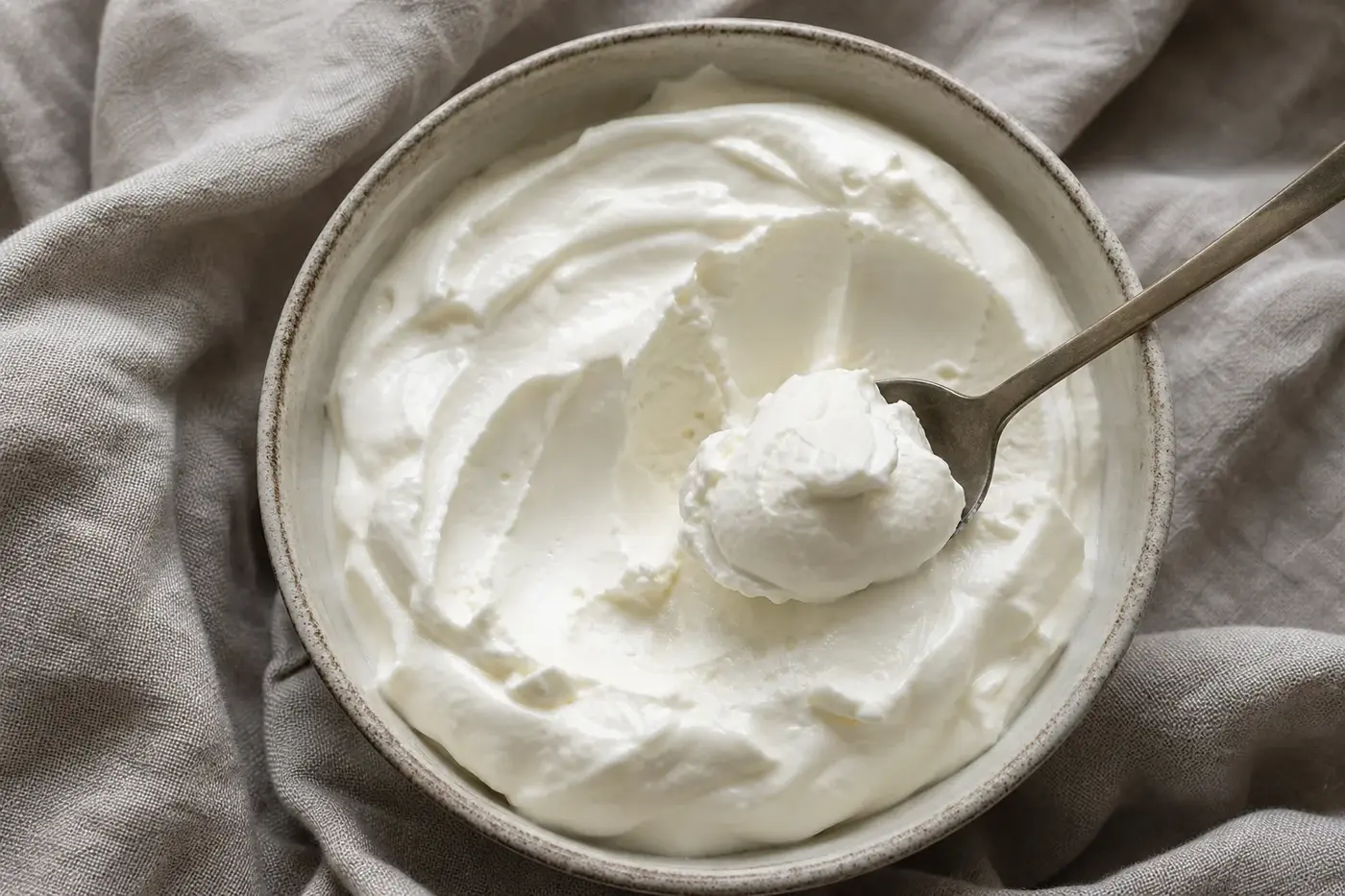
Dip your spoon into skyr. Thick and sour, it introduces you to Icelandic cheese through a bowl rather than a cheeseboard. Food scholarship describes it as a fresh acid-curd cheese; beyond that first spoonful, cream-enriched Höfðingi, white-and-blue-mould Stóri Dímon and Tindur lead you towards Iceland’s cattle, summer grasslands and dairy skills.[7][4][5]
Your Icelandic dairy pocket guide
| What to know | The essentials |
|---|---|
| Where you are | Iceland.[2] |
| The main milk today | Cow’s milk.[9] |
| The farming landscape | Grassland-based livestock farming; a short growing season.[2] |
| Names to take to the cheese counter | Tindur, Höfðingi, Stóri Dímon.[4][5] |
| Icelandic dairy names in MAST’s national protected-name list | None listed; November 2026 reference.[1] |
| EU registration status | Unspecified here. |
Start with a spoon, not a cheese knife
Skyr makes familiar food categories feel slightly less tidy. You eat this cultured milk food from a bowl, rather than cutting it into wedges. Your cheese knife can sit this one out.
In dairy science, separating whey, the watery part of milk, puts traditional skyr alongside fresh cheeses. Its production and structure explain that classification. The way you eat it explains why you often find it beside yoghurt.[7]
Matís, Iceland’s food research organisation, describes a traditional method using heated and cooled milk, a starter from an earlier batch and, in the commonly documented method, rennet. Rennet supplies enzymes that help milk coagulate into curd, which is then strained. Modern dairies can use selected cultures and mechanical or membrane separation instead, so milk, microbes and processing all help distinguish one maker’s skyr from another.[6]
For your first taste, choose plain skyr before reaching for a flavoured version. Notice the thickness, the acidity and how the curd holds together. Those three qualities give you something concrete to compare with your next spoonful.
A short summer, a busy farming year
Summer pasture is only part of Iceland’s dairy story. Winter feed matters just as much: the OECD describes predominantly grassland-based livestock farming, with hay among the principal crops and a growing season of around four months. Harvesting grass takes a central place in the farming year.[2]
The Agricultural University of Iceland’s farming survey describes a typical grazing period from late May to early September, sometimes interrupted by cold storms. Long periods of housing sit on the other side of that season. Weather, location and farm management decide each herd’s actual timetable, so those months give you the broader pattern.[3]
The same university account identifies the Icelandic dairy breed as a distinctive local cattle population. According to the official North Iceland visitor organisation, cow’s milk supplies the great majority of present-day dairy products. Ask which animal’s milk went into your cheese: sheep beside the road are not an ingredients list.[3][9]
Sheep’s milk appears in older accounts of skyr, but the university survey describes modern sheep farming as overwhelmingly directed towards meat. Milk production was confined to a handful of farms at the time of that survey. Goat dairying has a smaller, visible specialist presence, with Háafell offering goat products and herd visits; ask directly which sheep’s or goat’s milk cheeses are currently being made.[6][3][12]
Three names to take to the cheese counter
Start your shortlist with Höfðingi, Stóri Dímon and Tindur. The first two offer different expressions of the producer’s mould-ripened range. Taste them together and you have a useful comparison, rather than two isolated mouthfuls.[4]
Höfðingi: ease in with cream
Oval and enriched with cream, Höfðingi is described by MS as particularly creamy in texture and gentle in flavour. Start here if you want to explore a soft cheese. Then move to Stóri Dímon and its combination of white and blue mould.[4]
Stóri Dímon: look for mushrooms and butter
Mushrooms fried in butter: that is MS’s flavour reference for Stóri Dímon. The producer also describes a buttery texture and a balance of white and blue mould. After Höfðingi, notice the mould character and the finish, rather than making the tasting a contest to find the stronger cheese.[4]
Tindur: bring the full name and your questions
MS lists Tindur 12+ in its catalogue.[5] Before you choose it, ask about its milk, maturation, rind, texture and flavour. Take the complete name with you to the counter.
Familiar styles meet Icelandic makers
Dala Brie and Dala Camembert also belong to MS’s Búðardalur range. The producer describes mushroom and white-pepper notes in the Camembert, while the Brie becomes more pronounced with age. MS places both in the familiar Brie and Camembert style families: those product names identify styles, not where they were developed.[4]
Read a cheese name in two stages. First, identify the style; then establish who made it and where. For the bigger picture, telling cheese styles apart explains how milk, rind, texture and method work together, while reading a cheese label gives you practical questions to take to the counter.
Protected names: know what the label means
No Icelandic cheese or skyr name appears among the approved Icelandic names on MAST’s national list, with November 2026 as the reference point here. Iceland’s Food and Veterinary Authority updated that list on 11 March 2026. This concerns the national origin, geographical indication and traditional speciality scheme.[1]
As MAST explains, specified European names also receive protection in Iceland through the agreement between Iceland and the European Union. That is a separate route from registering an Icelandic product. To understand a protection claim, establish the precise name, territory and legal instrument.[1]
| Name or group | Icelandic national scheme, November 2026 | EU registration |
|---|---|---|
| Skyr | No entry among MAST’s approved Icelandic names.[1] | Unspecified here |
| Tindur, Höfðingi and Stóri Dímon | No entry among MAST’s approved Icelandic names.[1] | Unspecified here |
A product name and an origin scheme are not the same thing. protected names explained sets out the distinction. If you are buying abroad, use the maker’s information to establish where the product was manufactured.
Pull up a chair at the Icelandic table
Try your first spoonful of skyr plain, then add berries, milk or cream, all recorded accompaniments in Matís’s account. North Iceland’s visitor information places skyr among the country’s characteristic everyday dairy foods. Your bowl connects older food customs with the present-day table, while the accompaniment brings a contrast you can taste.[6][9]
At breakfast, make a small comparison: plain skyr in a bowl, then a slice of cheese on bread. Ask your host which cheese they normally use and write down its name. Everyday favourites deserve a place beside the cheeses you travelled to find.
For a snack or shared plate, compare bread with crackers and fruit. Keep one piece of each cheese plain, then try another with an accompaniment. Choose water alongside the plate to keep your first tasting focused on the milk food itself.
When every part of the milk had a job
Whey was much more than a leftover in Iceland’s dairy households. Medieval food accounts give both skyr and whey central roles: whey was drunk, soured and used to preserve foods. Archaeological scholarship places dairying within Iceland’s farming economy from the settlement period, connecting milk processing with the household task of storing the year’s produce.[8]
Butter and skyr belonged to the same working story. As the Cambridge study of Icelandic dairy heritage explains, separating cream for butter left skimmed milk available for skyr. The remaining whey found further uses, so the household made several foods from its milk.[7][8]
Around 1930, dairy-factory skyr production began to expand, according to Matís. Its account records earlier differences between households, followed by changes in cultures and separation equipment. The food and its name endured while the methods changed: a familiar bowl, made in changing ways.[6]
That deep dairying tradition does not, by itself, supply an exact settlement-era recipe. That needs evidence specific to the recipe. At an exhibition, ask what supports a particular account: archaeology, a medieval text or a later description of household practice. Each opens a different window onto the dairy’s past.[8]
Where your Icelandic cheese hunt begins
Start in a food shop, with the names and their accents written down. Ask which cheeses were made in Iceland, which are locally matured and which are imported. Request the complete product description for Tindur; for Höfðingi and Stóri Dímon, ask which packs the staff would choose to eat during your stay.
Selfoss: give your skyr a backstory
At the Old Dairy in central Selfoss, Skyrland presents an exhibition about skyr and Icelandic dairy culture. Its operator also lists an adjacent Ísey Skyr Bar serving skyr bowls and smoothies. You can explore the food’s history, then sit down to eat it in a contemporary setting.[10]
Efstidalur: keep the cows in view
Efstidalur II describes itself as a dairy farm with a restaurant, accommodation and its own ice cream. It promotes meals using the farm’s produce, with a view of the cows from the ice-cream setting. Before travelling, ask which dairy products feature on the current menu and whether a cheese or skyr tasting can be arranged.[11]
Háafell: make time for the goats
Háafell in Hvítársíða welcomes visitors to learn about its goats and products, and describes a small on-site shop. Its website distinguishes seasonal arrangements from visits by agreement. Ask directly about your travel date, the food products available to taste, access and booking.[12]
Before any farm visit, confirm official contact details, booking arrangements, accessibility and the products you hope to try. Find out whether a tasting is hosted, self-guided or simply a shop purchase. Build your route around confirmed arrangements, especially outside the main summer travel season.
Taste with curiosity, and leave room for notes
Let the cheese in front of you set the serving rules. Ask the maker or host about temperature and how its texture changes as it is served; for a shop-bought tasting, follow the product’s own directions. Taste skyr separately as a first course, then move through the cheeses in the seller’s suggested order.
- Record the product name, maker, milk and any stated age. Photograph the pack so you can find the same cheese again. Memory is a less reliable shopping companion than you might hope.
- Taste a small piece plain. Notice its firmness, how quickly it breaks down and whether the finish is sour, savoury or mould-led.
- Add plain bread or a cracker, then a little fruit or berry preserve. Experiment and note the combinations you prefer.
- Ask what is seasonal: the milk supply, cheese production, age at sale or visitor programme. Each can change independently.
Follow your next cheese question
- Cheese: The Complete Guide: put the cheeses you encounter into a wider framework.
- Rennet Explained: Animal, Microbial and Fermentation Produced: get to know the coagulants mentioned in skyr production.
- How Cheese Is Made: From Milk to Cheese: follow the relationship between milk, curd and whey.
Questions people ask
Is skyr a cheese or a yoghurt?
Food scholarship describes skyr as a fresh acid curd cheese because traditional production separates out the whey. At the table, it is usually eaten from a bowl and often appears beside yoghurt.
What milk is used in Icelandic cheese?
Cow’s milk supplies the great majority of present day Icelandic dairy products. Sheep’s milk appears in older accounts of skyr, while goat dairying has a smaller specialist presence.
Which Icelandic cheeses should I try?
Höfðingi is an oval, cream enriched cheese described as creamy and gentle. Stóri Dímon combines white and blue mould, while Tindur 12+ appears in the MS catalogue.
How is skyr traditionally served?
Matís records berries, milk and cream as accompaniments to skyr. It is thick, sour and eaten with a spoon.
Where can I learn about skyr in Iceland?
Skyrland at the Old Dairy in central Selfoss has an exhibition about skyr and Icelandic dairy culture. The adjacent Ísey Skyr Bar serves skyr bowls and smoothies.
Sources
[1] Matvælastofnun, Vernduð afurðaheiti, official national protected-product-name information and approved Icelandic names, updated 11 March 2026. Official source.
[2] OECD, Agricultural Policy Monitoring and Evaluation 2025: Iceland, 2025, “Key economic and agricultural statistics”. Country chapter.
[3] Agricultural University of Iceland, Special characteristics of Icelandic Agriculture, report 31, online PDF; publication year not verified from the retrieved extract. Sections on dairy cattle, grazing and sheep production. University report.
[4] Mjólkursamsalan, Dalaostar, undated producer account, current web edition checked November 2026. Commercial source for its own products and sensory descriptions. Producer account.
[5] Mjólkursamsalan, Tindur 12+ 330 g, undated product page, checked November 2026. Commercial source. Product page.
[6] Matís, Sérstaða hefðbundins skyrs, report 10-11, 2011. Sections 2.1 and 5, and the EuroFIR method summary. Research report.
[7] Cambridge University Press & Assessment, Heirloom Cultures and Heritage Branding, online book excerpt, section 1.2, “Original Skyr”; publication year not verified from the retrieved excerpt. Scholarly excerpt.
[8] From self-sufficiency to external supply and famine: Foodstuffs, their preparation and storage in Iceland, in Processing, Storage, Distribution of Food: Food in the Medieval Rural Environment, Ruralia VIII, Brepols, 2011, pages 173 to 186; university-hosted scholarly paper. Paper.
[9] Visit North Iceland, Dairy products, undated official regional visitor information, checked November 2026. Regional account.
[10] Skyrland, Welcome to Skyrland, Exhibition + Tasting, undated operator website, checked November 2026. Commercial visitor information. Operator website.
[11] Efstidalur II, Homepage, undated farm and restaurant website, checked November 2026. Commercial visitor information. Farm website.
[12] Háafell Geitfjársetur, Háafell, operator website with September 2026 visitor information, checked November 2026. Commercial visitor information. Operator website.
This piece was researched from official information, university publications, food research and producers’ published accounts, with tasting suggestions developed as editorial guidance.
Last checked: November 2026
Last checked November 2026.
The editors suggest you read next

French Cheese: The Complete Guide
Picture Normandy’s pastures, then follow the milk towards the Loire’s goat dairies, the Jura’s shared cheesemaking traditions and the sheep country of the Pyrenees.


