Korean Cheese
Lift a forkful of spicy chicken and follow the stretch of melted cheese.
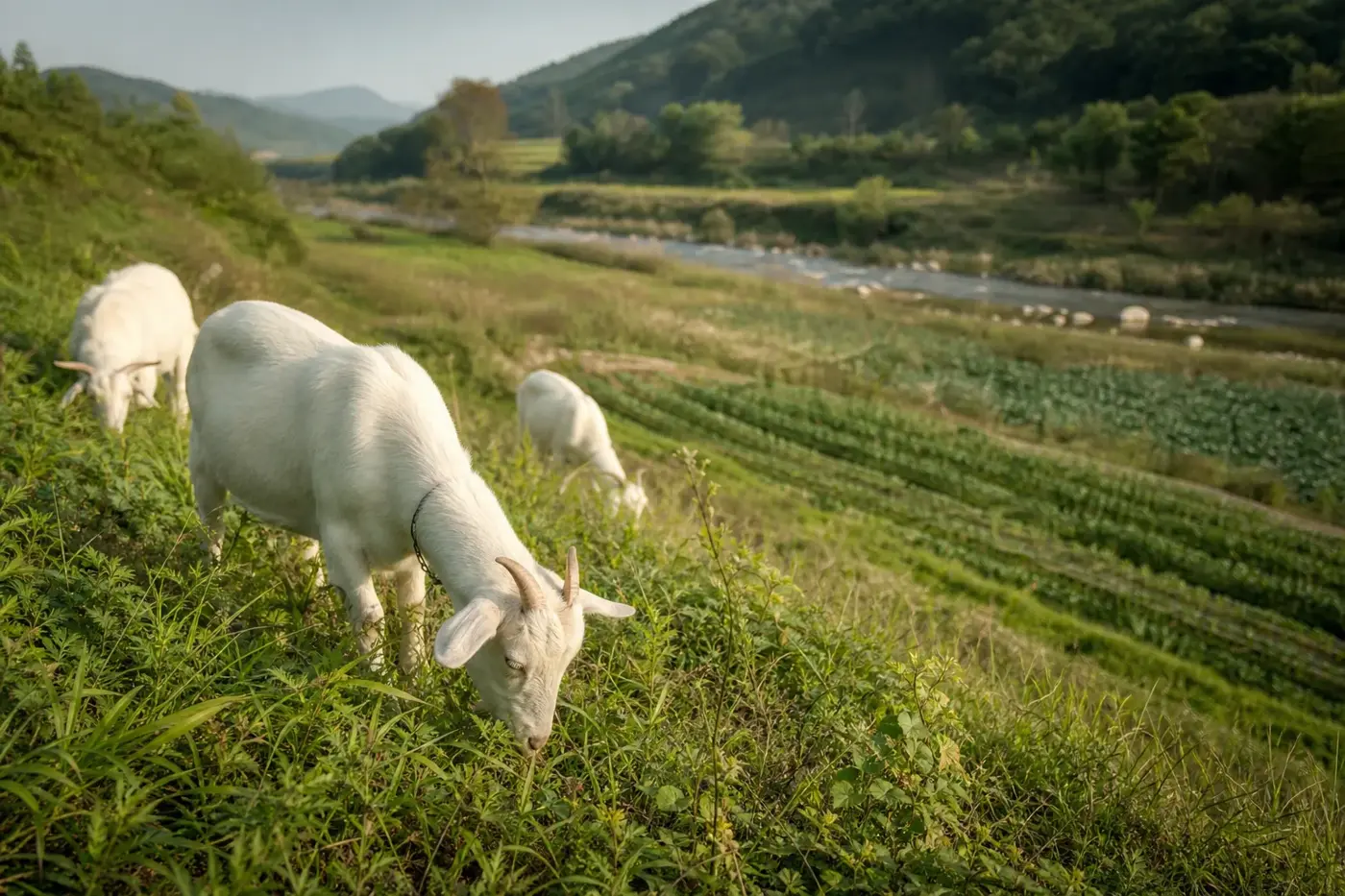
Lift a forkful of spicy chicken and follow the stretch of melted cheese. It is an unlikely route to a story about goats, a Belgian priest and farmers in Imsil, in South Korea’s south-west. Yet their efforts to turn unwanted goat milk into an opportunity helped lay the foundations of a dairy industry, a story that now reaches from local producers to bubbling dishes of corn cheese.[1,2,3]
| Get your bearings | South Korea |
|---|---|
| Where the history begins | Imsil, Jeonbuk State.[1,4] |
| Milk behind the story | Goat milk in Imsil’s beginnings; cow’s milk in its later dairy industry.[1,5] |
| Local styles to get to know | Mozzarella, string cheese, grilling cheese and matured cheese.[6] |
| More makers to explore | Cheese Flo and Sangha Farm, introduced below.[7,8] |
Follow two very different cheese stories
Before Imsil had a cheese story, its farmers had a milk problem. They were producing goat milk and struggling to sell it. Father Ji Jeong-hwan, the Korean name of Belgian Catholic priest Didier t’Serstevens, encouraged cheesemaking through his work with local farming families, as an official Korean account explains.[2]
Look beyond photographs of restaurant dishes covered in cheese and another picture emerges. Imsil’s history brings together agricultural development, community organisation and the patient business of learning to make a new food. The village’s own account places cheesemaking alongside cooperative activity, rooting the dairy enterprise firmly in local life.[2,9]
Then comes the kitchen story. In 2015, Korea.net was already documenting cheese-topped spicy chicken, small octopus and fried noodles. Cooks were finding room for cheese among strongly seasoned dishes, rather than reserving it for a separate European-style cheese course.[2]
As you explore, keep cheese made in South Korea distinct from cheese used in Korean cooking. Both deserve your attention, but they answer different questions. Ask which dairy supplied the cheese in a dish, then, if possible, find that producer’s cheese and taste it on its own.
Follow the milk through rural Jeonbuk
Goat milk belongs at the heart of Imsil’s beginnings. Cow’s milk enters its later chapters, with official accounts describing subsequent farm production of cow’s milk cheese and yoghurt. The Korea Tourism Organization also connects Imsil cheese with milk supplied by community dairy farms.[1,5]
Picture rural Jeonbuk: villages, cultivated land and hills. Imsil County’s description of Cheese Village includes a stream, village buildings and paths through rice fields. Dairying here sits among other kinds of farming, rather than in the vast, uninterrupted grazing country you might associate with cheese.[4]
Beyond Imsil, a maker’s milk supply gives you another route into the story. Sangha Farm in Gochang says its cheese workshop uses Korean milk; Cheese Flo describes artisan cheesemaking with local milk. Start there, then look more closely at the individual cheeses that catch your interest.[7,8]
Imports are a substantial part of the picture too. The Korea Rural Economic Institute’s Agricultural outlook 2026 records cheese imports of 152,309 tonnes in 2025, compared with 124,913 tonnes in 2024, using Korea Agro-Fisheries & Food Trade Corporation data. These are cheese product weights, not quantities expressed as milk equivalents.[10]
With domestic production alongside substantial imported supplies, pause over the cheese’s origin. A Korean restaurant, retailer or brand name tells you who is serving or presenting it. To establish where the cheese was manufactured, look at the product itself.
Begin with the stretch, then taste further
Mozzarella, string cheese and cheeses made for grilling have a prominent place in Imsil’s visitor-facing cheese culture. Cheese Village lists mozzarella, string cheese, grilling cheese, matured cheese and processed cheese separately in its product navigation. “Imsil cheese” is an umbrella, not one recipe with an unusually busy wardrobe.[6]
For string cheese, the Korea Tourism Organization offers three useful words: mild, chewy and elastic. It describes stretching and shaping as the process behind that structure, and identifies grilling cheese as a product intended for cooking. These are the organisation’s descriptions, rather than a fromage.co.uk tasting assessment.[1]
| Cheese to seek out | What awaits you | What to ask |
|---|---|---|
| Mozzarella | Imsil Cheese Village lists it and offers a mozzarella experience.[6] | Is this for eating fresh or cooking? |
| String cheese | The village lists it; the tourism organisation describes stretching and shaping.[1,6] | Which dairy made this pack? |
| Grilling cheese | It has its own listing, separate from mozzarella and matured cheese.[6] | What style does the maker call it? |
| Matured cheese | It has a separate category in the village’s range.[6] | What are its name, milk source and stated maturation? |
Mozzarella makes an inviting first stop. It connects the dairy, the kitchen and the visitor workshop, giving you several ways into the same cheese. The guide to mozzarella introduces the broader family; for an Imsil product’s place within it, turn to its label and the maker’s description.
If you can, taste different formats from the same producer. Put its mozzarella beside its string cheese or grilling cheese, keeping the maker constant. You can then focus on what changes between cheeses intended for different uses, and how those choices shape what you eat.
Meet the makers beyond Imsil
Imsil anchors the history, but there is more to the map. Cheese Flo describes its output on its own website as “Artisan Cheese Made with Local Milk”. That introduces the maker’s approach; for precise milk origin and production details, turn to each individual cheese.[7]
A small dairy does not need generations of family history to reward your curiosity. Ask about the choices it makes now: milk supply, cultures, maturation and the character it wants each cheese to have. Those questions bring a contemporary producer’s work into focus on its own terms.
Sangha Farm offers another route into locally made cheese. Its workshop in Gochang lists handmade Gouda, grilling cheese, bocconcini, string cheese and white Cheddar. It describes using Korean milk and provides a booking route for visits to cheese production at the Sangha factory.[8]
Here is an interesting contrast with an Imsil visit: several recognisable styles brought together by one producer. Ask how its white Cheddar differs from its Gouda, or which cheese it recommends eating alone rather than cooking. Your tasting gains both a direction and some context.
Before you begin, how to tell cheese styles apart gives you useful vocabulary for milk, rind, texture and method. Those distinctions reveal more about an individual cheese than the expectation that everything made in one country should share a single national flavour.
Let the name lead you to the cheese
“Imsil” can connect a cheese to a place and its history. You will also find “Imsil N Cheese” as regional branding in official tourism material, while Cheese Village gathers several product categories under its name. Read the producer’s name alongside the product wording to understand exactly what you are being offered.[1,2,6]
Begin with three questions: who made it, where was it made, and where did its milk come from? Treat any separate claim about registration or geographical protection as another question. Keep the exact Korean wording when looking into a claim, rather than relying only on a translated name.
| Name or protection question | Position for this article, November 2026 |
|---|---|
| “Imsil N Cheese” in official tourism material | Documented.[2] |
The guide to protected names explains the terminology behind geographical protection claims. Use it as your starting point when comparing what different claims mean.
Pull up a chair at the Korean table
Sweetcorn below, melted mozzarella above: corn cheese makes cheese’s place in Korean cooking easy to appreciate. The Korea Tourism Organization describes cooked sweetcorn kernels mixed with mayonnaise and butter, topped with mozzarella and heated until it melts. The corn remains the centre of the dish, with cheese above it.[3]
Taste the contrast between the separate kernels and that melted layer. When comparing versions, notice the balance of corn and topping, not just the length of the cheese pull. Admirable stretch is not, on its own, a tasting note.
If you want to discover Korean-made cheese through the dish, ask which mozzarella the kitchen uses. That small question turns your attention from the finished plate to the dairy behind one of its ingredients.
Spicy chicken is another inviting place to begin. Korea.net names cheese dakgalbi among the dishes through which cooks were bringing cheese into Korean restaurant food. Its account also includes cheese-topped small octopus and spicy fried noodles, so there is plenty to explore beyond chicken.[2]
Let your appetite decide which questions matter most. To discover the dish, follow the restaurant’s recommendation; to discover the cheese, ask for its name or supplier. A memorable plate and an identifiable local dairy may be two separate discoveries, and both are worth pursuing.
Take that curiosity to street food too. At a stall offering a cheese-filled hot dog, ask whether the cheese is the filling, part of a mixture or an extra topping. If local origin matters to you, ask to see the product name, because the menu wording may not settle it.
You can follow cheese into the kitchen yourself, too. Imsil County describes rice-dough pizza workshops at the theme park. Cheese Village advertises mozzarella, rice-pizza and cheese pork-cutlet experiences, giving visitors familiar dishes to make together.[4,6]
Leave room for both kinds of eating: a named cheese tasted separately, and cheese within a finished dish. One brings the dairy and its production choices into focus. The other shows you what a cook makes of the ingredient.
Go back to the goats and the cooperative
Imsil Cheese Village’s chronology begins with Ji Jeong-hwan’s appointment to Imsil in 1964. It records early goat-rearing and cheese-development work, the formation of a goat cooperative and the establishment of a cheese factory. From the beginning, this was a community undertaking, not an experiment unfolding in isolation.[9]
| Date | A step in Cheese Village’s story |
|---|---|
| 1964 | Ji Jeong-hwan arrived at Imsil parish and began keeping goats.[9] |
| 1966 | The Imsil goat cooperative was formed.[9] |
| 1967 | A cheese factory was established.[9] |
A promising idea was only the start. Korea.net describes failed experiments followed by Ji’s study of cheesemaking in Europe. Turning an agricultural possibility into a product that could be made reliably meant acquiring the knowledge to make it work.[2]
The village chronology continues through training, dairy-processing and visitor-experience developments. Follow those entries and you see Imsil becoming somewhere cheese could be produced, taught and encountered by visitors. Institutions and local participation carried the work beyond those first experiments.[9]
Keep that history in mind alongside the import figures and changing restaurant repertoire. Farming, manufacturing, imported supply and evolving cooking habits all contribute to modern Korean cheese culture. Follow them together and you get a fuller picture than either dairy history or cheese-topped dishes can offer alone.
Plan a visit with a taste of the place
Imsil Cheese Village: get closer to the making
You will find Imsil Cheese Village at 4 Cheese maeul 1-gil, Imsil-eup. The county describes resident-led dairy and rural experiences, alongside a local-food sales space. The village website lists mozzarella-making, rice-pizza-making and yoghurt-making among its programmes.[4,6]
Choose the session that follows your curiosity. Mozzarella brings you closer to one cheese format; pizza follows cheese into a finished dish. Before travelling, ask which programme is running, whether individual visitors can join, what language support is available and whether you need a reservation.
Imsil Cheese Theme Park: choose the right destination
The theme park is a separate destination at 50 Doin 2-gil, Seongsu-myeon. Imsil County describes cheese-experience halls, exhibition facilities and rice-pizza activities. Read your reservation closely: the park and Cheese Village are distinct places, not two names for the same visit.[11]
Alongside an exhibition or workshop, allow time to examine the cheeses available there. Ask staff who made a product and how it differs from another local cheese. Comparing two named products can turn souvenir browsing into a revealing tasting opportunity.
Gochang and the city: follow the maker’s name
Sangha Farm’s cheese workshop offers another rural visit. Use its official booking route to confirm factory-viewing arrangements, then ask which parts of production you can see on your intended date. A little planning helps you match the visit to what interests you most.[8]
In a city, seek out a specialist retailer or restaurant happy to name its cheese suppliers. Ask for cheese manufactured in South Korea, then request the producer’s name. Cheese Flo’s website offers one maker-led starting point for researching artisan cheese made with locally sourced milk.[7]
Bring home a cheese you can find again
Start with the individual cheese, not the country-themed display around it. Look for the manufacturer’s name, production location and the maker’s statement about milk origin. The guide to reading a cheese label helps you separate those details and use them to identify the product.
Before heading to a farm or centre, confirm access directly, including the precise venue, reservation, language and accessibility arrangements. Ask whether you will be tasting, observing or taking part. Keep the confirmation with the address, so your plans rest on current arrangements rather than assumptions.
Finally, record the cheese and its maker together. Photograph the label where permitted, or write down the product name. That small habit helps you find the cheese again, ask a sharper question at your next stop, or compare two producers without mistaking a cheese style for its source.
Questions people ask
How did cheesemaking begin in Imsil?
Local farmers were producing goat milk but struggling to find a market for it. Father Ji, a Belgian priest, encouraged cheesemaking through his work with farming families.
What kinds of cheese are made in Imsil?
Imsil Cheese Village lists mozzarella, string cheese, grilling cheese and matured cheese among its products. The Korea Tourism Organization describes Imsil string cheese as mild, chewy and elastic.
What is Korean corn cheese?
The Korea Tourism Organization describes it as cooked sweetcorn mixed with mayonnaise and butter, topped with mozzarella. It is heated until the cheese melts.
Can visitors make cheese in Imsil?
Imsil Cheese Village lists a mozzarella making experience among its programmes. The village and Imsil Cheese Theme Park are separate destinations, so check the venue when booking.
Can I eat Korean cheese during pregnancy?
The NHS advises avoiding unpasteurised milk, mould ripened soft cheese and soft blue veined cheese during pregnancy unless cooked until steaming hot. Check the NHS guidance on foods to avoid in pregnancy.
Sources
[1] Korea Tourism Organization. [Imsil] CHEESE. Page states last updated 31 December 2023. History, milk sourcing and descriptions of string and grilling cheese.
Read at english.visitkorea.or.kr
[2] Korea.net, Korean Culture and Information Service. Visit Imsil, a base for cheese tourism. 2015. Historical account, identity of Ji Jeong-hwan, regional branding and examples of cheese in Korean dishes.
Read at korea.net
[3] Korea Tourism Organization. Corn Cheese (콘치즈 / Corn Cheese). Undated retrieved entry. Dish description retrieved through the official search extract.
Read at english.visitkorea.or.kr
[4] Imsil County cultural tourism portal. 임실치즈마을 [Imsil Cheese Village]. Undated live visitor description.
Read at imsil.go.kr
[5] Korea.net, Korean Culture and Information Service. Imsil County impresses with scenic mountains, stunning rivers. 2015. Historical description of cow’s-milk dairy production.
Read at korea.net
[6] Imsil Cheese Village. Official website, product and experience navigation. Undated live pages.
Read at imsilcheesemaeul.kr
[7] Cheese Flo. Official website. Undated live maker description, “Artisan Cheese Made with Local Milk”.
Read at cheeseflo.com
[8] Sangha Farm. 치즈공방 [Cheese workshop]. Undated live producer description and visitor-booking route.
Read at sanghafarm.co.kr
[9] Imsil Cheese Village. 걸어온 길 [Our history]. Undated institutional chronology.
Read at imsilcheesemaeul.kr
[10] Korea Rural Economic Institute. 농업전망 2026 [Agricultural outlook 2026], livestock chapter, table 4-23, dairy-product imports. 2026. Underlying import source: Korea Agro-Fisheries & Food Trade Corporation.
Read at aglook.krei.re.kr
[11] Imsil County cultural tourism portal. 임실치즈테마파크 [Imsil Cheese Theme Park]. Undated live visitor description.
Read at imsil.go.kr
This desk-researched article brings together institutional histories, official tourism descriptions, producer statements and a Korean public research institute’s trade table; no visit or tasting was undertaken.
Last checked: November 2026
Last checked November 2026.
The editors suggest you read next
French Cheese: The Complete Guide
Picture Normandy’s pastures, then follow the milk towards the Loire’s goat dairies, the Jura’s shared cheesemaking traditions and the sheep country of the Pyrenees.