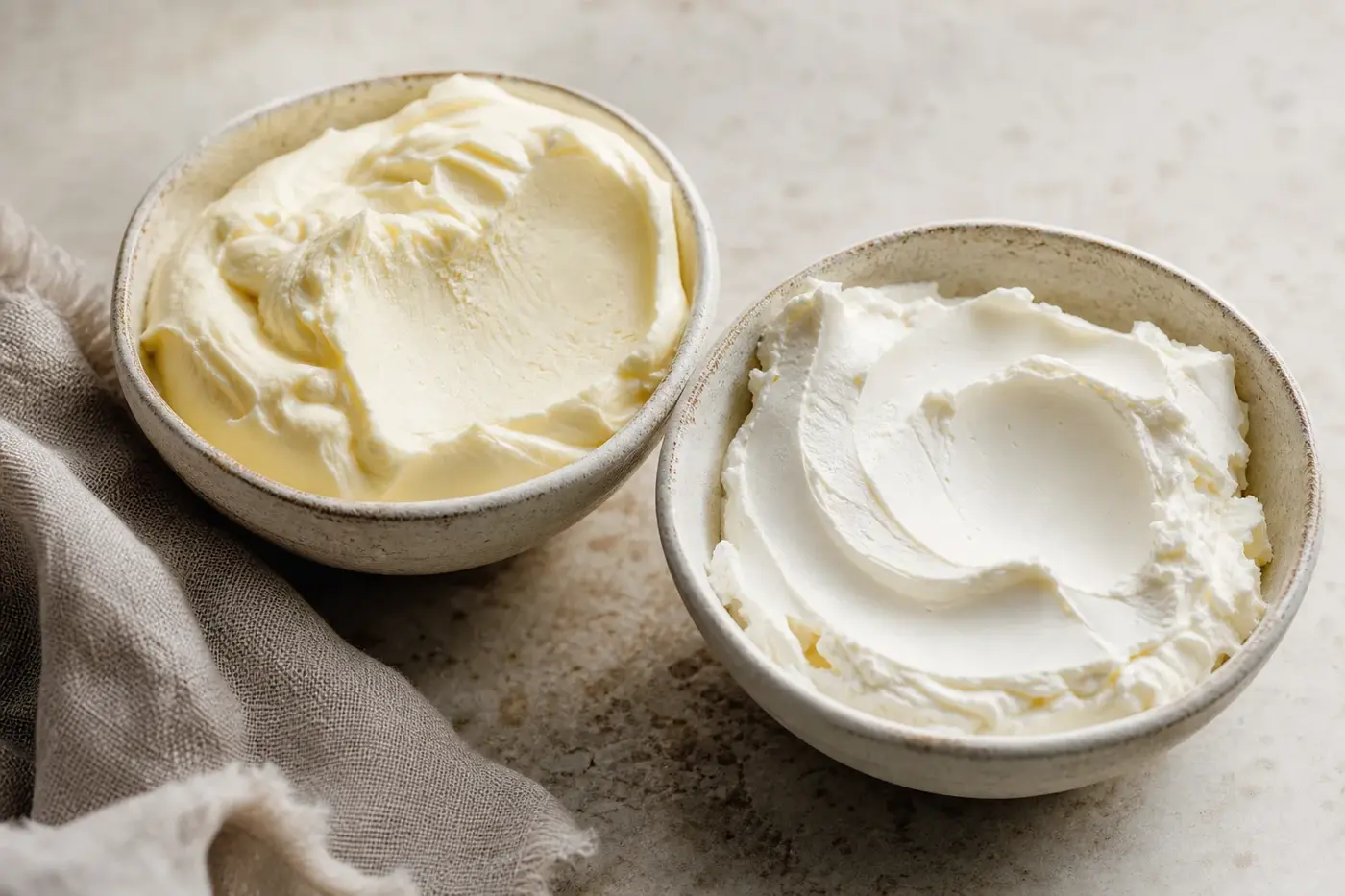
Coffee-soaked sponge fingers. A spoonful of mellow cream. Take a bite of tiramisu and you meet mascarpone at its most persuasive: sweet at first, then gently acidic, with a quiet richness rooted in the Po Valley around Lodi. Its traditional ingredients are cream and citric acid. Cream cheese takes you somewhere tangier, with a firmer, spreadable texture at home on bagels, in frostings and in cheesecakes. [1][4][11]
Both are fresh, rindless cheeses. Those similar-looking tubs, however, are not culinary identical twins. Swap one for the other and you change a dish’s balance, especially when you need a filling to set or a topping to hold its shape. [1][4][11]
Get to know the two tubs
| What you want to know | Mascarpone | Cream cheese |
|---|---|---|
| Flavour | Mild and creamy, slightly sweet, with a little acidity. [1] | Tangy, with salt in the British example. [3] |
| Texture | Dense, smooth and ready to spoon. [4] | Firm, but ready to spread. [11] |
| Main ingredient | Cream, sometimes with milk. [1][2] | Milk and cream. [3] |
| What you’ll find in British shops | Tubs, including 250 g and 500 g packs. [2][5] | Tubs and individual portions. [11] |
The real difference begins with how each cheese is made, not simply how soft it feels. To understand why these similar-looking tubs behave differently in your kitchen, start with the guide to cheese styles.
Follow mascarpone home to Lombardy
Follow mascarpone back to northern Italy and you arrive in Lombardy. Regione Lombardia’s atlas places its artisanal production in the Po Valley, particularly around Lodi, and lists cream and citric acid as the raw materials. The cheese it describes is white to yellowish, sweet on your tongue before a little acidity follows. [1]
Heat and acid thicken the cream, drawing proteins together into a soft mass during coagulation. The traditional account then describes separating the whey, the liquid released along the way. This is fresh cheese, rather than one left to develop a rind through prolonged ripening. [1]
That method defines the style, but producers do not all use precisely the same ingredients. Galbani’s British mascarpone contains pasteurised cream, pasteurised milk and citric acid; Italian producer CLC describes cream with citric or lactic acid. Your pack tells you which version is coming home with you. [2][4]
Cream cheese has its own recipe
Cream cheese generally starts with cultured milk and cream. Philadelphia’s British product information describes its Original as full fat soft cheese, with milk, cream, salt, guar gum as a stabiliser and citric acid among the ingredients. Recipes and stabilisers vary, so guar gum belongs to this formulation, not to every cream cheese. [3]
Before comparing brands for cooking, separate plain full fat cheese from flavoured or reduced-fat versions. Start with the product category your recipe asks for, then read the ingredients. “Soft cheese” alone leaves you with rather too much guesswork.
Let your spoon lead the way
Mascarpone’s appeal is its creamy gentleness. Galbani describes a delicate flavour and velvety smooth texture, while the Lombardy atlas records a slight yellow cast. Philadelphia describes its cream cheese as white and suggests spreading it on bagels, where its tang offers a sharper contrast to mascarpone’s mellow richness. [1][2][11]
Think about the finish you want before reaching for a tub. A spooned cream, a spread, a piped topping and a sliceable filling each ask something different of your cheese. Colour and firmness straight from the fridge tell only part of the story: your other ingredients and method determine the finished texture.
Fat, calories and protein: put the labels side by side
Here is the November 2026 comparison of these British product examples. Every figure is for 100 g of cheese as sold, not fat in dry matter. [2][3]
| British product | Energy (kJ/kcal) | Fat (g) | Protein (g) |
|---|---|---|---|
| Galbani Mascarpone 500 g | 1662 / 403 | 41 | 4.5 |
| Philadelphia Original | 932 / 225 | 21 | 5.4 |
In this pairing, mascarpone has nearly twice the fat and more energy, while cream cheese has slightly more protein. If you choose another brand, a reformulated pack or a reduced-fat version, read the label afresh. These figures belong to the two products above. [2][3]
Give salt a look, too: the examples list 0.08 g per 100 g for mascarpone and 0.75 g for cream cheese. Add your cheese before tasting for seasoning, rather than automatically carrying over all the original recipe’s salt. The guide to how to read a cheese label takes you through the wider checks. [2][3]
Give each cheese a chance to shine
Choose mascarpone when you want dairy richness behind coffee, cocoa or fruit. Galbani’s published tiramisu brings it together with eggs, sugar, coffee and sponge fingers. Its caramel cheesecake pots use a gently folded mascarpone filling, moving beyond the familiar layered pudding into spooned desserts. [5][6]
That mellow richness has a savoury side, too. Galbani suggests stirring mascarpone into tomato sauce for enrichment, rather than a sharply tangy contrast. If a smooth sauce is your goal, choose a recipe designed around mascarpone. [2][4]
Reach for cream cheese when you want a tangy spread, savoury dip or cream cheese frosting. Philadelphia’s British information specifically recommends it for bagels and baked cheesecake. If that recognisable frosting tang is what you love, keep the cream cheese: mascarpone takes the flavour somewhere milder. [11][12]
Tiramisu: choose your level of tang
Cream cheese can take the dairy role in a tiramisu-style dessert, but you will taste its tang. Keep mascarpone when you want a mellow filling. If a cheesecake-like contrast against coffee and cocoa appeals, choose a recipe written for cream cheese.
Then follow the whole recipe, not just its choice of tub. Galbani’s published mascarpone version is lightened with whisked egg whites before chilling. Adding extra cream by guesswork changes the balance again, so begin with a method developed for the cheese you plan to use. [5]
Cheesecake rewards a little loyalty to the recipe
Both cheeses have published cheesecake uses. Philadelphia recommends Original for baked cheesecake; Galbani’s mascarpone examples include individual caramel pots and a lemon mousse dessert containing cream and gelatine. Choose a tested recipe for your cheese and the texture you want, because the whole filling determines the result. [6][7][11]
For a no-bake cheesecake, keep the specified cheese and setting ingredients together. For a baked version, use a formulation developed for your chosen cheese rather than swapping tubs while keeping the same eggs, liquids and baking schedule. Mascarpone brings mellow richness and cream cheese brings tang, but a firm, sliceable result depends on the recipe as a whole.
Frosting: flavour first, then staying power
For that familiar cream cheese frosting tang, use cream cheese. For a milder dairy topping, find a mascarpone frosting recipe that specifies the cream, sugar and mixing method. Begin with a recipe built for the flavour and finish you want.
A topping spread over a traybake has a different job from tall piping or a filling between cake layers. When precise shape matters, keep the specified product. Changing the cheese means reformulating; icing sugar cannot be expected to negotiate every disagreement in the bowl.
Hot sauces leave you room to taste
A sauce gives you more room to adjust than a cheesecake already sitting in its tin. Replace mascarpone with cream cheese in tomato sauce and you change both flavour and salt contribution. Swap the other way and mascarpone brings a milder, richer dairy character; either way, incorporate the replacement before adjusting your seasoning. [2][3][4]
Follow the source recipe’s heating method for your chosen cheese. A boiling or simmering instruction does not automatically suit another formulation simply because both resemble thick cream. Taste before adding salt or acid, then add any thinning liquid gradually until the consistency suits your finished dish.
Keep your tubs fresh from the first spoonful
Both cheeses belong in the fridge. For England, Wales and Northern Ireland, the Food Standards Agency advises a home fridge temperature of 5 °C or below. Follow the dairy product’s storage instructions, including any stricter temperature on the pack, and read the opening instructions when you first lift the seal. [8]
Observe the stated period after opening and the use-by date, whichever comes first. GOV.UK’s consumer guidance distinguishes use-by dates, which concern safety, from best before dates, which concern quality. Do not eat chilled cheese after its use-by date. [9]
Once you have made a dessert, it needs its own checks. Follow the recipe’s storage instructions as well as the limits for its ingredients. The guide to storing cheese at home covers the wider routine.
This page summarises published guidance from the official sources it cites. It is not medical advice. Guidance differs between countries and changes over time, so check the current source for where you live, and ask your doctor, midwife, pharmacist or dietitian about your own circumstances.
Vegetarian suitability and pregnancy: check the whole dish
Galbani’s British mascarpone and Philadelphia Original are both described by their manufacturers as suitable for vegetarians. Check your exact product, then consider the rest of the dish. Galbani’s lemon mousse cheesecake contains gelatine: vegetarian cheese does not necessarily make a vegetarian dessert. [2][3][7]
For pregnancy in the UK, NHS guidance for November 2026 lists pasteurised cream cheese and mascarpone among soft cheeses that can be eaten. Check the packaging for pasteurisation and read the dish’s other ingredients. Galbani lists pasteurised cream and milk, while Philadelphia’s product information lists pasteurised milk; use the full ingredient information for the exact product you are buying. [2][3]
With tiramisu, give the eggs their own check. The NHS permits raw or partially cooked hen eggs bearing the British Lion mark or produced under the Laid in Britain scheme during pregnancy. Other hen eggs, and duck, goose or quail eggs, should be well cooked. Pasteurised cheese does not settle the egg question. [10]
The NHS advises that the safest approach during pregnancy in the UK is not to drink alcohol. For any dish containing alcohol, check its current guidance and ask your midwife about your circumstances. Outside the UK, follow your own national guidance.
Both cheese examples contain milk, so read the full ingredient list for your dish, including biscuits, fillings and decorations. The guide to cheese allergy vs lactose intolerance explains the distinction between those conditions. [2][3]
Questions people ask
What is the difference between mascarpone and cream cheese?
Mascarpone is mild, slightly sweet and dense, while cream cheese is tangier and firm but spreadable. Mascarpone is made by thickening cream with heat and acid; cream cheese is generally made by culturing milk and cream.
Can I use cream cheese instead of mascarpone in tiramisu?
Cream cheese can fill the dairy role, but it adds tang to the flavour. For that contrast against coffee and cocoa, choose a complete recipe written for cream cheese.
Can I use mascarpone instead of cream cheese in cheesecake?
Both cheeses have published cheesecake uses, but they give different flavours. Choose a tested recipe for your cheese and the texture you want, because the whole filling determines the result.
Does mascarpone have more fat than cream cheese?
In the page’s British product comparison, Galbani Mascarpone has 41 g of fat per 100 g and Philadelphia Original has 21 g. These figures describe those two products, so check the label for another brand or formulation.
Can I eat mascarpone or cream cheese during pregnancy?
The NHS lists pasteurised cream cheese and mascarpone among soft cheeses that can be eaten during pregnancy. Check the packaging and the dish’s other ingredients, and consult current NHS guidance, including its guidance on eggs and alcohol.
Sources
Manufacturer sources below describe their own products and recipes and have a commercial interest in them. Their descriptions are attributed accordingly.
- Regione Lombardia. Atlante dei prodotti della Lombardia, 2017, entry “Mascarpone artigianale”. Regional institutional account of ingredients, production area, method, colour and flavour.
- Galbani UK. Galbani Mascarpone 500g, undated product information, retrieved November 2026. British ingredients, nutrition, vegetarian declaration and suggested uses.
- Philadelphia UK. Philadelphia Original, undated product information, retrieved November 2026. British ingredients, nutrition, pasteurisation and vegetarian declaration.
- Compagnia Lattiera Casearia. Mascarpone per industria, undated manufacturer information, retrieved November 2026. Cream, direct acidification and product consistency.
- Galbani UK. Valentine’s Day Tiramisu with Galbani Mascarpone, undated published recipe, retrieved November 2026.
- Galbani UK. Mascarpone and Caramel Cheesecake Pots, undated published recipe, retrieved November 2026.
- Galbani UK. Lemon Mousse Cheesecake with Galbani Mascarpone, undated published recipe, retrieved November 2026.
- Food Standards Agency. How to chill, freeze and defrost food safely, published 18 December 2017, current retrieved version November 2026. Applies to England, Northern Ireland and Wales.
- GOV.UK. Understanding food labelling: Best before and use-by dates, current retrieved version November 2026.
- NHS. Foods to avoid in pregnancy, current retrieved version November 2026. UK advice on pasteurised soft cheeses and eggs.
- Mondelēz Away From Home. Explore Philadelphia wholesale, undated British manufacturer information, retrieved November 2026. Soft white cheese, formats and culinary applications.
- Philadelphia UK. Recipes, current recipe index retrieved November 2026. Categories include cheesecakes, sandwiches, bagels and dips.
Researched through institutional production records, British manufacturer product information, published manufacturer recipes and official UK consumer guidance.
Last checked: November 2026
Last checked November 2026.
The editors suggest you read next
Cheddar vs Gouda: Taste, Texture and How to Use Each
Bite into a long-aged Gouda and, beneath your teeth, something crunches.