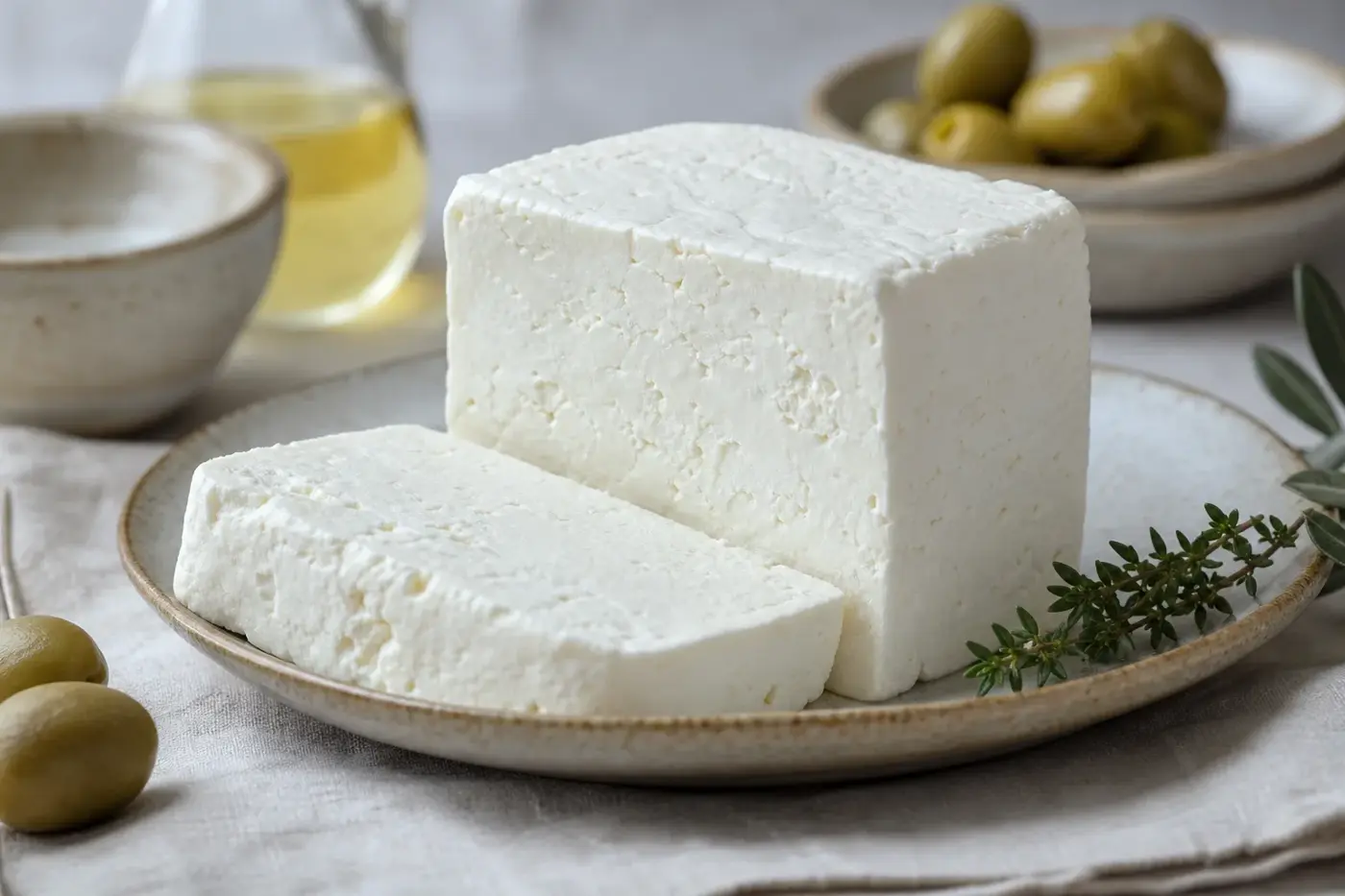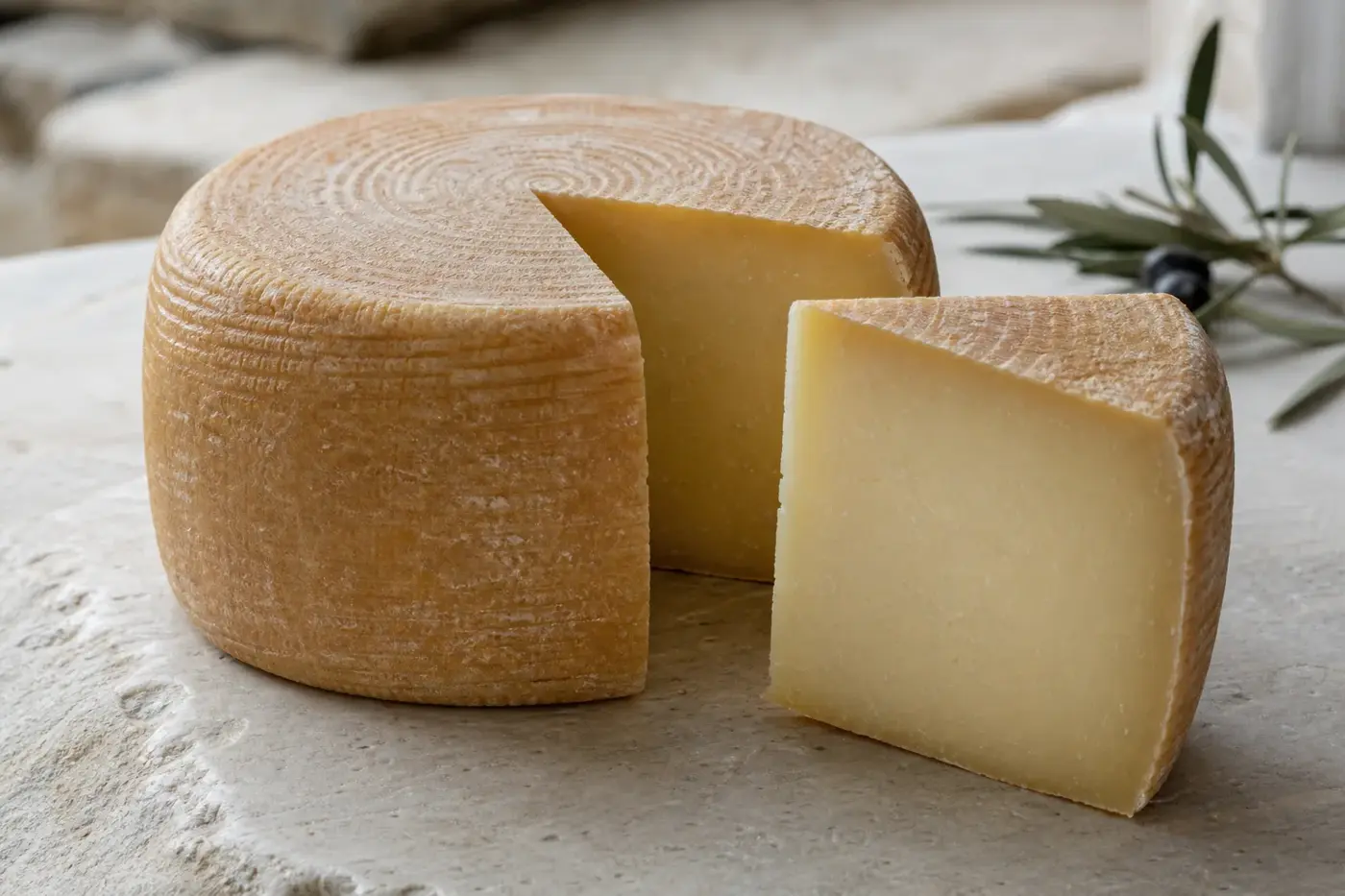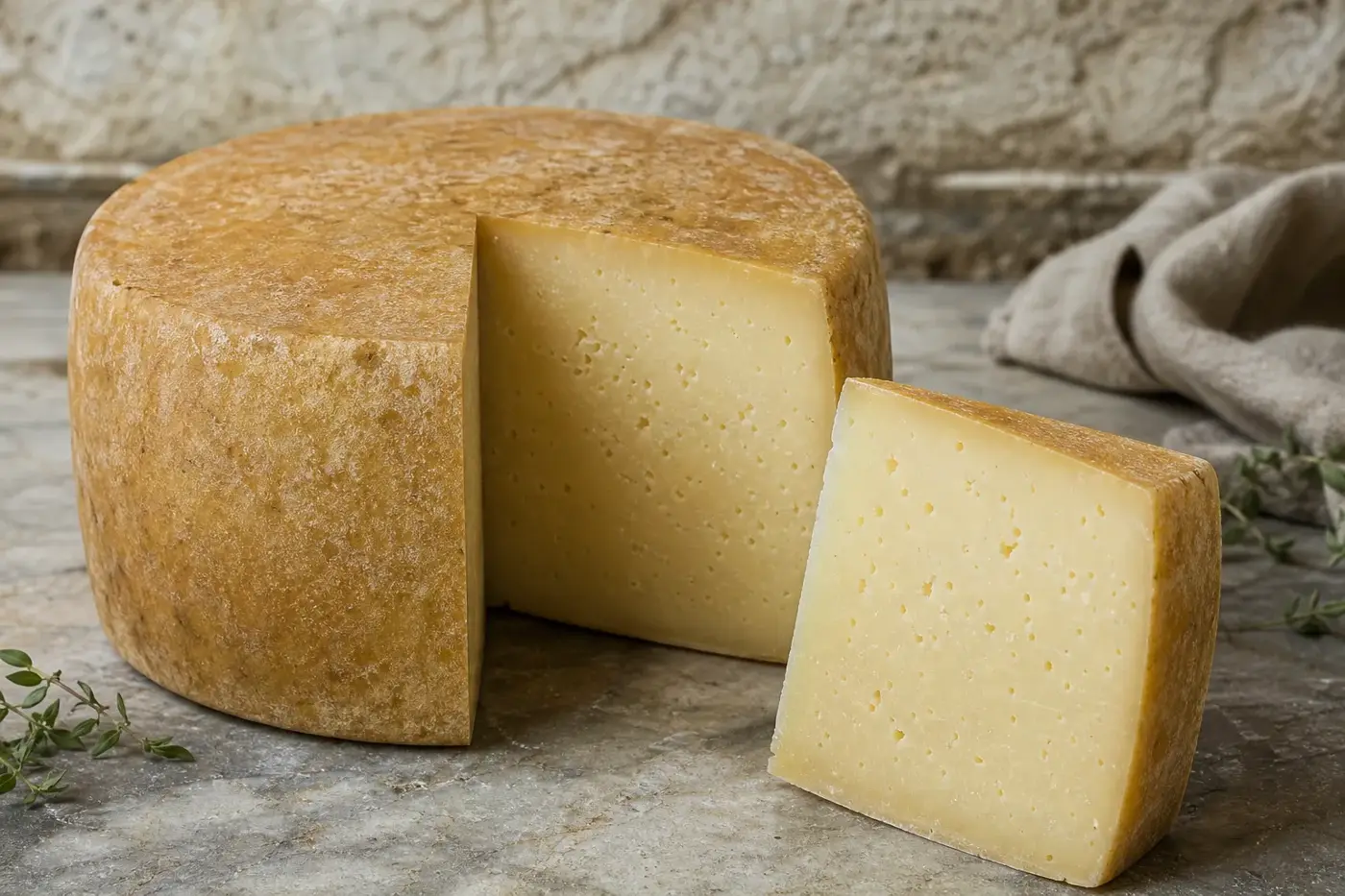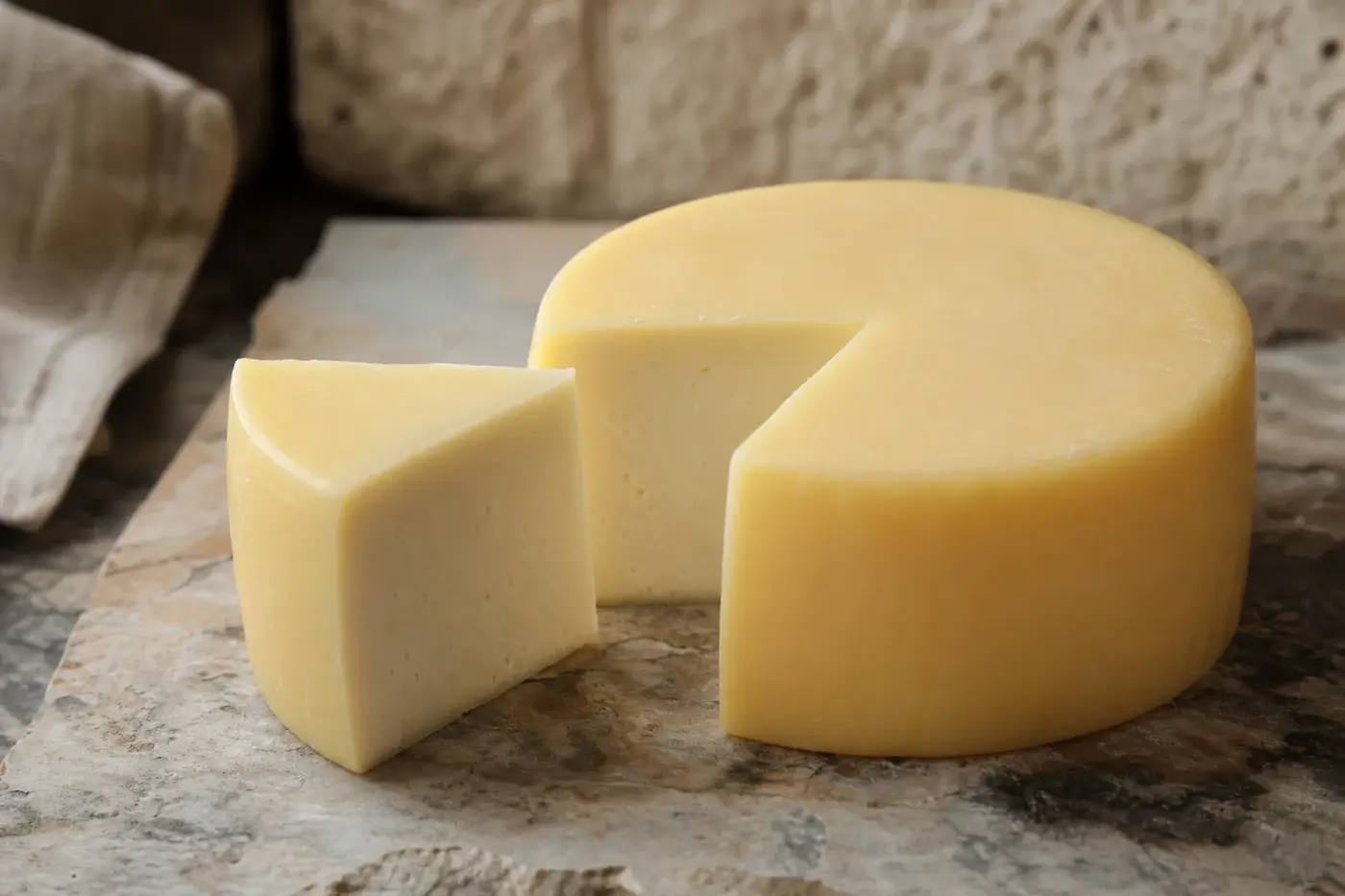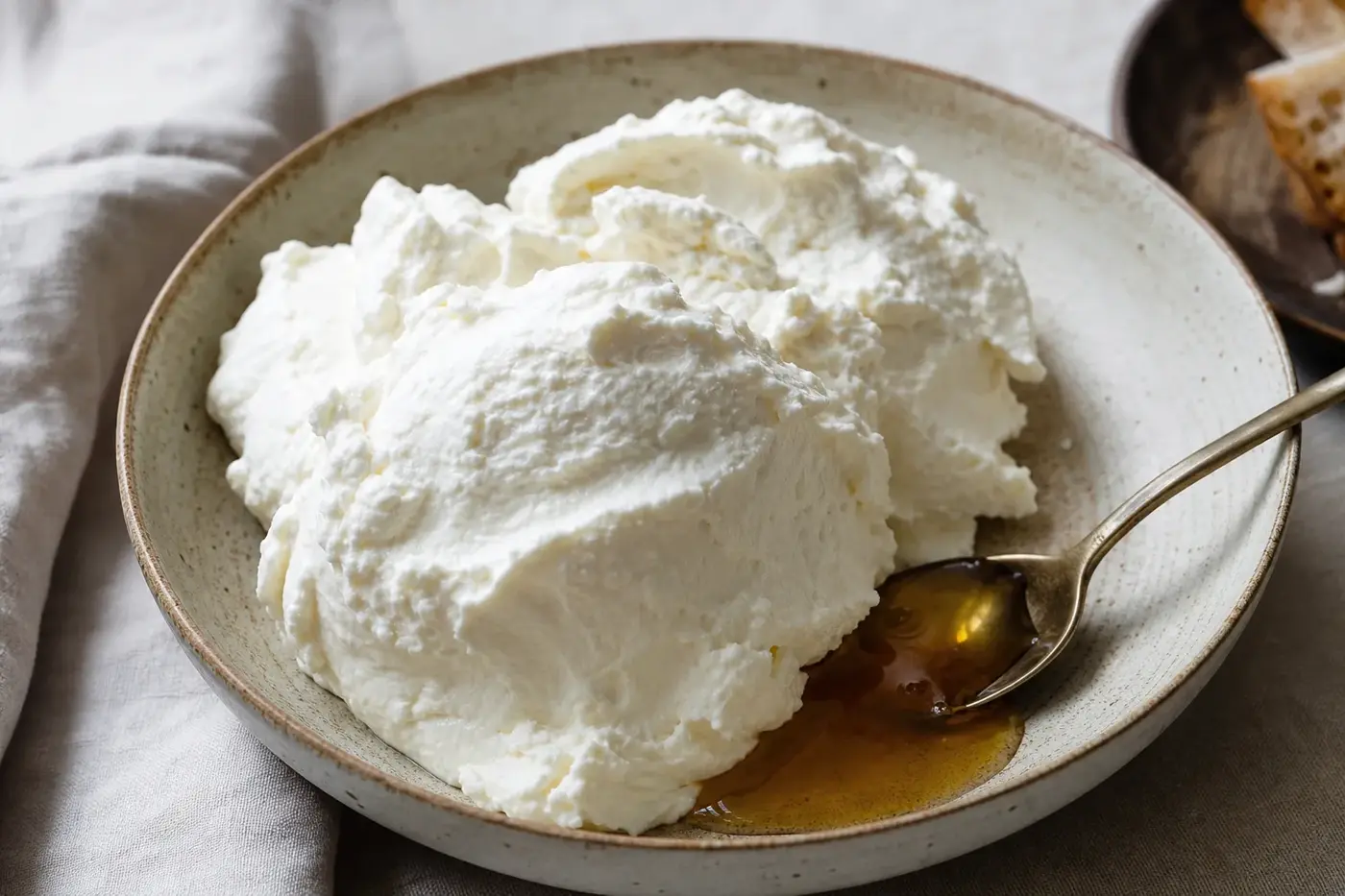
Watch a spoonful of honey settle over fresh Mizithra. Now picture the dried cheese falling in fine shavings over hot pasta. One is soft and milky, the other firm enough for your grater: two deliciously different destinations for a Greek cheese that begins with whey.[1][2][3]
| Your quick guide | What to know |
|---|---|
| Names to look for | Mizithra; also written Myzithra.[2][3] |
| Its name in Greek | Μυζήθρα.[2] |
| Where it belongs | Whey cheese, fresh or dried.[1][2][3] |
| Milk sources listed by makers | Sheep and goat whey, sometimes with milk and cream.[2][3] |
| Its Greek statutory category | Food and Drinks Code, Article 83, section A.3, whey cheeses; published edition April 2014.[1] |
| Close relations | Anthotyros; the separately specified Xynomyzithra Kritis.[5][6] |
A second act for the cheesemaker’s whey
Once a cheesemaker has gathered the first curd, something worth keeping remains: whey, the liquid left when those solids separate. Heat it further and another collection of curd forms, ready to drain into cheese. Greek producers list sheep and goat whey among the ingredients of both fresh and dried Mizithra.[2][3][6]
The Greek Food and Drinks Code describes strong heating, with or without acidification, in its published definition of whey cheese. Milk, milk together with cream, and salt are permitted additions. The code also distinguishes fresh cheeses from those that are partially dehydrated or matured.[1]
That gives Mizithra its place beside other Greek cheeses. Instead of beginning another batch entirely from milk, the cheesemaker puts the remaining whey to work. You can follow the wider journey in how cheese is made.[1][6]
Watch those fine curds rise
Heat encourages the proteins remaining in whey to gather into fine curds. The documented production of related Xynomyzithra Kritis gives you a picture of the moment. Flakes appear, gather in a layer at the surface, then move into moulds to drain.[6]
Milk and cream can give whey cheese a surprisingly substantial, soft texture. Kalogeraki’s fresh Mizithra lists sheep and goat whey, pasteurised milk and cream, salt and lactic acid. Keep that particular recipe in mind, rather than assuming every cheese bearing the name has the same ingredients.[2]
Fresh and dried forms start with a shared approach, then part company. Tzafettas describes its dry Myzithra as fresh Myzithra that has been dried. By the time you bring it into your kitchen, a cheese for spooning has become one for grating.[3]
Fresh Mizithra calls for a generous spoon
Fresh Mizithra need not wait at the edge of your plate as a final seasoning. Kalogeraki describes its version as white and soft, with a fluffy, smooth surface. Expect slight sweetness, light salt and the scent of fresh milk.[2]
You are in gentle dairy territory, rather than meeting the sharpness of a sour cheese. The producer calls this sweet form Myzithra Glykia. Its serving suggestions include honey, pies and kalitsounia, the small Cretan pastries.[2]
Before you cook, see how the cheese behaves under a spoon. A loose, moist version needs different handling from one drained more firmly. For pastry especially, choose a consistency that lets your filling hold its shape, not merely the right name on the label.
Bring out the grater for dried Mizithra
Dried Mizithra takes you from filling to finishing. Tzafettas describes its version as hard, usually salty and strongly flavoured. The maker lists goat and sheep whey, milk, cream and salt, and suggests grating it over pasta, salads, grilled vegetables and pies.[3]
Drying removes moisture, firms the cheese and concentrates what remains. Salt adds seasoning and changes the fresh curd’s character. Start with a modest scattering, then taste, especially if olives, capers or another salty ingredient have already joined your dish.
Not every dried Mizithra is salted, though. Galiatsatos Dairy in Kefalonia describes its dry Myzithra as unsalted and suitable for grating, with approximately 1 kg heads and vacuum-packed pieces. Salt and presentation both vary, so let the individual maker’s cheese guide you.[4]
Let the maker introduce their cheese
Small details on a label can make a real difference once you start cooking. Kalogeraki’s fresh Cretan Mizithra contains milk and cream, while the two dried products above differ in their stated use of salt. Those details tell you more than a simple description of soft or hard.[2][3][4]
Look at three things: ingredients, form and intended use. A fresh cheese suggested for honey and pastries has a different job from a dry cheese recommended for grating. If your local recipe simply says “Mizithra”, ask the seller which form you need.[2][3]
Buying a cut portion? Keep the maker’s description with it so you can find the same form again. It also gives you something useful to compare if a replacement turns out wetter, firmer or less inclined to behave in your favourite recipe.
Meet Anthotyros and a sour Cretan relation
Anthotyros is a close neighbour in the whey-cheese family. Tzafettas describes its Anthotyro as fresh sheep and goat whey cheese enriched with cream and milk. Set that ingredient list beside documented fresh Mizithra and you will find plenty of shared ground.[2][5]
If you are considering a swap, look beyond the names to the cheeses themselves. Moisture, salt and consistency matter most in cooking. Avoid a fixed rule that one name always means fresh and the other always means dried.[2][3][5]
Xynomizithra Kritis is a separate cheese with its own Cretan specification. The Great Britain register, as of November 2026, records Ξυνομυζήθρα Κρήτης / Xynomyzithra Kritis as a registered protected designation of origin.[7]
Its published Greek specification describes sheep or goat whey, or a mixture of both. Acidity increases during production, developing a slightly sour to sour taste. The process includes maturation rather than simply the drying used for grating Mizithra, so expect that sourness to make itself known in your dish.[6]
Set a place for fresh Mizithra
Begin with honey. Kalogeraki recommends this pairing as a dessert, and it gives you room to enjoy the cheese itself. Keep your first serving simple, then decide whether you want fruit or another accompaniment.[2]
For pastry, choose a recipe written specifically for fresh Mizithra. Kalogeraki associates the cheese with Cretan kalitsounia and recommends it for pies, but your filling’s consistency still matters. Sharing a name does not qualify a hard grating cheese for the job of a moist filling.[2][3]
For something savoury, place a spoonful alongside bread and vegetables, then season to taste. Fresh Mizithra can also supply the mild element in a filling with herbs. In either case, taste first and let the cheese guide how much extra salt or sharper flavour you add.
Give dried Mizithra the finishing touch
Pasta is an inviting first outing for dried Mizithra, and one of Tzafettas’s documented uses. Grate a little over the finished dish, toss, then scatter a little more over your plate. Treat it as seasoning and you can judge exactly how much you want.[3]
Keep that first pasta preparation simple. You will get to know what the cheese contributes before introducing several other strong ingredients. A fine grating scatters evenly; a coarser one leaves recognisable pieces, so choose whichever finish appeals to you.
Grilled vegetables and pies also feature among the producer’s suggestions. Try a little over warm courgettes or aubergines, or follow a pie recipe calling for dry grated cheese. Before seasoning anything else, check whether yours is salted, because the documented dried versions differ.[3][4]
Shop with your recipe in mind
Decide fresh or dried first, then look at the milk species and any added ingredients. The products cited here use sheep and goat ingredients, and some versions include milk and cream. Let the label in front of you guide your choice, rather than a general idea of Mizithra.[2][3][4]
Treat milk treatment as a separate detail. Kalogeraki specifies pasteurised added milk and cream for its fresh Mizithra. Keep the complete label when comparing production details, so that wording remains attached to the ingredients it describes.[2]
If you are buying a cut portion, ask for the original product information, including the maker, storage instructions and date marking. Choose a quantity that suits those instructions and your plans. For help separating the product name from the other details, turn to reading a cheese label.
Find its place in your fridge
For home storage in England, Wales and Northern Ireland, the Food Standards Agency advises keeping your fridge at 5 °C or below.[8] Read its guidance, dated here to November 2026, alongside your cheese’s own storage and opening instructions.
If you need advice about time out of refrigeration, consult the Food Standards Agency guidance for England, Wales and Northern Ireland. That guidance is also dated here to November 2026.[8]
Follow the product’s date marking and opening instructions. You can find further handling guidance in storing cheese at home and mould on cheese.
Choose a stand-in suited to the dish
For fresh Mizithra, consider fresh Anthotyros. The documented products share a whey base with added milk and cream. Compare consistency and salt before using one in a pastry or savoury filling, where those differences can affect your result.[2][5]
For dried Mizithra, a firm dried whey cheese such as ricotta salata may suit your grater. Check its salt and flavour against the recipe. Add it gradually so you can judge what it brings to the dish.
Keep your swap tied to the task: soft cheese for a soft filling, dry cheese for a grated finish. If your detailed recipe recommends an alternative, make that your first choice.
General information only, not medical advice: follow the official guidance where you live.
Questions people ask
What is Mizithra made from?
Mizithra is a whey cheese, also written Myzithra. Greek producers document sheep and goat whey in their products, sometimes with added milk and cream.
What is the difference between fresh and dried Mizithra?
Fresh Mizithra can be soft, white and milky. Dried Mizithra is firm enough to grate, and Tzafettas describes its version as hard, usually salty and strongly flavoured.
How do you use Mizithra?
Fresh Mizithra can be served with honey or used in pies and kalitsounia. Tzafettas recommends grating its dried Myzithra over pasta, salads, grilled vegetables and pies.
What can I use instead of Mizithra?
Fresh Anthotyros is a candidate for fresh Mizithra, though it is worth comparing consistency and salt. For grating, a firm dried whey cheese such as ricotta salata may work in place of dried Mizithra.
How should I store Mizithra?
For home storage in England, Wales and Northern Ireland, the Food Standards Agency advises a fridge temperature of 5 °C or below. Consult its guidance alongside the cheese’s own storage and opening instructions.
Sources
[1] Independent Authority for Public Revenue, Greece, General Chemical State Laboratory. Food and Drinks Code, Article 83: Cheese products, edition 3, April 2014. Section A.3, particularly paragraphs 3.1 and 3.6 to 3.7. Official published text.
[2] Kalogeraki. Fresh Myzithra and Μυζήθρα Γλυκιά, undated product pages, retrieved November 2026. Producer descriptions, ingredients and serving suggestions. English product page; Greek product page.
[3] Tzafettas. Dry Myzithra, undated product page, retrieved November 2026. Producer account of drying, ingredients, character and uses. Product page.
[4] Galiatsatos Dairy. Dry Myzithra, undated product page, retrieved November 2026. Producer declaration of an unsalted grating cheese, formats and packaging. Product page.
[5] Tzafettas. Anthotyro, undated product page, retrieved November 2026. Producer description and ingredients. Product page.
[6] Greek Ministry of Agriculture. Ministerial Decision No. 313051, Recognition of Protected Designation of Origin “Xynomyzithra Kritis”, Government Gazette, second series, issue 18, 14 January 1994. Articles 1 to 4, reproduced by WIPO Lex. Text and document record.
[7] Department for Environment, Food & Rural Affairs. Ξυνομυζήθρα Κρήτης / Xynomyzithra Kritis, Great Britain protected food-name register, published 4 January 2021, retrieved November 2026. Register entry.
[8] Food Standards Agency. How to chill, freeze and defrost food safely, published 18 December 2017, current retrieved page checked November 2026. Applies to England, Northern Ireland and Wales. Official guidance.
[9] Greek Ministry of Rural Development and Food. Article 83: Cheeses, consultation text, undated retrieved page, November 2026. Used to identify a proposed revision, not as enacted law.
[10] European Commission. eAmbrosia geographical indications register, accessed November 2026. The register interface returned no readable entry data in this research session. Register.
[11] Food Standards Agency. Alerts, live recall and allergy-alert listing, accessed November 2026. Official listing.
This piece was researched from official Greek texts, government guidance and named producers’ published descriptions, with serving suggestions identified as editorial suggestions.
Last checked: November 2026
Last checked November 2026.
The editors suggest you read next