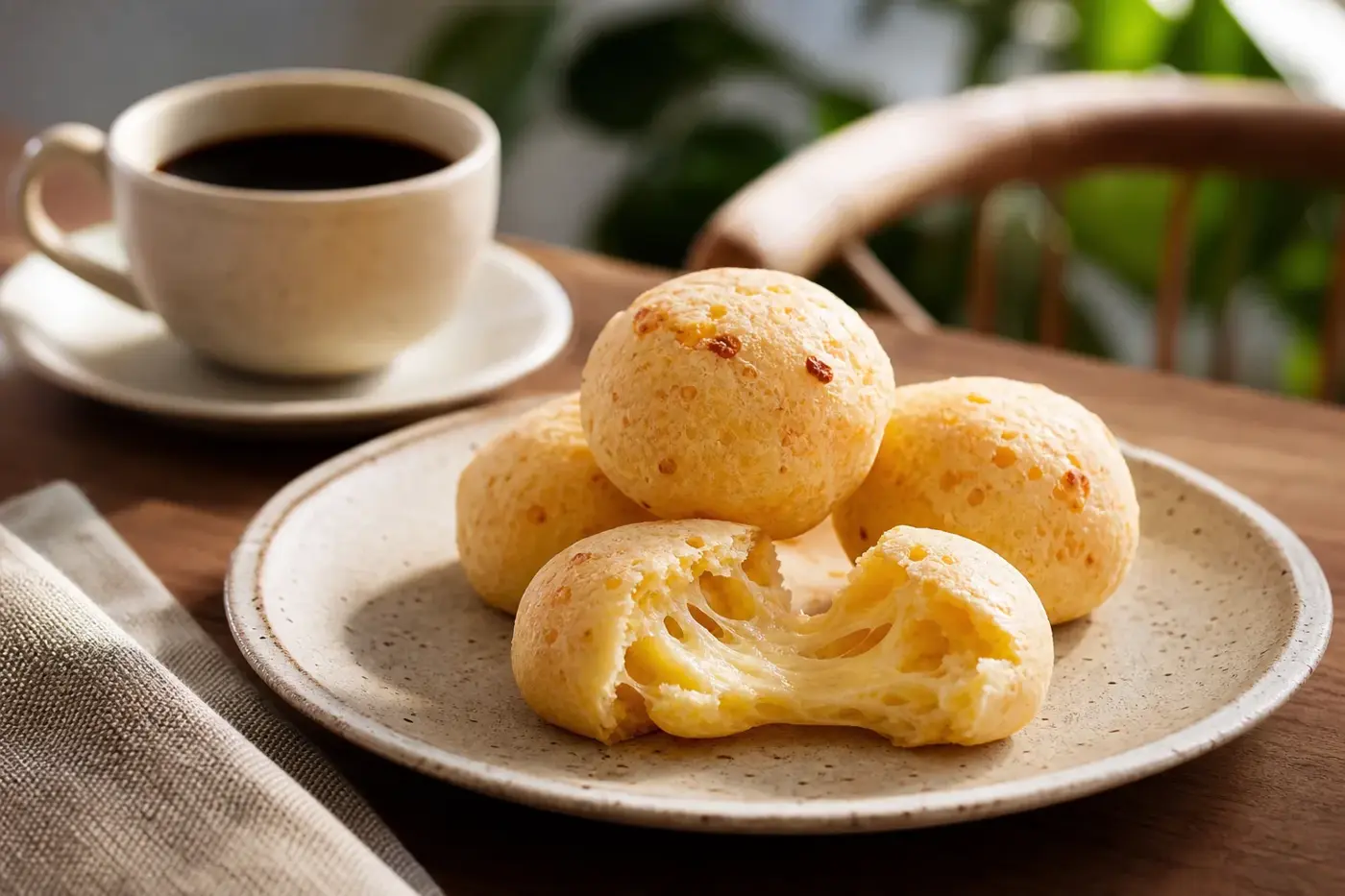
The shell gives a little crack. Inside, you find a stretchy, chewy centre: the pleasure of pão de queijo, Brazil’s cheese rolls. Cassava starch, not wheat flour, gives them that character. Closely associated with Minas Gerais, they belong beside your breakfast coffee or a freshly brewed afternoon cup. [1,2]
Pull up a chair in Minas Gerais
In Minas Gerais, pão de queijo belongs among the quitandas, the home baking served with coffee. IPHAN, Brazil’s heritage institute, documents the close relationship between coffee, matured grated cheese and freshly baked rolls. Start at that table and you begin to understand the bread. Cheese and coffee are part of its story, not supporting refreshments. [2]
The familiar origin story takes you to eighteenth-century farms, where resourceful cooks combined cassava starch with hardened cheese scraps. Contagem’s municipal account repeats that story. A Minas Gerais legislative committee report also connects the bread with colonial reliance on local ingredients when imported wheat was difficult to obtain. [3,4]
These retrospective accounts describe a tradition rather than date its first recipe. The committee report records how legislators understood the dish’s regional significance in 2021. Pinning down the first batch would take earlier, identifiable kitchen or archival evidence. [3,4]
Meet the starch that shapes your rolls
Polvilho doce is sweet cassava starch, but you can leave the sugar bowl alone. “Sweet” distinguishes it from the fermented version; it does not mean added sugar. Polvilho azedo is sour cassava starch. [5]
The Brazilian technical guide Mandiocultura: derivados da mandioca describes fermentation under water, followed by draining and sun drying. Along the way, organic acids change the starch’s properties. You see the consequences when your rolls reach the oven. [5]
Panelinha’s cooking guidance describes sour starch as giving more expansion and bubbles, while sweet starch produces a denser, softer result. Research comparing native, laboratory-produced sour and commercial cassava starches supports the importance of sour starch’s expansion properties. Its acidity also brings a sharper note to the dough. [5,6,7]
The recipe below follows a published sweet-starch formulation. If you fancy combining the two starches, choose a recipe developed for that balance, such as Panelinha’s. Keep your starch choice consistent while you learn the dough, because changing it changes the result. Buy fine cassava or tapioca starch, not coarse cassava flour or tapioca pearls. [1,5,6,8]
Let the cheese earn its place
Well-matured grated cheese is the choice IPHAN associates with pão de queijo. Traditional queijo Minas artesanal is a regional cheesemaking tradition with distinct local expressions. IPHAN describes raw cow’s milk, rennet, salt and pingo, a starter obtained from whey drained from earlier cheeses. It also distinguishes fresh cheese from semi-matured and matured forms. [2]
For your UK kitchen, the recipe below uses a hard grating cheese. Panelinha recommends firm, matured cheeses for their salt and flavour. Mature Cheddar, alone or mixed with hard grating cheese, is an experimental alternative. Keep the total cheese weight unchanged, and allow for uncertainty in moisture, salt, melting and flavour. [1,6]
Look for cheese firm enough to grate, with a developed flavour. A very soft cheese does not become suitable simply because “Minas” appears in its name: the name cannot do the grating for you. For another recipe, explore the differences in our guide to cheese styles. [2,6]
Make your own batch of pão de queijo
Your starting point is Good Food’s published recipe. This adaptation combines that formulation with shaping and cooling guidance from Brazilian cooking sources, bringing the method together below. [1,6,8,9]
Yield: 24 small rolls. Preparation: about 20 minutes. Baking: about 30 minutes. Oven: 220 °C conventional, 200 °C fan (428 °F conventional, 392 °F fan). [1]
Equipment: saucepan, large heatproof bowl, sturdy spoon or stand mixer, scales, grater and baking trays.
Get your ingredients ready
- 300 g sweet cassava starch
- 250 ml whole milk
- 125 g unsalted butter, plus a little for greasing
- 2 eggs
- 100 g hard grating cheese, finely grated
- 5 g fine salt
From saucepan to golden rolls
- Heat the oven and grease the trays. Bring the milk, butter and salt to the boil in the saucepan. [1]
- Take the pan off the heat. Add the starch and stir vigorously until the liquid is incorporated. This is the scalding stage. [1,9]
- Transfer to the bowl and beat until cool enough to add the eggs without cooking them. Beat in one egg completely, then add the second. Fold in the cheese. [1,6]
- Spoon into 24 small mounds, about a tablespoon each, leaving 5 cm between them. Bake for about 30 minutes until crisp and golden. Serve warm. [1]
A pause that makes better dough
Scalding brings hot liquid into contact with the starch before you add the eggs and cheese. Stir firmly so the liquid reaches any dry pockets. Small lumps are normal. Panelinha describes a rustic, slightly lumpy dough, not the smooth elasticity you expect from wheat bread. [6,8,9]
Give cooling the time it needs. Hot dough can cook the eggs and melt the cheese prematurely, separating fat before the mixture is ready. Panelinha identifies insufficient cooling as a common cause of failure. While the scalded starch loses its heat, you can prepare your trays and grate the cheese. [6,8]
After each egg, the mixture may look broken before coming together again. Keep mixing until no separate liquid egg remains. You want sticky dough you can portion with a spoon, not kneadable bread dough, so resist adding flour to firm it up. Lightly oiled hands help when you are rounding firmer mixtures. [6,8]
Help your next batch along
If a batch disappoints, change one variable at a time. Your next attempt will tell you more than a complete overhaul would. The suggestions below draw on the published methods used for this recipe and its dough guidance. [1,6,8,9]
| What you notice | What might be happening | Try this next time |
|---|---|---|
| Dough runs flat | Excess liquid or softer cheese than specified | Recheck your quantities and cheese choice. |
| Dough is dry and crumbly | Incomplete mixing or measuring error | Mix through dry pockets and recheck quantities. |
| Rolls spread | Loose dough, or cheese added while hot | Cool properly; keep portions small and well spaced. |
| Rolls are unexpectedly dense | Starch choice or poor incorporation | Check the starch type and fully incorporate each egg. |
| Browning is uneven | Unequal portions or oven hot spots | Make equal mounds, leave space and turn the tray if one side colours faster. |
Put the coffee on
Bring a small batch straight from the oven, with coffee ready to pour. You are following the Minas Gerais custom documented by IPHAN. For a caffeine-free table, offer a drink your guests enjoy. Warm rolls give you the best of the contrast between crust and elastic centre described by Panelinha. [2,8]
You could offer butter, a little savoury relish or thin slices of cooked ham alongside. For something sweet, set out guava paste or a spoonful of fruit preserve. IPHAN records fruit sweets alongside Minas cheese, connecting these accompaniments to the region’s wider table. Keep them separate so everyone can choose. [2]
This page summarises published guidance from the official sources it cites. It is not medical advice. Guidance differs between countries and changes over time, so check the current source for where you live, and ask your doctor, midwife, pharmacist or dietitian about your own circumstances.
Give your leftovers a safe home
Cool baked leftovers as quickly as possible, ideally within one to two hours, then refrigerate them. This handling advice follows UK Food Standards Agency guidance for England, Wales and Northern Ireland, as of November 2026. Keep your fridge at 0 to 5 °C (32 to 41 °F), and eat the rolls within 48 hours or freeze them. [10,11]
To freeze, pack cooled baked rolls in an airtight container or freezer bag and label with the date. The FSA recommends freezing homemade food promptly and keeping the freezer around -18 °C (0 °F). Defrost baked rolls in the fridge, then use within 24 hours of complete thawing. [10]
For England, Wales and Northern Ireland, the Food Standards Agency advises reheating food until steaming hot all the way through, and reheating it only once. Check the centre, not just the warm crust. Reheat only the number you plan to serve. [11]
Panelinha describes baking its own shaped dough from frozen. That method belongs to its recipe. Baking this adaptation from frozen remains experimental. [8]
Make room for careful gluten-free preparation
Cassava starch is only part of the gluten-free picture. Preparation depends on every ingredient and on how you make the rolls. In England, Wales and Northern Ireland, the Food Standards Agency advises checking labels each time because ingredients can change. Check the starch, cheese and accompaniments, including any precautionary allergen statements. [12]
Use clean equipment and work surfaces. Keep wheat flour and breadcrumbs away from both dough and serving plate: FSA guidance makes clear that avoiding cross-contamination matters alongside ingredient choice. This recipe contains milk and eggs, and changing the cheese does not remove those allergens. For ingredient questions, start with the guide to reading cheese labels. [12,13]
Follow your appetite a little further
- Cheddar: get to know the style before choosing cheese for an alternative batch.
- How to Store Cheese at Home: look after your remaining cheese between baking sessions.
- Cheese Food Safety: The Complete Guide: explore the wider guidance behind careful kitchen handling.
Questions people ask
What makes pão de queijo chewy?
Its crisp shell and stretchy, chewy centre come from cassava starch rather than wheat flour. Sweet cassava starch produces a denser, softer result, while sour starch gives more expansion and bubbles.
What is the difference between sweet and sour cassava starch?
Sweet cassava starch, or polvilho doce, does not contain added sugar. Sour cassava starch, or polvilho azedo, is fermented under water, then drained and dried in the sun.
What cheese can I use for pão de queijo in the UK?
The recipe uses finely grated hard grating cheese. Mature Cheddar, alone or mixed with hard grating cheese, is an untested alternative; keep the total cheese weight unchanged.
Why did my pão de queijo spread?
The dough may have been too loose, or the cheese may have been added while the dough was still hot. Cool the scalded dough properly and keep the portions small and well spaced.
Is pão de queijo gluten free?
Gluten free preparation depends on every ingredient and how the rolls are made. The Food Standards Agency advises checking labels each time and avoiding cross contamination; see its guidance for England, Wales and Northern Ireland. The recipe contains milk and eggs.
Sources
- Good Food, Brazilian cheese bread (pão de queijo), recipe published in Good Food, June 2014. Basis for the quantities, yield, preparation time, oven settings and baking cues. The salt has been expressed as a weighed adaptation of its teaspoon measure.
- Instituto do Patrimônio Histórico e Artístico Nacional, Modo artesanal de fazer queijo de Minas: Serro, Serra da Canastra e Serra do Salitre (Alto Paranaíba), Dossiê Iphan 11, 2014. Institutional heritage dossier, retrieved from a third-party documentary repository.
- Prefeitura de Contagem, Força econômica e cultural: pão de queijo se destaca no setor de alimentos, undated retrieved edition, accessed November 2026. Municipal account of regional associations and the commonly repeated origin story.
- Assembleia Legislativa de Minas Gerais, Comissão de Cultura, committee report on Projeto de Lei nº 4.002/2017, 19 May 2021. Used as evidence of the committee’s cultural interpretation, not as enacted legislation or contemporary evidence of invention. (almg.gov.br)
- Universidade de São Paulo, ESALQ, Casa do Produtor Rural, Mandiocultura: derivados da mandioca, technical booklet, page 20, undated retrieved edition.
- Panelinha, FAQ do pão de queijo, 29 June 2020. Practical guidance on starch choice, matured cheese, cooling, egg incorporation and shaping.
- Revista do Instituto Adolfo Lutz, Análises rápidas para prever a expansão do polvilho azedo, volume 70, issue 2, pages 199 to 205, 2011. Research abstract describing the starch comparisons and expansion measurements.
- Panelinha, [Pão de queijo](../pao-de-queijo/), undated retrieved edition, accessed November 2026. Brazilian mixed-starch recipe and guidance on texture, shaping and baking frozen dough.
- EPTV, Rede Globo, Espia Só, broadcast pão de queijo recipe, undated retrieved edition, accessed November 2026. Corroborating Brazilian scalding, cooling and shaping method.
- Food Standards Agency, How to chill, freeze and defrost food safely, current retrieved edition, November 2026; England, Wales and Northern Ireland.
- Food Standards Agency, Cooking your food, current retrieved edition, November 2026; England, Wales and Northern Ireland.
- Food Standards Agency, Food allergy and intolerance advice for consumers, updated 7 August 2026; England, Wales and Northern Ireland.
- Food Standards Agency, Food allergen labelling and information requirements technical guidance, current retrieved edition, November 2026. Used for the distinction between ingredient selection and cross-contamination controls.
Researched through Brazilian heritage and technical records, published Brazilian and British recipes, and current FSA guidance, with culinary suggestions distinguished from recorded kitchen testing.
Last checked: November 2026
Last checked November 2026.
The editors suggest you read next