Piacentinu Ennese
Cut a golden slice and out come the peppercorns: whole, black and impossible to overlook against the saffron yellow cheese.
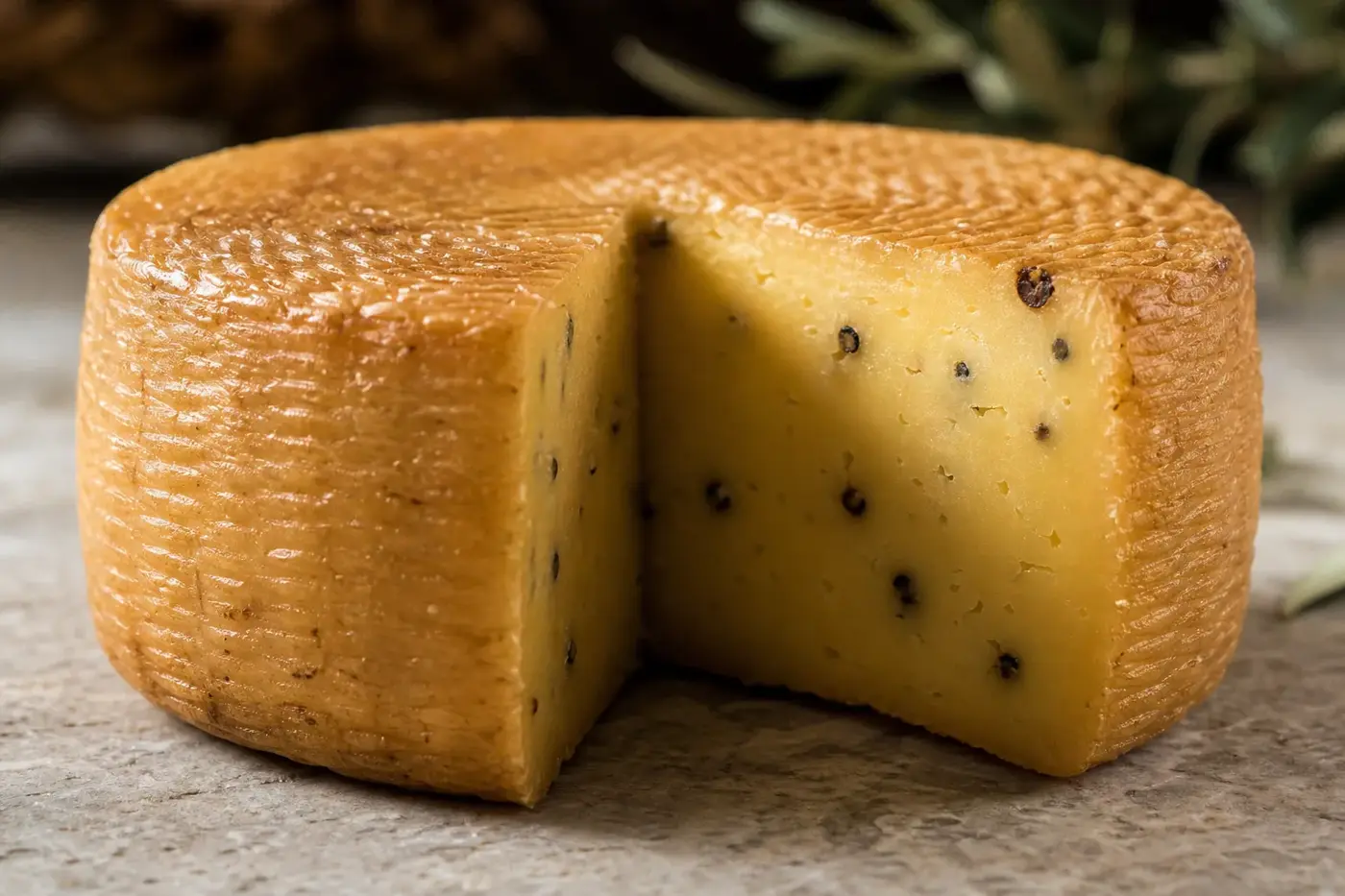
Cut a golden slice and out come the peppercorns: whole, black and impossible to overlook against the saffron yellow cheese. Subtle wardrobe, this is not. Made from raw sheep’s milk in the hills around Enna in central Sicily, Piacentinu Ennese is compact, delicately scented with saffron and, according to its specification, increasingly pungent as it matures. [1,3]
Your first look at Piacentinu Ennese
| What you want to know | The details, November 2026 |
|---|---|
| Registered name | Piacentinu Ennese. [1] |
| Authority and dossier | European Commission; IT-PDO-0005-0646-25.09.2007. [3] |
| EU protection | PDO, registered under Regulation (EU) No 132/2011. [2] |
| Great Britain protection | Registered PDO; UK scheme registration 31 December 2020. [4] |
| Its legally defined home | Entire administrative province of Enna, Sicily. [1,2] |
| Milk and rennet | Whole raw sheep’s milk; lamb or kid rennet paste. [1,3] |
| Its two spices | Locally produced saffron; whole black peppercorns. [1,2] |
| Minimum maturation | 60 days from production. [1,3] |
| Typical ageing | No established figure given |
| Shape and weight | Cylinder; 3.5 to 4.5 kg. [1,7] |
| Fat content | At least 40% fat in dry matter. [3] |
| UK pregnancy guidance | NHS guidance linked in Sources; November 2026. [9] |
Follow the flock into Enna’s hills
Picture the country between the Erei mountains and the Dittaino valley, with pastures of sulla, vetch, rosemary and wild fennel described by Slow Food. This is Piacentinu Ennese’s traditional setting. You are in Sicily’s hilly interior around Enna, not its coastal dairy plains. [5]
Here, sheep’s milk, inland grazing and local cheesemaking belong together. Even the saffron grows in the same area as the milk is produced. That close connection runs through the cheese’s production rules, too. [1,3,5]
The current Italian specification sets a precise boundary: the entire administrative province of Enna. Milk production, cheesemaking and maturation must all happen inside it. Older descriptions name nine municipalities in the province’s western part; the consolidated specification approved in December 2024 and published in January 2025 establishes the broader boundary used here. [1,2,3]
Look beyond the golden colour
There is more to Piacentinu Ennese than yellow sheep’s milk cheese dotted with pepper. Its name belongs to a defined production system, with rules covering origin, ingredients, method and the finished wheel. PDO means Protected Designation of Origin; DOP is the Italian abbreviation. [1,6]
CoRFiLaC, the certification body, describes inspections covering location, production technology, identification and traceability, followed by evaluation for certification. At the counter, ask for Piacentinu Ennese DOP and the producer’s details. The name and its provenance deserve as much attention as that golden colour. [1,6]
Great Britain separately lists Piacentinu Ennese as a registered PDO, with UK scheme registration dated 31 December 2020. If you are wondering how geographical protection differs from a brand or a general cheese style, the guide to protected names explains the distinctions. [4]
Meet the sheep behind the saffron
Comisana, Pinzirita and Valle del Belice sheep, together with their crosses, supply the milk. It must be whole and raw. The specification describes flocks grazing for much of the year, supported by fodder from the production area, so their feed forms part of the cheese’s connection with its surroundings. [1,3]
The spices arrive at different moments. Saffron goes into the milk before coagulation, when the milk sets into curd. Whole black peppercorns join the curd during moulding, while lamb or kid rennet paste is the required coagulant. [2]
You can read those choices in every slice. Saffron colours the cheese yellow throughout, while the pepper remains in distinct dark points. One spreads its colour; the other keeps its own company. [2]
Step from the wooden vat to the baskets
The cheesemaker begins with a wooden vat called a tina. After adding saffron and rennet, they break the curd into small grains, introducing hot water during working. The separated liquid, or whey, is removed, and the curd is gathered ready for pressing. [2,7]
Next come the rush baskets that shape the wheel. The cheesemaker fills them with curd, adding pepper and pressing to drive out more whey. The filled baskets then spend several hours in hot scotta, the whey left after ricotta production. [2,7]
Dry salting follows in stages separated by ten days. Finally, the wheels mature within the production area for at least 60 days. Each step, from wooden vat to maturation room, helps identify this established dairy process; the guide to how cheese is made puts curd, whey and ripening into their wider context. [2,7]
Read the marks on the rind
Look closely at the yellow rind and you will see the basket impressions. Under the current specification, the cylindrical wheel measures 18 to 20 cm in diameter and 11 to 15 cm in height. It weighs 3.5 to 4.5 kg, and its rind may be dressed with oil or oil sediment, so ask your seller which treatment this particular wheel has received. [1]
Inside, the specification calls for a smooth, non-granular paste, evenly yellow, with a little eye formation permitted. The pleasure is in the contrast. You have compact golden cheese set against those whole black peppercorns, each clearly visible in the cut. [1]
Let the flavour catch up with the colour
The colour makes quite an entrance; the official flavour description is quieter. It specifies a delicate smell, a slight saffron aroma and barely perceptible saltiness. Pungency is mild in the first months, then tends to intensify. [3]
Slow Food describes the cheese at about 60 days as aromatic and slightly sweet, with that character associated with saffron. When you choose a piece, ask its age and how the wheel cuts. Minimum maturation tells you when it can qualify for sale; your seller can describe its present firmness and intensity. [3,5]
If you are offered a taste, try a little plain paste first. Then try a piece containing a peppercorn. That small comparison gives you a useful sense of the cheese before you decide which piece to take home. [3,5]
Hear the tale of the Norman count
Around 1090, the story goes, a Norman count asked local cheesemakers to help his profoundly unhappy wife. Their answer was a restorative cheese, made by adding saffron to sheep’s milk. The producers’ consortium records the tale, and Slow Food explicitly recounts it as a legend. [5,7]
The story gives this golden cheese a memorable place in local folklore, including the powers attributed to saffron. Today’s documented production rules tell a more practical story. The defining ingredients remain local milk, local saffron, animal rennet and whole pepper. [1,5,7]
Choose a piece with its story attached
Start with the name and producer information on the whole wheel or its packaging. The specification allows both whole cheeses and portions, provided those portions come from certified wheels. Keep that identity with your purchase, especially if you are comparing several pecorini at home. [1]
Refrigerate your cheese and follow the packaging instructions, as the Food Standards Agency advises for dairy products. Its guidance for England, Wales and Northern Ireland recommends a fridge between 0 and 5 °C. For a freshly cut portion, keep the seller’s instructions too, including wrapping and use after cutting; the guide to storing cheese at home covers the wider practical details. [8]
Set the table with bread and a Sicilian glass
Begin with a small wedge and plain bread. Taste the cheese alone before adding anything else, giving that delicate saffron aroma room to emerge. Then offer pears, a few unsalted almonds or simply more bread: these are serving suggestions, not prescribed pairings, and nobody needs a committee to choose their next mouthful. [3,5]
For adults of legal drinking age, Grillo with a younger piece and Nero d’Avola with a more pungent one are suggested Sicilian wine starting points. Explore them in small servings. Water or an alcohol free white wine gives you an alternative.
People who are pregnant, driving, taking medicines that interact with alcohol, or recovering from alcohol dependence should not drink. Consult the current NHS advice. For a broader approach, try the cheese and wine pairing guide.
Put out only what you expect to eat. The NHS advises eating ready-to-eat food within four hours of taking it out of the fridge and keeping the fridge at 5 °C or below. This is UK guidance as of November 2026. [10]
Give saffron room in the kitchen
Taste a newly bought piece at the table before deciding what role it should play in a dish. You might shave it over warm vegetables, add small pieces to a bread-based salad, or grate a firmer portion over pasta. These are suggested uses, not a tested recipe. [3,5]
Start with a little cheese, then taste before adding salt or pepper. You want the saffron to remain part of the flavour. Give it space rather than asking it to compete with several other seasonings. [3,5]
This page summarises published guidance from the official sources it cites. It is not medical advice. Guidance differs between countries and changes over time, so check the current source for where you live, and ask your doctor, midwife, pharmacist or dietitian about your own circumstances.
Know the milk, rennet and UK health guidance
Piacentinu Ennese requires animal rennet, so it is unsuitable for vegetarians who avoid animal-derived coagulants. Its production specification also requires raw milk; if you want a pasteurised alternative, you will need a different cheese. The rennet guide explains animal, microbial and fermentation-produced coagulants. [1]
For pregnancy in the UK, the NHS lists hard cheeses made with pasteurised or unpasteurised milk among cheeses that can be eaten. Which NHS category applies to Piacentinu Ennese remains uncertain here. Consult current NHS guidance alongside the product information, and ask your midwife about your circumstances. [9]
The NHS identifies pregnant people, newborn babies, older people and people with weakened immunity among those at greater risk of serious listeriosis. Its guidance lists unpasteurised dairy products among possible sources of infection. Consult that official advice for your situation, especially when serving someone in a higher-risk group; both NHS pages are referenced here as of November 2026. [9,10]
Find your way around the pecorino family
Pecorino describes a sheep’s milk cheese; Piacentinu Ennese is one particular named example. If you compare it with Pecorino Siciliano or other Italian sheep’s milk cheeses, look beyond peppercorns and a basket-patterned rind. Read the full name, origin, ingredients and maturation. [1,3,5]
Piacentinu Ennese’s defining combination is specific: raw milk from the specified breeds, saffron from the production area, whole black pepper, animal rennet and maturation within Enna province. That is what you are choosing. The colour and shape are only part of its identity. [1,3,5]
For cooking substitutions, think about the cheese’s job in your dish. Another sheep’s milk cheese can bring savoury depth; choose Piacentinu Ennese when saffron and whole pepper are central. Taste your chosen cheese before adjusting the seasoning.
Questions people ask
Where is Piacentinu Ennese made?
It is made in the administrative province of Enna in central Sicily. Milk production, cheesemaking and maturation must all take place within the province.
What does Piacentinu Ennese taste like?
Its official flavour description notes a slight saffron aroma and barely perceptible saltiness. Pungency is mild in the first months and tends to intensify as the cheese matures.
Is Piacentinu Ennese vegetarian?
It uses lamb or kid rennet paste. It is therefore unsuitable for vegetarians who avoid animal rennet.
Can I eat Piacentinu Ennese during pregnancy?
The NHS lists hard cheeses made with pasteurised or unpasteurised milk among cheeses that can be eaten during pregnancy, but the applicable NHS category for Piacentinu Ennese has not been verified. Check the current NHS guidance alongside the product information, and ask your midwife about your circumstances.
How should I store Piacentinu Ennese?
The Food Standards Agency advises refrigerating dairy products and following packaging instructions. Its guidance for England, Wales and Northern Ireland recommends a fridge temperature between 0 and 5 °C.
Sources
[1] Ministero dell’agricoltura, della sovranità alimentare e delle foreste. Disciplinare di produzione della denominazione d’origine protetta “Piacentinu Ennese”. Consolidated specification following the December 2024 amendment, published in 2025. Articles 1 to 5 and 8.
[2] Italian Republic, Gazzetta Ufficiale, Serie generale No 5, 8 January 2025. Decree of 23 December 2024, approval of the ordinary amendment for Piacentinu Ennese, with consolidated specification annexed. Articles 1 and 2 of the decree; Articles 2, 3 and 5 of the annex.
[3] European Commission. Publication of an application pursuant to Article 6(2) of Council Regulation (EC) No 510/2006. Single document for Piacentinu Ennese, 2010/C 164/10, 24 June 2010. Used for the original dossier identifier and unchanged product characteristics, not the superseded geographical boundary or dimensions.
[4] Department for Environment, Food & Rural Affairs. Piacentinu Ennese. GB protected food names register entry, published 4 January 2021, live entry checked November 2026.
[5] Fondazione Slow Food. Piacentinu ennese. Presidio account, undated, accessed November 2026. Used for its description of the traditional setting, sensory character and recorded legend.
[6] CoRFiLaC. Piacentinu Ennese DOP certification. Certification procedure, undated, accessed November 2026.
[7] Consorzio di Tutela del Formaggio Piacentinu Ennese DOP. Official website, sections on production, characteristics, identification and origin stories, undated, accessed November 2026. An industry source representing producers.
[8] Food Standards Agency. How to chill, freeze and defrost food safely. Published 18 December 2017, live guidance checked November 2026. Applies to England, Wales and Northern Ireland.
[9] NHS. Foods to avoid in pregnancy. Live UK guidance, checked November 2026, section “Cheese, milk and other dairy”.
[10] NHS. Listeriosis. Live UK guidance, checked November 2026, sections on sources of infection, higher-risk groups and prevention.
[11] Food Standards Agency. Alerts. Official alerts index, accessed November 2026 for the editorial recall check described below.
This desk-researched article compares the consolidated Italian specification with the earlier Commission document, the GB register, published producer accounts and UK official guidance.
Last checked: November 2026
Last checked November 2026.
The editors suggest you read next
Parmigiano Reggiano
Break into a wheel of Parmigiano Reggiano and flakes fall away, revealing a finely granular cheese, pale straw to straw in colour.