Pleasant Ridge Reserve
Twice a day, fresh Wisconsin pasture awaits the spring-calving cows at Uplands Cheese.
Twice a day, fresh Wisconsin pasture awaits the spring-calving cows at Uplands Cheese. Follow their raw milk to the vat near Dodgeville, and you reach the beginnings of Pleasant Ridge Reserve, a firm cheese inspired by Beaufort and Gruyère. Months of rind washing and maturation happen on that same farm. You could call it Alpine ambition with a Wisconsin address. [1][2][4]
Get acquainted at the cheese counter
| What you might ask | What to know |
|---|---|
| Name | Pleasant Ridge Reserve. [3] |
| Who makes it, and where? | Uplands Cheese, near Dodgeville, south-west Wisconsin, United States. [1] |
| What style is it? | Firm and Alpine-inspired. [3][4] |
| What milk goes in? | Raw cow’s milk from the farm’s own herd. [2][4] |
| Producer’s declared ingredients | Unpasteurised milk, cheese cultures, salt and rennet. [3] |
| Producer’s declared allergen | Milk. [3] |
| What about the rind? | Washed rind, tended with brine. [4] |
| Typical wheel weight | Approximately 4.1 to 4.5 kg (9 to 10 lb). [3] |
| Current advertised maturation | Nine months or more. [5] |
Before the cheese, a decision about grass
The story begins with pasture, not a cheese vat. Uplands dates the farm’s conversion to perennial pasture to 1994, with the first batches of cheese following in 2000. On Pleasant Ridge in Wisconsin’s Driftless Region, the plan was to keep cows suited to the land, graze them, and turn their milk into something that could mature beyond the grazing season. [2]
Beaufort and Gruyère offered inspiration, particularly the versions made during their pasture season. Pleasant Ridge Reserve brings that seasonal thinking to a Wisconsin farmstead. The herd, cheesemaking and maturation all belong to the same farm, so you can follow the cheese’s story without leaving the place. [1][4]
If those connections catch your interest, explore Le Gruyère. The Alpine link gives you a useful starting point. Pleasant Ridge Reserve’s own character, though, comes from Uplands’ choices about its herd, pastures and production.
Read the seasons through the pasture
Here, grass has a say in the cheesemaking calendar. Uplands describes spring-calving cows moving onto fresh pasture twice daily. Production follows the availability of that pasture rather than an unchanging schedule. [1][2]
When you choose a piece, think about two dates: when the milk became cheese, and when the matured wheel became ready to eat. The current product page advertises nine months or more of maturation and year-round shipping. Your winter purchase can therefore carry the character of milk from an earlier grazing season. [5]
Weather, grazing plants and seasonal changes in milk composition help explain differences between batches, according to the maker. Ask your cheesemonger for the production date and age of the wheel being cut. Those details give you more to go on than the name alone. [5]
There is little reward in chasing one supposedly perfect month. Instead, ask what makes the current batch distinctive. You will learn more about your piece than you would by expecting every summer’s milk to behave alike.
Meet the herd behind your slice
Every cow milked at Uplands was born and raised on the farm, according to the maker. The herd has been closed since 1994, it says. Over time, nine breeds have been crossed to develop cows suited to both the land and the cheese. [2]
Their milk goes into Pleasant Ridge Reserve unpasteurised. The producer lists milk, cheese cultures, salt and rennet, the enzyme preparation that sets milk into curd. Its published documents do not specify whether that rennet comes from an animal or microbial source. [3]
If vegetarian suitability matters to you, request a current product declaration. The sell sheet’s phrase “traditional rennet” does not settle the question. For a clear guide to milk treatments, turn to raw milk, thermised and pasteurised cheese.
From the milking barn to the ripening room
Fresh milk travels straight from the milking barn to the cheese vat through an underground pipe. Uplands’ production photographs take you through the next stages: curd being cut and stirred, then placed into moulds. The finished wheels move into the farm’s ripening rooms. [1][2]
There, the hands-on work continues. The sell sheet describes weekly hand washing with brine. This encourages the creamery’s rind culture and helps develop the meaty character the maker associates with Pleasant Ridge Reserve. [4]
That repeated washing makes this a washed-rind cheese. If the phrase has you reaching for a spoon, pause a moment. Here, the brine tends the surface of a firm wheel, not a soft, spoonable cheese. [3][4]
Uplands currently describes Pleasant Ridge Reserve as aged nine months or more. Its product description also discusses tending batches for upwards of a year, giving different characteristics time to emerge. If you are choosing between a regular release and an older selection, ask the age of the actual wheel on offer. [5]
Take a closer look at that golden centre
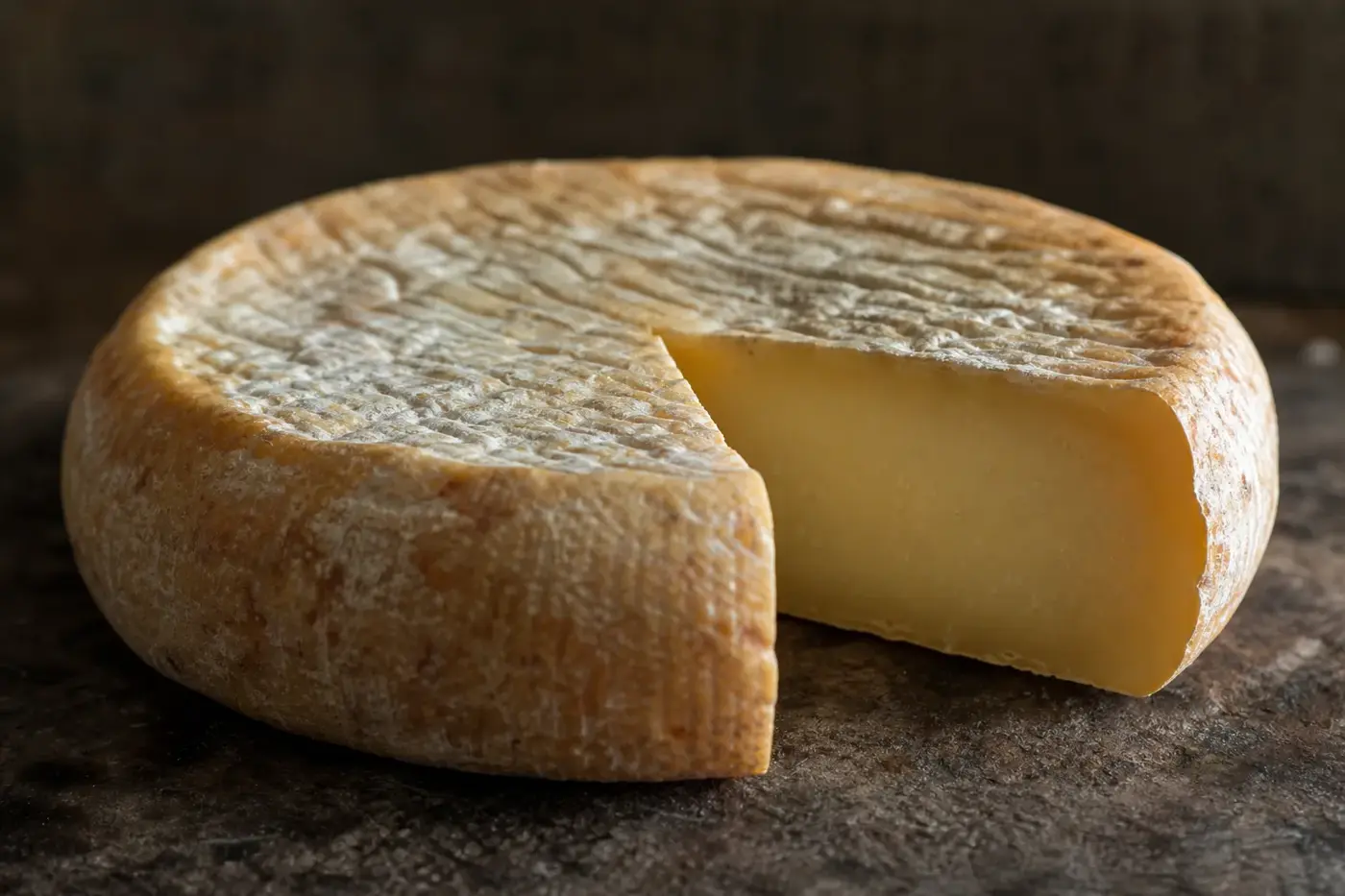
Pale golden and firm: that is the interior described in the producer’s January 2026 technical sheet. You will find it inside substantial round wheels weighing approximately 4.1 to 4.5 kg. [3]
Cheesemakers call the interior beneath the rind the paste. Here, it stays firm rather than flowing like a soft cheese. Together, that centre and the brine-tended surface give you useful identifying features to discuss at the counter. [3][4]
For your first serving, try thin slices rather than large cubes. They make it easier to compare the centre with the area near the rind and find the balance you prefer. Before tasting the rind itself, ask whether the rind on your particular cut is intended to be eaten.
Follow the flavour from toffee to broth
Caramel or toffee sweetness leads Uplands’ tasting description. Possible tropical-fruit, broth-like and roasted-nut notes bring contrast. These are the producer’s tasting notes, rather than a fromage.co.uk tasting. [5]
The sell sheet gives you another handful of clues: meaty, salty and fruity. It also describes sweetness that the maker associates with pastured milk. Taken together, those accounts point towards a meeting of sweetness and savoury depth. [4]
Start with a plain slice before bringing in bread or accompaniments. Notice your first impression, then follow it through the finish. Does the sweetness linger, and does the savoury side suggest stock, roasted food or something else to you?
Age tells only part of the story; the batch matters too. Uplands links variation to pasture, weather and milk composition, so ask how the seller describes the cheese currently being cut. That gives you a better introduction to your wheel than a familiar tasting note alone. [5]
Three Best of Show wins, and one important detail
Pleasant Ridge Reserve won American Cheese Society Best of Show awards in 2001, 2005 and 2010. For the third win, pay attention to the name. The winner was specifically Extra Aged Pleasant Ridge Reserve. [8]
The Society’s contemporary announcement records the 2010 award on 28 August. That year’s competition received 1,462 cheeses and cultured milk products from 225 producers across the United States, Canada and Mexico. It is useful context for the scale of that recognition. [8]
Those separate wins mark sustained recognition, with an older selection taking the third award. They help explain the cheese’s established reputation. When you choose your piece today, though, give the actual wheel, its age and its handling just as much attention.
Bring bread, and leave room for contrast
Crusty bread, savoury accompaniments and nuts are Uplands’ recommendations. Its broader serving suggestions also include pickled foods and dark chocolate. Both offer you a way to explore contrast with the cheese’s sweetness. [5][6]
Begin with cheese and bread, then introduce one accompaniment at a time. Keep assertive pickles or chocolate to the side. You and your guests can decide how much contrast each bite needs, without asking one mouthful to host the entire gathering.
| What to pour | Why give it a try? |
|---|---|
| Crisp white wine | The producer recommends it with the cheese’s sweet and savoury profile. [5] |
| Lighter-bodied red wine | Uplands’ suggested alternative to a powerful red. [5] |
| Wheat beer or Belgian beer | Both feature in Uplands’ suggestions. [5] |
| Sparkling water | An alcohol-free editorial suggestion for tasting between bites. |
| Unsweetened apple infusion | An alcohol-free editorial suggestion alongside the maker’s described fruity notes. [4] |
Alcoholic pairings are for adults of legal drinking age. Offer small servings and an alcohol-free choice. People who are pregnant, driving, taking medicines that interact with alcohol or recovering from alcohol dependence should not drink. Consult current NHS advice. [13]
For more ideas about matching your glass to your cheese, see cheese and wine pairing. Use those broader principles to guide your choices.
Choose your piece, then give it a good home
At the counter, ask who made the cheese, when the wheel was cut and what the seller knows about its age. If you are choosing a named older selection, request batch information. Not every Pleasant Ridge Reserve wheel receives the same maturation.
At home, Uplands recommends wrapping the cheese in paper, then putting it in a resealable bag or container to limit drying. Follow any storage instructions supplied with your particular purchase. [6]
Fridge guidance differs by country. Use the recommendation for where you live:
- England, Wales and Northern Ireland: the Food Standards Agency recommends a fridge between 0 and 5 °C. [11]
- United States: the FDA recommends 4.4 °C (40 °F) or below. [12]
Bring out only what you need. In the United States, the FDA advises refrigerating perishable food within two hours, or within one hour when the temperature is above 32.2 °C (90 °F). Follow your local official guidance. [12]
A small remaining piece still gives you plenty of options. Uplands suggests gratins, French onion soup, fondue and toasted cheese sandwiches; its storage guide adds omelettes and finishing soups or salads. [5][7] Choose a familiar recipe, add the cheese, then taste before reaching for more salt.
For more help with wrapping and refrigeration, visit how to store cheese at home. Keep the instructions supplied with your purchase to hand too.
This page summarises published guidance from the official sources it cites. It is not medical advice. Guidance differs between countries and changes over time, so check the current source for where you live, and ask your doctor, midwife, pharmacist or dietitian about your own circumstances.
Pregnancy and cheese: start with your country’s guidance
UK: the NHS lists pasteurised and unpasteurised hard cheeses among foods that can be eaten during pregnancy. Its November 2026 guidance works by cheese category, with different instructions for soft and blue cheeses. Consult the current advice and your midwife about your circumstances. [9]
United States: CDC pregnancy guidance in November 2026 lists any cheese made with unpasteurised milk as a riskier choice, and hard cheese made with pasteurised milk as a safer choice. Follow the current US source when making decisions there. [10]
Questions people ask
What does Pleasant Ridge Reserve taste like?
Uplands describes caramel or toffee sweetness, with possible tropical fruit, broth and roasted nut notes. Its sell sheet also describes the cheese as meaty, salty and fruity.
How long is Pleasant Ridge Reserve aged?
Uplands currently advertises it as aged nine months or more. The producer also describes tending some batches for upwards of a year.
Is Pleasant Ridge Reserve vegetarian?
The producer lists rennet among the ingredients but does not specify whether it comes from an animal or microbial source. If vegetarian suitability matters, request a current product declaration.
Can I eat Pleasant Ridge Reserve during pregnancy?
The NHS lists pasteurised and unpasteurised hard cheeses among foods that can be eaten during pregnancy. The CDC lists any cheese made with unpasteurised milk as a riskier choice and hard cheese made with pasteurised milk as a safer choice. Consult the current NHS or CDC pregnancy guidance for where you live.
How should I store Pleasant Ridge Reserve?
Uplands recommends wrapping it in paper, then placing it in a resealable bag or container to limit drying. Follow any storage instructions supplied with your purchase.
Sources
- Uplands Cheese, Farmstead Cheese from Wisconsin’s Driftless, undated website, retrieved November 2026. Producer account of location, grazing and integrated production.
- Uplands Cheese, Our Story: A Family Dairy Farm in Wisconsin, undated website, retrieved November 2026. Producer account of herd development, history and production.
- Uplands Cheese, Pleasant Ridge Reserve Cheese, technical specification, version 26 January 2026.
- Uplands Cheese, Pleasant Ridge Reserve Sell Sheet, undated PDF, retrieved November 2026. Producer descriptions of production, maturation and flavour.
- Uplands Cheese, Pleasant Ridge Reserve, undated product page, retrieved November 2026. Producer tasting notes, maturation statement and serving suggestions.
- Uplands Cheese, Shipping, Storage & Ordering FAQ, undated website, retrieved November 2026.
- Uplands Cheese, Storing and Serving Our Cheese, undated website, retrieved November 2026.
- American Cheese Society, 2010 ACS Judging & Competition Winners, announcement dated 29 August 2010.
- NHS, Foods to avoid in pregnancy, current online guidance retrieved November 2026.
- CDC, Safer Food Choices for Pregnant Women, 31 January 2025, retrieved November 2026.
- Food Standards Agency, How to chill, freeze and defrost food safely, 18 December 2017, current online publication retrieved November 2026. Applies to England, Northern Ireland and Wales.
- FDA, Safe Food Handling, current online guidance retrieved November 2026.
Researched from producer documents, the American Cheese Society’s contemporary award announcement and official national food guidance, with serving suggestions identified separately from recorded tasting evidence.
Last checked: November 2026
Last checked November 2026.
The editors suggest you read next
American Cheese: The Processed Slice Explained
Watch a slice of American cheese soften over your burger.