Pouligny-Saint-Pierre
A tall pyramid stands on your cheese board, its square base beneath an ivory finish or a blue-tinged rind.
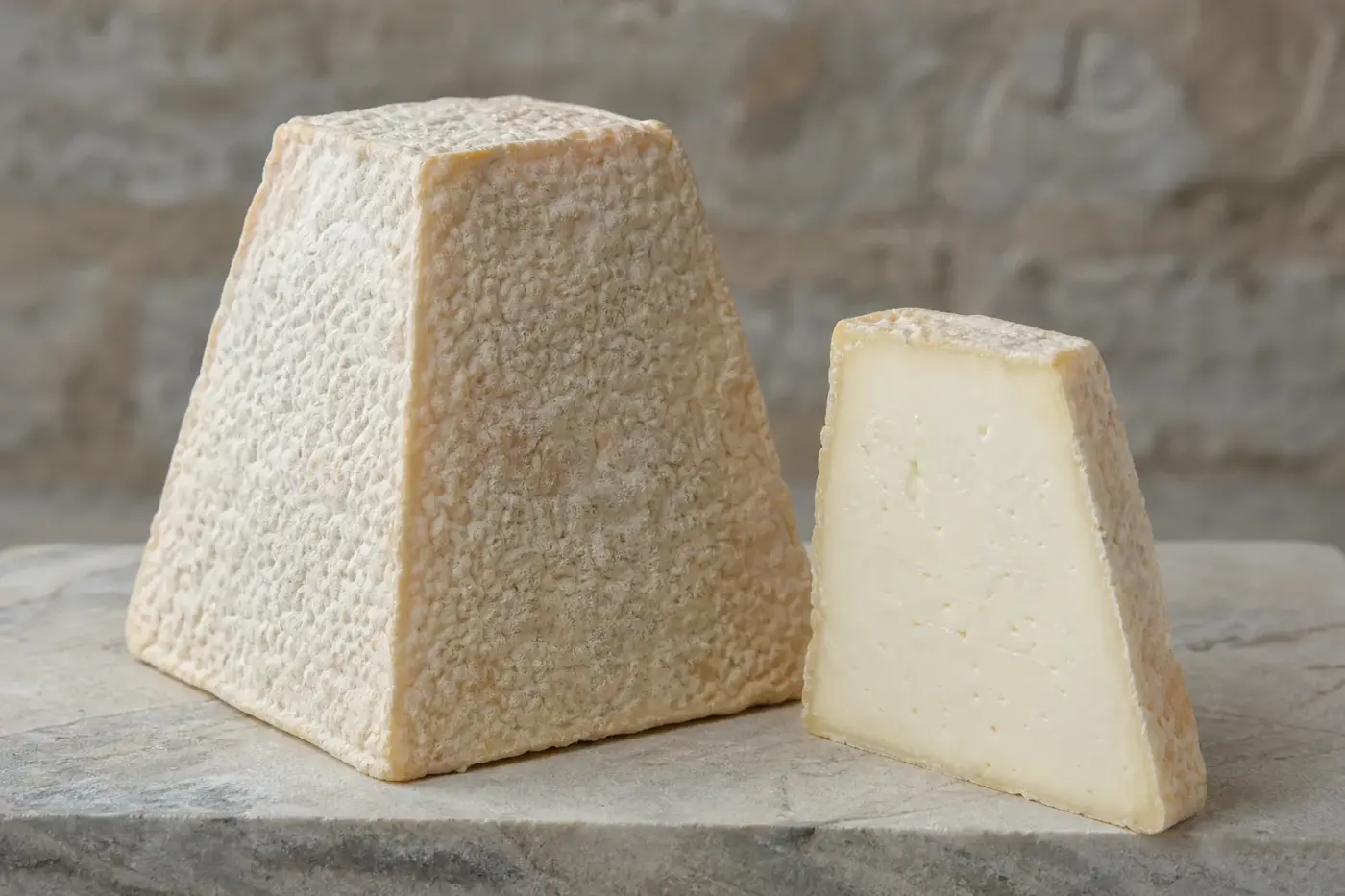
A tall pyramid stands on your cheese board, its square base beneath an ivory finish or a blue-tinged rind. The shape has presence, even before you reach for a knife. Choose ivory for the producers' milky, goat aromas; choose blue for more pronounced mushroom notes. Both begin with raw goat's milk in the Brenne, in the Berry region of central France.[3,4,5]
| At a glance | Your quick guide |
|---|---|
| Name | Pouligny-Saint-Pierre [1] |
| Kind | Soft goat's milk cheese [4,5] |
| Origin | Brenne, western Indre, France [1,3] |
| Registered name | Pouligny-Saint-Pierre [2] |
| Authority | INAO in France; Defra for the GB register [1,2] |
| Register ID | Not specified here |
| Protection | France: AOP listed by INAO; Great Britain: registered PDO [1,2] |
| Milk | Raw, whole goat's milk [1,4] |
| Formats | About 250 g and 150 g, according to the producers' syndicat [4,10] |
| Specified dimensions | Not specified here |
| Legal minimum maturation | Not specified here |
| Typical maturation | Not specified here |
| Rind | Natural surface flora, white-ivory or blue-tinged [1,5] |
| Pregnancy guidance | UK NHS advice, November 2026 [8] |
Follow the pyramid to the country of ponds
Follow the name and you reach a village. Follow the cheese and you find 22 communes in western Indre, near the meeting of Berry and Touraine. INAO places its territory in the Parc naturel régional de la Brenne, the country of ponds that sets the scene for its goat farming tradition.[1]
The producers' syndicat describes poor soils, woodland and heath, with lucerne and sainfoin among the plants supporting local husbandry. This is the pyramid's home ground. Its character belongs to this small farming area and its producers, not just that unmistakable outline.[3]
Look at the village church tower and you may spot a family resemblance. A story recorded by INAO suggests it inspired the cheese's shape. Whatever the inspiration, a mould shaped like a truncated pyramid gives Pouligny-Saint-Pierre its distinctive silhouette.[1]
A village name worth looking for
Pouligny-Saint-Pierre received French appellation recognition in 1972. INAO identifies it as an appellation d'origine protégée, or AOP, the French term for PDO. In Great Britain, Defra records it as a registered PDO, entered into the UK scheme on 31 December 2020.[1,2]
At the counter, look for Pouligny-Saint-Pierre written in full, alongside the producer's name. Ask who made it and who matured it: those details help you get to know your cheese. For the wider difference between a geographical name and a brand, explore protected names.
Good things take a little draining
Raw, whole goat's milk sits at the heart of INAO's description. Those two words have separate jobs: whole describes the milk's fat content, while raw describes its treatment. You can explore those treatment distinctions in raw and pasteurised milk.[1,4]
The regional producer body calls Pouligny-Saint-Pierre a lactic curd cheese. Acidification takes the leading role in setting the milk. The syndicat describes a slow sequence: coagulation, hand ladling into moulds, then natural draining for at least 24 hours. Curd is the set milk; whey is the liquid that drains away.[4,5]
A little rennet, the milk-clotting preparation, also appears in the syndicat's technical account, which describes a lightly salted cheese. After draining and salting comes affinage: controlled maturation, when the surface flora develops. The table above includes an entry for legal minimum maturation.
Ivory or blue? Get to know the rind
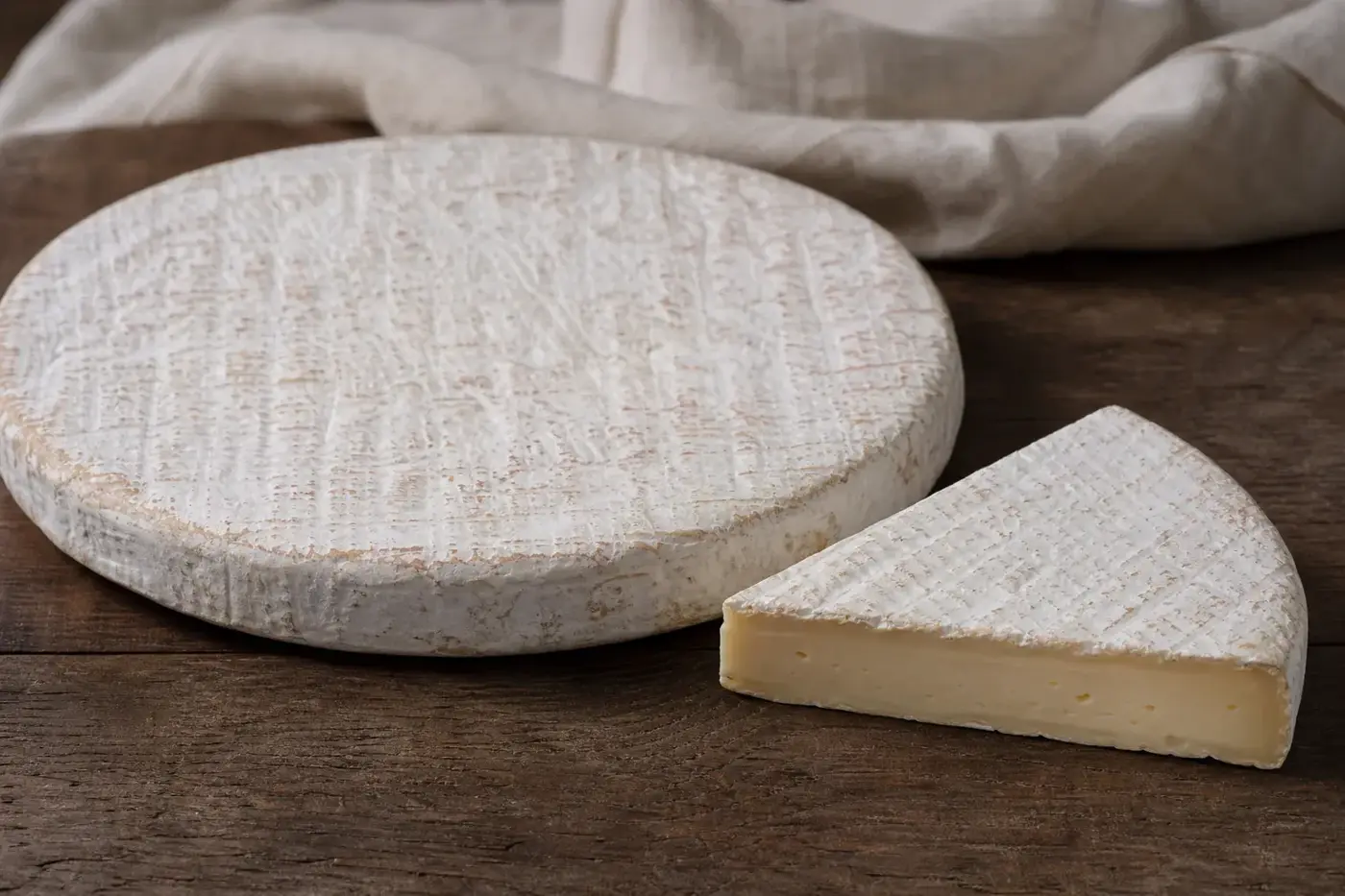
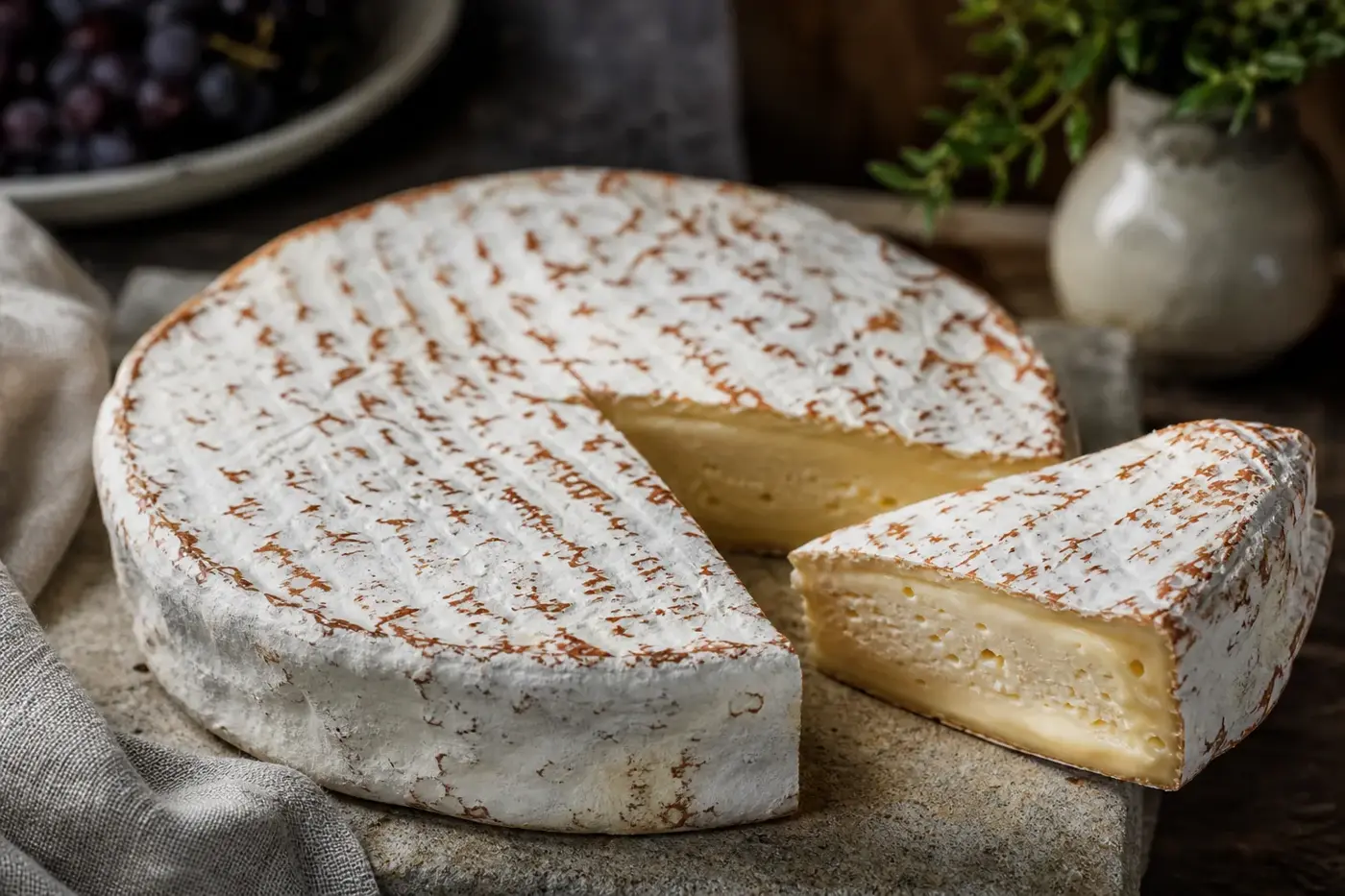
That blue finish is surface flora, not an ash coating. The regional producer body describes a thin rind carrying white and bluish surface moulds. INAO describes a white-ivory covering that can become slightly blue, so the darker finish is a recognised expression of Pouligny-Saint-Pierre, not a separate product name.[1,5]
Cut into it and you find a pale paste beneath that changing rind. The syndicat describes a yielding, melting texture, with milky and goat aromas in the ivory finish and stronger mushroom notes in the blue-tinged cheese. Ask to see a cut example so you can choose the texture that appeals to you.[4,5]
Find your sort of flavour
For a gentler introduction, ask for a younger cheese with an ivory finish. The regional producer body associates white ripening with tangy and dried-fruit notes, and describes the blue-ripened version as more full-flavoured. Hazelnut also appears in the syndicat's aromatic range.[4,5]
Use these descriptions to start a conversation, not to revise for a cheese exam. Do you fancy milky and gently tangy, or something more pronounced, with mushroom, goat and nut notes? Ask about the age and finish of the cheese in front of you. An older pyramid offers a different experience, not an automatic promotion.[4,5]
Pick your pyramid, then meet its maker
The producers' syndicat describes a larger format of about 250 g and a small Pouligny of about 150 g. Both have that distinctive silhouette. Choose the smaller one for fewer servings, or the larger one when you want more full-height slices to share.[4,10]
Farm and dairy production sit side by side here. In the syndicat's account, farm production uses milk from the holding itself; dairy production brings together milk suppliers and a cheesemaking business. Ask where the milk came from, where the cheese was made and who matured it.[10]
Those answers tell you more than treating farm production as a flavour grade. For ripeness, look at the actual rind and cut surface, then listen to the cheesemonger's account of the batch. Let the cheese in front of you make its own case.
A good conversation at the cheese counter
Tell the cheesemonger when you plan to serve it and how pronounced you like goat cheese. Ask for a pyramid that will be ready for your occasion. The darkest rind need not be your best match: producer bodies recognise different surface finishes, so colour tells only part of the story.[4,5]
For a wrapped cheese, read the full name, producer or responsible business, milk information, storage instructions and date marking. Keep those details after opening. Buying a counter-cut piece? Ask for the equivalent information, especially storage instructions; reading cheese labels explains the wider terminology.
Give each slice the whole experience
The syndicat recommends taking Pouligny-Saint-Pierre out of the fridge an hour before tasting. Treat that as flavour guidance within the UK NHS advice to eat ready-to-eat foods within four hours of refrigeration ending. Bring out only what you intend to serve, and follow any stricter pack instructions.[6,7]
- Stand the pyramid upright on a clean board.
- Cut vertically through the centre, from the narrow top down to the base.
- Divide each half into upright wedges, so every portion gets top, base, rind and centre.
- Taste a little paste first, then a piece with rind, and compare their character.
This follows the regional producer body's recommendation to cut along the height.[5] You get to explore the centre and rind in the same serving, rather than choosing between them.
Bread first, then something to sip
Put crusty bread beside the pyramid, with a plain slice available so you can taste the cheese by itself. Start simply. Give the milky centre and more developed rind your attention before other strong flavours arrive on the plate.[4,5]
For wine, the syndicat recommends dry, fruity whites from the Cher and Loire valleys: Reuilly, Quincy, Menetou-Salon, Sancerre and Touraine Sauvignon.[6] Wine is for adults of legal drinking age; use a small serving. People who are pregnant should not drink, according to the UK NHS.[8]
People who are driving, taking medicines that interact with alcohol or recovering from alcohol dependence should not drink. Consult current national guidance. For an alcohol-free table, still or sparkling water with the same bread keeps the cheese in focus.
If you want to explore matching intensity and texture, turn to cheese and wine pairing. You can also bring the cheese into a meal: the syndicat suggests salad with walnut oil or warm toast.[4,6]
Choose a younger, milky cheese for the salad, or let a more pronounced example stand on its own with bread. If you add oil or other accompaniments, check their ingredients for everyone sharing the dish.[4,6]
Wrap it carefully, keep it cool
Keep Pouligny-Saint-Pierre in its original wrapping, as the producers advise. For home refrigeration in England, Wales and Northern Ireland, the FSA recommends 0 to 5 °C. Follow stricter pack instructions, and use a fridge thermometer rather than relying on the control dial alone.[6,9]
Store it separately from raw meat and other possible sources of contamination, keeping the label with the wrapped remainder. The NHS advises using opened food within two days unless the packaging says otherwise, and following use-by dates. For the broader routine, see storing cheese at home.[7,9]
This page summarises published guidance from the official sources it cites. It is not medical advice. Guidance differs between countries and changes over time, so check the current source for where you live, and ask your doctor, midwife, pharmacist or dietitian about your own circumstances.
Take care when choosing for higher-risk groups
If you are pregnant, UK NHS advice is not to eat soft cheeses with a white coating, including some goat cheeses, unless cooked until steaming hot.[8] Read the current NHS guidance alongside the cheese's description. Its age or colour alone is not enough to guide your choice.
The NHS identifies pregnant people, newborn babies, people with weakened immunity and older people as groups at greater risk of serious listeriosis. It also identifies unpasteurised dairy and soft mould-ripened cheeses among foods associated with infection. When choosing for someone in one of these groups, consult official guidance and their healthcare professional.[7]
Keep your cheese curiosity going
- Raw Milk, Thermised and Pasteurised Cheese: get to know the milk-treatment distinctions.
- How to Store Cheese at Home: find your refrigeration and wrapping routine.
- Listeria and Cheese Safety: explore the wider safety guidance and its official sources.
Questions people ask
What is Pouligny-Saint-Pierre made from?
It is a soft cheese made from raw, whole goat’s milk. The curd is ladled by hand into pyramid moulds and left to drain naturally for at least 24 hours.
What does Pouligny-Saint-Pierre taste like?
The producers describe the ivory cheese as having milky and goat aromas, while the blue finish has stronger mushroom notes. The regional producer body also associates white ripening with tangy and dried fruit notes.
Why does some Pouligny-Saint-Pierre have a blue rind?
The blue colour comes from surface flora, not an ash coating. It is a recognised finish of the same cheese, rather than a separate product name.
How should Pouligny-Saint-Pierre be served?
The producers’ syndicat recommends taking it out of the fridge an hour before tasting. The regional producer body recommends cutting along its height, so each wedge can include the top, base, rind and centre.
Can I eat Pouligny-Saint-Pierre during pregnancy?
In the UK, the NHS advises pregnant people not to eat soft cheeses with a white coating, including some goat cheeses, unless cooked until steaming hot. Check the current NHS guidance alongside the description of the cheese.
Sources
- INAO, Pouligny-Saint-Pierre, official product summary, undated current web edition, retrieved November 2026. Product description, sensory characteristics, territory, recognition and consumer summary of maturation. Official printable record.
- Department for Environment, Food & Rural Affairs, Pouligny-Saint-Pierre, GB protected food name register entry, published 4 January 2021, checked November 2026. Official register entry.
- Syndicat des producteurs de Pouligny-Saint-Pierre, Le territoire, undated current web edition, retrieved November 2026. An industry body's account of its production territory and farming background. Territory account.
- Syndicat des producteurs de Pouligny-Saint-Pierre, Le Pouligny-Saint-Pierre, undated current web edition, retrieved November 2026. Producer descriptions of formats, flavour, finishes and manufacture. Product account.
- Association des fromages de chèvre AOP du Centre-Val de Loire, AOP Pouligny-Saint-Pierre, undated current web edition, retrieved November 2026. Industry descriptions of rind, tasting character, cutting and pairing. Regional producer account.
- Syndicat des producteurs de Pouligny-Saint-Pierre, Conseils et conservation, undated current web edition, retrieved November 2026. Producer serving, wrapping and accompaniment suggestions. Serving and conservation advice.
- NHS, Listeriosis, reviewed 10 November 2023, current page checked November 2026. UK guidance.
- NHS, Foods to avoid in pregnancy, current web edition checked November 2026. UK pregnancy guidance.
- Food Standards Agency, How to chill, freeze and defrost food safely, published 18 December 2017, current text checked November 2026. Applies to England, Northern Ireland and Wales. Official consumer guidance.
- Syndicat des producteurs de Pouligny-Saint-Pierre, Réglementation, undated web account incorporating historical regulatory material, retrieved November 2026. Used for attributed descriptions, not as verification of legislation currently in force. Syndicat account.
- Food Standards Agency, Alerts, live official portal accessed November 2026 for editorial recall screening. Official alerts portal.
- French government, Rappel Conso, live official portal accessed November 2026 for editorial recall screening. Official recall portal.
Researched through official product and register records, attributed producer publications and UK agency guidance, with unresolved specification checks recorded for the editor below.
Last checked: November 2026
Last checked November 2026.
The editors suggest you read next