Provolone Valpadana
Look up: pears, melons and long salami shapes hang overhead, their golden rinds lightly marked by cords.
Look up: pears, melons and long salami shapes hang overhead, their golden rinds lightly marked by cords. You are in a dairy, though the cheese seems to have borrowed its wardrobe from several other food shops. This is Provolone Valpadana, an Italian cows' milk cheese that brings southern Italy's stretched curd tradition to the dairying country of the Po Valley.[1,2,8]
You have two principal styles to get to know: younger, gentler Dolce and more assertive Piccante. Different rennets and maturation give each its character. Both share a name with protected designation of origin (PDO) status in the EU.[1,2,8]
| At a glance | What you need to know |
|---|---|
| Registered name | Provolone Valpadana.[1] |
| Authority and file | European Commission, PDO-IT-0021.[1] |
| EU status | Registered PDO; status recorded November 2026.[1] |
| Great Britain status | Registered PDO since 31 December 2020; status recorded November 2026.[5] |
| Northern Ireland | EU GI scheme; status recorded November 2026.[6] |
| Milk | Whole cows' milk; raw, thermised or pasteurised permitted by the current EU document.[1] |
| Coagulant | Dolce: calf rennet, with some lamb or kid permitted; Piccante: lamb and/or kid.[2] |
| Starter | Natural whey starter.[2,3] |
| Character | Semi-hard stretched curd cheese, mild or sharp.[1,8] |
| Usual ageing | Dolce: generally within three months; Piccante: longer, sometimes beyond a year.[3,11] |
| Rind and coverings | Smooth yellow to golden rind; paraffin or protective plastic permitted.[2] |
| Where it is made | Defined parts of northern Italy, set out in the production rules.[1,2] |
| EU legal minimum ageing | Confirmation against the current operative specification outstanding. |
| EU legal source | Confirmation of the current operative specification outstanding. |
| Switzerland and United States status | Separate confirmation outstanding. |
| Pregnancy guidance | Dated official guidance links still required before publication. |
Southern craft puts down northern roots
Picture plentiful milk, abundant fodder and people who already know their way around a dairy. These gave a southern Italian technique a promising northern home. The official EU account places production in the defined northern area from the second half of the nineteenth century.[1,4]
The method travelled, then acquired an identity rooted in its new surroundings. According to an agricultural atlas published by the Autonomous Province of Trento, “Valpadana” joined the name in 1993. EU registration followed in 1996, recognising a cheese with southern technical roots and a distinctly northern name.[4,5]
Follow Valpadana across the map
The protected area takes you through the whole provinces of Cremona and Brescia in Lombardy; Verona, Vicenza, Rovigo and Padova in Veneto; and Piacenza in Emilia-Romagna. It also includes specified municipalities in Bergamo, Mantova and Lodi, plus defined territory in the Autonomous Province of Trento. For the precise boundaries, turn to the production specification.[1,2]
PDO ties the full name to a place and a method, not simply a handsome cheese. The milk must come from the designated area, and the cheese must be made there. The consortium, a producers' industry body, explains that traceability follows the milk through making, maturation and marking.[8]
The name's protection has its own record in each jurisdiction. The EU scheme applies in the EU and Northern Ireland; the UK scheme protects it in Great Britain. If you want to separate origin from branding, protected names explained takes you through it.[5,6]
Watch the cheesemaker stretch the curd
The make begins with a natural whey starter, a culture carried forward in whey from an earlier batch. Next comes rennet, the enzyme preparation that sets milk into curd: the solid mass separated from liquid whey. Dolce uses calf rennet, with a proportion of lamb or kid permitted; Piccante uses lamb and/or kid rennet.[2,3]
After cutting and heating, the curd drains and acidifies. Then you reach the transformation: the cheesemaker works it in hot water until it becomes a cohesive, pliable mass, ready for shaping by hand or machine. This is pasta filata, literally spun paste, the broad method explored in how cheese is made.[2,3]
Water cools and firms the shaped cheese before its brine bath, with salting time depending on the form's size. Once dried and tied, the cheeses traditionally hang from cords during maturation. Those shallow impressions on the rind tell you something of how they have spent their time.[2,3]
Milk treatment is a separate matter. The current EU single document permits raw milk, thermisation or pasteurisation. If that informs your choice, read the particular product's declaration: the PDO name alone cannot tell you which treatment the dairy used.[1]
Meet the pears, melons and grander shapes
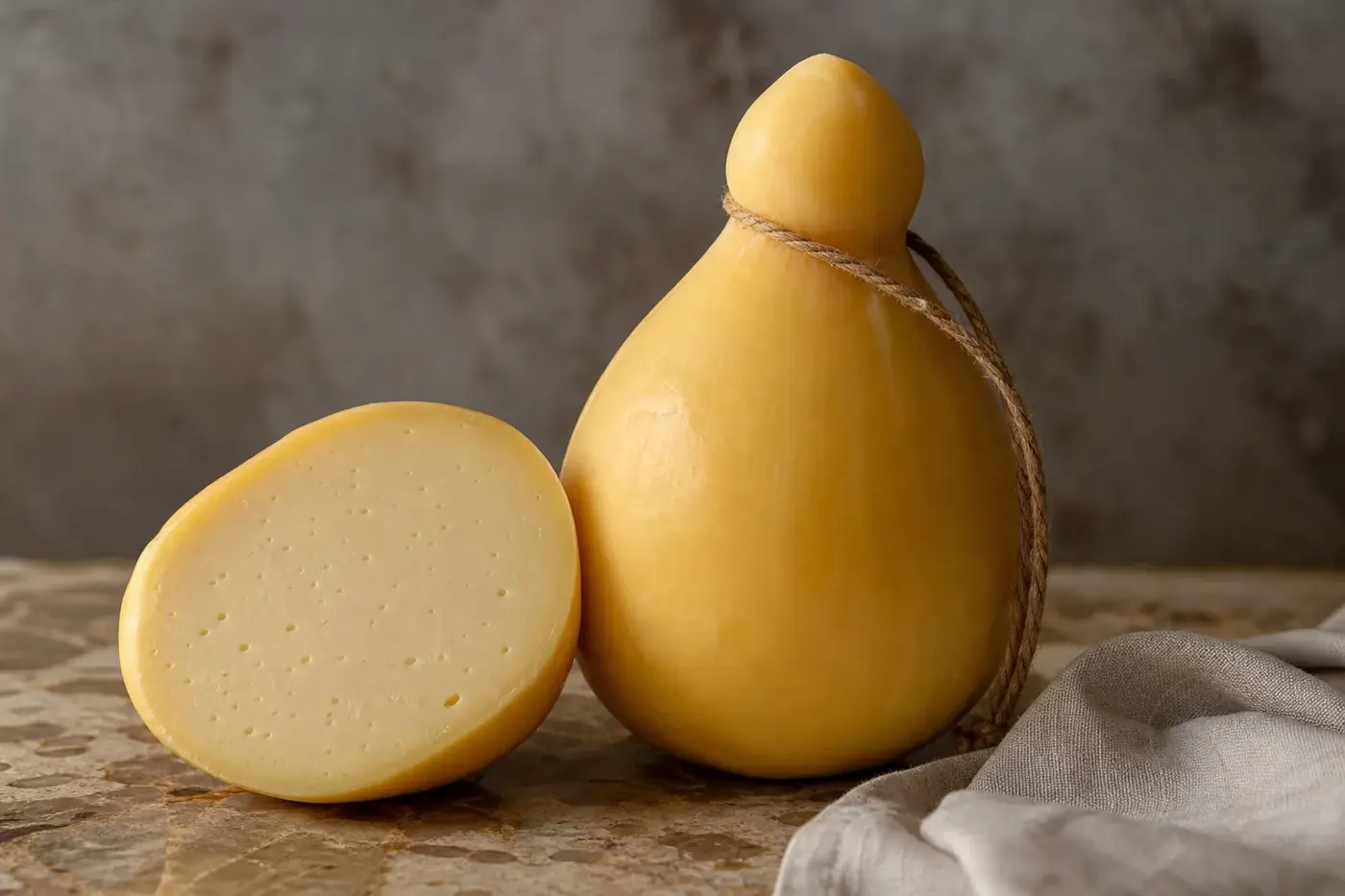
A long salami, a rounded melon, a pear or a truncated cone: you need not look for one silhouette to recognise Provolone Valpadana. Add a little spherical head to a pear and you have the flask-like fiaschetta. These are recognised shapes of the same cheese, not separate cheese names.[2]
Stretching gives cheesemakers freedom with size, too. The Trento atlas records examples from 500 g to great cheeses weighing 60 to 100 kg. That is a documented range of formats, not a fixed legal minimum and maximum, though some clearly require more commitment than your average cheese board.[4]
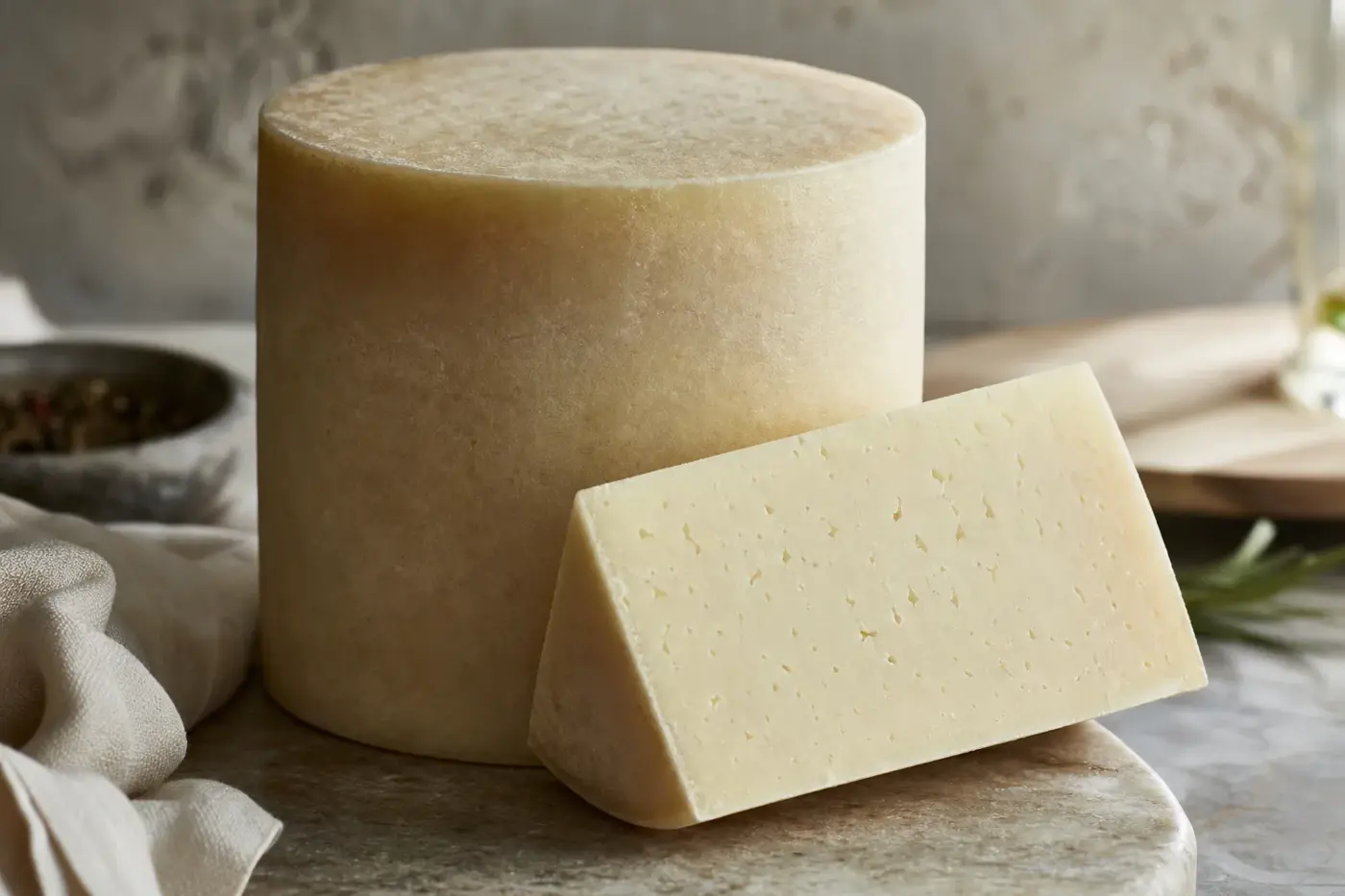
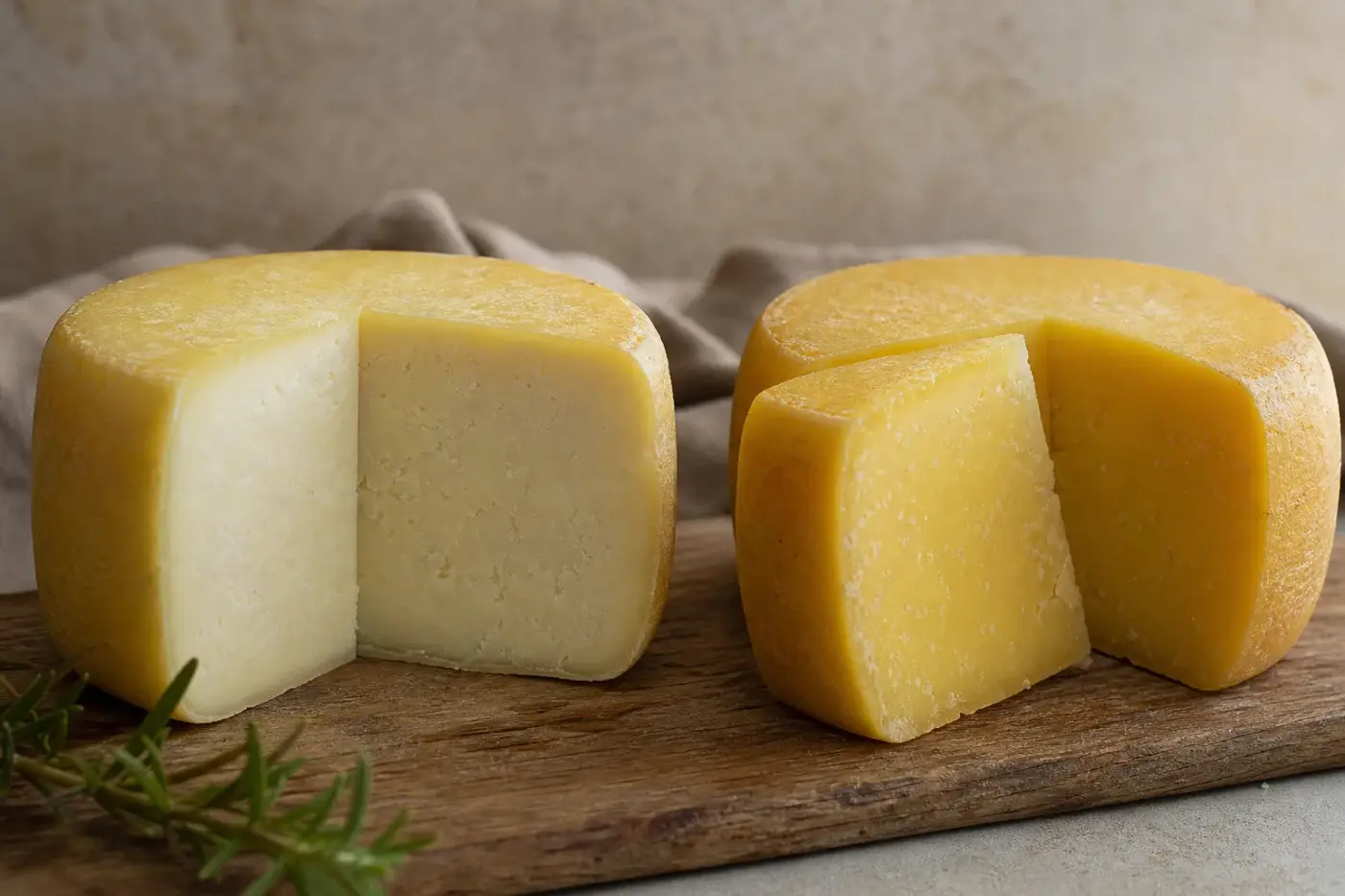
Look closer and the specification describes a thin, smooth rind, light yellow to golden and sometimes yellow-brown. Inside, the compact paste is generally pale straw, with occasional small holes; selected mature cheese is also described as white shading towards straw. More pronounced flaking develops with age.[1,2]
Dolce or Piccante? Let your appetite decide
The difference begins in the vat, not simply on the ageing calendar. Rennet choice works alongside maturation, so Dolce and Piccante are not merely the same cheese offered at different ages. For more on what goes into the vat, try rennet explained.[2]
| What you will notice | Dolce | Piccante |
|---|---|---|
| Rennet | Calf, with some lamb or kid permitted.[2] | Lamb and/or kid.[2] |
| Flavour | Delicate and milky.[1,4] | More pronounced, developing a sharp bite.[1,4] |
| Aroma described by the Trento atlas | Cooked milk and butter.[4] | Animal notes in longer-aged examples.[4] |
| Texture as it matures | Compact, with lighter flaking.[1,2] | More marked flaking as maturation advances.[1,2] |
| Usual age | Usually within three months.[3] | Often beyond three months; some exceed a year.[3,11] |
Cooked milk, butter, animal notes: the Trento atlas gives you useful clues to take to the cheese counter. Choose Dolce when you fancy gentler dairy character, Piccante when you want greater force. Ask for the age as well as the style, because both help explain the piece before you.[4]
Ageing starts with the scales
Here, the weight of the whole cheese matters. Under the current EU requirements, forms up to 6 kg need at least 10 days; those over 6 kg need at least 30 days. Piccante forms over 15 kg require at least 90 days: these are legal minima, distinct from the usual ages you encounter at the counter.[1]
The consortium describes Dolce as generally maturing within two to three months, while Piccante can carry on beyond a year. Keep that practical distinction alongside the rules based on weight. It does not mean every Piccante has a blanket three-month minimum.[3,11]
You may also encounter P.V.S., meaning Provolone Valpadana Stagionato, a further selection of mature Piccante. The specification provides for forms over 30 kg matured beyond eight months. To receive the additional mark, they undergo a technical assessment of appearance, paste, flavour and aroma.[1,2]
At the counter, ask for the full name
The complete name earns its place on your shopping list. Provolone is a broader description; in the EU, Provolone Valpadana is a PDO name governed by its specification. Neither a familiar shape nor the word “Italian” identifies it.[1,8,9]
Provolone del Monaco is a separate Italian PDO, centred on thirteen municipalities in the province of Naples. Its specification requires raw cows' milk, at least 20% from registered Agerolese cattle, and at least 180 days of maturation. Its prescribed melon or headless pear shape and 2.5 to 8 kg format belong to that cheese.[10]
You can recognise a family resemblance in their shared stretched curd heritage. The protected names nevertheless draw a clear distinction. Del Monaco has its own specification, rather than being a southern version of Provolone Valpadana.[8,10]
Choose a piece with supper in mind
Start with the full name, then look for the Dolce or Piccante designation and the age of the particular cheese. If you are buying a cut piece, ask to see the original identification or accompanying product information. Whole cheeses carry the denomination's identifying mark, while consumer packs must reproduce the product name and logo.[1,9]
Now picture how you want to serve it. For neat sandwich slices, ask for a younger piece with a compact cut face. For a board where the cheese takes centre stage, choose Piccante with a stated maturation; both styles can also be smoked, if you fancy that extra character.[1,3]
Give the outside your attention, too. The specification permits paraffin and protective plastic coverings, alongside authorised surface treatments. Ask which outer layers need removing, and discard string and any wax or plastic before serving.[2]
Keep it cool and serve what you need
Follow the pack's storage instructions and dates, including its directions after opening. For England, Wales and Northern Ireland, the Food Standards Agency's household guidance advises refrigerating dairy products and keeping the fridge between 0 and 5 °C (32 to 41 °F). Wrap the remaining cheese as its packaging directs.[7]
To take off the fridge chill, put out only the portion you intend to eat, shortly before the meal. The same agency advises keeping time outside refrigeration as short as possible, with a maximum of four hours, including preparation and display. For fuller handling guidance, see how to store cheese at home.[7]
Make room for both at the table
Give Dolce plain bread and ripe pear, allowing its gentler flavour some space. With Piccante, try apple or a small spoonful of fruit preserve. To compare them, taste Dolce first, then Piccante, noticing the changing aroma, bite and flaking; these suggestions draw on the contrast described by the Trento atlas.[4]
For sandwiches, try thinly sliced Dolce with roasted peppers or grilled courgettes, keeping the filling balanced. Use smaller amounts of Piccante with tomato or cooked greens when you want the cheese to speak more clearly. These pairing suggestions follow the documented differences between the styles.[1,4]
In the kitchen, start with Dolce in a toasted sandwich, stuffed vegetables or a layered potato bake. Try Piccante shaved or grated over pasta and vegetables, or folded into a filling that welcomes a stronger cheese flavour. Add it gradually and taste before adding more seasoning: these are cooking ideas, rather than site-tested recipes.
General information only, not medical advice: follow the official guidance where you live.
Questions people ask
What is the difference between Dolce and Piccante?
Dolce is delicate and milky, while Piccante has a more pronounced flavour and a sharp bite. Dolce uses calf rennet, with some lamb or kid permitted; Piccante uses lamb and/or kid rennet.
Is Provolone Valpadana made with pasteurised milk?
It can be made with raw, thermised or pasteurised whole cows’ milk. Check the particular product’s declaration, as the PDO name does not identify the treatment used.
Where is Provolone Valpadana made?
Its protected production area covers defined parts of northern Italy, including the whole provinces of Cremona, Brescia, Verona, Vicenza, Rovigo, Padova and Piacenza. It also includes specified municipalities in Bergamo, Mantova and Lodi, and defined territory in the Autonomous Province of Trento.
Is Provolone Valpadana the same as Provolone del Monaco?
No, they are separate Italian PDO cheeses with their own specifications. Provolone del Monaco is centred on thirteen municipalities in the province of Naples and requires raw cows’ milk.
How should I store Provolone Valpadana?
Follow the pack’s storage instructions and dates. For England, Wales and Northern Ireland, the Food Standards Agency advises refrigerating dairy products at 0 to 5 °C and keeping time outside refrigeration as short as possible, with a maximum of four hours including preparation and display; see its household guidance.
Sources
- European Commission. Publication of the communication of an approved standard amendment to a product specification of a geographical indication, Provolone Valpadana, C/2026/3255, published 22 June 2026. Includes the amended single document, reference PDO-IT-0021-AM04. Official text and single document.
- Italian Ministry of Agriculture, Food Sovereignty and Forestry. Disciplinare di produzione della DOP «Provolone Valpadana», consolidated annex to the decree of 22 June 2023, reproduced by the consortium. Used for the detailed production provisions, read alongside the subsequent 2026 EU communication. Specification and decree.
- Consorzio Tutela Provolone Valpadana. Manuale di corretta prassi operativa, 2008 version. Used for the descriptive production sequence and typical maturation patterns, not as the current legal specification. Operational manual.
- Autonomous Province of Trento. Atlante dei prodotti agroalimentari del Trentino, Provolone Valpadana entry, undated online edition. Used for the institutional historical account, documented formats and attributed aroma descriptions. Official atlas.
- Department for Environment, Food & Rural Affairs. Provolone Valpadana, UK protected food names register, published 4 January 2021, live entry checked November 2026. Register entry.
- Department for Environment, Food & Rural Affairs. Protected geographical food and drink names: UK GI schemes, updated 8 March 2024. Official jurisdiction guidance.
- Food Standards Agency, GOV.UK. How to chill, freeze and defrost food safely, published 18 December 2017, live guidance checked November 2026. Applies to England, Northern Ireland and Wales. Official household guidance.
- Consorzio Tutela Provolone Valpadana. Disciplinare di produzione del Provolone Valpadana D.O.P., undated explanatory page, checked November 2026. An industry body's explanation of the designation and traceability requirements. Consortium explanation.
- Consorzio Tutela Provolone Valpadana. Il marchio del Provolone Valpadana D.O.P. è una coccarda, undated identification page, checked November 2026. Read alongside the current EU single document's labelling provisions. Product identification.
- Italian Ministry of Agriculture, Food Sovereignty and Forestry. Disciplinare di produzione della denominazione di origine protetta «Provolone del Monaco», edition currently linked from the ministry's cheese specifications directory, checked November 2026. Official specifications directory, Provolone del Monaco attachment.
- Consorzio Tutela Provolone Valpadana. La stagionatura del Provolone Valpadana richiede maestria e pazienza, undated. The retrieved excerpt confirms that Piccante can mature beyond twelve months. Maturation account.
This desk-researched article compares the published production rules with institutional history and consortium descriptions, separating statutory maturation minima from typical maturation and editorial serving suggestions.
Last checked: November 2026
Last checked November 2026.
The editors suggest you read next
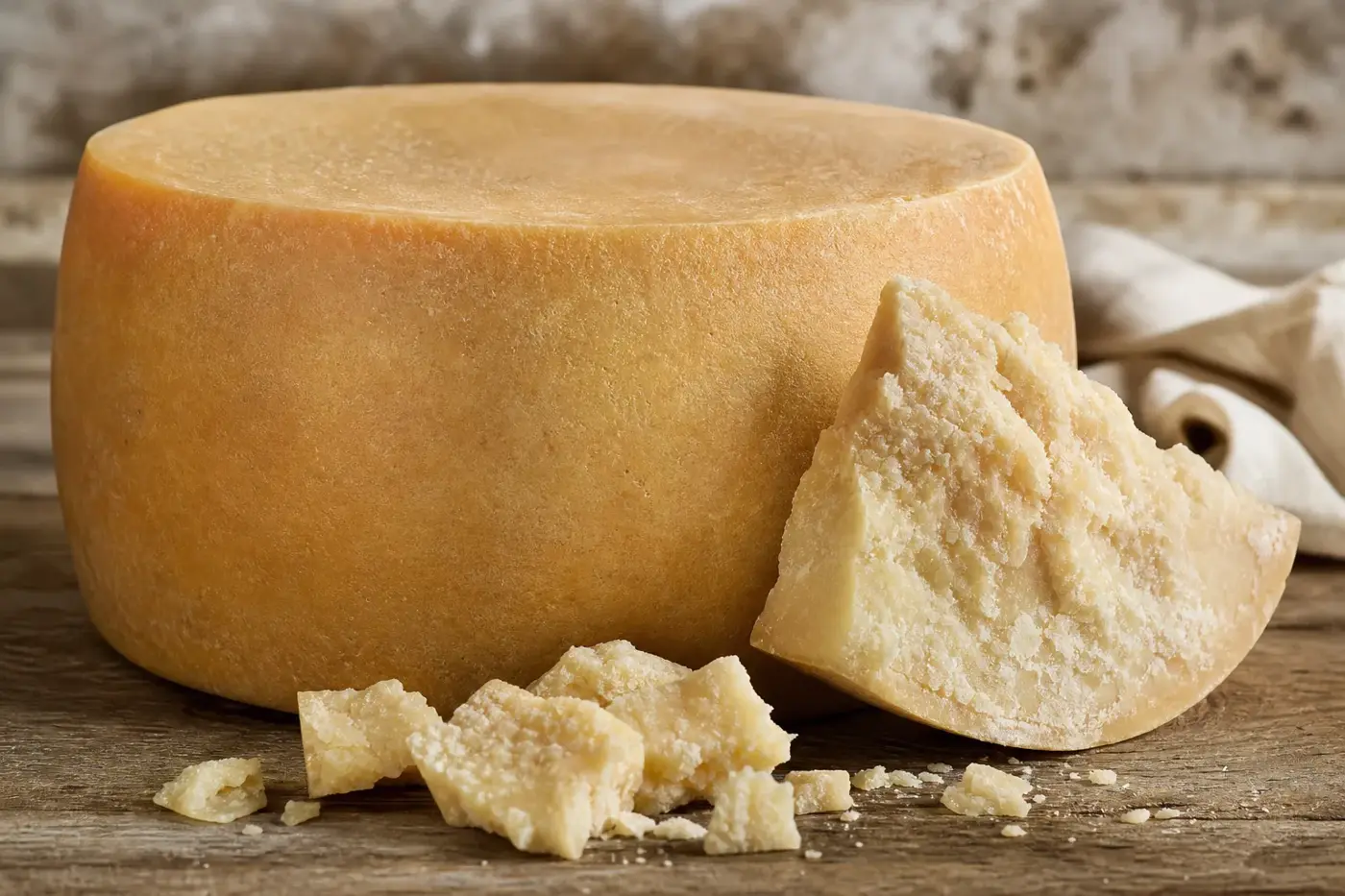
Parmigiano Reggiano
Break into a wheel of Parmigiano Reggiano and flakes fall away, revealing a finely granular cheese, pale straw to straw in colour.