Provolone del Monaco
Two people, one mass of curd, and a good deal of twisting.
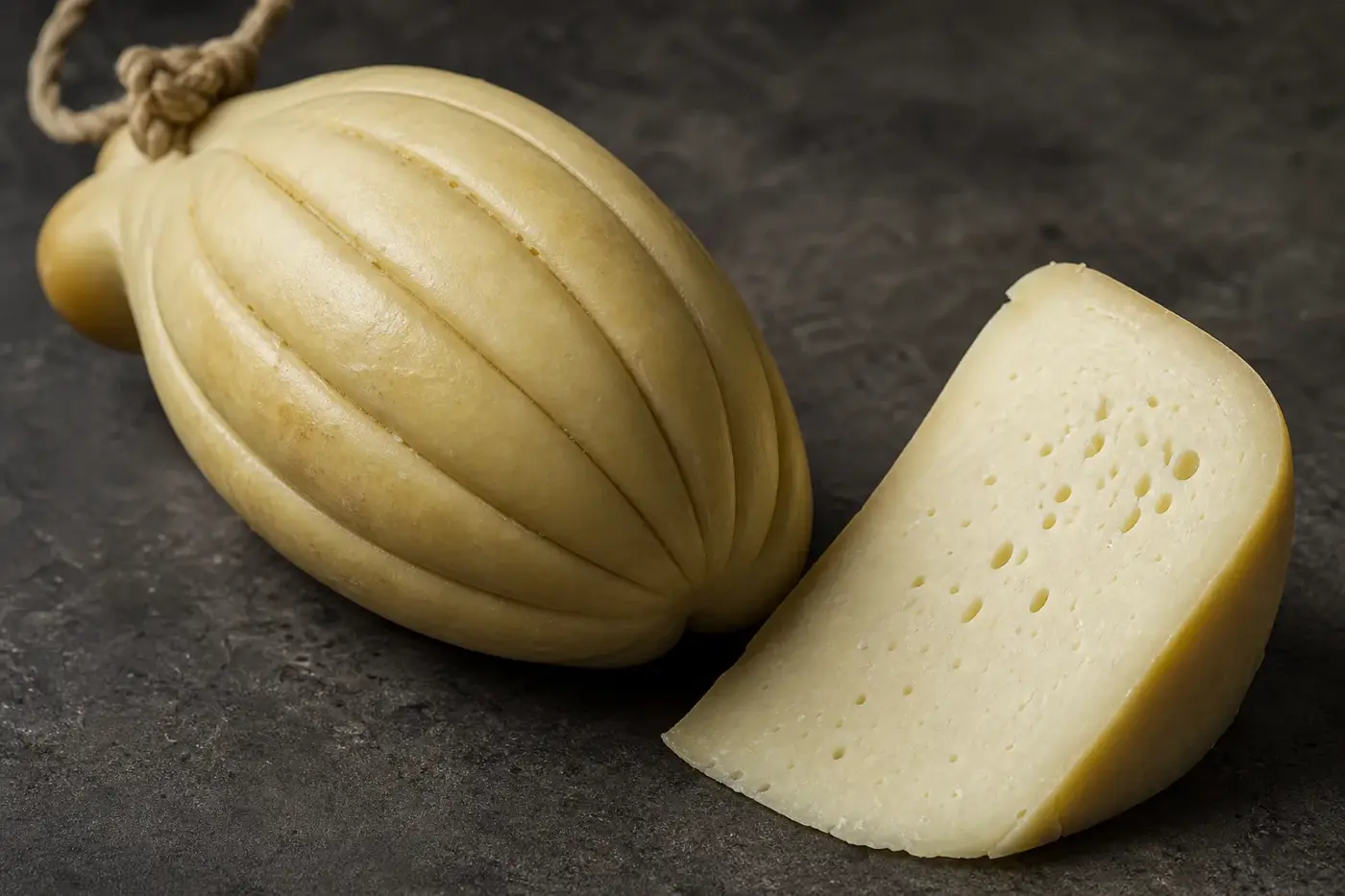
Two people, one mass of curd, and a good deal of twisting. Making Provolone del Monaco can be a shared undertaking. Shaped into a grooved pear or elongated melon, tied in pairs and hung to mature, this Campanian cows’ milk cheese carries its working life on its rind.[1][2]
Follow it home and you reach the mountain pastures of the Sorrentine peninsula. Its EU protected designation of origin brings together local milk, an Agerolese breed requirement and at least six months of ageing. You can read something of that story before your knife reaches the cheese.[1][2]
| At a glance | The details |
|---|---|
| Name | Provolone del Monaco.[1] |
| EU registration authority and act | European Commission, Regulation (EU) No 121/2010, adopted 9 February 2010.[1][5] |
| EU register ID | Not established here. |
| EU protection status | Current register status not established here. |
| Northern Ireland protection status | Not established here. |
| Switzerland protection status | Not established here. |
| US protection status | Not established here. |
| Great Britain | Registered PDO; scheme registration 31 December 2020 at 23:00; register information dated November 2026.[5] |
| Milk | Raw cows’ milk; at least 20% from registered Agerolese cattle.[1] |
| Minimum ageing | 180 days, described as six months.[1] |
| Whole cheese weight | 2.5 to 8 kg.[1] |
| Minimum fat | 40.5% fat in dry matter.[1] |
| Named product rennet | Recco declares kid rennet paste.[3] |
Follow the cheese from mountain pasture to Sorrento
Head towards Provolone del Monaco’s home and you find upland grazing country beside the coastal settlements around Sorrento. The Monti Lattari and the Sorrentine peninsula frame the landscape. Campania’s regional agriculture department links the cheese’s character to local milk, cheesemaking practice and the microclimate of its maturing rooms.[2]
This is a place with a precise boundary. It covers the entire territories of 13 municipalities: Agerola, Casola di Napoli, Castellammare di Stabia, Gragnano, Lettere, Massa Lubrense, Meta, Piano di Sorrento, Pimonte, Sant’Agnello, Sorrento, Santa Maria La Carità and Vico Equense. Cattle rearing, cheesemaking and maturation must all take place within it.[1]
At the counter, distinguish the place of sale from the place of production. A seller’s address in Naples tells you where the cheese is sold, not its whole journey. Ask for the producer and full cheese name, especially if you are looking at a cut portion.
Meet the Agerolese cattle behind your slice
At least 20% of the milk must come from Agerolese cattle entered in the breed register. That means the milk itself, not simply the proportion of Agerolese animals in a dairy’s herd. Nor does it mean every cheese must be made entirely from Agerolese milk.[1]
The remaining milk may come from other cattle named in the specification, including Friesian, Brunalpina, Pezzata Rossa, Jersey, Podolica and local crosses. All must be reared within the defined area. Campania’s regional account describes Agerolese cattle as relatively modest milk producers, but gives them a central place in the area’s dairy tradition.[1][2]
The cloaked cheesemakers behind the name
Picture an early morning sea journey to Naples, with cold and damp making a coarse cloak very welcome. Campania’s agriculture department records a local explanation for the name: travelling cheesemakers wore cloaks resembling monks’ habits. Market workers supposedly called the sellers monks, and the name passed to their cheese. Monaco means monk in Italian.[2]
Treat that as local tradition rather than a dated eyewitness account. The formal paperwork offers a more precisely dated story: an Italian decree of 9 February 2009 refers to national transitional protection originally granted on 11 July 2005. It also refers to a revised specification sent to the European Commission in January 2009.[9]
EU registration followed through Commission Regulation (EU) No 121/2010, adopted on 9 February 2010. Defra gives 11 February 2010 as the original EU registration date. These mark different moments: adoption of the regulation and registration.[1][5]
A stretch of curd, and sometimes a helping pair of hands
Provolone del Monaco belongs to the pasta filata family. Its curd, the coagulated milk solids, is worked into a stretchable mass before shaping. Campania’s production account follows coagulation and breaking the curd into small grains, then heating, stretching, shaping, salting, drying and maturation.[2][3]
For its Provolone del Monaco, Recco declares kid rennet paste. If the coagulant matters to your choice, read the declaration for the named product. You can explore the differences in rennet explained.[3]
Recco’s technical sheet describes heating the broken curd beneath whey, the liquid separated from it, then draining it before stretching. It gives a 20 hour drainage stage. Setting milk into curd and working that curd into a stretched structure are separate jobs, not different names for the same task.[3]
Stretching takes skill and, according to Campania’s account, may need two people to twist the curd. The shaped cheeses are then tied in pairs for suspension. Those grooves on the finished cheese are more than decoration: you are seeing the marks of working and hanging.[2]
Read the rind before you choose your wedge
Look for a slightly elongated melon or a pear without a little head. These are the shapes described in the specification. Raffia bindings press lengthways into the rind, dividing its surface into at least six faces.[1]
Together, shape and bindings tell you more than “pear shaped” alone. Several southern Italian cheeses could fit that description. A pear shape, in other words, is not much of a passport.[1]
Recco describes a thin, yellowish rind around a compact, elastic and uniform interior, dotted with small “partridge eye” openings. Ask to see both the rind and the cut face when you buy a wedge. They give you different views of the cheese’s structure.[3]
Taste the butter, then wait for the bite
Sweet and buttery, with a light piquant edge: that is the official flavour description. Campania’s account adds an intense aroma, linked to the local grazing and maturing environment. Give your first piece a little attention before reaching for anything else on the board.[1][2]
After seven to eight months, the specification describes a yellower, more piquant cheese with a thicker rind. The interior becomes firmer but remains fairly soft and free of flaking. Age gives you a useful guide to the choice between gentler and more yielding, or firmer with more bite.[1]
Ask for the actual age rather than letting a darker rind choose for you. A younger example suits a board where you want gentler flavour. A longer aged cheese can bring a sharper contribution to a dish.
Get to know the name on the label
DOP stands for Denominazione di Origine Protetta, the Italian counterpart of PDO, protected designation of origin. Provolone del Monaco also appears as registered in Great Britain’s official register, with register information dated November 2026. Its GB scheme registration is dated 31 December 2020 at 23:00.[1][5]
If you are buying a cut piece, ask your cheesemonger to show you the originating label or whole cheese identification. For current identification and labelling requirements, turn to the operative specification.
Appearance is only one part of traceability. Agroqualità’s 2023 control plan sets out documentary, inspection and analytical checks across milk production, collection, cheesemaking and maturation. These include label checks and assessments of shape, colour, flavour and openings, alongside fat in dry matter.[4]
The plan requires a statement that the product is certified by a control body authorised by the competent ministry, followed by ITALIA or the Italian flag. Read those details alongside the exact name and producer. A flag alone tells you less; protected names explained takes you through the wider system.[4]
Choosing between Monaco, Valpadana and caciocavallo
The shared word “provolone” does not make two cheeses interchangeable. Provolone Valpadana is a separate designation, and its consortium presents dolce, piccante, smoked and matured products as distinct options. Compare the exact designation, age and maker rather than expecting the same character.[6]
With caciocavallo, ask which named cheese you are being offered, where it was made and how long it matured. Similar shapes do not establish shared production requirements. If your recipe calls for Provolone del Monaco, another cheese is an adaptation rather than an equivalent.
Make a little room on your plate
Begin with a small piece on its own, then try it with plain bread. Let the cheese have its say before a strongly flavoured preserve joins the conversation. Its piquancy will help you judge how much contrast you want.
Keep accompaniments simple until you know that particular age and batch. You are choosing partners for the piece in front of you, not just the name on its label. The preserve can wait its turn.
For wine, try a dry Campanian white such as Fiano with a gentler cheese, or a restrained red with a more piquant example. These are starting points, not marching orders. The cheese and wine pairing guide explains the principles and offers further guidance; water and plain bread provide an alcohol free alternative.
Wine suggestions are for adults of legal drinking age, and servings should stay small. People who are pregnant, driving, taking medicines that interact with alcohol, or recovering from alcohol dependence should not drink.[10] In the kitchen, Campania’s regional account recommends Provolone del Monaco for pasta e patate, pasta with potatoes, either grated or in thin shavings.[2]
Choose your piece, then give it a cool home
Before buying, ask three questions: who made it, how long did it mature, and what does the seller recommend after cutting? Choose your piece for the job you have in mind. A wedge suits slicing at the table; for cooking, ask for a piece suited to grating.
Keep the label and its storage instructions. At home, follow the pack’s advice rather than giving every piece the same keeping time. Pay attention to instructions for storage after opening, too.
The UK Food Standards Agency advises keeping your fridge at 5 °C or below and using a fridge thermometer to check its actual temperature. Protect the cut face with its wrapping or a suitable food container. Keeping the cheese cool and properly protected matters.[7][8]
Take out only what you expect to serve shortly, leaving the rest refrigerated. In hotter than usual weather, UK government guidance advises keeping food out for no longer than two hours and discarding perishables left out beyond that. Keep your board shaded and use a cool bag for the journey home in hot weather.[8]
For wrapping and fridge organisation, turn to how to store cheese at home. For help understanding the information that comes with your piece, see how to read a cheese label.
General information only, not medical advice: follow the official guidance where you live.
Questions people ask
Where is Provolone del Monaco made?
It comes from the Monti Lattari and Sorrentine peninsula in Campania. Cattle rearing, cheesemaking and maturation must all take place within a defined area covering 13 municipalities.
What milk and rennet are used in Provolone del Monaco?
It is made from raw cows’ milk, at least 20% of which must come from registered Agerolese cattle. Recco declares kid rennet paste for its Provolone del Monaco, so check the declaration for the particular product.
How long is Provolone del Monaco aged, and what does it taste like?
It is aged for at least 180 days, described as six months. Its flavour is sweet and buttery with a light piquant edge, becoming more piquant after seven to eight months.
How can I serve Provolone del Monaco?
Try a small piece on its own, then with plain bread. Campania’s regional agriculture department also recommends it grated or shaved over pasta e patate.
How should I store Provolone del Monaco?
Follow the pack’s storage instructions and protect the cut face with its wrapping or a suitable food container. The UK Food Standards Agency advises keeping the fridge at 5 °C or below and using a fridge thermometer; see its guidance for more details.
Sources
- Italian Ministry of Agricultural, Food and Forestry Policies. Provvedimento 19 febbraio 2010: Iscrizione della denominazione «Provolone del Monaco», with the production specification and summary. Gazzetta Ufficiale, Serie generale No 56, 9 March 2010, printed pages 28 to 40. Official publication.
- Regione Campania, agricultural department. Provolone del monaco DOP. Undated regional product account, accessed November 2026. Regional account.
- Provoloni Recco. Provolone del Monaco DOP, technical product sheet, undated. Producer evidence for its declared ingredients, process and product characteristics; the producer has a commercial interest. Product sheet.
- Agroqualità. Dispositivo per il controllo di conformità della DOP Provolone del Monaco, DC revision 00, 10 October 2023. Control plan.
- Department for Environment, Food & Rural Affairs. Provolone del Monaco, Great Britain protected food name register entry, published 4 January 2021, accessed November 2026. Register entry.
- Consorzio Tutela Provolone Valpadana. Official website and product navigation, undated, accessed November 2026. Industry consortium evidence for the product categories it presents. Consortium website.
- Food Standards Agency. Storing chilled foods at incorrect temperatures, consumer guidance document, accessed November 2026. Guidance document.
- UK government. Food safety in a heatwave: advice for consumers, current online version accessed November 2026. Official guidance.
- Italian Ministry of Agricultural, Food and Forestry Policies. Decreto 9 febbraio 2009: Modifica del decreto 11 luglio 2005, concerning transitional national protection for Provolone del Monaco. Gazzetta Ufficiale, No 46, 25 February 2009. Official decree.
Researched through official Italian publications, regional documentation, the GB register, certification records, a producer’s technical declaration and UK consumer guidance; serving and wine suggestions are editorial judgement.
Last checked: November 2026
Last checked November 2026.
The editors suggest you read next
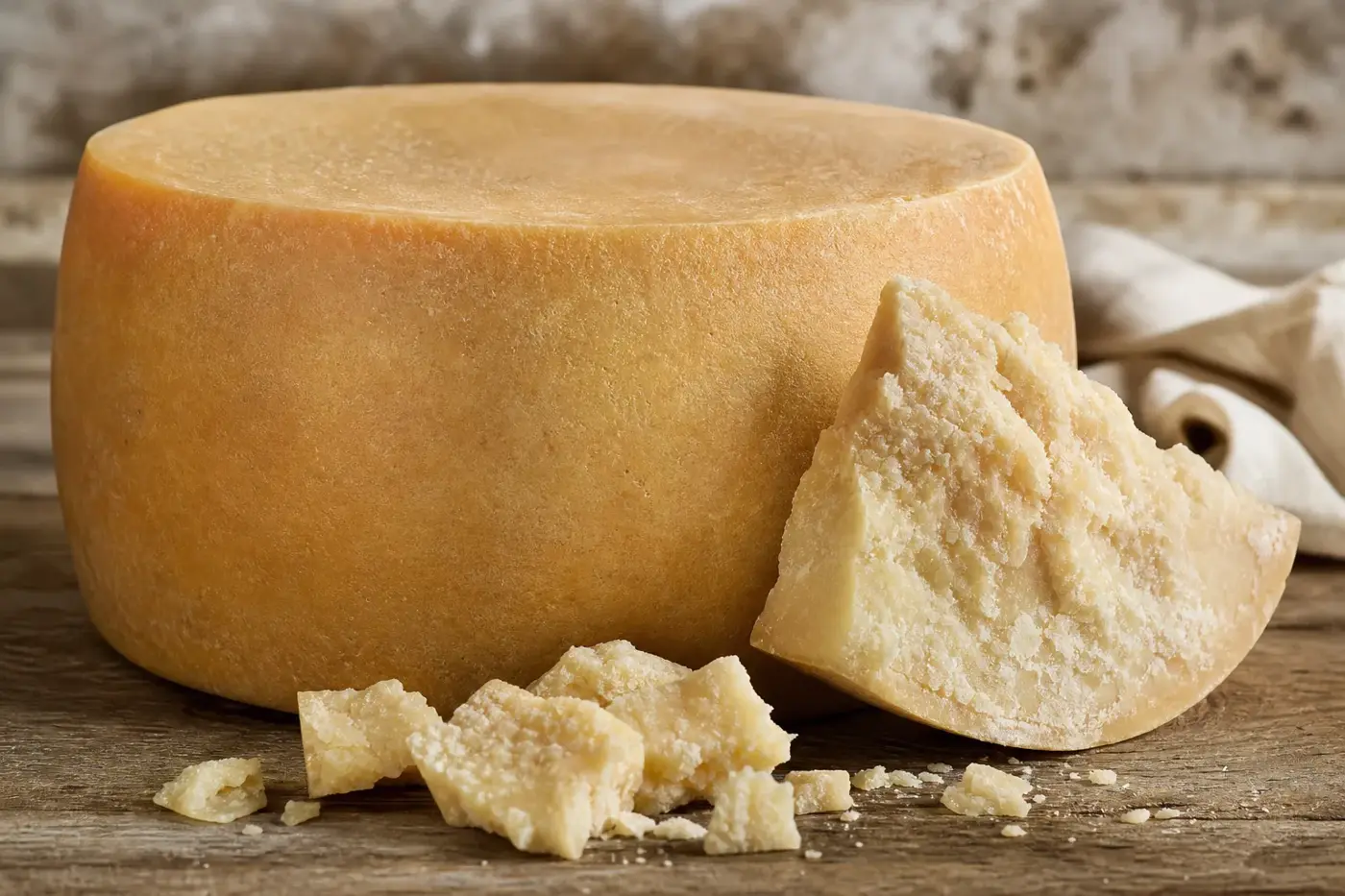
Parmigiano Reggiano
Break into a wheel of Parmigiano Reggiano and flakes fall away, revealing a finely granular cheese, pale straw to straw in colour.