Provolone
Picture more than 30 kg of cheese hanging in cords, their marks pressed into its smooth rind.
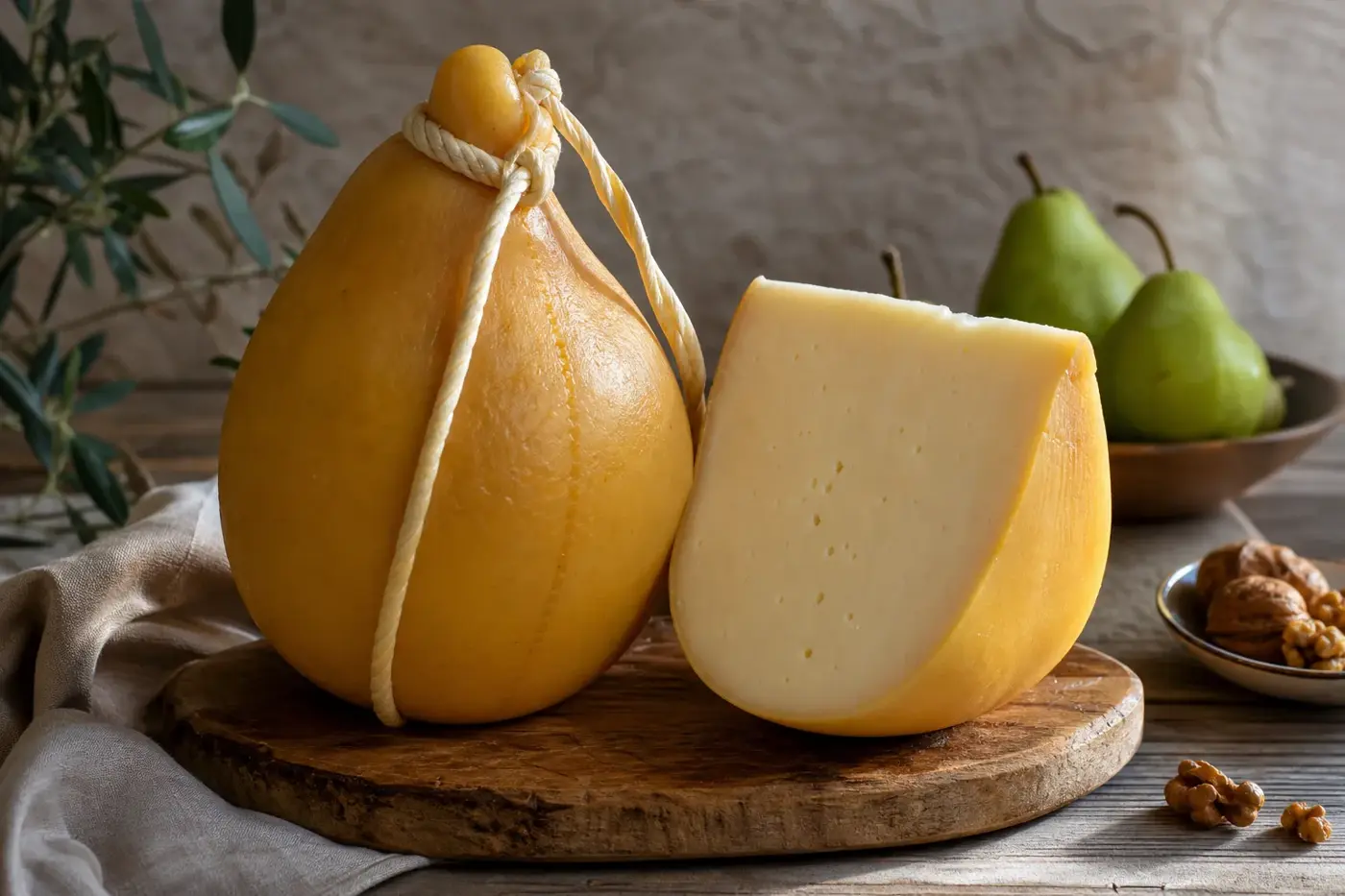
Picture more than 30 kg of cheese hanging in cords, their marks pressed into its smooth rind. Inside is straw-yellow curd, heated, stretched and shaped into something rather grand. You might need to reconsider the space you left in the fridge.
This cow’s milk cheese carries southern Italy’s pasta filata tradition into the dairies of the Po Valley. Its flavours run from mild dolce to sharper piccante, following a rhythm of stretching, shaping, salting and maturation. [1,2,6]
Provolone at a glance, before your first slice
| What you want to know | The essentials |
|---|---|
| What kind of cheese? | A cheese family defined by pasta filata, the stretched-curd method. [6] |
| Which milk? | Traditionally cow’s milk; both Italian PDO examples below use cow’s milk. [3,6] |
| Which styles? | Dolce, piccante and smoked. [1] |
| Names worth knowing | Provolone Valpadana and Provolone del Monaco, registered PDOs in Great Britain as of November 2026. [4,5] |
| How long does it mature? | There is no single minimum across the family; named specifications set their own requirements. [1,3] |
Follow a southern craft to the Po Valley
Provolone’s northern chapter begins after Italian unification. Emilia-Romagna’s regional agriculture authority traces its development there to the spread of southern Italian pasta filata cheesemaking in the second half of the nineteenth century. The craft found a promising home, with plentiful cow’s milk and a strong dairy industry. [2]
You have, then, a cheese with southern technique and a best-known production area in the north. The Provolone Valpadana specification connects its Po Valley development to forage, milk supply and local cheesemaking skills. Meanwhile, the south keeps its own story alive through the separate Provolone del Monaco tradition around the Sorrento peninsula. [1,3]
Watch the curd stretch into shape
Stretching gets the attention, but first the curd has to be ready. Rennet, the coagulant that sets milk, produces curd: the solids separated from liquid whey. For Provolone Valpadana, a natural whey starter supplies the fermentation culture, and the curd acidifies before stretching begins. [1]
Then comes filatura, the operation that defines the family. The acidified curd is heated and worked into a cohesive, stretchable mass, then shaped by hand or with moulds. Water cools and firms the cheese before its brine bath. Under the Valpadana specification, the cheese’s size determines how long that bath lasts. [1,6]
After salting comes maturation under controlled conditions. Stretching gives these cheeses their family resemblance; milk treatment, rennet, shape and maturation give each its own character. You can follow the wider journey in how cheese is made. [1,3]
Dolce or piccante: find your kind of flavour
Dolce points you towards mildness; piccante brings a more pronounced, pungent character. For Provolone Valpadana, rennet helps draw that distinction, alongside maturation. The specification describes a delicate flavour up to three months, with pungency increasing through longer maturation or the use of kid or lamb rennet. [1]
| What makes the difference | Valpadana dolce | Valpadana piccante |
|---|---|---|
| Rennet | Calf; some lamb or kid rennet permitted. [1] | Kid and/or lamb. [1] |
| Permitted milk treatment | Up to pasteurisation. [1] | Up to pasteurisation at weights up to 6 kg; up to thermisation for larger piccante cheeses. [1] |
These are the options permitted by the Italian specification, not a description of every cheese you will encounter. For the story of yours, read the label or ask the maker. Thermisation and pasteurisation are different heat treatments; milk treatments explains the distinction. [1]
Age changes texture as well as flavour. The specification describes a compact paste, with layering that becomes more marked during maturation. Think about what you want from your cheese: a pliable sandwich slice and a mature shaving over vegetables offer quite different pleasures. [1,7]
Meet the pears, melons and 30 kg giants
That tidy cylindrical slice at the counter may have started life as something much larger. The Valpadana specification allows long salami-like forms, rounded melons, truncated cones and pears, with formats exceeding 30 kg. Cords can leave indentations on the surface. This is a cheese family with a fairly adventurous wardrobe. [1]
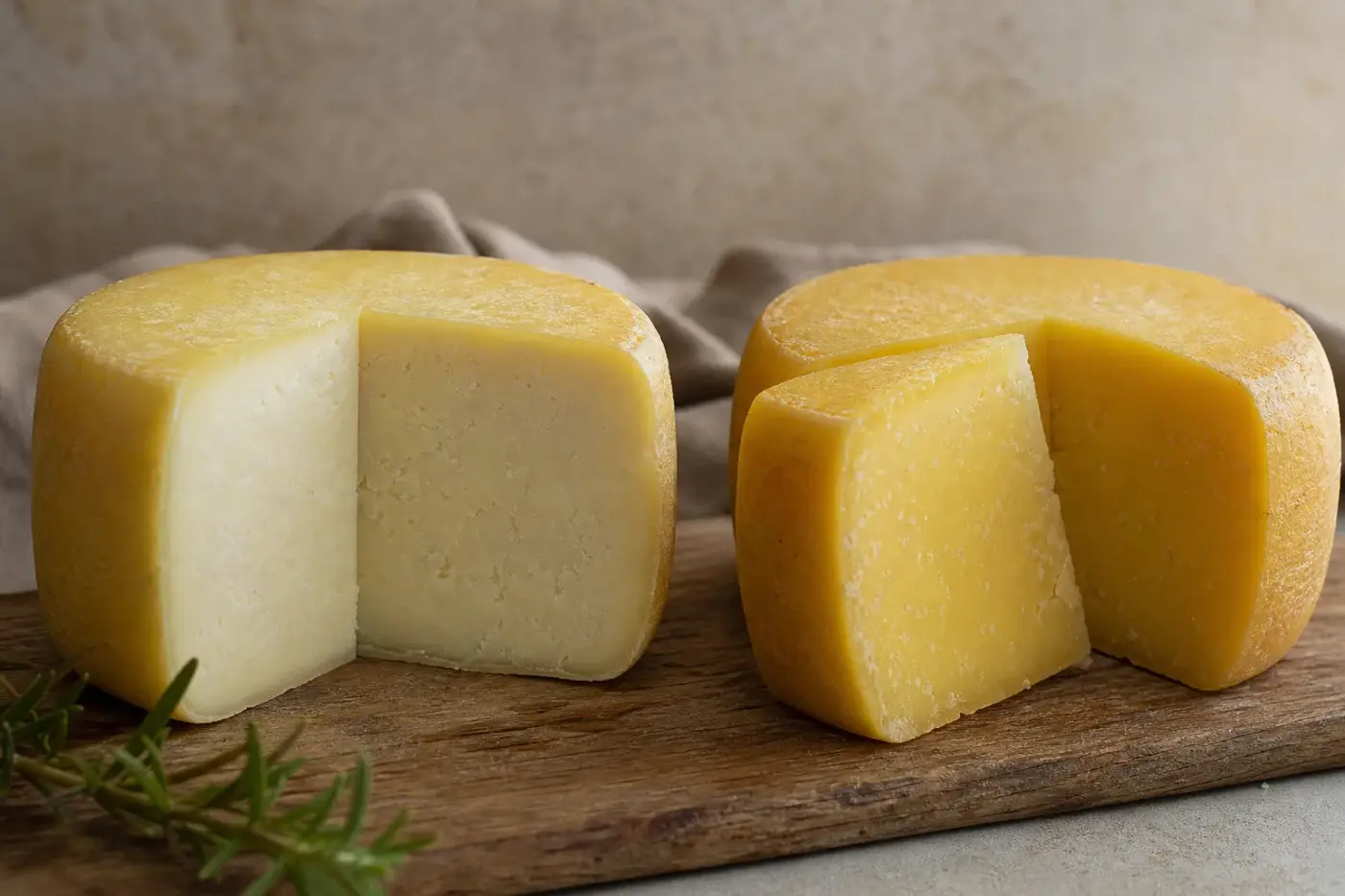
The same specification describes a thin, smooth rind, ranging from pale yellow to golden or yellow-brown, around straw-yellow paste. Smoking is optional, while paraffin and protective plastic packaging are permitted. Before eating any rind, follow the producer’s instructions and remove wax, plastic and ties. Rind colour alone tells you little about milk treatment. [1]
Get to know two protected names and their homes
Look closely at the full name when you buy. Provolone Valpadana and Provolone del Monaco are separate protected designations of origin, or PDOs, on the Great Britain register as of November 2026. Their records give the original EU registration dates as 21 June 1996 and 11 February 2010 respectively. [4,5]
Provolone Valpadana’s legally defined northern area covers specified territory in Lombardy, Veneto, Emilia-Romagna and Trento. Its permitted shapes and maturation rules accommodate very different sizes. The Italian specification requires at least ten days for cheeses up to 6 kg, thirty days above 6 kg, and ninety days above 15 kg for piccante. The P.V.S. category above 30 kg needs more than eight months. [1]
Head south and you find Provolone del Monaco in thirteen municipalities in the province of Naples. It requires raw cow’s milk, at least 20% from Agerolese cattle, and at least 180 days of maturation. Its elongated melon or headless pear shapes weigh 2.5 to 8 kg. Inside, the specification describes cream-coloured paste with yellowish tones and characteristic eyes, plus a sweet, buttery flavour with light pungency. [3]
You will also meet cheeses called provolone outside these two PDO registrations. The dedicated entries are Provolone Valpadana and Provolone del Monaco. To untangle a cheese style from a registered geographical name, turn to protected names explained.
Take three good questions to the cheese counter
Start with the complete product name and where the cheese was made. A packer’s or distributor’s address is not the same as its place of manufacture. For either PDO, compare the full designation with the register entry. The word provolone or an Italian-looking design cannot stand in for that name. [4,5]
Keep milk treatment, coagulant and style separate in your mind. Dolce describes flavour, not pasteurisation or vegetarian suitability. Read any stated maturation alongside the style description, and ask the maker about missing details. Your seller should explain this particular cheese, rather than borrow another provolone’s rules. [1,3]
Ask three questions: where was this cheese made, which milk treatment was used, and how long was it matured? If you are cooking, explain the task, whether you need slices for layering or a little mature cheese for finishing. Buying a cut piece? Ask to see the original label, so you can choose on the strength of the cheese in front of you.
Give dolce and piccante their moments at the table
Try mild provolone sliced with tomatoes, basil and bread. Or shave a mature example over roasted peppers, beans or pasta. These pairings follow the documented range from mild to pungent. Let the milder cheese sit alongside the other ingredients, and use the stronger one as an accent. [1]
For a toasted sandwich or vegetable bake, dolce is a useful place to start, layered in slices. Choose piccante when you want the cheese flavour to stay noticeable among the other ingredients. Slice or grate to suit your dish, and taste the other ingredients before adding salt. Style gives you a better starting point than shape alone.
For an alcohol-free pairing, try sparkling water with dolce to keep things quiet, or unsweetened black tea with piccante for a contrasting dry finish. Pears or plain bread make useful companions when you compare two maturities. Taste the milder cheese first, before the stronger one takes over.
Keep it covered, and serve a little at a time
At home, the Food Standards Agency’s guidance for England, Wales and Northern Ireland recommends a fridge between 0 and 5 °C (32 to 41 °F). Keep your provolone covered, follow the pack’s storage instructions and retain its date information. Reclose the original packaging where practical. Otherwise, protect the cut face with food-contact wrapping and place it in a clean, covered container. [8]
Bring out a modest portion to serve and leave the rest refrigerated. The FSA advises keeping chilled food out of the fridge for the shortest possible time during preparation. Follow the pack’s storage instructions for that particular cheese. [8]
A use-by date is about safety: the FSA says not to eat food after it, even if it looks or smells acceptable. If unexpected mould appears, consult current official food safety guidance before deciding what to do, and follow any recall notice affecting the product. For fuller handling advice, read how to store cheese at home. [9,10]
This page summarises published guidance from the official sources it cites. It is not medical advice. Guidance differs between countries and changes over time, so check the current source for where you live, and ask your doctor, midwife, pharmacist or dietitian about your own circumstances.
Vegetarian diets and pregnancy: find the details that matter
Animal rennet is central to both Italian specifications here. Valpadana uses calf, kid or lamb rennet; del Monaco permits kid paste rennet and calf rennet. If you follow a vegetarian diet, look for an explicit suitability statement on the particular product and confirm the coagulant with its maker. The guide to rennet explains the different sources. [1,3]
For pregnancy in the UK, the NHS lists pasteurised semi-hard cheeses among foods that can be eaten, alongside pasteurised or unpasteurised hard cheeses. It also advises that any cheese cooked until steaming hot can be eaten. Match the actual cheese’s milk treatment and category to that guidance, rather than deciding from the name provolone alone. [11]
That distinction matters especially when you compare a labelled pasteurised product with a raw-milk PDO. Consult the NHS page for the full UK advice; the guidance referenced here is from November 2026. Elsewhere, use your national agency’s guidance, and ask your midwife, doctor or dietitian about your individual circumstances. [11]
A little more reading for your next cheese shop visit
- How to Read a Cheese Label: find your way around the information on an unfamiliar pack.
- Mould on Cheese: When to Cut and When to Bin: explore the separate question of unwanted mould.
Questions people ask
What is provolone made from?
Provolone is traditionally made from cow’s milk. Its defining method is pasta filata, in which curd is heated and stretched before shaping.
What is the difference between dolce and piccante provolone?
Dolce is mild, while piccante has a more pronounced, pungent character. In Provolone Valpadana, rennet and maturation both contribute to the difference.
Is provolone suitable for vegetarians?
Both Italian PDO specifications described on the page use animal rennet. Look for an explicit vegetarian suitability statement on the particular product and confirm the coagulant with its maker.
Can you eat provolone during pregnancy?
The NHS lists pasteurised semi hard cheeses and pasteurised or unpasteurised hard cheeses among foods that can be eaten. It also advises that any cheese cooked until steaming hot can be eaten. Check the cheese’s milk treatment and category against the full advice on the NHS page.
How should provolone be stored?
Keep provolone covered, follow the pack’s storage instructions and retain its date information. The Food Standards Agency recommends a fridge temperature between 0 and 5 °C for households in England, Wales and Northern Ireland.
Sources
- Italian Ministry of Agriculture, Food Sovereignty and Forestry, Decreto 22 giugno 2023: Modifiche ordinarie al disciplinare di produzione della denominazione di origine protetta «Provolone Valpadana», including consolidated specification, Annex A, 2023. Official Gazette facsimile hosted by the consortium.
- Regione Emilia-Romagna, Provolone Valpadana Dop, regional agriculture reference page, undated version retrieved November 2026.
- Italian Ministry of Agriculture, Food Sovereignty and Forestry, Disciplinare di produzione della denominazione di origine protetta «Provolone del Monaco», ministry-hosted specification, undated file retrieved November 2026.
- Department for Environment, Food & Rural Affairs, Provolone Valpadana, Great Britain protected food names register, published 2021, current entry retrieved November 2026.
- Department for Environment, Food & Rural Affairs, Provolone del Monaco, Great Britain protected food names register, published 2021, current entry retrieved November 2026.
- Consorzio Tutela Provolone Valpadana, Disciplinare di produzione, explanatory webpage, undated version retrieved November 2026. The consortium represents the protected cheese’s producers.
- Italian Ministry of Agriculture, Food Sovereignty and Forestry, Disciplinare di produzione della DOP Provolone Valpadana, earlier ministry-hosted specification, undated file retrieved November 2026. Used only as corroboration of its description of selected mature cheese, not for current maturation thresholds.
- Food Standards Agency, How to chill, freeze and defrost food safely, published 2017, live guidance retrieved November 2026; applies to England, Northern Ireland and Wales.
- Food Standards Agency and GOV.UK, Understanding food labelling: Best before and use-by dates, live guidance retrieved November 2026.
- Food Standards Agency, Natural toxins factsheet, document reference FSA/0486/0302, 2002, retrieved November 2026.
- NHS, Foods to avoid in pregnancy, live guidance retrieved November 2026.
Researched through desk research using Italian production specifications, official register entries, a regional agriculture account and published UK food safety guidance; serving and pairing suggestions are editorial judgements, not recorded tastings.
Last checked: November 2026
Last checked November 2026.
The editors suggest you read next
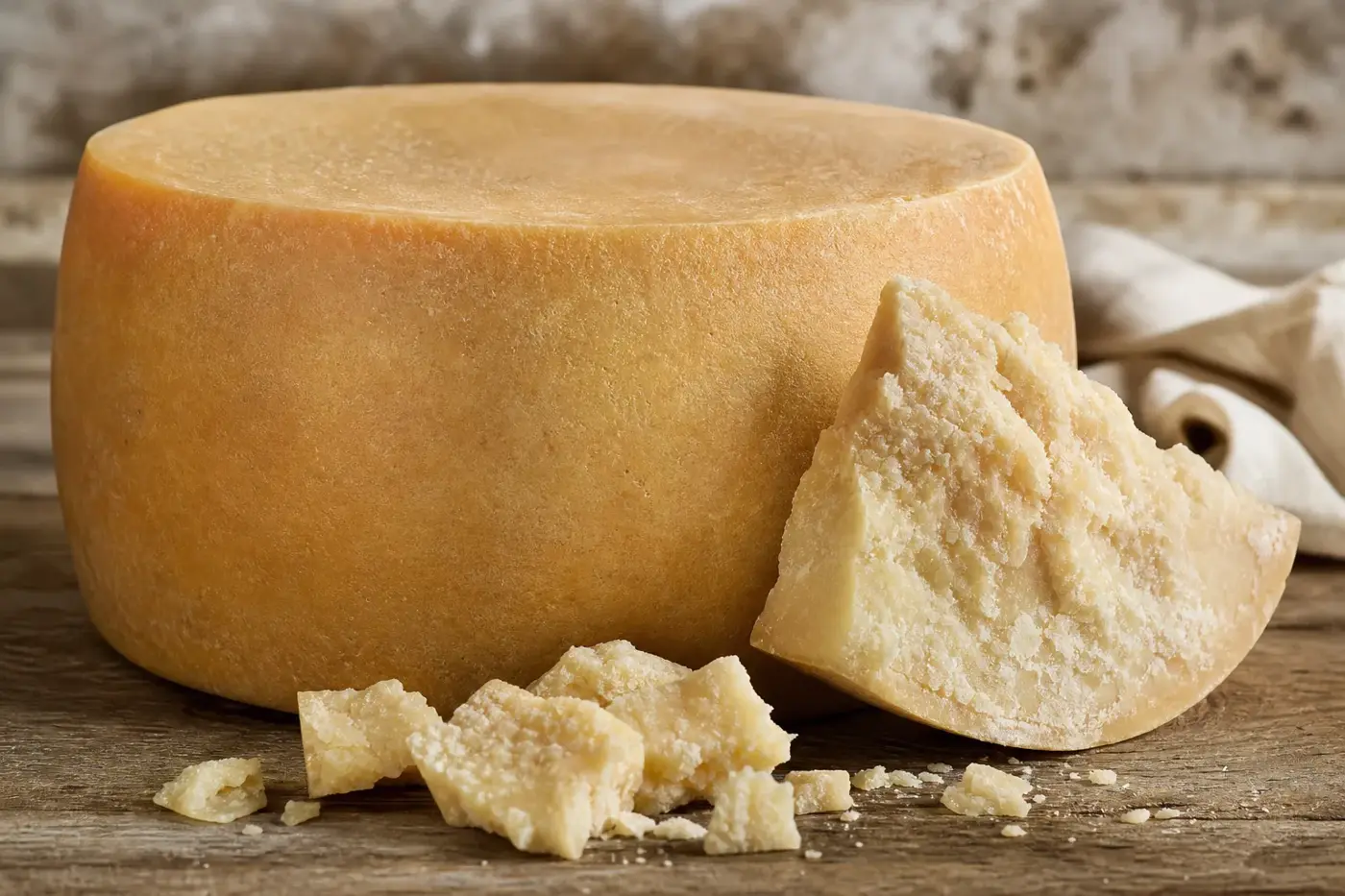
Parmigiano Reggiano
Break into a wheel of Parmigiano Reggiano and flakes fall away, revealing a finely granular cheese, pale straw to straw in colour.