Pyengana Cheddar
Cool air slips through an underground tunnel beneath Pyengana Dairy’s farmgate café.
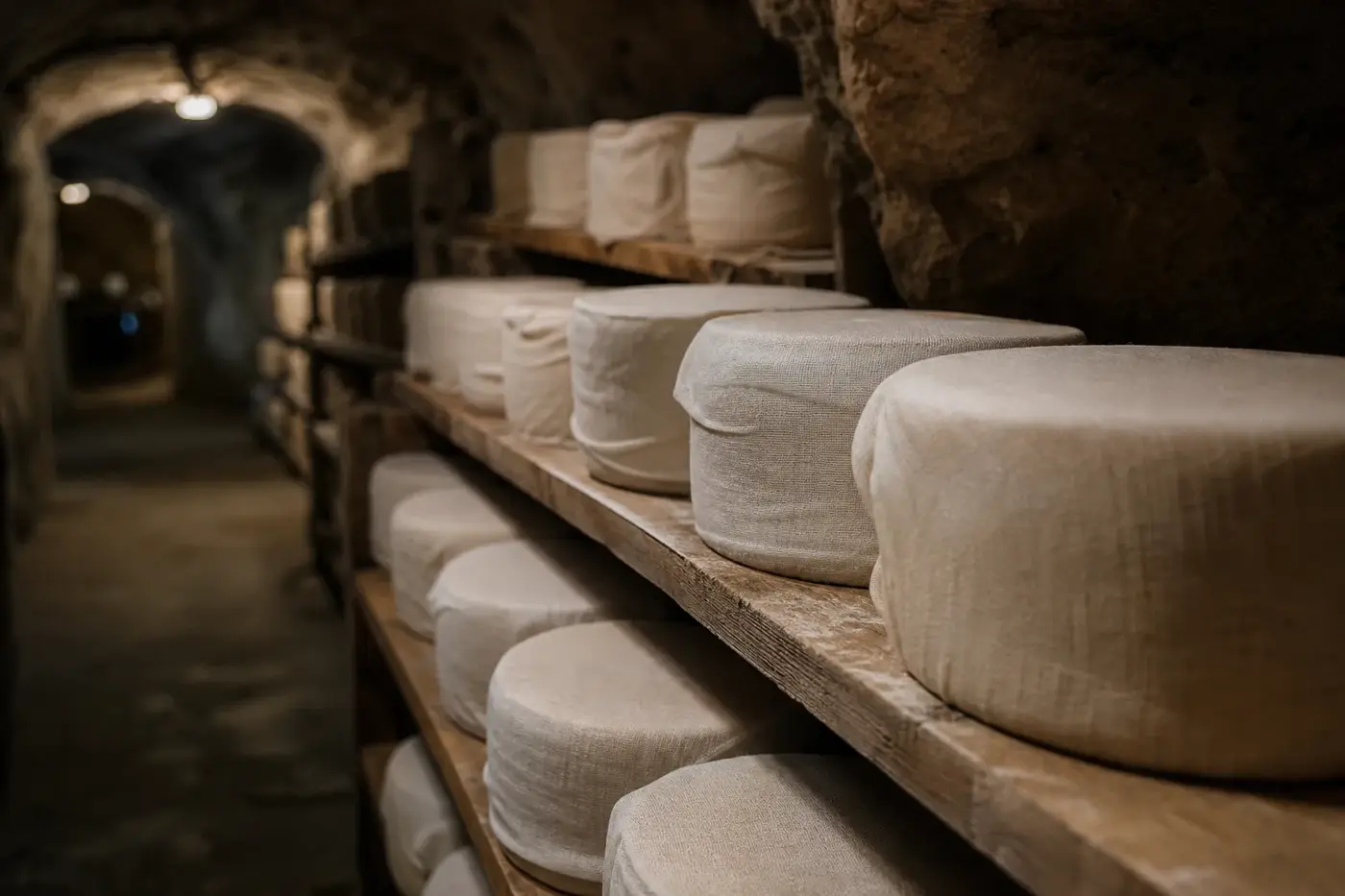
Cool air slips through an underground tunnel beneath Pyengana Dairy’s farmgate café. It reaches the cellar where cheddar matures, while above lies the green, river watered dairy country of northeast Tasmania. Take a piece and you taste a connection to that valley: local milk, curds worked by hand and time spent in cloth, with a character the producer calls earthy. [1][2]
| What you might want to know | The details |
|---|---|
| The name to look for | Pyengana Cheddar. [1] |
| Who makes it, and where | Pyengana Dairy, Pyengana, northeast Tasmania, Australia. [1] |
| Current business owner | Artisanal Market Pty Ltd; acquired December 2025, according to the producer. [1] |
| Milk and its treatment | Cow’s milk; the producer’s 2022 account describes pasteurisation. Current treatment: confirmation needed. [2][5] |
| Rennet used | Non-animal rennet in the 2022 account. Current practice: confirmation needed. [2] |
| Starter cultures | Selected bacterial cultures in the 2022 account; species and strains undisclosed. Current practice: confirmation needed. [2] |
| The wheel’s wrapping | Muslin cloth in the 2022 account. Current practice: confirmation needed. [2] |
| Time in the cellar | Traditional: 6 to 12 months. Reserve Vintage: 18 to 24 months. [1] |
| Australian geographical protection and register ID | Confirmation needed |
| Whole-product vegetarian suitability | Confirmation needed |
Follow the rivers into cheddar country
Two rivers help keep Pyengana’s pasture growing year round. This is dairying country, and the producer’s current account says all its milk comes from Pyengana. When you read the name on the cheese, you are also reading where its milk comes from. [1]
That connection carries through the dairy door. Valley milk meets a regional cheesemaking tradition, curd worked by hand and a maturation cellar beneath the farmgate café. The landscape matters here for more than a handsome label. [1][2]
When choosing a piece, pay particular attention to the cloth maturation. Pyengana belongs to the broad cheddar family, but its producer, place and methods give you something more specific to explore. The wider guide to cheddar offers a useful starting point for this Tasmanian expression.
From the farmers’ surplus to a fresh start in 1992
Long before today’s dairy, farmers in the valley had milk to preserve. Former owner TasFoods traces local farm cheesemaking to the 1880s, when spring and late-summer peaks in milk production became cheese. A factory followed in the 1890s, then a cooperative; after its closure in the 1950s, family farms kept cheesemaking alive. [3]
The modern business began in 1992, founded by a fourth generation dairy farmer. Keep that distinction in mind: 1992 marks Pyengana Dairy’s foundation, not the beginning of cheese in the valley. TasFoods acquired the business in 2017. [3][4]
In December 2025, ownership passed to Artisanal Market Pty Ltd, named as the purchaser by the producer. TasFoods’ January 2026 stock-exchange report confirms that the sale completed in late December 2025. [1][6]
Owners have changed, but the producer continues to describe cheese being made and matured at Pyengana. Its recipe and equipment remain associated with the valley. The connection between those earlier farms and today’s business is a practical one: cheese is still being made here. [1]
Meet the hands that shape the curd
Cheddar’s character begins in the vat, long before you can judge its firmness or bite. Cultured milk, rennet coagulation, whey removal, curd treatment, salting and pressing all play their part. In conventional cheddaring, drained curd mats together and is worked, then milled into smaller pieces for salting, helping establish the cheese’s structure. [7]
At Pyengana, the published method puts hands to work on the drained curd, working and breaking it. The dairy describes that handling in its manufacturing account. Its distributor, Calendar Cheese Company, calls the method stirred curd. [2][5]
Hold on to that distinction, rather than picturing every stage of conventional slab cheddaring. Here, drained curd is worked before salting and pressing, then the cheese matures in cloth. Those steps tell you more about its making than firmness alone can reveal. [2][5][7]
If you would like to place it alongside other cheeses, start with how to tell cheese styles apart. It gives you a wider view of the different families.
An old tradition, with pasteurised milk
Pyengana Dairy’s September 2022 manufacturing account starts with pasteurisation, followed by selected starter cultures and non-animal rennet. The cultures are bacteria used in developing the cheese. Rennet is the enzyme preparation that sets the milk into a gel. [2]
An old recipe and modern milk treatment sit comfortably together. The valley’s long history does not make this a raw-milk cheese: the published process records pasteurisation and selected cultures. Let that account tell you how it was made, rather than asking the age of the tradition to do the job. [2][3]
If you are buying for a vegetarian, ask about the whole product, including anything used on the outside. Non-animal rennet tells you the coagulant type. It does not answer every question about the other ingredients or materials involved.
For the distinctions behind those labels, turn to the explanation of rennet. It covers animal, microbial and fermentation-produced preparations.
This page summarises published guidance from the official sources it cites. It is not medical advice. Guidance differs between countries and changes over time, so check the current source for where you live, and ask your doctor, midwife, pharmacist or dietitian about your own circumstances.
Muslin, moulds and a night in the press
Cut the set milk and you get curds, the solids destined to become cheese, and whey, the liquid they release. In Pyengana’s published sequence, heating and stirring drive out moisture. The drained curd is then worked, broken and salted. [2]
Next come moulds lined with muslin. The salted curd goes in and stays under pressure overnight. When the cheese leaves its mould, the cloth becomes the covering around the maturing wheel. [2]
Each step has its purpose. Working establishes the curd’s body, pressing brings it together, and maturation develops its finished eating character. The clothbound wheel you see owes its shape and character to decisions made back in the vat.
Knowing that sequence gives you another way into the finished piece. Its body reflects both the curd treatment and the time that follows. The general guide to cheesemaking takes you through these stages across different cheese styles. [7]
Down to the cellar and the pine shelves
Beneath the farmgate café, an underground tunnel feeds cool air into Pyengana’s maturation cellar. That natural ventilation creates the cave-like environment where the producer matures its cheese. The café above and the cellar below have rather different ideas about a quick bite. [1]
Calendar Cheese Company describes wheels resting on pine shelves, with surface microflora contributing to their development. The distributor links this maturation to a fine, crumbly body and a flavour that lingers. Those apparently quiet shelves are an important part of the story. [5]
Do not let a retail wrapper confuse the picture. Cloth maturation describes how the whole cheese matures, not necessarily how your piece travels home. A wrapped wedge can come from a wheel that matured in cloth; the coverings belong to different stages. [2][8]
Look for that distinction in the product description when you buy. It connects the cheese on the counter with the wheel in the cellar. It also makes “cloth matured” a useful detail, rather than just an appealing phrase.
Find your crumble, bite and cellar time
Traditional Cloth Matured Cheddar and Reserve Vintage are separated by time and batch selection. The producer grades batches to decide their maturation, giving general ranges of 6 to 12 months for Traditional and 18 to 24 months for Reserve Vintage. The individual Traditional product page specifies 12 months. [1][8]
For Traditional, Pyengana highlights crumbliness and a pronounced bite. Calendar Cheese Company describes aromas recalling grass, herbs and honey, followed by sweetness and a nut-like finish. These are things you might notice, not an entrance exam for the cheese board. [5][8]
The outside is clothbound; the body, also called the paste, is described as fine textured and crumbly. The maker links longer maturation with stronger flavour and calls the cheese’s broader character earthy. For rind appearance and specific differences in aroma and texture between maturity levels, ask for further detail. [1][5]
Choose Traditional to explore the established cheddar character, or Reserve Vintage for the producer’s longer-matured expression. If you can, try them side by side with plain bread first. Add accompaniments afterwards, once you have had a chance to taste each cheese on its own.
Look beyond the name on the label
Pyengana Cheddar names a cheese associated with Pyengana Dairy and its Tasmanian locality. That producer relationship, together with the history of cheesemaking there, underpins its documented identity. It gives you a place and a maker to keep in mind as you choose. [1][3]
Geographical protection is a separate legal question, with Australian protection status still requiring confirmation. IP Australia explains that geographical indications can be protected through certification trade marks. A strong connection to a place and legal protection are different matters. [9]
When you buy, read the producer name alongside the product description and maturity designation. Together, those details tell you more about the particular cheese than “Pyengana” alone. Traditional and Reserve Vintage are not interchangeable descriptions.
For help making sense of the wording, try the guide to reading a cheese label. It explains how to put that information to work when choosing your cheese.
Bring out the sourdough, or put on a toastie
Start with a piece of cheddar, sourdough and one restrained accompaniment. Calendar Cheese Company recommends sourdough, pickles, relish, dried fruit and fruit-and-nut bread with Pyengana. Choose one or two rather than inviting the entire cupboard: you want room to notice the cheese. [5]
For something hot, the dairy publishes a vintage-cheddar toastie with leeks, Dijon mustard and pickled onions. It gives you a useful combination to build around. The leeks bring sweetness, the onions acidity, and the mustard sits alongside the cheddar. [10]
Treat that as a serving idea, not a complete recipe with quantities and timings. If your cheese is strongly matured, taste the filling before adding other salty ingredients.
For an alcohol free accompaniment, consider a dry apple drink or still water. These are serving suggestions, rather than pairings published by the producer.
Take home a portion, and hold on to the label
Start with the exact product name and maturation information. The dairy lists Traditional and Reserve Vintage portions, plus a small clothbound truckle. A portion gives you an introduction; the truckle suits an occasion when presenting the whole cheese is part of the appeal, so ask the producer or seller for current product details. [11]
Ask how your piece has been cut and wrapped, and keep its label. That small bit of packaging preserves its identity and the storage instructions for that particular product. Follow the pack’s refrigeration and date instructions rather than assigning every piece of Pyengana the same shelf life.
Food Standards Australia New Zealand provides Australian consumer food safety guidance. Keep that guidance in mind alongside the instructions supplied with your cheese. [12]
Once you have cut it, protect the remaining cheese’s exposed surface and follow the seller’s or pack’s wrapping instructions. For more on wrapping choices and refrigerator handling, turn to the guide to storing cheese at home.
Questions people ask
Where is Pyengana Cheddar made?
It is made by Pyengana Dairy in northeast Tasmania, Australia. The producer says all its milk comes from Pyengana.
Is Pyengana Cheddar made with pasteurised milk?
The dairy’s 2022 manufacturing account documents pasteurisation. The current milk treatment has not been verified.
Is Pyengana Cheddar vegetarian?
The dairy documented rennet not derived from animals in 2022, but current practice has not been verified. Whole product vegetarian suitability has not been verified, so ask for confirmation covering all ingredients and exterior materials.
How long is Pyengana Cheddar matured?
The producer gives a general range of 6 to 12 months for Traditional and 18 to 24 months for Reserve Vintage. Its individual Traditional product page specifies 12 months.
What does Pyengana Cheddar taste like?
The producer describes its broader character as earthy and emphasises the Traditional cheese’s crumbliness and pronounced bite. Calendar Cheese Company describes aromas of grass, herbs and honey, followed by sweetness and a nutty finish.
Sources
- Pyengana Dairy, About Us, undated, current page retrieved November 2026. Producer statements on locality, milk sourcing, current ownership, maturation premises and maturity ranges. Source.
- Pyengana Dairy, Crafting of Pyengana Cloth Bound Cheddar Cheese, 20 September 2022. Producer’s manufacturing account. Source.
- TasFoods, Pyengana Dairy, undated. Former owner’s historical account, used for history only. Source.
- TasFoods Limited, Independent Expert’s Report and Financial Services Guide, 6 November 2025, section 4.1. Filed corporate material confirming the foundation and 2017 acquisition. Source.
- Calendar Cheese Company, Traditional Clothbound Cheddar 150g: Pyengana Dairy, 20 July 2021. Commercial distributor’s product and tasting account. Source.
- TasFoods Limited, Business Activity Report and Appendix 4C Quarterly Cash Flow, 30 January 2026, page 1. Completion statement for the December 2025 business sale. Source.
- Tetra Pak, Dairy Processing Handbook, chapter 16, Cheese, online edition retrieved November 2026, particularly “Cheddar cheese” and “Cheddaring machine”. Technical equipment supplier’s reference. Source.
- Pyengana Dairy, Traditional Cloth Matured Cheddar 150g, undated, retrieved November 2026. Product-specific maturation and sensory description. Source.
- IP Australia, Geographical indications and certification trade marks, current guidance retrieved November 2026. Australian protection mechanisms. Source.
- Pyengana Dairy, Leek and Pyengana Dairy Vintage Cheddar Toastie, 29 November 2022. Producer’s published cooking suggestion, also described in its news index. Source.
- Pyengana Dairy, Cheese, current product collection retrieved November 2026. Product names and formats, without an availability claim. Source.
- Food Standards Australia New Zealand, Food safety basics, consumer guidance retrieved November 2026. Official reference for Australian readers. Source.
This piece was researched from producer accounts, filed corporate records, a distributor’s product documentation, a technical reference and Australian official guidance.
Last checked: November 2026
Last checked November 2026.
The editors suggest you read next