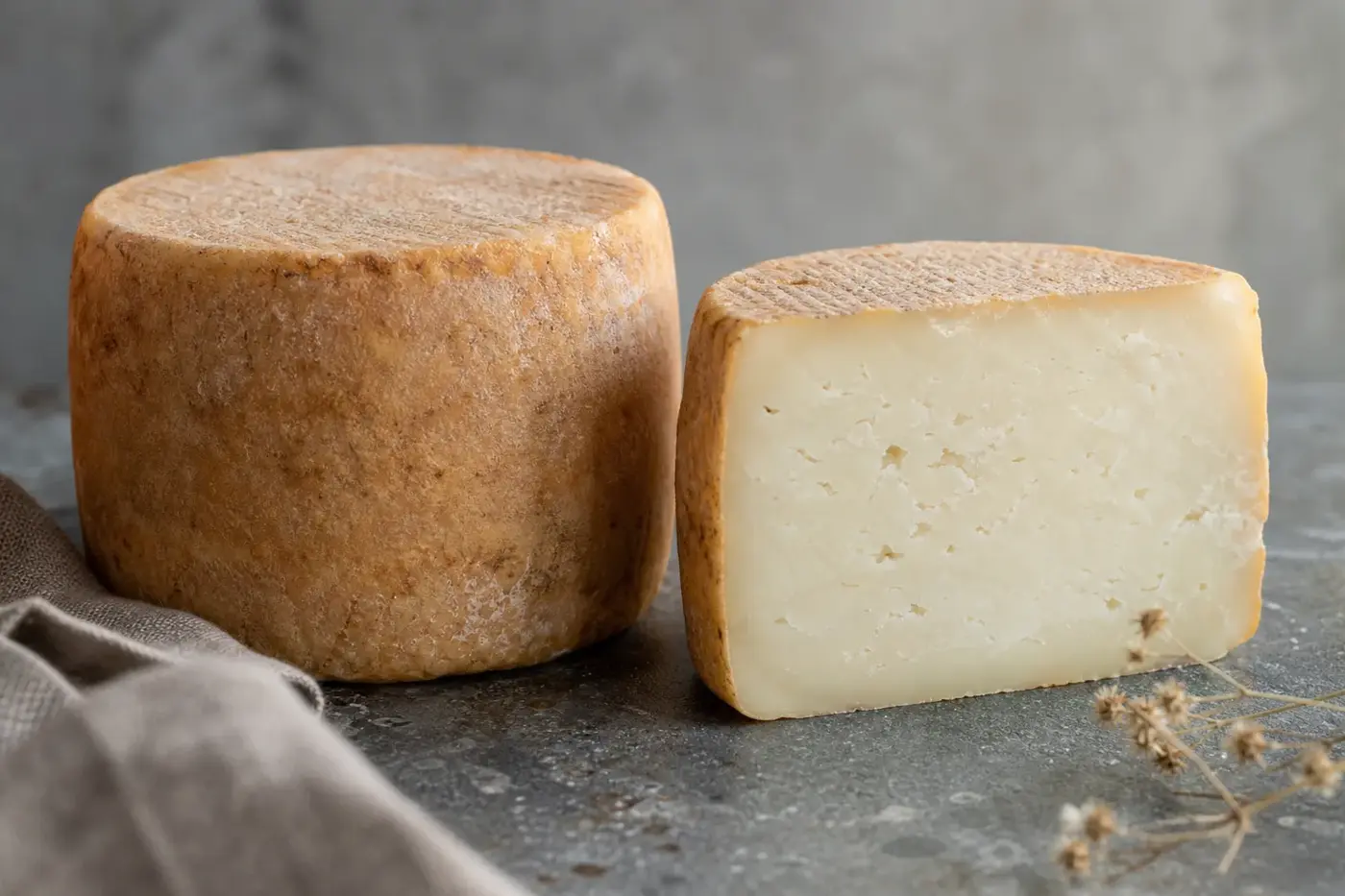
The first bite brings a pronounced lactic tang. Stay with it and you find flavours that deepen as the cheese ages, all tucked into a compact interior. Behind Queso Castellano lies Castilla y León, Spain, where everything happens, from producing the sheep’s milk to making and maturing the cheese. Its name means Castilian cheese: a regional inheritance with a precise protected meaning in the European Union.[1][2]
| What to know | The detail |
|---|---|
| Name to look for | Queso Castellano, its familiar and registered name.[1] |
| EU registration | Protected Geographical Indication, PGI-ES-02307; registered under Commission Implementing Regulation (EU) 2020/247.[1][2] |
| Great Britain | Registered PGI; November 2026 status.[3] |
| Where it all happens | Castilla y León: milk production, manufacture and maturation.[2] |
| Milk | Sheep’s milk, raw or pasteurised.[2] |
| Time to mature | At least 30 days for cheeses weighing no more than 1.5 kg; 60 days for larger cheeses.[2] |
| Shape and size | Cylindrical; maximum whole-cheese weight 3.8 kg.[2] |
| Rind | Defined and mould-free under the specification; natural or covered with authorised coatings.[2] |
| Can you eat the rind? | Check your product; Lavega declares its cited cheese’s rind inedible.[7] |
An old tradition, a name worth knowing
Castilian sheep’s milk cheesemaking was established long before its PGI. Today, Queso Castellano is a registered geographical name in the EU, with defined requirements. It is not an unrestricted description for any cheese made somewhere in historic Castile.[1][4]
If you want a labelled PGI product, look for the full name, the EU PGI symbol and the scheme’s identifying label. The current single document requires all three. You can buy the cheese whole, in portions, sliced or grated.[4]
Older descriptions, restaurant shorthand and references to “Castilian-style” cheese deserve a closer look. Establish which product you are looking at before applying the PGI’s milk, origin or maturation requirements. The guide to protected cheese names explains the difference between a regional association and a registered specification.
Great Britain also lists Queso Castellano as a registered PGI. That entry establishes its status there, separately from the EU registration. These are two distinct jurisdictional records, rather than one interchangeable entry.[3]
Follow the sheep through Castilian history
Sheep’s milk does not keep itself. Preserving this perishable food was a practical necessity in a region with pronounced seasonal conditions. The PGI’s geographical account connects the cheese to sheep farming, the wool industry and shepherds moving between regions.[4]
A pressed, matured cheese could travel and be eaten in portions. Knowledge travelled alongside it. The specification’s historical narrative describes cheesemaking skills spreading through transhumance, the seasonal movement of livestock.[2]
Today, several farming systems sit behind the cheese you buy. The specification recognises extensive, semi-extensive and intensive holdings, with intensive systems making up the majority. Some systems include grazing and crop stubbles; conserved forage and supplementary feed also play a part.[2]
So do not picture one pasture-based routine behind every wheel. This regional tradition brings together different farms and dairies working to the same production requirements. Their sheep’s milk comes from across the defined area, while the finished cheeses share a protected identity.
A sheep on the label is only the beginning
PGI Queso Castellano uses sheep’s milk exclusively. That milk must come from Castilla y León. The producers’ association also emphasises this requirement in its account of the scheme.[4][5]
On a Spanish ingredient list, leche de oveja means sheep’s milk. Leche cruda tells you the milk is raw; leche pasteurizada means pasteurised. Read the whole list: the sheep on the front has not done all your homework.
Two documented cheeses show why the details matter. El Pastor’s San Ruffino small-format PGI cheese lists pasteurised sheep’s milk, salt, rennet and dairy cultures. Lavega’s pasteurised curado also lists sheep’s milk, and names traditional animal rennet as its coagulant.[6][7]
The specification allows natural rennet or other coagulating enzymes. The protected name alone therefore cannot tell you whether a cheese suits vegetarians.[2] For more on those choices, see milk treatments and types of rennet.
Where the maker leaves their mark
First, the milk becomes a gel. Rennet or another permitted enzyme causes coagulation, giving the maker something to cut. Cutting then separates curd particles from whey, the liquid released from the milk.[2]
That shared sequence still leaves room for decisions. Follow the process and you can see where each maker has choices:
| Stage | What the maker can do |
|---|---|
| Coagulation | Use rennet or other coagulating enzymes; dairy cultures are permitted.[2] |
| Cutting | Cut small curd grains, or larger grains to retain more whey.[2] |
| Moulding and pressing | Place curds in moulds and press them.[2] |
| Salting | Use dry salting or immersion in brine.[2] |
| Maturation | Mature in controlled rooms, turning and cleaning as required.[2] |
Milk treatment, cultures, retained whey and maturation decisions all help shape what you taste. Two cheeses can follow the same specification yet give you different experiences. These are useful things to ask about at the cheese counter.
Ask for the actual age as well as the maturity description. El Pastor gives approximately 150 days for its cited San Ruffino product, with a stated variation of 30 days either side. Lavega describes its pasteurised curado as matured for approximately six months.[6][7] Those details tell you more than maturity wording alone.
Get to know the wheel and its rind
Round and cylindrical does not mean one standard size. Documented formats include small whole cheeses and cut wedges. El Pastor’s cited product is a 550 g whole cheese; Lavega offers an approximately 350 g portion.[6][7]
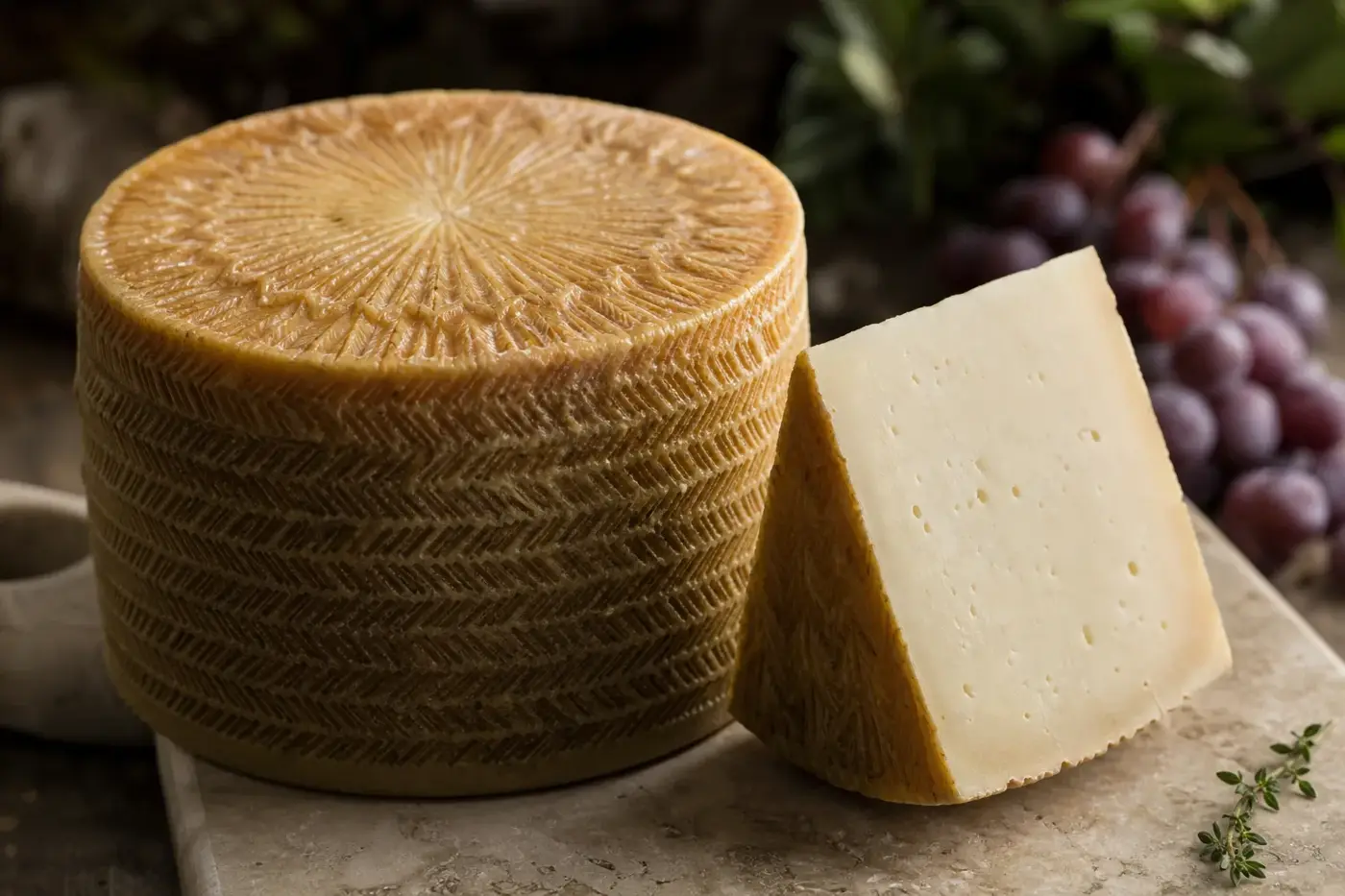
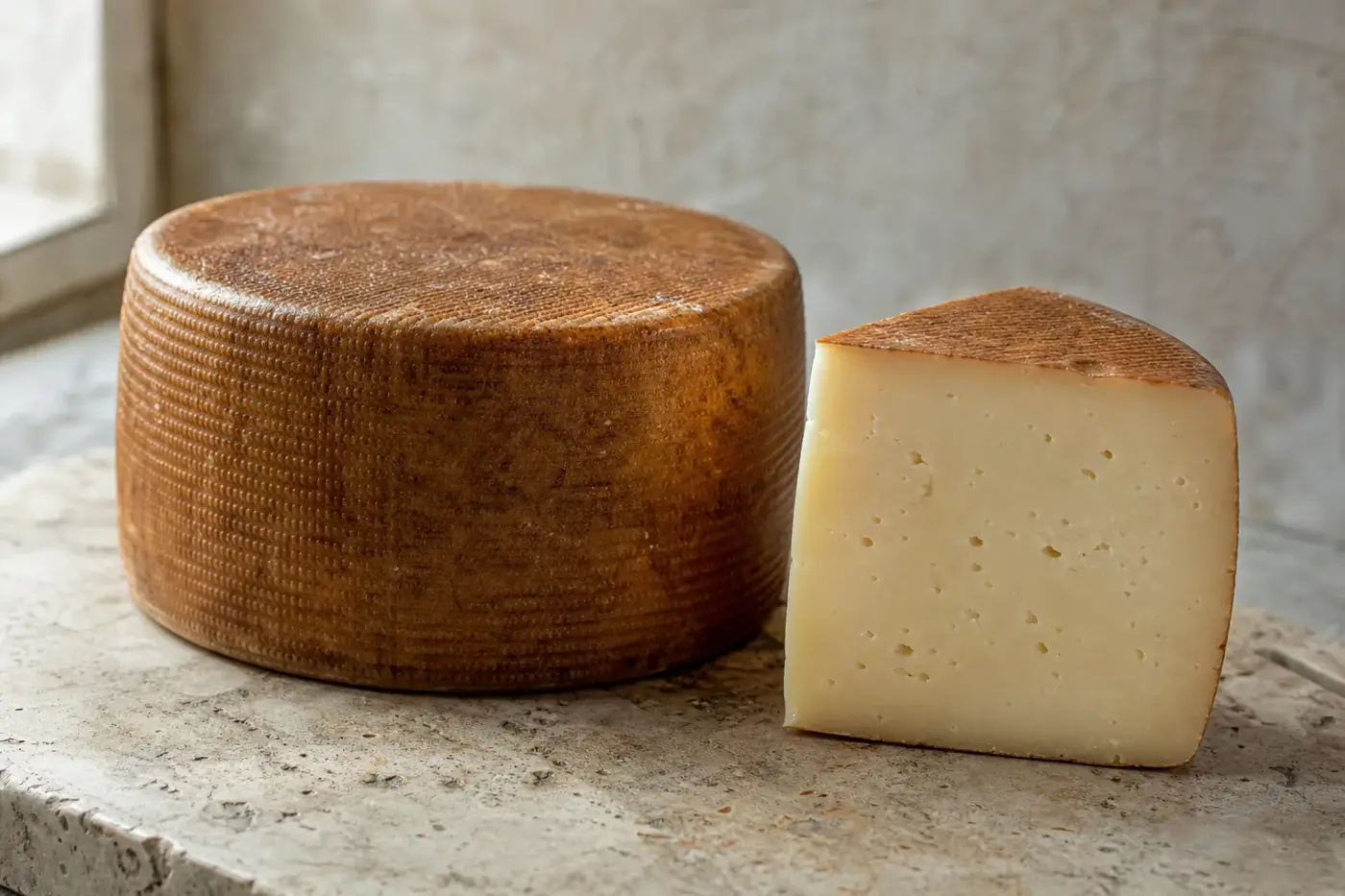
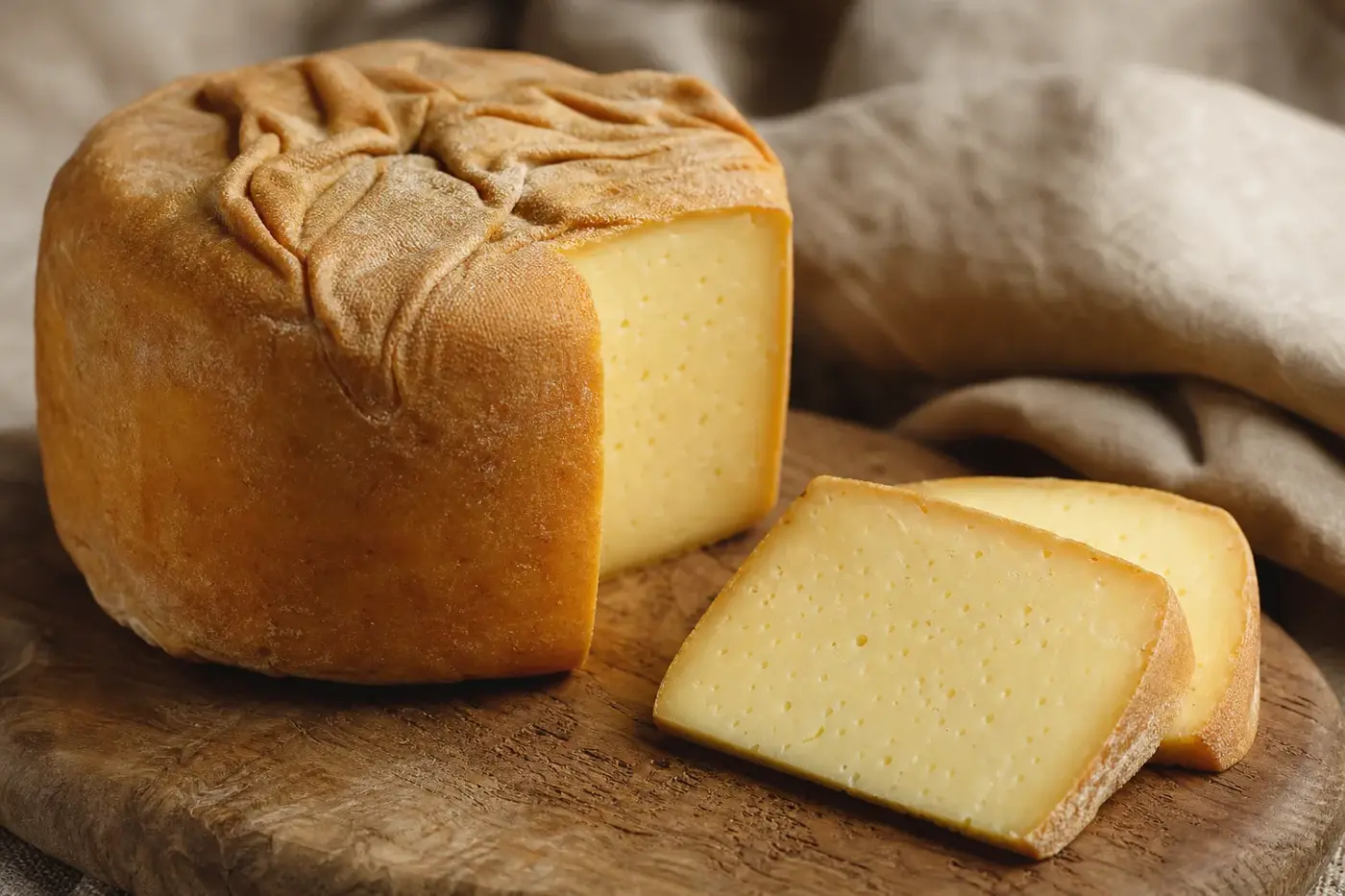
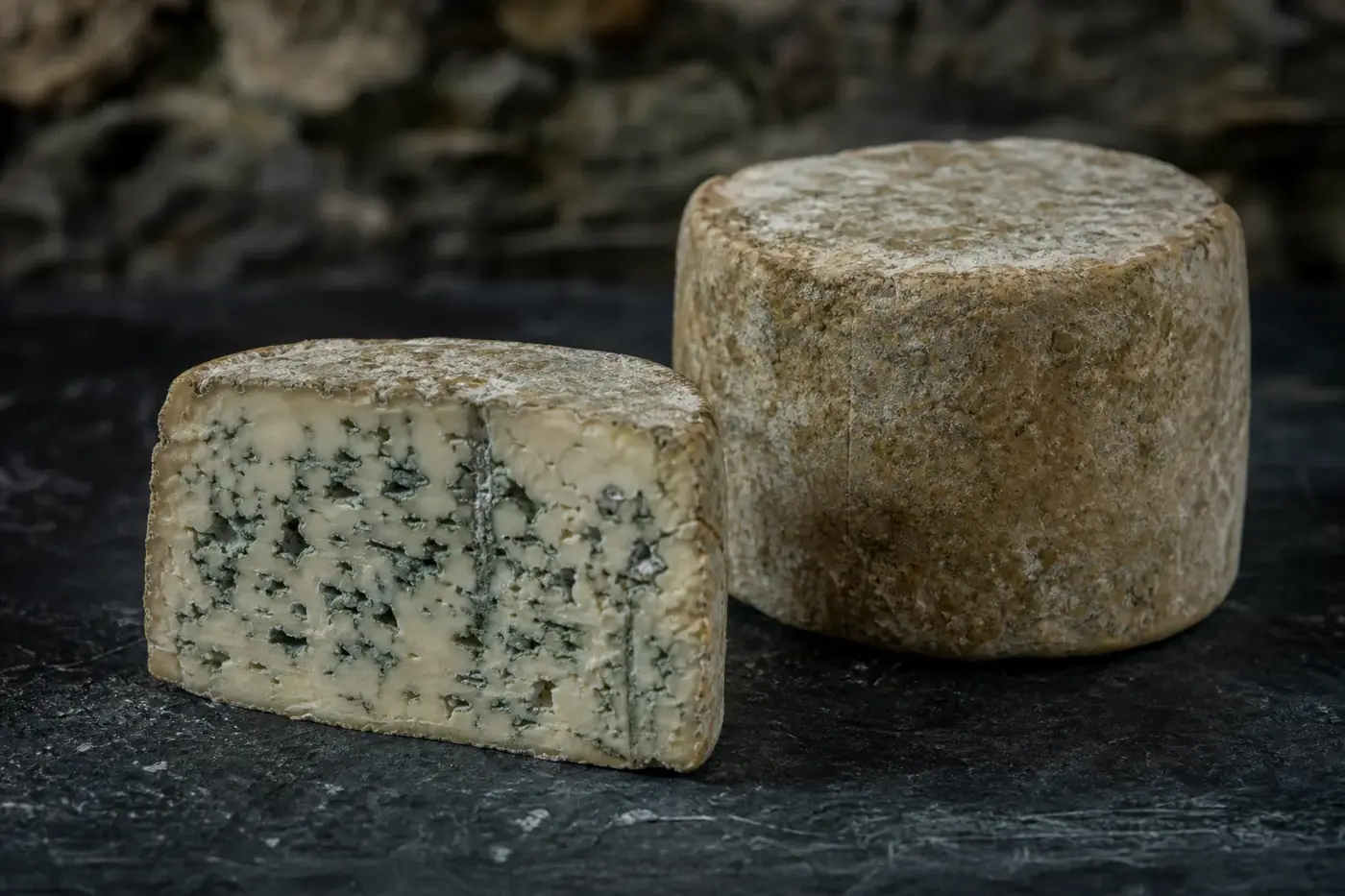
Look at the rind and you may see anything from pale yellow to brown, sometimes marked by a mould, cloth or traditional binding. Inside, the paste, or body of the cheese, is firm and compact. The official description gives its colour as whitish yellow to beige, with a few small openings scattered irregularly through it.[4]
Those details help you recognise the cheese, but the label confirms its identity. A patterned rind is not a passport to a protected name.
Give the rind instructions their own moment of attention. Lavega explicitly declares its cited product’s rind non-edible, so remove it when preparing that cheese. For other products, follow the individual producer’s directions rather than assuming every rind has the same treatment.[7]
Taste what a little time can do
Lactic, sheep-associated and caramel aromas lead the official sensory description. Behind them come lesser notes of fruit, vegetal flavours and dried nuts. On your palate, the description points to pronounced acidity and saltiness, slight piquancy and an intensity that grows with maturation.[4]
The producers’ association describes a paste that is fairly firm but yields in the mouth. It also distinguishes the gentler aroma of younger cheese from the more developed aroma of longer-matured examples.[8]
For a particular tasting reference, consider Lavega’s approximately six-month pasteurised curado. The maker describes an initially mild cheese, with sweet and fruity notes, followed by a persistent finish recalling nuts and butter. That description belongs to this particular cheese, rather than every Castellano you might encounter.[7]
Choose the age to suit your occasion. A younger example brings restrained aroma to straightforward slices; a more developed cheese can hold your attention in small pieces. If you can, try two ages from the same maker and let maturation become the focus of your tasting.
Castellano, Manchego or Zamorano? Make room for all three
Put these three side by side and you are exploring related traditions of pressed sheep’s milk cheese. Geography and breed requirements distinguish their protected names. Here is how the Spanish protected products compare, with their November 2026 status.[2][9][10]
| Name | EU protection, November 2026 | Where it comes from | What to know about the milk |
|---|---|---|---|
| Queso Castellano | IGP, equivalent to PGI | Castilla y León | Sheep’s milk; not restricted to Manchega sheep.[2] |
| Queso Manchego | DOP, equivalent to PDO | La Mancha | Milk exclusively from Manchega sheep.[9] |
| Queso Zamorano | DOP, equivalent to PDO | Province of Zamora | Churra, Castellana and specified first-generation crosses with Assaf española.[10] |
Zamorano’s defined area is smaller, sitting within Castilla y León. Manchego has a different geographical designation and requires milk from a particular sheep breed.[9][10]
When choosing, look beyond the name to the maker, milk treatment and maturity. For a revealing board, serve examples of comparable ages and ask your guests to describe the differences before revealing the labels. You keep the cheeses centre stage while giving those protected names something tangible to explain.
Read the label, then plan your board
Start with identity and origin, then work towards flavour. Look for the protected name, milk species, milk treatment and stated age, followed by rind instructions and storage directions. If you buy a cut portion, keep the wrapper or photograph the label; reading cheese labels explains the wider terminology.
How much Castellano should you buy? Picture its place in the meal: a brief course after dinner, part of a larger spread or the main food. Then consider how many other cheeses will share the board.
Cut and weigh a sample portion in the size you intend to serve. Multiply that weight by your guest count, then divide the board’s total among its cheeses. Keep an extra piece chilled for replenishment rather than cutting everything at once.
This fits the quantity to your menu and serving plans. One allowance cannot do every occasion justice, however persuasive your cheese-loving instincts.
Give Castellano a place at your table
Start with plain bread, then try one accompaniment at a time. Spanish membrillo, fresh pear or a few walnuts are useful starting points; apple or a modest spoonful of fig preserve offer alternatives. Notice how something fresh, sweet or gently bitter meets the cheese’s acidity and savoury character.
For an alcohol-free pairing, begin with water or unsweetened tea. Adults who choose wine can try a dry Spanish white before moving to a red. Compare the combinations rather than assuming firm cheese demands the strongest drink; cheese and wine pairing gives you a fuller method.
El Pastor advises taking its cited small cheese out ten minutes before eating.[6] Keep that product advice alongside local food guidance. In England, Wales and Northern Ireland, the Food Standards Agency advises keeping chilled food out of the fridge for the shortest possible time during preparation.[11]
Serve thin slices with bread, or small pieces alongside roasted peppers. In the kitchen, try it grated over baked vegetables, shaved over lentils or added in small amounts to a potato filling. Taste before adding more salt: the cheese has already made a contribution.
Look after the wedge you bring home
In England, Wales and Northern Ireland, the FSA advises keeping your fridge at 5 °C or below. Refrigerate dairy products and follow the packaging instructions, including any directions for storage after opening.[11]
Cover your cut wedge and keep its original label. Follow the product’s own wrapping instructions; storing cheese at home offers a broader storage method.
A dry cut surface needs a different assessment from mould or other deterioration. Before trimming it for appearance, consider how the cheese has been stored and read its date instructions. UK official guidance distinguishes a best-before date, which concerns quality, from a use-by date, which concerns safety.[12]
Unexpected mould calls for a separate decision from the mould-free rind described by the PGI.[4] Consult mould on cheese for product-specific guidance. The same trimming rule does not belong on every cheese.
General information only, not medical advice: follow the official guidance where you live.
Questions people ask
Where is Queso Castellano made?
Its milk production, cheesemaking and maturation all take place in Castilla y León, Spain. Queso Castellano is a registered PGI in both the EU and Great Britain.
Is Queso Castellano made with raw milk?
It can be made with either raw or pasteurised sheep’s milk. On a Spanish ingredient list, leche cruda means raw milk and leche pasteurizada means pasteurised milk.
Is Queso Castellano suitable for vegetarians?
The protected name alone does not establish whether a cheese is suitable for vegetarians. The specification permits natural rennet or other coagulating enzymes, and Lavega’s cited curado uses animal rennet.
How is Queso Castellano different from Manchego?
Queso Castellano comes from Castilla y León and is not restricted to milk from Manchega sheep. Manchego comes from La Mancha and must be made exclusively with milk from Manchega sheep.
Can you eat the rind of Queso Castellano?
Check the instructions for the particular product. Lavega declares the rind of its cited cheese inedible.
Sources
- European Commission, Commission Implementing Regulation (EU) 2020/247, adopted 18 February 2020, published 25 February 2020, Articles 1 and 2. Official text retrieved from Spain’s BOE.
- Instituto Tecnológico Agrario de Castilla y León, Pliego de condiciones de la IGP «Queso Castellano», Revision 1, amendment dated 20 November 2024, revision record updated for 2025. Sections A to F.
- Department for Environment, Food & Rural Affairs, Queso Castellano, Great Britain protected food-name register, published 4 January 2021, current entry retrieved November 2026.
- Instituto Tecnológico Agrario de Castilla y León, Documento único: «Queso Castellano», version dated 20 November 2024. Sections 3 to 5.
- Asociación IGP Queso Castellano, 100% Oveja, undated producer-association account.
- Quesos El Pastor, Baby 550 grs oveja curado IGP Queso Castellano San Ruffino, undated product specification. Commercial producer source, used for its own product declarations.
- Quesos Lavega, Oveja curado pasteurizado, undated product specification and tasting notes. Commercial producer source, used for its own product declarations.
- Asociación IGP Queso Castellano, Sabor, undated producer-association sensory account.
- Fundación Consejo Regulador de la Denominación de Origen Queso Manchego, Queso Manchego, Denominación de Origen Protegida and Identificación, current website material, undated.
- Instituto Tecnológico Agrario de Castilla y León, Pliego de condiciones de la DOP «Queso Zamorano», Revision 1, amendment in force 22 April 2015, product characteristics and geographical area.
- Food Standards Agency, How to chill, freeze and defrost food safely, published 18 December 2017, current retrieved text. Applies to England, Wales and Northern Ireland.
- UK Government, Understanding food labelling: Best before and use-by dates, current retrieved text, November 2026.
Researched through official legal texts, regional specifications, national guidance and attributed producer descriptions, with serving suggestions identified as editorial recommendations.
Last checked: November 2026
Last checked November 2026.
The editors suggest you read next