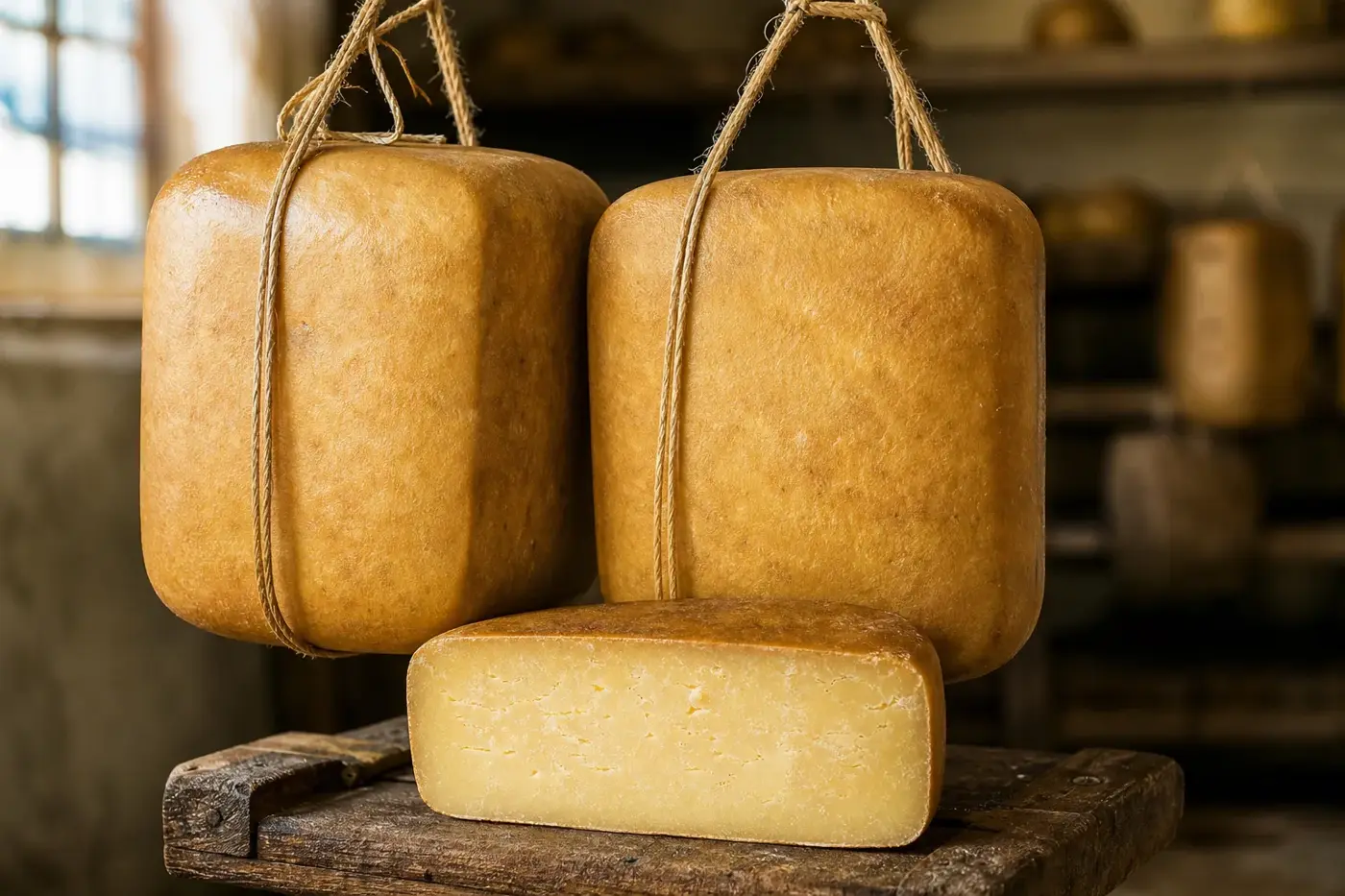
Two hefty blocks hang from ropes across a wooden support. Before you taste a crumb, Ragusano has made an entrance. This Sicilian stretched-curd cheese takes whole, raw cow’s milk and turns it into a long rectangle with rounded corners. Its PDO registrations in the EU and Great Britain tie that craft to the pastures around Ragusa and neighbouring parts of Syracuse. [1, 3, 4]
| Ragusano at a glance | What you need to know |
|---|---|
| Name to look for | Ragusano. [1, 3] |
| Who registers it | EU: European Commission; eAmbrosia record identifier: not supplied here. Great Britain: Defra, register entry “Ragusano”. [3, 4] |
| Protected status | EU: PDO, registered under Regulation (EC) No 1263/96; specification amendments approved by Implementing Regulation (EU) 2019/1785. [4] Great Britain: registered PDO, scheme registration dated 31 December 2020. [3] Northern Ireland, Switzerland and the US: status not supplied here. |
| Where it must be made | Twelve municipalities in Ragusa province and three in Syracuse province, Sicily. [1] |
| Milk and rennet | Whole, raw cow’s milk; lamb or kid rennet paste. Contains milk. [1] |
| How the curd is worked | Pasta filata: stretched curd. [1] |
| Minimum maturation | Three months from shaping. [2] |
| The whole cheese | Rectangular block with rounded corners, 12 to 16 kg; square cross-section 15 to 18 cm, length 43 to 53 cm. [2] |
| Outside and inside | Smooth, thin rind; compact, white to straw-yellow interior. [2] |
| UK pregnancy guidance | NHS advice distinguishes hard cheese from other categories; see the dated guidance below. [10] |
Follow Ragusano into Sicily’s Iblean country
Picture limestone uplands, dry-stone walls, carob trees and olive trees. Around them lie pastures rich in spontaneous vegetation: the Iblean country described by the producers’ protection consortium. Here in south-eastern Sicily, the masseria, or farmstead, brings dairy farming and cheesemaking together in one rural setting. [5, 6]
The legal map draws a firmer boundary. In Ragusa province, it covers Acate, Chiaramonte Gulfi, Comiso, Giarratana, Ispica, Modica, Monterosso Almo, Pozzallo, Ragusa, Santa Croce Camerina, Scicli and Vittoria. In Syracuse province, written Siracusa in Italian, it includes Noto, Palazzolo Acreide and Rosolini. Both the milk and its transformation into cheese must come from within this area. [1]
At the counter, “Sicilian” starts the conversation, but it cannot finish it. Ask for the registered name and the producer’s identity, because an island-wide description does not identify a particular cheese. You can explore that connection between name and place in protected names.
Meet the Modicana cow on home ground
Those pastures are more than a handsome backdrop. Ragusano’s specification requires the cows’ feed to consist predominantly of spontaneous plants and forage crops from the Iblean plateau. These may also be conserved as hay, making the local feeding system part of the production rules, not simply part of the view. [1]
The Modicana cow has a special place in this landscape. The consortium’s technical sheet describes its historical importance, alongside today’s use of Bruna cattle and, to a lesser extent, Friesian cattle. Modicana milk is not compulsory: the extra wording “Ragusano da vacca Modicana” is reserved for cheese made exclusively from that breed’s milk. [6]
If the breed matters to you, those are the words to find. Ragusano without them can still meet the designation’s requirements. Ask separately about the producer, age and milk source: a breed name cannot tell you who made your cheese or how long it has matured.
Take a closer look at that remarkable block
Ragusano looks almost architectural, with its long body, square cross-section and softened corners. Its smooth rind moves from straw-yellow or golden yellow towards brown as it matures. Look closely and you may see shallow indentations left by the supporting ropes. [2]
Inside, the paste, the cheesemaker’s word for the interior, is compact and pale. The production requirements allow a few small openings, while longer maturation can bring cracks. That cut face gives you clues to both structure and age. [2]
Before choosing your wedge, ask to see the whole cheese, or a photograph. A small portion gives little away about the original block’s considerable proportions. This is not a cheese that travels light.
See raw milk become stretched curd
The work begins with milk from one or more milkings. The specification sets coagulation at 34 °C, allowing a variation of 3 °C either way. Lamb or kid rennet paste sets the milk into curd: the coagulated solids that separate from the liquid whey. [1]
Then comes a succession of hands-on steps. The curd is broken, treated with hot water, drained and pressed, before further hot-liquid treatment. After resting and approximately 20 hours on supports, it is sliced and worked in water at about 80 °C until it becomes a cohesive mass. [1]
This is pasta filata, the stretched-curd method. Once workable, the curd is gathered into a smooth, closed form and moulded into Ragusano’s characteristic rectangle. The shape you see comes from handling the curd, not from cutting a rectangle out of an already matured cheese. [1]
Want to follow what happens beyond the vat? You can trace the wider journey from milk to ripening in how cheese is made.
From the brine to a place on the ropes
After shaping, Ragusano goes into brine for salting, then into ventilated rooms at 14 to 16 °C. Maturation must last at least three months from shaping. Cheeses may hang in pairs across supports, leaving air free to reach their surfaces. [1, 2]
One heavy rectangle counterbalancing another is quite a sight. Paired hanging is a permitted method under the current specification, though, not the only arrangement. The rules also provide for olive-oil treatment during prolonged maturation and allow traditional natural smoking, indicated by the word affumicato. [1]
When you buy, keep two questions separate: how old is it, and is it smoked? Age and smoking are distinct choices. Knowing both gives you a clearer idea of the cheese you are taking home.
Taste Ragusano as it grows bolder
Start young, and Ragusano has a gentler voice. The consortium describes sweetness, a vanilla-like character and only slight pungency. With advanced maturation, its description turns towards a more pronounced savoury, piquant flavour and an almond note. [7]
The bite changes along with the flavour. The consortium’s technical sheet describes the texture moving from semi-hard towards hard as the cheese matures. Younger pieces are more yielding; older ones suit the grater. For grating, the consortium recommends Ragusano matured beyond 12 months. [6, 8]
As you taste, notice the firmness first. Then follow the sweetness, saltiness and pungency. If you are comparing two ages, start with the younger cheese so its quieter character gets a hearing before the more forceful piece.
Ask for the actual maturation period whenever it is available. “Young” and “mature” are useful beginnings, but an age in months makes comparisons easier. It also helps you find your way back to a style you enjoyed.
Know the marks on your Ragusano
Ragusano’s PDO, Protected Designation of Origin, connects its origin, milk, manufacture and finished characteristics. The EU approved specification amendments in 2019. Great Britain separately lists Ragusano as a registered PDO on its protected food names register. [1, 3, 4]
Begin with the cheese itself. The specification provides for the name impressed on the rind, a casein identification plate and branding after the minimum maturation period. It also prescribes Ragusano identification on packaging, so the information accompanying your portion matters just as much as the marks on the whole block. [1]
CoRFiLaC, the certification body, describes checks on location, production technology, identification and traceability, followed by certification assessment. Its role is different from that of the producers’ protection consortium. Keep that distinction in mind when reading about the cheese. [12]
Buying a cut piece? Ask to see the original cheese’s identification or its accompanying product information. For prepacked cheese, read the registered name, producer or packer details and storage instructions together. The guide to reading a cheese label helps you make sense of each part.
Make room for Ragusano at the table
Bread and vegetables make a lovely, straightforward introduction. The consortium recommends Ragusano as a table cheese and records it with vegetables, in filled dishes and grated over pasta. Its culinary account also describes grilling younger cheese and grating older cheese. [8]
For your first serving, try thin slices beside plain bread and cooked or raw vegetables. Water makes an alcohol-free companion that keeps your attention on the cheese. With little else competing, you can follow the texture, gentle sweetness and more piquant finish.
The consortium recommends taking Ragusano from the fridge about half an hour before eating. Follow its storage instructions and bring out only the portion you need. Food Standards Agency guidance for England, Wales and Northern Ireland says chilled food should spend the shortest possible time out during preparation, with a maximum of four hours. [8, 9]
For a taste of local cooking, the consortium records scacce ragusane, folded filled breads, and pasta ’ncasciata ragusana. It describes Ragusano as a filling that melts without making the dough watery. That is a useful talent in a cheese destined to spend time tucked inside bread. [8]
You can keep things simpler still. Grate a mature piece over pasta or vegetables at the table, add a little, then taste. Only then decide whether you need more cheese or salt, however persuasive the grater looks.
Choose your piece and give it a good home
Tell your cheesemonger what you have in mind: slices for the table, a filling or something for the grater. Ask the cheese’s age, whether it is smoked and how to store your cut portion. Keep the wrapping or label so its producer’s identification and handling instructions stay with it.
The consortium recommends keeping Ragusano wrapped and refrigerated in a container. For households in England, Wales and Northern Ireland, the FSA recommends a fridge between 0 and 5 °C, checked with a thermometer. Follow the packaging’s storage instructions and date information too. [8, 9]
Keep ready-to-eat cheese away from raw meat and its juices. The FSA recommends putting raw meat, poultry and fish in packaging or sealed containers on the bottom shelf. Give your cheese that separation. [9]
Choose a portion that fits your plans. Follow any instructions supplied for storage after cutting or opening, rather than relying on the size or appearance of the piece. For more on wrapping and fridge organisation, turn to storing cheese at home.
Choosing raw-milk cheese: guidance for you
Ragusano is made with raw milk because its specification requires it. Establish that before buying, especially if anyone sharing the cheese follows particular medical or dietary guidance. It is an important part of choosing your piece. [1]
For pregnancy in the UK, NHS guidance as of November 2026 lists pasteurised or unpasteurised hard cheeses among foods that can be eaten. It separately lists pasteurised semi-hard cheeses and gives different advice for soft and mould-ripened cheeses. Ask the supplier about your particular cheese’s texture and maturation, then use the NHS guidance with your midwife or doctor to decide what suits your circumstances. [10]
The NHS’s broader dairy guidance identifies infants and young children, people over 65, pregnant women, and people with a long-term medical condition or weakened immunity as groups needing particular care with certain cheeses. Its advice considers cheese type as well as milk treatment. If you live outside the UK, consult your own national authority. [11]
If you want to understand the different milk treatments, there is more to read. See raw, thermised and pasteurised cheese for an explanation.
Ragusano, Caciocavallo or Pecorino Siciliano? Know your cheese
You may come across the name caciocavallo ragusano. It belongs to Ragusano’s history and appears in the consortium’s technical account, but today Ragusano is the registered name to seek out. Caciocavallo can mean different cheeses, so ask the seller which cheese, producer and origin they mean. [3, 6]
With Pecorino Siciliano, milk gives you the clearest starting point. Its consortium describes a cheese made exclusively from whole sheep’s milk. Ragusano, by contrast, uses whole cow’s milk. [1, 13]
Begin there, then ask about age and what you want to do with your cheese. For Ragusano, the most useful conversation is a specific one: who made it, how many months it has matured, and whether you want a slice for your plate or a piece for your grater.
General information only, not medical advice: follow the official guidance where you live.
Questions people ask
Where is Ragusano made?
Ragusano is made in a defined area of south eastern Sicily, covering twelve municipalities in Ragusa province and three in Syracuse province. Both milk production and its transformation must take place within this area.
What milk and rennet are used to make Ragusano?
Ragusano is made from whole, raw cow’s milk. The milk is set with lamb or kid rennet paste.
What does Ragusano taste like?
The consortium describes young Ragusano as sweet and vanilla like, with slight pungency. With advanced maturation, it becomes more savoury and piquant, with an almond note.
Can you eat Ragusano during pregnancy?
NHS pregnancy guidance lists pasteurised or unpasteurised hard cheeses among foods that can be eaten, and separately lists pasteurised semi hard cheeses. Ask the supplier about the particular cheese’s texture and maturation, and see the NHS pregnancy guidance with your midwife or doctor.
How is Ragusano used in cooking?
The consortium records its use with vegetables, in filled dishes and grated over pasta. It also describes grilling younger cheese and grating older cheese.
Sources
- Consorzio per la tutela del formaggio Ragusano DOP, Disciplinare di produzione del Formaggio Ragusano, 2019 specification, Articles 1 to 4. Product specification.
- CoRFiLaC, Piano dei controlli “Ragusano DOP”, revision 04, 20 March 2025, particularly requirements S03 to S10. Control plan.
- Department for Environment, Food & Rural Affairs, Ragusano, protected food names register entry, published 4 January 2021, retrieved November 2026. Great Britain register entry.
- European Commission, Commission Implementing Regulation (EU) 2019/1785 of 18 October 2019 approving non-minor amendments to the specification for a name entered in the register of protected designations of origin and protected geographical indications (Ragusano (PDO)), Official Journal L 272, 25 October 2019. EUR-Lex record.
- Consorzio Ragusano DOP, Territorio, undated, retrieved November 2026. Production territory.
- Consorzio Ragusano DOP, Scheda tecnica: Ragusano, undated PDF in the consortium’s March 2025 document collection. Technical sheet.
- Consorzio Ragusano DOP, Ragusano Dop, undated, retrieved November 2026. Product description.
- Consorzio Ragusano DOP, Utilizzo, undated, retrieved November 2026. Commercially interested industry source, used for attributed culinary and serving recommendations. Uses and serving.
- Food Standards Agency, How to chill, freeze and defrost food safely, published 18 December 2017, live guidance retrieved November 2026; applies to England, Northern Ireland and Wales. Official chilling guidance.
- NHS, Foods to avoid in pregnancy, live guidance retrieved November 2026. UK pregnancy guidance.
- NHS, Dairy and alternatives in your diet, live guidance retrieved November 2026. UK dairy guidance.
- CoRFiLaC, Ragusano DOP certification, undated, retrieved November 2026. Certification procedure.
- Consorzio per la tutela del Pecorino Siciliano DOP, Pecorino Siciliano PDO, undated, retrieved November 2026. Used solely for its declared sheep’s-milk identity. Consortium description.
Researched from the production specification, certification documents, official legal and register records, attributed consortium descriptions and UK public-health guidance; serving suggestions are identified as editorial recommendations.
Last checked: November 2026
Last checked November 2026.
The editors suggest you read next
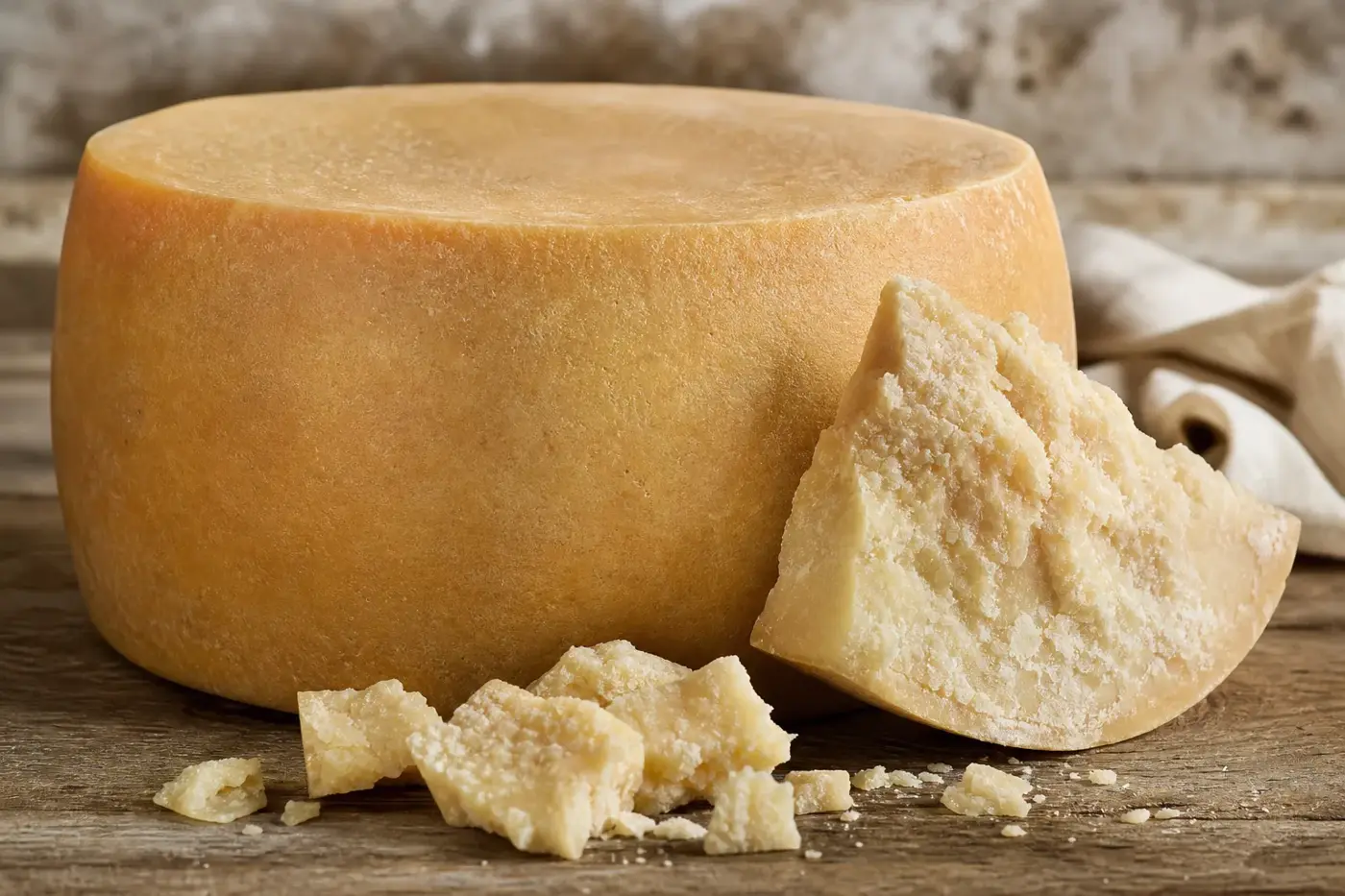
Parmigiano Reggiano
Break into a wheel of Parmigiano Reggiano and flakes fall away, revealing a finely granular cheese, pale straw to straw in colour.