Reggianito
Break a morsel from a wedge of Reggianito and watch the pale cheese fracture into brittle granules.
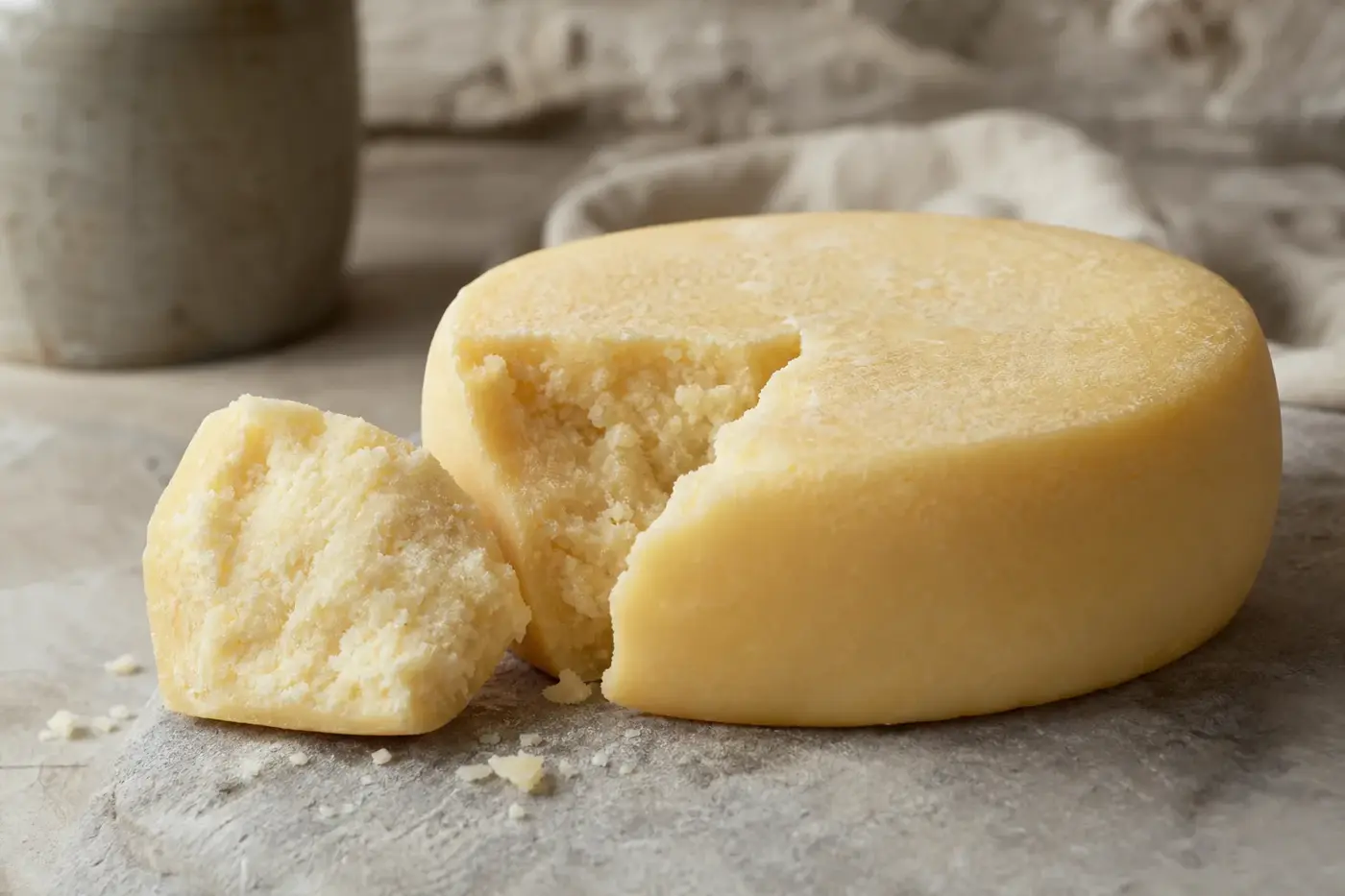
Break a morsel from a wedge of Reggianito and watch the pale cheese fracture into brittle granules. Then comes the salt, followed by a slightly piquant bite. Your grater can wait a moment. [1][2]
The whole wheel weighs just 5 to 10 kg, but its story crosses an ocean. Italian immigrants carried their cheesemaking traditions to Argentina, where those skills took on a local identity, shaped by the country’s own rules on composition, format and maturation. [1][2]
| At a glance | Reggianito |
|---|---|
| Argentine legal name | Queso Reggianito. [1] |
| The rules behind the wheel | Argentine Food Code, Chapter VIII, Article 635. [1] |
| Protected name status | Jurisdiction-specific status remains uncertain |
| Milk | Cow’s milk; raw or pasteurised permitted by the Argentine standard. [1][2] |
| Permitted coagulant | Rennet and/or other suitable coagulating enzymes. [1] |
| A typical standard wheel | Flat-faced cylinder, slightly convex sides, 5 to 10 kg. [1] |
| Legal minimum maturation | Six months for the standard wheel-weight range. [1] |
Italian skills find an Argentine home
Immigrants brought the methods. Argentina made the cheese its own. The agriculture ministry’s 2008 Reggianito quality protocol describes its technology as an adaptation of Italian methods brought to the country by immigrants, with Italian hard cheeses among its antecedents. [2]
Think of skills travelling and evolving, rather than one inventor unveiling a finished cheese. The meaning and naming history of Reggianito remain uncertain.
If you want to understand the cheese in front of you, ancestry tells only part of the story. Italian practice explains its development; Argentina’s food standard defines what is sold under the name. Its distinct wheel format and production requirements show an inherited approach becoming an Argentine category. [1][2]
Meet the dairies in Córdoba, Santa Fe and Buenos Aires
Follow Reggianito through Argentina and you find several dairy regions in the picture. Manfrey’s product sheet places its cooperative in Freyre, Córdoba, and presents a whole-wheel Reggianito weighing approximately 7 kg. Cassini y Cesaratto includes Reggianito in its range and identifies its industrial plant at San Carlos Sud, Santa Fe. [3][4]
Buenos Aires province has a place in the story too. Vacalin’s Reggianito technical sheet identifies its industrial plant at Bartolomé Bavio, in the district of Magdalena. Together, these records place the cheese across several provinces, without giving any one of them exclusive ownership of the style. [5]
Regional enthusiasm needs a little perspective. Lácteos Premium describes its Córdoba dairy basin in superlative terms, for example. When choosing your next wedge, focus on the named dairy, its disclosed location and what it tells you about the cheese itself. [8]
From the vat to the maturing room
Cooking, draining, pressing, salting and maturation give Reggianito its structure. The Argentine standard places it in the cooked-curd tradition and requires milk, specific lactic cultures, a suitable coagulant and salt. Article 635 also permits cream, concentrated milk proteins and calcium chloride as optional ingredients. [1]
Curd is the coagulated milk that becomes your cheese. Whey is the liquid separated from it. To follow the wider sequence, see how cheese is made.
Vacalin’s technical sheet takes you through its own process, from the milk entering the vat to the finished cheese. Here is how its Reggianito comes together. [5]
| Stage | What happens at Vacalin |
|---|---|
| Preparing the milk | Standardised milk is pasteurised before entering the vat. |
| Forming the curd | Starter culture, calcium chloride, rennet and lipase are added. |
| Shaping and pressing | Curd enters a pre-press, is cut and moulded, then pressed. |
| Adding the salt | Unmoulded cheeses are immersed in brine. |
| Maturing and packing | Cheeses mature in a chamber, then are packed whole or portioned. |
That product record tells you things the name alone cannot. Vacalin specifies pasteurisation and pressing for its cheese. For another dairy’s milk treatment and coagulant, read its own information alongside the permissions in the general standard. [1][5]
Look inside that pale, granular wedge
Cut through the smooth, well-formed rind and you should find a hard, brittle, granular interior. Its colour runs from yellowish white to slightly yellow. The Argentine standard allows occasional small holes or mechanical openings, although the paste is generally closed; the compact wheel is part of its characteristic appearance. [1]
Vacalin describes its cheese as compact, brittle and granular, with no eyes, the cheesemaking term for holes. You can enjoy that texture in irregular morsels as readily as in fine gratings. A wedge need not spend its entire life auditioning for pasta. [5]
The rind has its own story. The 2008 Argentine quality protocol describes both naturally pale-yellow and black-painted rinds. If you see a dark exterior, treat it as a coating, not a colour chart for the cheese underneath. [2]
Taste the salt, sharpness and time
Salty, slightly piquant, with a characteristic aroma: the official Argentine sensory description gives you a useful starting point. Vacalin’s specification echoes that salty, lightly piquant profile. Here, piquant means a sharp flavour impression, not chilli. [1][5]
Individual makers fill in the picture. Chamen describes its Reggianito as firm, compact and slightly brittle, with a developed flavour that grows more complex through prolonged maturation. La Paulina links its hard, grating texture to long maturation and describes an intense flavour and aroma. [6][7]
Each description belongs to that producer’s own cheese. When you ask about age, find out which standard the answer refers to. The Argentine quality scheme protocol requires at least eight months for cheeses seeking that scheme, separate from the general statutory minimum. [2]
Reggianito and Parmigiano Reggiano, side by side
Their shared hard-cheese ancestry makes comparison natural. Look at their production requirements, though, and you can see why they are not interchangeable identities. Parmigiano Reggiano’s specification requires raw cow’s milk, partial skimming by natural creaming, a natural whey starter and calf rennet. [9]
Place matters too. Its milk production, cheesemaking and maturation are tied to a defined Italian area. Here is what the two standards ask of their cheeses. [9]
| What to compare | Reggianito, Argentine standard | Parmigiano Reggiano, Italian production specification |
|---|---|---|
| Origin | Argentine cheese tradition. [2] | Defined area including Parma, Reggio Emilia, Modena and specified parts of Bologna and Mantua. [9] |
| Milk treatment | Raw or pasteurised permitted. [1] | Raw milk, without heat treatment. [9] |
| Coagulant | Rennet and/or suitable coagulating enzymes. [1] | Calf rennet exclusively. [9] |
| Minimum maturation | Six months for standard wheels. [1] | Twelve months. [9] |
| Whole-wheel weight | 5 to 10 kg. [1] | At least 30 kg. [9] |
Name protection is a separate question. The Great Britain register lists Parmigiano Reggiano as a registered PDO, with UK-scheme registration dated 31 December 2020. That registration applies within its jurisdiction, distinct from Argentina’s statutory definition of Reggianito. Register information: November 2026. [10]
For a closer look at the Italian cheese’s production and identity, read Parmigiano Reggiano.
Make room for it on your table
Before you grate the lot, consider a picada, the Argentine spread of small foods to share. Lácteos Premium recommends small cubes or wedges of Reggianito for it. Chamen also suggests boards and appetisers, giving you good reason to bring this cheese to the table in its own right. [6][8]
Begin with a small piece on its own. Notice how readily it breaks, the size of the granules and whether salt or sharpness leads the finish. Those details tell you more about your next wedge than an age statement alone, and help you decide how to serve it.
These suggestions build on the producers’ documented table, pasta and salad applications. Choose the cut that suits what you are serving: [6][7][8]
- Broken pieces: serve with bread and sliced pear, keeping the cheese’s texture distinct.
- Fine gratings: scatter over pasta gradually, tasting before you add more salt.
- Thin shavings: lay over salad or cooked vegetables for separate bites of cheese.
- Coarser gratings: finish a savoury dish rather than automatically treating Reggianito as a melting cheese.
If your recipe specifies Parmigiano Reggiano, using Reggianito changes the ingredient. Let salt, texture and flavour guide you. Equal quantities need not behave identically.
Choose your wedge and keep its label
Start with the producer, declared age, ingredients and storage instructions. Ask whether the rind is natural, painted or covered with another material, and what you should remove before eating or grating. Argentine rules permit appropriate surface coverings and paraffined cheeses, so appearance alone cannot tell you the treatment. [1]
Wax, plastic coatings and cloth are not food. Look at the cut face too: Vacalin’s description of its own Reggianito gives you a useful reference in pale, compact, granular cheese. A heavily trimmed wedge leaves fewer clues about the original exterior, making the seller’s information especially valuable. [5]
At home, follow the instructions on your particular pack. Protect the cut face with clean food-grade wrapping or a suitable covered container. Keep the original label alongside the cheese so its dates and storage guidance stay to hand.
In England, Wales and Northern Ireland, the Food Standards Agency advises keeping your home fridge at 5 °C or below. Follow the storage instructions on the packaging. Guidance date: November 2026. [11]
For the wider routine, see how to store cheese at home.
Let the label guide your dietary choices
For vegetarian suitability, ask about rennet rather than judging by the wheel’s traditional appearance. Chamen lists cuajo, meaning rennet, without identifying its origin on its product page. If the source matters to you, ask the maker; rennet explained sets out the different types. [6]
Milk treatment calls for the same attention to the individual product. Chamen and Vacalin explicitly declare pasteurised milk, while Argentina’s general standard also permits raw milk. The named cheese’s declaration gives you a clearer answer than an assumption about the style. [1][5][6]
For lactose, look for a product-specific declaration or analytical information. La Paulina labels its Reggianito lactose-free on its published product page; that declaration applies to that product. You can explore the broader subject in lactose in cheese. [7]
Read the full ingredients and allergen information too. Vacalin’s sheet declares lysozyme and states that its Reggianito contains milk and egg derivatives. Even with a familiar hard cheese, those details deserve your attention before you choose a wedge. [5]
General information only, not medical advice: follow the official guidance where you live.
Questions people ask
How is Reggianito different from Parmigiano Reggiano?
Reggianito is an Argentine cheese whose standard permits raw or pasteurised cow’s milk. Parmigiano Reggiano is made in a defined Italian area using raw cow’s milk and calf rennet. Reggianito wheels weigh 5 to 10 kg, while Parmigiano Reggiano wheels weigh at least 30 kg.
How long is Reggianito matured?
The Argentine statutory minimum is six months for standard wheels. The Argentine quality scheme protocol requires at least eight months for cheeses seeking that scheme.
Is Reggianito suitable for vegetarians?
The Argentine standard permits rennet or other suitable coagulating enzymes. Check the coagulant used by the producer. Chamen lists rennet without identifying its origin, so ask the maker if its source matters to you.
Does Reggianito contain lactose?
Look for a product specific declaration or analytical information. La Paulina labels its Reggianito as free of lactose, but that declaration applies to its own product.
How should I store Reggianito?
Follow the instructions on the pack and protect the cut face with clean food grade wrapping or a suitable covered container. Keep the original label for its dates and storage guidance. In England, Wales and Northern Ireland, the Food Standards Agency advises keeping a home fridge at 5 °C or below; check its current guidance.
Sources
- Argentine authorities, Código Alimentario Argentino, Capítulo VIII: Alimentos lácteos, consolidated chapter updated October 2025, Article 635, particularly sections 3, 4 and 5. Official current chapter retrieved through the national code index.
- Secretaría de Agricultura, Ganadería, Pesca y Alimentos, Resolución 16/2008: Protocolo de calidad para queso Reggianito, 2008, annex covering historical background, product attributes and maturation. This is the quality-label protocol, whose additional requirements are separate from the general food standard.
- Manfrey, Queso Reggianito horma x 7 kg. aprox., product sheet, hosted in the manufacturer’s December 2023 document directory; revision date not stated.
- Cassini y Cesaratto, Reggianito, official export product page, undated, including industrial-plant address.
- Vacalin, Queso Reggianito, manufacturer’s technical sheet, 2024 file, covering ingredients, production, sensory characteristics, storage and plant address.
- Chamen, Queso Reggianito, official product page, undated, covering ingredients, sensory description and suggested uses.
- La Paulina, Reggianito, official product page, undated, covering texture, culinary applications and the manufacturer’s lactose-free declaration.
- Lácteos Premium, Reggianito, official product record, undated. Retrieved search record gives nine months’ maturation, table uses and sensory description; the opened page confirms the Villa Nueva, Córdoba address.
- Consorzio del Formaggio Parmigiano Reggiano, Product specification of the protected designation of origin “Parmigiano Reggiano”, specification identified by the consortium as in force from 24 April 2025, English file dated July 2025, Cheese Production Standards, Articles 1 to 4.
- Department for Environment, Food & Rural Affairs, Parmigiano Reggiano, Great Britain protected food-name register entry, published 4 January 2021, current entry checked November 2026.
- Food Standards Agency, How to chill, freeze and defrost food safely, published 18 December 2017, current guidance retrieved through the FSA consumer chilling link and its GOV.UK destination, November 2026.
This piece was researched from Argentine legislation and institutional records, manufacturers’ published product information, the Italian production specification, the Great Britain register and official household storage guidance.
Last checked: November 2026
Last checked November 2026.
The editors suggest you read next
American Cheese: The Processed Slice Explained
Watch a slice of American cheese soften over your burger.