Small white flakes rise through hot sheep’s whey. Gathered into perforated moulds, they become Ricotta Romana: fresh, delicately sweet and milky, made from the whey left by cheesemaking in Lazio. Before you reach for a spoon, pause over the regional story in that basket. Its protected designation of origin, PDO, is registered in the EU and Great Britain, tying sheep farming, production and packing to the region surrounding Rome.[1][2][3]
| What you want to know | The details |
|---|---|
| Name to look for | Ricotta Romana.[2][3] |
| EU designation | PDO, confirmed in the official amendment publication of September 2026.[2] |
| EU registration authority and amendment reference | European Commission; amendment reference: PDO-IT-0298-AM01.[2] |
| Great Britain status | Registered PDO; UK scheme registration dated 31 December 2020.[3] |
| Original EU registration date | 14 May 2005, as recorded by Defra.[3] |
| Where it comes from | The whole Lazio region, Italy.[1] |
| What goes into it | Whey from whole sheep’s milk; additional whole sheep’s milk permitted within the specification’s limit.[1] |
| Shape and size | Fresh, in truncated-cone moulds; maximum weight 2 kg with a 10% tolerance.[1][2] |
| Allergen | Milk.[8] |
| Status date | November 2026.[1][2][3] |
Follow Ricotta Romana beyond Rome
Rome lends Ricotta Romana its name, but the whole of Lazio is its home. Milk production, the transformation of whey into ricotta and the packing of the finished product must all happen inside the regional boundary. The designation protects that complete local chain, not simply the address of the business selling it.[1][2]
Keep that distinction in mind at the counter. A Roman shop may sell several ricottas, and its location tells you little about where each was made. Ask for the full protected name and look at the product’s identification.
The history takes you through Lazio’s markets, too. The EU’s published account points to market records from Rome, Viterbo, Frosinone and Latina as evidence of Ricotta Romana’s regional presence. This is a story rooted in trade across the region, rather than one ingenious inventor having a particularly good morning.[2]
A regional name and a cheese style are not quite the same thing. You can untangle the difference in protected names explained.
Meet the sheep behind your spoonful
Eight sheep breeds appear in the European Commission’s September 2026 amendment publication. They are Sarda, Comisana, Sopravissana, Massese, Lacaune, Merinizzata, Assaf and Valle del Belice, together with their crossbreeds.[2]
What those sheep eat is part of the geographical story. The rules describe pasture, meadow land and forage typical of the area, while allowing supplementary feed. Feed from outside the area may supply no more than 30% of annual dry matter. Summer mountain grazing in neighbouring regions is allowed during the animals’ dry period, when they are not producing milk.[2]
You need not memorise eight breeds before choosing a basket. The full protected name is more useful: “sheep’s ricotta” tells you the milk species alone. Ricotta Romana brings that species together with a defined origin and production requirements, and all three belong to its identity.
Give the whey its second act
By the time Ricotta Romana begins, another cheese’s curd has already been collected. What remains is whey, the liquid separated from curd during cheesemaking. Here it comes from making sheep’s-milk cheeses, and becomes the beginning of something fresh.[1]
Reheating coaxes the whey proteins into small flakes, which rise to the surface. These are gathered away from the remaining liquid, known as scotta. Recovering this second set of solids distinguishes ricotta production from cheesemaking that starts by coagulating milk directly.[1]
That difference offers you a useful clue at the table. Think of fresh ricotta as something to spoon, spread or work into a filling, not a miniature aged wheel. Let its soft, fresh character guide what you do with it.
Curious about the work that happens before the whey is left behind? Follow curd formation, separation and draining in how cheese is made.
Heat, patience and a perforated basket
Gentle heat and careful gathering shape the ricotta you eventually eat. When the whey reaches 50 to 60 °C, the specification allows whole sheep’s milk to be added, up to 15% of the whey’s volume. That addition is optional, so do not expect that proportion in every batch.[1]
The whey reaches 85 to 90 °C with gentle agitation. Acidity adjusters are excluded, while salt is permitted up to 4 g per litre. Heating then stops for about five minutes, allowing the floating flakes to consolidate. Collected into perforated, truncated-cone moulds, they drain for 8 to 24 hours.[1]
Those figures describe manufacturing requirements, not a method for making cheese at home. At the counter, the useful question is whether the finished ricotta has the consistency your dish needs. Ask to see it if possible, especially if you are planning a filling.
Let the first spoonful speak for itself
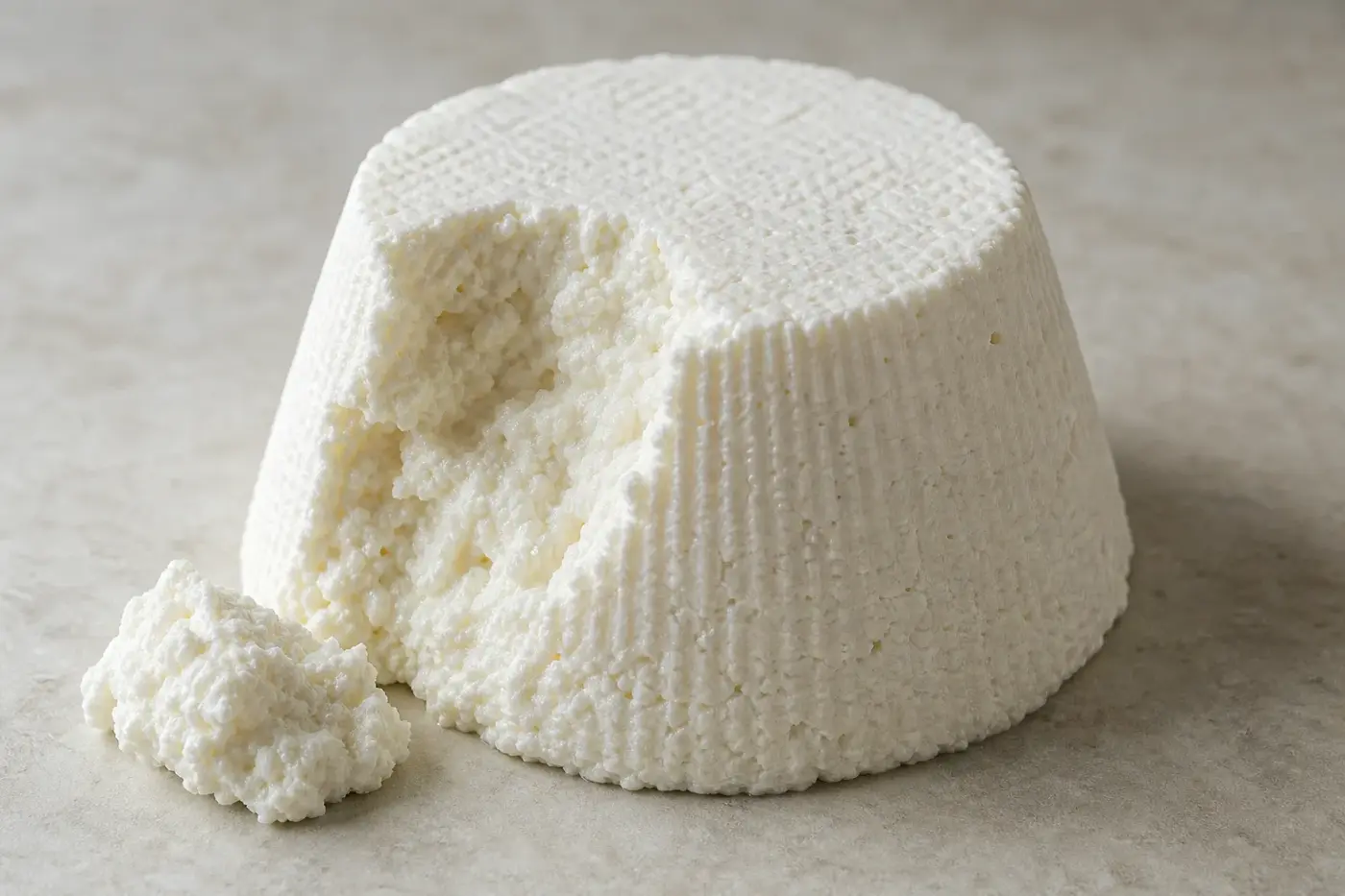
White, lumpy paste and a sweetish milk flavour: that is Ricotta Romana in the official description. Qualivita’s account offers a similar picture, describing a white, uneven structure and characteristic milky sweetness.[1][4]
This is fresh, moist ricotta, without a developed rind for you to trim. Its draining mould gives it that truncated-cone shape. You get a different view from a whole basket than from a portion already spooned into a container.[1][4]
Begin with an unadorned spoonful. Notice the soft grains, their size, how readily they spread and how much seasoning you think they need. Then try a little with bread. Treat this as your own exploration at home, rather than a set of tasting notes to match.
Let that first mouthful suggest the direction of your meal. Add accompaniments gradually and taste as you go. Sugar, salt and sauce can wait a moment; they rarely suffer from a lack of attention.
Find the ricotta your dish needs
Ricotta Romana is a particular PDO product, not another name for every ricotta on the shelf. If a pack says simply “ricotta”, consider its ingredients and origin on their own terms. That shorter name does not establish compliance with the Ricotta Romana specification.[1][2]
When you substitute, begin with texture. For a spooned topping, compare how well each product holds its shape; for a filling, consider whether it needs more draining. Taste before seasoning, rather than assuming the same quantities will suit every ricotta.
Ricotta Romana is sold fresh, without maturation.[2] Salted, matured Ricotta Salata is a different proposition. If your recipe calls for grating or crumbling rather than spooning, follow its choice closely: that texture has a job to do.
Another fresh ricotta can still be a useful substitute. Just call the replacement by its own name, rather than presenting it as the protected product.
Look beyond the lovely basket
Start with the identification, however inviting the basket looks. The protected product’s packaging must carry “Ricotta Romana”, the designation wording, the producer and packer’s identification, the product logo and the EU logo. The name must appear in Italian.[2]
Give those details a moment before presentation wins you over. For help separating the food’s name from the wording around it, turn to how to read a cheese label.
At a counter, ask three things: to see the original product identification, when the portion was opened or packed, and what its storage and use instructions are. If texture matters, explain what you are cooking. That gives the person serving you more to work with than “fresh ricotta, please”.
Choose a quantity that fits your plans. Tonight’s supper, a filling or several individual servings may call for different amounts, so match your intended use to the pack’s instructions. Those instructions are more useful than a universal number of days after purchase.
Make a little room for ricotta
On its own, with bread or in fillings: these are Qualivita’s recommended uses for Ricotta Romana.[4] There is plenty for you to explore within that simple starting point. The ideas below are serving suggestions, rather than tested recipes.
For a savoury plate, set out bread and ricotta, then offer olive oil, black pepper and herbs separately. You and anyone sharing can find the balance you like without committing the whole basket to one seasoning.
With pasta, try a spoonful beside a simply dressed portion before mixing everything together. If you like the balance, let it guide another meal. With vegetables, serve the ricotta alongside, giving it space rather than burying it beneath a strongly seasoned topping.
For something sweet, put fruit and a little honey or sugar beside a small bowl. Taste the ricotta first and add sweetness gradually. If lemon zest appeals, try it in a separate spoonful before flavouring the whole portion.
Keep the combinations spare enough to taste what you came for. Ricotta, bread and one accompaniment leave its character room to show. A crowded plate can turn that gentle milky flavour into a very quiet dinner guest.
Keep the basket chilled, take your portion
Your domestic fridge should be between 0 and 5 °C, according to Food Standards Agency guidance for England, Wales and Northern Ireland. The FSA advises refrigerating dairy products and following their packaging instructions. Use a fridge thermometer to check the temperature, rather than relying only on the control dial.[5]
Keep Ricotta Romana refrigerated as its label directs, including any instructions for after opening. Take out only the portion you plan to use, and keep preparation time short. This follows the FSA guidance for England, Wales and Northern Ireland.[5]
Pay attention to the dates, too. UK government guidance distinguishes use-by dates, which concern safety, from best-before dates, which concern quality. Incorrect storage can make food unsafe even before its use-by date.[6]
Before planning another serving, read the date alongside the opening instructions. Both matter to your decision. For more handling advice, see how to store cheese at home.
This page summarises published guidance from the official sources it cites. It is not medical advice. Guidance differs between countries and changes over time, so check the current source for where you live, and ask your doctor, midwife, pharmacist or dietitian about your own circumstances.
Milk allergy and pregnancy: guidance for your choice
For milk allergy, sheep’s milk still counts
Sheep’s-milk cheeses appear among the foods Cambridge University Hospitals’ NHS guidance lists as unsuitable for a milk-allergy exclusion diet. That guidance separates allergy to milk proteins from lactose intolerance, which concerns difficulty digesting milk sugar.[8]
Starting with whey does not take Ricotta Romana outside that advice. Follow your allergy team’s instructions, and consider the complete food and everything served alongside it. You can explore the distinction further in cheese allergy versus lactose intolerance.
In pregnancy, consider the particular product
Pasteurised ricotta is on the NHS list of soft cheeses that can be eaten during pregnancy. The NHS also lists cooked soft cheeses as suitable when cooked until steaming hot all the way through.[7]
Apply the current advice to the particular product and how it has been handled. If its treatment is unclear on the packaging, ask the producer or retailer to explain. Follow the storage and use instructions, consult the current NHS guidance, and ask your midwife or another appropriate healthcare professional about your circumstances.[5][7]
Questions people ask
What is Ricotta Romana made from?
It is made from whey left over from making sheep’s milk cheeses. Whole sheep’s milk may also be added, up to 15% of the whey’s volume.
How can I recognise protected Ricotta Romana?
Look for the full name Ricotta Romana on the packaging. The pack must also show the designation wording, producer and packer identification, the product logo and the EU logo.
How should Ricotta Romana be stored?
The Food Standards Agency advises refrigerating dairy products and following the packaging instructions. Its guidance for England, Wales and Northern Ireland says a domestic fridge should be between 0 and 5 °C; check the FSA guidance for details.
Can I eat Ricotta Romana during pregnancy?
The NHS lists pasteurised ricotta as a soft cheese that can be eaten during pregnancy. It also lists cooked soft cheeses as suitable when cooked until steaming hot all the way through. Check the current NHS pregnancy guidance and ask a midwife or another appropriate healthcare professional about your circumstances.
Is Ricotta Romana suitable for someone with a milk allergy?
Cambridge University Hospitals’ NHS guidance lists sheep’s milk cheeses as unsuitable for a milk allergy exclusion diet. Consult that guidance and follow your allergy team’s instructions.
Sources
- Ministero dell’agricoltura, della sovranità alimentare e delle foreste, Disciplinare di produzione della DOP “Ricotta Romana”, June 2026 version, Articles 1 to 5 and 8. Official specification.
- European Commission, Publication of the communication of an approved standard amendment to a product specification of a geographical indication in accordance with Article 5(4) of Commission Delegated Regulation (EU) 2025/27, C/2026/4828, 17 September 2026, including the single document for Ricotta Romana. Official publication.
- Department for Environment, Food & Rural Affairs, Ricotta Romana, UK protected food names register, published 2021, live entry checked November 2026. Register entry.
- Fondazione Qualivita, Ricotta Romana PDO, undated live product account, appearance, flavour and gastronomy sections, checked November 2026. Product account. This industry reference is used for its published sensory description and suggested uses.
- Food Standards Agency, How to chill, freeze and defrost food safely, 2017, live guidance checked November 2026. Applies to England, Northern Ireland and Wales. Official guidance.
- UK Government, Understanding food labelling: Best before and use-by dates, live guidance checked November 2026. Official guidance.
- NHS, Foods to avoid in pregnancy, live guidance, cheese, milk and other dairy section, checked November 2026. Official guidance.
- Cambridge University Hospitals NHS Foundation Trust, Milk allergy, live patient information checked November 2026. Official patient information.
- Food Standards Agency, Alerts, live recall and allergy-alert service, accessed November 2026 for the editorial recall check. Official alerts.
Researched from the current Italian specification, the EU amendment publication, the Great Britain register and official UK health and handling guidance; serving suggestions are editorial desk research.
Last checked: November 2026
Last checked November 2026.
The editors suggest you read next
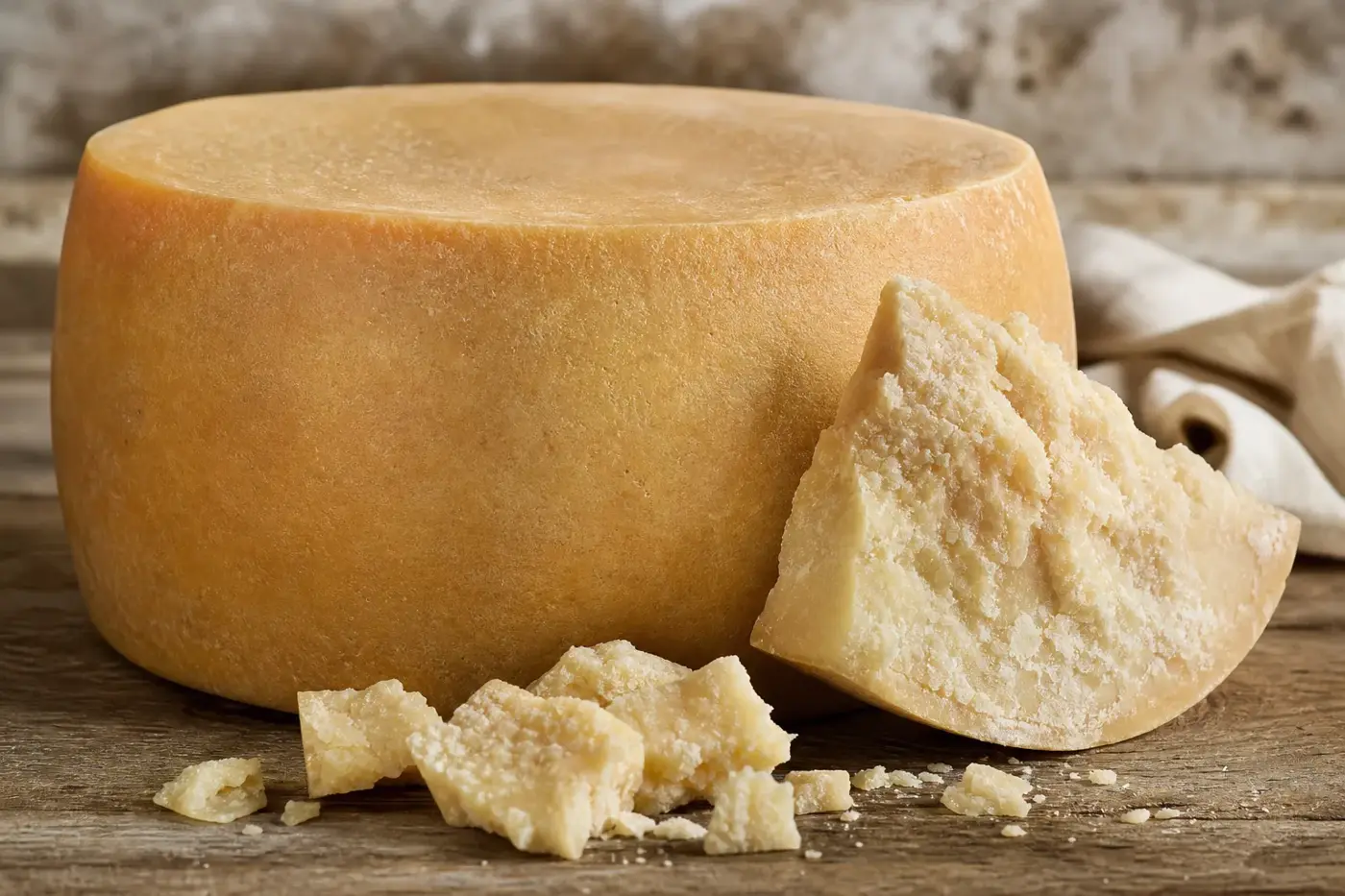
Parmigiano Reggiano
Break into a wheel of Parmigiano Reggiano and flakes fall away, revealing a finely granular cheese, pale straw to straw in colour.