Tomato sauce clings to the pasta. Fried aubergines and basil follow, then a final snowfall of grated salted ricotta. This is how Catania’s pasta alla Norma gets its finishing touch. [5] If you know ricotta only as soft, delicate curds, you have another side of it to meet.
Draining, salting and maturation turn those whey curds into ricotta salata: firm enough to grate and salty enough to season a forkful. Closely associated with Sicily, it varies in texture, milk source and intensity between makers and regional traditions. [1, 5] There is more to the name than one familiar white cheese.
| Your quick guide | What to know |
|---|---|
| The familiar name | Ricotta salata. [1] |
| Its recorded regional name | Ricotta salata siciliana, recorded in Sicily’s traditional product documentation. [1, 2] |
| Where it belongs | Sicily, within the wider central and southern Italian tradition described by the regional record. [1] |
| What whey goes into it | Cow’s, sheep’s, goat’s or mixed whey in the Sicilian record; ingredients vary by producer. [1, 3, 4] |
| What to look for | Cylinder or truncated cone; pale surface; firm, friable paste. [1] |
| Where it earns its place | Grating, or eating at a softer stage. [1] |
| Legal minimum ageing | Not established here |
| Allergen | Milk. [3, 4, 11] |
| Pregnancy guidance | UK NHS guidance on foods to avoid in pregnancy, November 2026. [12] |
Sicily’s finishing touch, ready for your grater
Turning the soft result of whey heating into something you can grate is ricotta salata’s particular achievement. Sicily’s regional documentation records it as a traditional product across the island. [1, 2] The soft curds are the beginning, not the whole story.
That transformation gives you a useful kitchen clue. Reach for ricotta salata when you want cheese scattered over a finished dish, rather than spooned into a filling. A little grated over tomato and aubergine seasons each forkful; a larger crumble makes the cheese an ingredient you notice in its own right.
Before reaching for the knife, decide what you want from it. A fine finishing layer or distinct pieces? Let that choice guide how you cut the cheese you have bought.
Follow the whey from saucepan to basket
Whey is the liquid separated from curd during cheesemaking, but there is still something worth gathering in it. Heating recovers its remaining proteins. In ricotta production, these gather into soft flakes, rise towards the surface and are collected. [1]
At Azienda Agricola Guarino, the producer describes heating whey to approximately 85 °C. Those floating flakes go into draining baskets, where the fresh ricotta loses liquid before being salted by hand and matured. [3] Salt and the gradual loss of moisture give the soft curds a different character.
| Stage | What happens to your cheese |
|---|---|
| Heating | Whey proteins gather into flakes ready to be collected. [3] |
| Collecting and draining | Baskets hold the soft ricotta while liquid drains away. [3] |
| Compaction | Ask whether the curd is pressed and how it becomes firm. |
| Salting | Guarino applies coarse salt by hand after draining. [3] |
| Maturation and drying | The Sicilian regional account describes drying until the paste hardens. [1] |
Draining, salting and maturation shape the cheese you take home. If you are curious about pressing, ask the producer how that particular cheese becomes firm. For your immediate kitchen plans, a simpler question helps: is this piece meant for grating, or for cutting into softer pieces?
For the wider distinction between milk curd and whey, see how cheese is made.
A pale surface and a crumbly heart
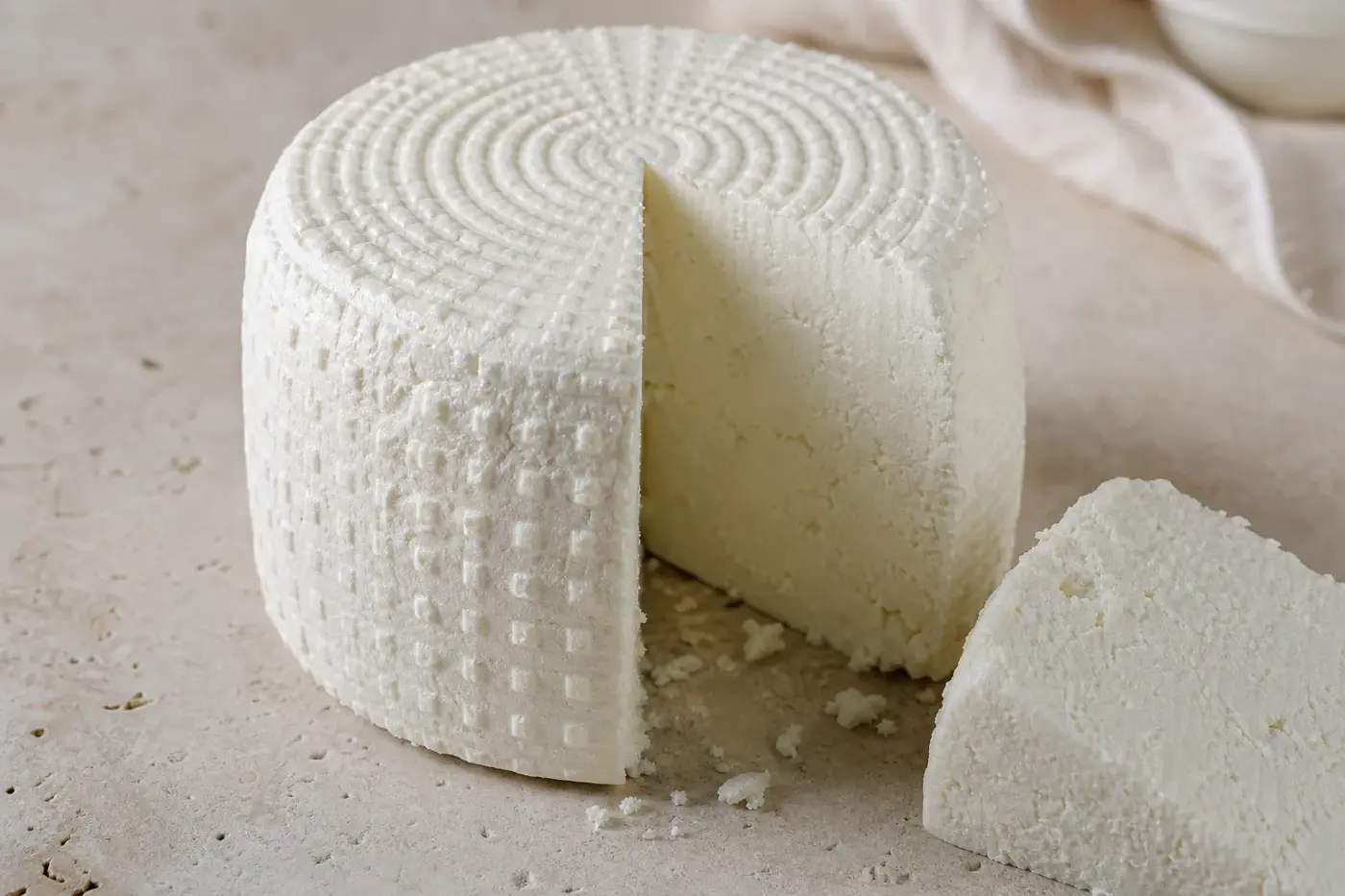
You may recognise the small cylinder, though documented products also include truncated cones. Sicily’s regional description gives a white or ivory surface and a semi-hard paste. It is friable rather than elastic: expect it to crumble, not stretch. [1]
Risiu’s technical sheet describes a truncated-conical cheese with compact paste ranging from white towards pale straw. [4] Together, these descriptions give you a useful picture at the counter. Look for a pale, comparatively dry-looking cheese whose cut face holds its shape, rather than a tub of loose curds.
Match that texture to your plans. For a fine finishing layer, ask for a piece that grates cleanly; for salads or vegetables, ask whether it crumbles into small pieces or cuts into thin slices. One particularly hard or soft example tells you about that cheese, not every ricotta salata.
Let the flavour speak beyond the salt
Salt makes itself known, but there is dairy character beneath it. The Sicilian record describes a salty taste with a faint reminder of the original whey. Risiu’s tasting description brings together sweetness, savouriness and a delicate aroma. [1, 4]
A compact, relatively gentle cheese and a drier grating cheese can both carry the name. Maturation and drying affect firmness, while milk ingredients and salting practice help explain differences between producers. [1, 3, 4] Fresh ricotta’s sweetness is only the opening chapter.
Taste a small piece before giving your dish its final seasoning. Dress the vegetables or finish the sauce, add the cheese, then decide whether you need more salt. The grater may encourage generosity, but it is not in charge of dinner.
Three ricotta names worth getting to know
Fresh ricotta is the soft starting point, not an interchangeable finishing ingredient. Caseificio Sacco describes its fresh ricotta as smooth and spreadable, suitable for sweet and savoury preparations. It lists salted ricotta separately. [6]
Choose fresh ricotta when you want to spoon, spread or mix it through a dish. Choose ricotta salata for a firmer finishing element. Swapping them changes the food’s structure as well as its seasoning: a soft mixture and a scattering of firm cheese have different jobs.
Ricotta Romana brings another distinction. Qualigeo describes it as a fresh product made from sheep’s milk whey in Lazio, with a white, lumpy texture and a sweet milky flavour. [8] The exact name Ricotta Romana is registered as a protected designation of origin in Great Britain, according to the official register, November 2026. [7]
Read the complete product name and description when you buy, rather than stopping at “ricotta”. For the separate question of what a protected designation establishes, see protected names explained.
At the counter, get to know your piece
“Ricotta salata” gives you a name, not a complete ingredient list. Sheep’s whey is an important part of its story: Guarino describes a sheep’s milk product. Risiu’s technical sheet, meanwhile, lists whey, raw whole cow’s milk and salt. [3, 4]
Look for the whey species, any added milk and the declared treatment on the label. If those details matter to you and are unclear, ask the retailer to obtain the producer’s information. How to read a cheese label explains the difference between a product’s name and the information supporting it.
Ask where the cheese was made and whether it is intended for grating. Find out which instructions apply after cutting or opening, too. These are useful questions to settle while your cheese is still on the counter.
For a counter-wrapped piece, keep the original label or the retailer’s written storage information. Buy an amount that suits both your planned dishes and the stated storage period. A good piece deserves a plan, even if your shopping list simply said “cheese”.
Give ricotta salata its moment at the table
Finish pasta alla Norma the Catanian way
Sicily’s official tourism website describes pasta alla Norma as a Catanian dish of pasta, tomato sauce, fried aubergines, salted ricotta and basil. Its method finishes the dressed pasta with grated salted ricotta. [5] Here, the cheese arrives at the end.
Follow that order yourself: assemble the dish, then grate the cheese over it. Start with a light covering and taste before adding more. Let the tomatoes and aubergines guide your quantity, so the salty finish is a choice rather than a reflex.
Find a place for it over vegetables, salads and soup
Ricotta salata’s documented use as a table and grating cheese gives you a starting point for these serving suggestions. [1, 4] Think about the cut as well as the quantity. A fine grating and a generous crumble make quite different mouthfuls.
- Roasted vegetables: try a fine grating over aubergines, courgettes or peppers just before serving. Leave some pieces uncovered so you can judge the balance.
- Salads: crumble it over tomatoes and cucumber, or combine it with cooked beans and herbs. Add the cheese before deciding on the final salt.
- Soups: grate a little into individual bowls of vegetable or bean soup. You have more control than when seasoning the whole saucepan with cheese at once.
- Simple pasta: finish tomato sauce or vegetables with grated ricotta salata, borrowing the approach documented for Norma. [5]
Before adding more cheese, try changing the cut. Fine gratings spread it across the dish; larger crumbles give you distinct pieces to encounter. For your first use, finish one portion separately, taste it, then adjust the next to suit the particular cheese in front of you.
Feta or aged pecorino? Let the dish decide
If you need an alternative, start with what the cheese needs to do. In a salad, feta gives you a moist crumble and a tangier direction. Over pasta, aged pecorino offers a hard grating cheese with a more assertive finish.
These are serving substitutions, not equivalent versions of ricotta salata. Compare the salt information on the packs, start with less than you planned and adjust the finished dish. Do not assume a particular ranking of saltiness or a fixed replacement quantity.
If you want the distinctive character of a whey cheese, look for another salted, matured ricotta. A similar colour is not enough to guide your choice. The feta guide covers that cheese separately.
Keep the label close and the cheese chilled
The storage temperature and opening instructions supplied with your cheese come first. For consumers in England, Wales and Northern Ireland, the Food Standards Agency advises keeping the fridge between 0 and 5 °C and refrigerating dairy products. [9]
After cutting, reclose the original packaging if it is suitable. Otherwise, use clean food wrapping and a covered container. Keep the label alongside the cheese so you still have its dates and instructions, and follow any product-specific storage instruction that differs.
A use-by date concerns safety; a best-before date concerns quality, according to UK government guidance. Do not eat cheese after its use-by date, even if it looks or smells acceptable. [10] Appearance and smell do not replace that safety instruction.
Observe the stated after-opening limit as well as the printed date. For broader guidance on wrapping and refrigeration, see how to store cheese at home.
This page summarises published guidance from the official sources it cites. It is not medical advice. Guidance differs between countries and changes over time, so check the current source for where you live, and ask your doctor, midwife, pharmacist or dietitian about your own circumstances.
Milk allergy and pregnancy: the details you need
Ricotta salata contains milk ingredients. UK government guidance identifies milk as an allergen that food businesses must communicate to customers. If you are buying a cut piece from a counter, ask for the allergen information. [3, 4, 11]
For pregnancy, look for the product’s pasteurisation information and consult the current guidance for your country. You can find the UK NHS guidance on foods to avoid in pregnancy, November 2026, here. [12]
Use that NHS source, November 2026, when considering the guidance. If the product information leaves you uncertain, ask your midwife or another healthcare professional about your circumstances.
Questions people ask
What is ricotta salata?
Ricotta salata is a salted, matured ricotta closely associated with Sicily. It is firm enough to grate, although its texture and intensity vary between makers.
What milk is ricotta salata made from?
Sicily’s regional record lists cow’s, sheep’s, goat’s or mixed whey. Ingredients vary by producer: Guarino describes a sheep’s milk product, while Risiu lists whey, raw whole cow’s milk and salt.
How is ricotta salata different from fresh ricotta?
Fresh ricotta is soft and can be spooned, spread or mixed into dishes. Ricotta salata is drained, salted and matured, making it firmer and suitable for grating or crumbling.
What can I use instead of ricotta salata?
Feta is an option for a moist crumble in salads, while aged pecorino offers a hard grating cheese for pasta. They are serving substitutions rather than equivalent versions of ricotta salata.
How should I store ricotta salata?
Follow the storage and opening instructions supplied with your cheese. For consumers in England, Wales and Northern Ireland, the Food Standards Agency advises refrigerating dairy products and keeping the fridge between 0 and 5 °C.
Sources
- Regione Sicilia, Ricotta salata siciliana, Schede PAT Sicilia, XXIV aggiornamento, 2024. Regional product record reproduced by ONAF. Source document.
- Regione Siciliana, IRVOS, Prodotti agroalimentari tradizionali siciliani, December 2024 edition returned by the publisher’s link. Official document.
- Azienda Agricola Guarino, Ricotta Salata Siciliana, undated producer account, accessed November 2026. Commercial producer source. Producer account.
- Risiu, Scheda tecnica: Ricotta salata, undated technical sheet, accessed November 2026. Commercial product source. Technical sheet.
- Regione Siciliana, Department of Tourism, Sport and Entertainment, Visit Sicily, Pasta alla Norma, undated, accessed November 2026. Official culinary account.
- Caseificio Sacco, La ricotta Elisir, undated product page, accessed November 2026. Commercial producer source. Producer description.
- Department for Environment, Food & Rural Affairs, Ricotta Romana, protected food name register entry, published 2021, checked November 2026. Official register entry.
- Fondazione Qualivita, Qualigeo, Ricotta Romana PDO, undated product summary, accessed November 2026. Secondary reference. Product summary.
- Food Standards Agency, How to chill, freeze and defrost food safely, published 2017, current page checked November 2026. Applies to England, Wales and Northern Ireland. Official guidance.
- UK Government, Understanding food labelling: Best before and use-by dates, current page checked November 2026. Official guidance.
- UK Government, Understanding food labelling: Allergen labelling, current page checked November 2026. Official guidance.
- NHS, Foods to avoid in pregnancy, current page checked November 2026. Official guidance.
Researched through regional product documentation, published producer descriptions, an official protected-name register and current UK consumer guidance; culinary suggestions are editorial synthesis, without a site tasting or recipe test.
Last checked: November 2026
Last checked November 2026.
The editors suggest you read next
Parmigiano Reggiano
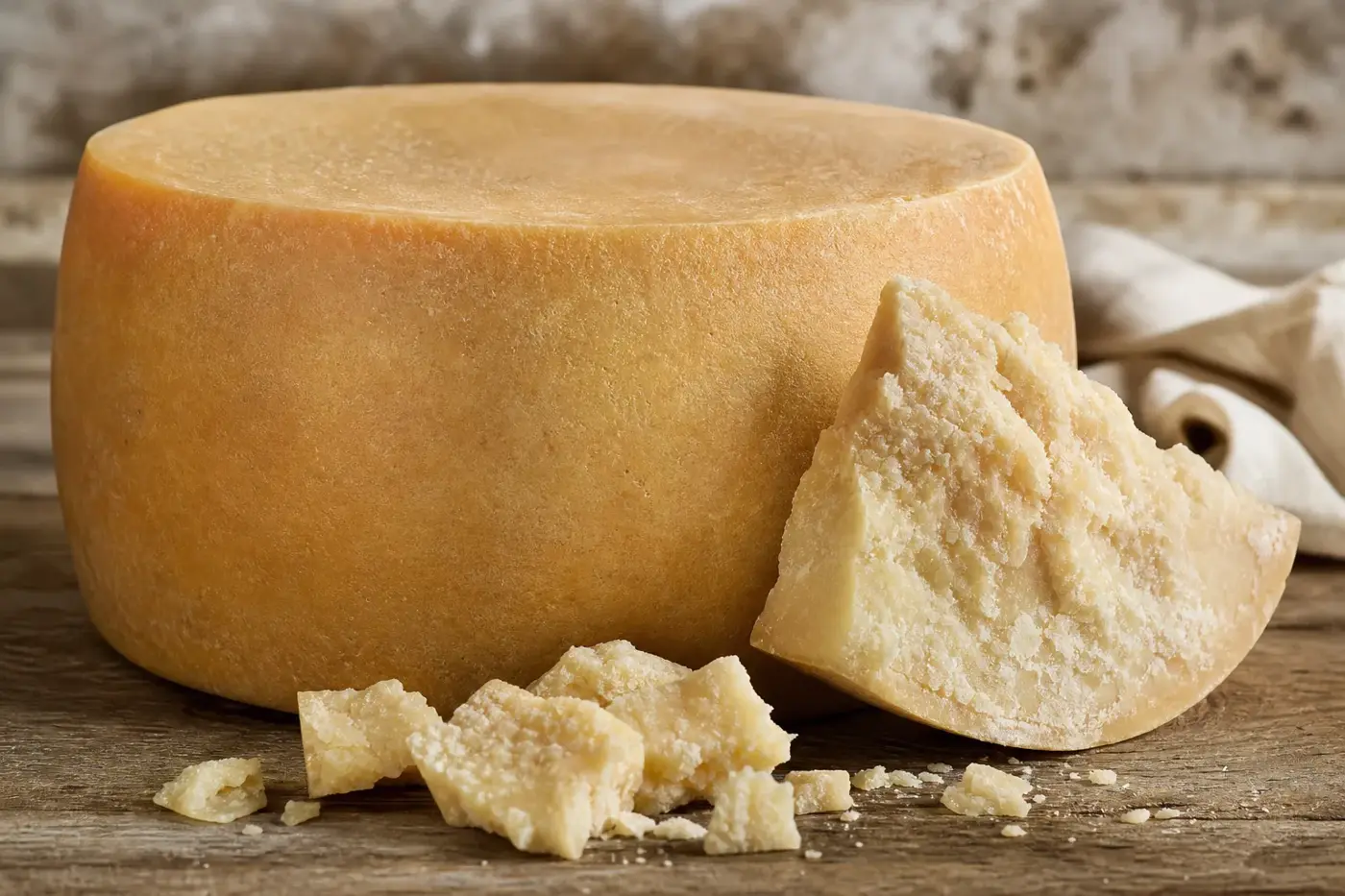
Break into a wheel of Parmigiano Reggiano and flakes fall away, revealing a finely granular cheese, pale straw to straw in colour.