Ricotta vs Cottage Cheese
Push your spoon into ricotta and it meets a soft mass of fine grains.
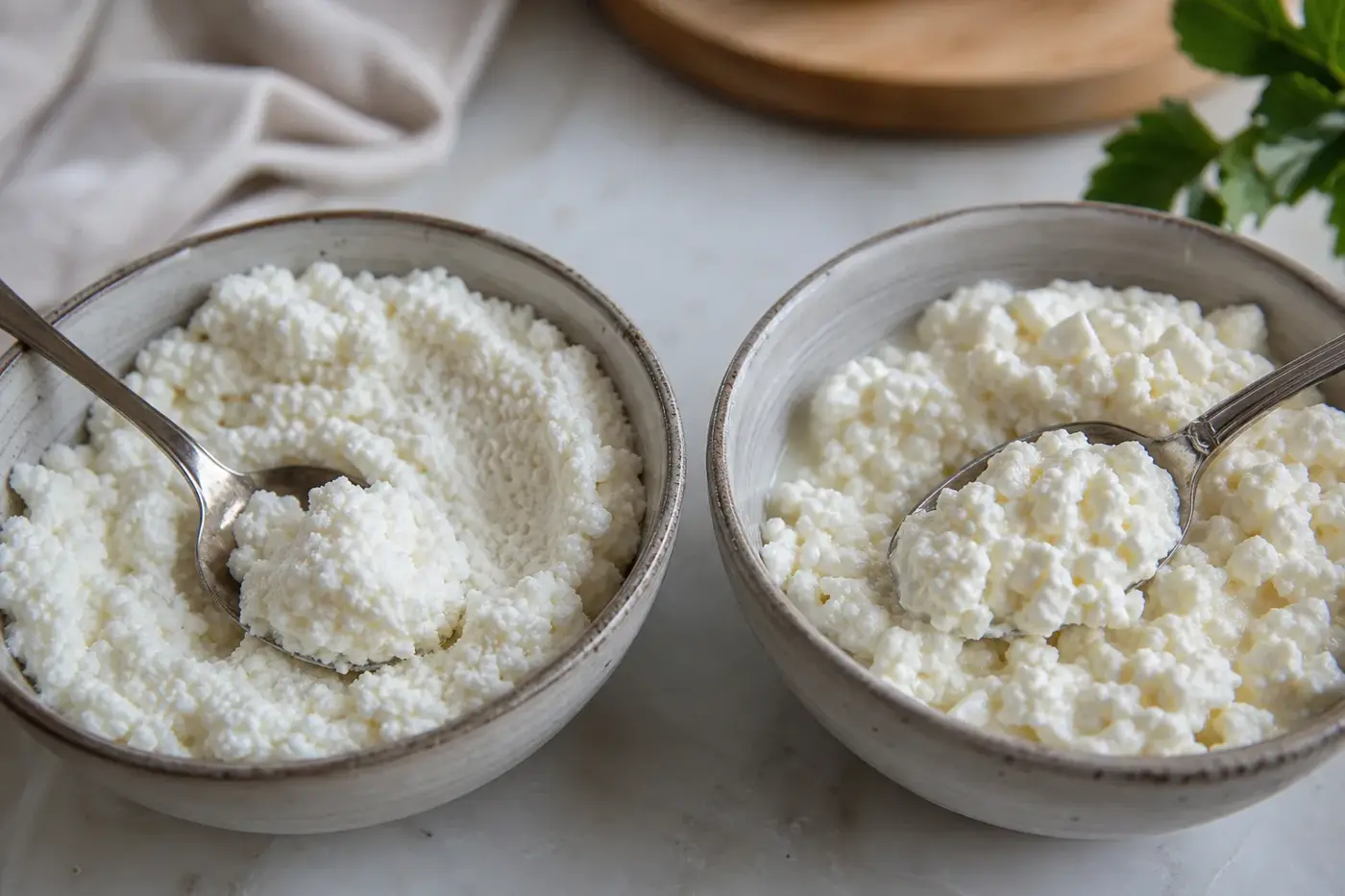
Push your spoon into ricotta and it meets a soft mass of fine grains. In cottage cheese, the moist curds hold their shape. One begins with whey left behind by cheesemaking; the other begins with milk. You taste and feel the difference in the kitchen, whether you want a cohesive pasta filling or a bowl where the curds deserve a little attention of their own. [1][2][3]
Two pots, three useful pointers
- Traditional ricotta starts with whey; cottage cheese starts with milk. [1][4]
- The two UK products below have different fat and protein figures per 100 g. Other products have their own nutritional profiles. [2][3]
- Swapping in cottage cheese? Drain it to reduce loose moisture, then blend it if you want finer curds.
Ricotta gives whey a second act
Traditional ricotta makes something fresh from what cheesemaking leaves behind. Once the curds have been separated, the remaining liquid is whey. Heating it recovers proteins into a fresh curd, which is then collected and drained. A useful reminder that the leftovers sometimes deserve their own billing. [1][4]
Milk or milk fat may join the whey, too. Tetra Pak's Dairy Processing Handbook describes whey cheeses made both with and without these additions. [1][4]
Cottage cheese takes a different route, starting with milk rather than leftover whey. In the handbook's cultured process, bacteria produce lactic acid, causing milk proteins to coagulate into a gel. A little rennet, a milk-setting enzyme preparation, may help the process along. [1]
That gel is cut into curds, heated and drained, then washed and cooled. A dressing, sometimes containing cream, can be mixed through the separate grains. You can follow the wider journey in how cheese is made. [1]
Let your spoon tell the texture story
Ricotta's fine grains gather into a soft mass. Cottage cheese keeps its individual curds, with moisture or dressing around them. Blending breaks those curds up, which is why a blended cottage cheese dip feels different from a spoonful straight from the pot. That texture guidance follows from how the cheeses are made. [1][2]
Both are mild enough to welcome sweet and savoury ingredients. Galbani describes its ricotta as fresh-tasting and grainy; Arla describes its natural cottage cheese as thick and fresh-tasting. [2][3]
You may have heard that ricotta is sweeter and cottage cheese saltier. Your pot's label tells you more: salt contributes savouriness, while fat and production method shape flavour and mouthfeel. The examples below have almost identical salt figures but different fat contents. That gives you a more precise guide to what each brings to your dish. [1][2][3]
A closer look at two UK pots: nutrition per 100 g
For this November 2026 comparison, these are the manufacturers' published typical values for products marketed in the UK. Equal weights make the differences easier to see. Recipes and brands vary, so let the current pack guide your choice. Every fat figure is grams per 100 g of the whole product. [2][3]
| Nutrient per 100 g | Galbani Ricotta [2] | Arla Natural Cottage Cheese [3] |
|---|---|---|
| Energy | 682 kJ, 164 kcal | 426 kJ, 102 kcal |
| Fat | 12 g | 5.4 g |
| Saturates | 8.3 g | 3.2 g |
| Carbohydrate | 6 g | 3.1 g |
| Sugars | 4.5 g | 2.9 g |
| Protein | 8 g | 10.3 g |
| Salt | 0.4 g | 0.39 g |
Here, cottage cheese gives you more protein and less fat and energy per 100 g. Use those differences to match these particular products to your requirements. They do not give every ricotta or cottage cheese the same nutritional identity. [2][3]
What does that mean for a smaller spoonful? A 30 g portion of the Galbani product provides approximately 205 kJ, 49 kcal, 3.6 g fat, 2.49 g saturates, 1.8 g carbohydrate, 1.35 g sugars, 2.4 g protein and 0.12 g salt. These figures are calculated from the values above. [2][3]
A 30 g portion of the Arla product provides approximately 128 kJ, 31 kcal, 1.62 g fat, 0.96 g saturates, 0.93 g carbohydrate, 0.87 g sugars, 3.09 g protein and 0.117 g salt. These figures, too, are calculated from the values above. [2][3]
Compare the amount you will actually spoon into your bowl or recipe. A little of one and a generous serving of the other give a different comparison from equal weights. Remember, too, that these figures describe the products before you drain them or add other ingredients. [2][3]
Turn the pot around: the label matters
Galbani's ricotta lists pasteurised whey from milk, milk cream and/or whey cream, salt, and lactic and citric acids as acidity regulators. Arla's natural cottage cheese lists cottage cheese made from milk, and salt. Cream appears explicitly in the ricotta's ingredients; you will find the cottage cheese's fat content in its nutrition panel. [2][3]
Neither cheese belongs in a dairy-free diet. Whey and cream are milk ingredients too, and the Food Standards Agency's UK consumer guidance identifies milk among the regulated allergens. Follow its advice to check allergen information, however familiar the name or front label looks. [7]
Lactose and vegetarian suitability need separate attention. Neither cheese name tells you that a product is lactose-free. For vegetarian suitability, seek an explicit manufacturer declaration or ask which coagulants are used: the handbook records that cottage cheese production can include rennet. For help, turn to rennet explained and how to read a cheese label. [1][2][3]
Reach for ricotta when you want a soft filling
Ricotta comes into its own when you want cheese to become part of a filling or settle into a soft layer. Galbani recommends its product for pasta, sauces, cheesecake and spreading on bread. The same pot can take you from savoury cooking to dessert, through hot and cold dishes. [2][4]
In filled pasta, those fine curds are the attraction. They distribute through a cohesive filling more readily than distinct cottage cheese grains. Making ravioli or cannelloni for the first time? Use the ricotta your recipe specifies when consistency matters; texture is the reason. [1][2]
In baked dishes, give ricotta a role as a soft layer or filling. For a dessert or spread, start with a plain product so the herbs, fruit and other flavourings remain your choice. If your finished dish needs to set or hold its shape, follow a recipe written for the cheese you have. [2][4]
Give cottage cheese's curds room to shine
Choose cottage cheese when you want to notice the curds. Spoon it beside fruit in a bowl, add it to a salad, or put it on toast with vegetables and herbs. Keep the curds whole if their shape and texture are what brought you to the pot. [1][3]
You can cook with it, too. Arla suggests baking its natural cottage cheese into lasagne or blending it into sauces. The same approach works for dips: decide whether you want visible grains or a more uniform base before adding other ingredients. Sort out the texture first, then season the finished mixture. [3]
Swapping cheeses? Start with the texture
You can often exchange one for the other, provided you work with their texture and moisture. These practical recommendations draw on their documented curd structures and the manufacturers' suggested uses. [1][2][3][4]
Replacing ricotta with cottage cheese? Look first at the liquid around the curds. For a thicker filling, drain off loose liquid in a sieve in the fridge, following the product's refrigeration instructions. Blend afterwards if visible curds would be unwelcome. [1][3][6]
Draining reduces loose moisture; blending reduces grain size. They are different jobs, so choose the step your dish actually needs. [1][3][6]
Whole cottage cheese curds may fit happily into a rustic baked pasta dish. In a fine dessert filling, they are less inclined to keep a low profile, so blending is the better starting point. Before adding seasoning or sweet ingredients, read the salt figure rather than assuming your swap needs extra salt. [2][3]
Going the other way, ricotta can supply the soft cheese in a bowl or spread, but its finer texture replaces those separate cottage cheese curds. If your recipe depends on a particular amount of moisture, fat or protein to set, find one written for the replacement cheese. Changing the curds does not make the ingredient lists or nutrition panels match. [1][2][3]
Keep it cold, and note when you opened it
For England, Wales and Northern Ireland, the FSA advises a home fridge temperature between 0 °C and 5 °C, alongside following the packaging's storage instructions. Arla's natural cottage cheese page specifies refrigeration below 5 °C and eating it within three days of opening. Follow that instruction for that product, and read your ricotta's own label for its opening limit. [3][6]
Note when you open the pot, and watch its printed date. UK official guidance distinguishes use-by dates, which concern safety, from best-before dates, which concern quality. Follow both the opening instructions and the printed date; do not eat refrigerated cheese after its use-by date. You'll find broader handling advice in how to store cheese at home. [8]
This page summarises published guidance from the official sources it cites. It is not medical advice. Guidance differs between countries and changes over time, so check the current source for where you live, and ask your doctor, midwife, pharmacist or dietitian about your own circumstances.
Pregnant? Make pasteurisation your first check
The NHS lists pasteurised ricotta and pasteurised cottage cheese among the soft cheeses you can eat during pregnancy. Its guidance, reviewed on 15 June 2026, is the basis of this November 2026 summary. It tells you to check the packaging for pasteurisation. Consult the NHS pregnancy food guidance for current advice, and ask your midwife or doctor about your own circumstances. [5]
Let dinner decide which pot you open
Choose ricotta for a fine-textured pasta filling, dessert or spread. Choose cottage cheese when you want distinct, moist curds in a bowl, on toast or in a salad. If you swap them, treat loose moisture and curd size as separate adjustments. Then look at your particular product's salt and fat: the pot in front of you matters more than the style's reputation. [1][2][3][4]
Questions people ask
What is the difference between ricotta and cottage cheese?
Traditional ricotta starts with whey, while cottage cheese starts with milk. Ricotta forms a fine, soft mass, whereas cottage cheese retains distinct, moist curds.
Can I use cottage cheese instead of ricotta?
You can often substitute it, but the texture and moisture will differ. Drain loose liquid in a sieve in the fridge for a thicker filling, following the product's refrigeration instructions, and blend the curds if you want a finer texture.
Which has more protein, ricotta or cottage cheese?
In the two UK products compared on the page, Arla Natural Cottage Cheese has 10.3 g of protein per 100 g, while Galbani Ricotta has 8 g. Recipes and brands vary, so check the current pack.
Can you eat ricotta or cottage cheese during pregnancy?
The NHS lists pasteurised ricotta and pasteurised cottage cheese among the soft cheeses that can be eaten during pregnancy, and advises checking the packaging for pasteurisation. See the NHS pregnancy food guidance for current advice and ask your midwife or doctor about your own circumstances.
Are ricotta and cottage cheese vegetarian?
Neither cheese name establishes vegetarian suitability. Look for an explicit manufacturer declaration or ask which coagulants are used, as cottage cheese production can include rennet.
Sources
-
Tetra Pak, Dairy Processing Handbook, online chapter “Cheese”, undated current edition, checked November 2026. Sections on whey cheese, fresh cheese types and cottage cheese production. Read the chapter. Technical industry reference, used for manufacturing descriptions rather than UK legal definitions.
-
Galbani UK, Galbani Ricotta 250g, undated product page, checked November 2026. Ingredients, typical nutrition per 100 g, manufacturer tasting description and suggested uses. Read the product information. Commercial manufacturer source.
-
Arla UK, Arla Natural Cottage Cheese 500g, undated product page, checked November 2026. Ingredients, typical nutrition per 100 g, storage, opening instructions and suggested uses. Read the product information. Commercial manufacturer source.
-
Galbani UK, Ricotta, undated product-category page, checked November 2026. Whey heating and draining, and sweet and savoury applications. Read the account. Commercial manufacturer source.
-
NHS, Foods to avoid in pregnancy, reviewed 15 June 2026. Section “Cheese, milk and other dairy”. Read the current guidance.
-
Food Standards Agency, How to chill, freeze and defrost food safely, published 18 December 2017, current online text checked November 2026. Applies to England, Northern Ireland and Wales. Read the guidance.
-
Food Standards Agency, Food allergy and intolerance advice for consumers, updated 7 August 2026. Sections on regulated allergens and consumer allergen information. Read the guidance.
-
GOV.UK, Understanding food labelling: Best before and use-by dates, undated current online edition, checked November 2026. Date meanings and storage after opening. Read the guidance.
-
Food Standards Agency, Recalls and alerts, updated 7 July 2026. Recall information and route to the current alerts list, consulted for the editorial recall check described below. Read the information.
This comparison combines desk research from a dairy-processing reference, UK manufacturer product information and official UK guidance; the substitution recommendations are editorial synthesis.
Last checked: November 2026
Last checked November 2026.
The editors suggest you read next
Cheddar vs Gouda: Taste, Texture and How to Use Each
Bite into a long-aged Gouda and, beneath your teeth, something crunches.