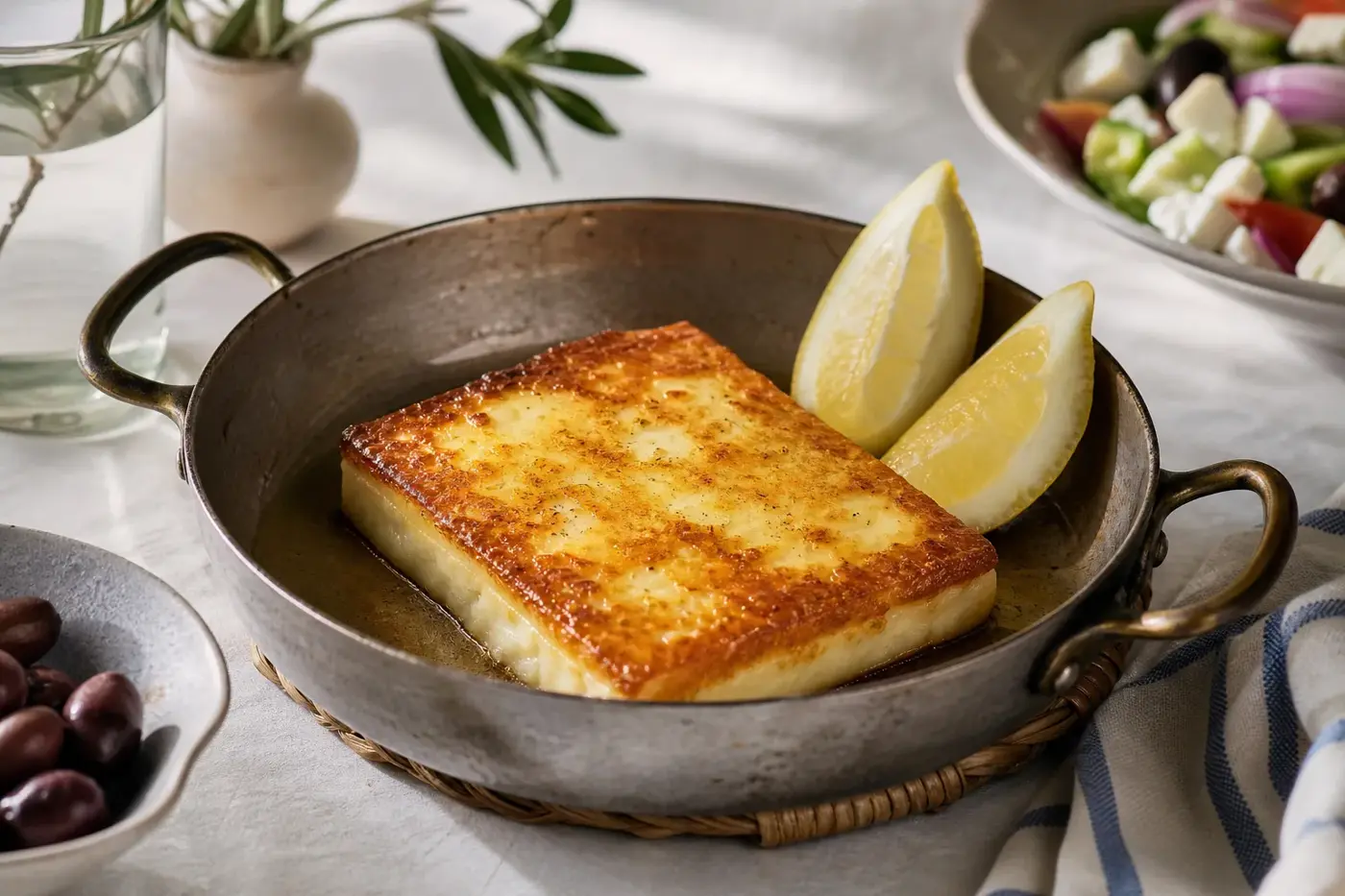
Squeeze lemon over hot cheese and listen to the pan. Your fork breaks through the golden crust; the centre still yields. This is saganaki’s deliciously brief moment, named first for the small Greek frying pan with two handles, then for the food inside it. A thick slice and controlled heat bring that contrast to your plate.[1][3]
The little Greek pan behind your appetiser
Before saganaki was your appetiser, it was the vessel. Written σαγανάκι in Greek, the word means a small frying pan with two handles in the Dictionary of Standard Modern Greek. Eggs, cheese and mussels appear among its examples of dishes cooked inside.[1]
Here, you’re making cheese saganaki, a hot appetiser. Greek culinary sources describe a flour-dusted slab, shallow-fried and finished with lemon squeezed over at the table. Without the traditional pan, use a normal small non-stick frying pan. Your cheese needs to lie flat, with enough room to turn without folding.[3][9]
Choose your golden-crusted centrepiece
Graviera and kefalotyri are good places to begin: Greek recipes recommend both. For a centre that melts more readily, choose kasseri and cut smaller pieces. A Greek chef’s recipe warns that it can escape through a broken crust, so keep your spatula ready.[3][4]
| Cheese | The maker’s description | What that means in your pan |
|---|---|---|
| Kefalotyri | Roussas describes its cheese as hard and salty.[5] | Firm enough for a substantial slice; the dairy recommends frying it in olive oil.[5] |
| Graviera | Kalogeraki describes its cheese as sweetish and slightly briny.[6] | A gentler-flavoured place to start; the maker lists saganaki among its uses.[6] |
| Kasseri | Roussas describes its cheese as semi-hard, sharp and salty.[5] | Can melt through a damaged coating; keep pieces smaller and turn carefully.[4] |
These descriptions belong to the makers’ own products, not every cheese with the same name. Salt levels vary between producers, so compare the salt declarations on your packets. If the terminology leaves you squinting, turn to how to read a cheese label.
No Greek cheese? There’s still supper
MyGreekDish suggests thick slices of Monterey Jack, provolone or young Pecorino when Greek cheeses are unavailable.[2] Each brings its own flavour and melting behaviour. Choose a block you can cut evenly, rather than thin sandwich slices.
One Greek recipe source also suggests halloumi; another lists Gouda and Cheddar.[3][4] For your first attempt, look for a cheese its maker specifically recommends for frying. Arvanitis, for example, explains that it developed a lower-moisture frying cheese because ordinary kefalotyri sometimes melted during cooking.[8]
You’re after a slice that lifts intact, with a softened middle. A very stretchy cheese and a firm grilling cheese give different results beneath that golden surface. Let the texture you fancy guide you, rather than the name alone.[4][8]
Your saganaki recipe, from slice to sizzle
This is an adaptation of MyGreekDish’s published recipe, with an editorial oil quantity and preparation notes, rather than an independently tested fromage.co.uk recipe.[2]
Serves: 2 as a shared appetiser.
Preparation: 5 minutes.
Cooking: allow 10 minutes.
Total: about 15 minutes.
Method: shallow frying on the hob.
Oven temperature: not applicable.[2]
Put your ingredients within reach
- 110 g graviera or kefalotyri, in one even slice
- 50 g plain flour, for dredging; most remains in the dish
- 30 ml olive oil
- Half a lemon, cut into wedges
- Cold water, for dampening the surface
Substitutions: replace graviera with kasseri if you like, preferably in smaller pieces. For non-Greek alternatives, choose from the cheeses above. Salt and melting behaviour depend on the product, so leave salt out of the coating.[4][5]
Give your cheese a snug pan
You’ll need a small heavy-based non-stick frying pan, wide spatula, shallow flour dish, kitchen paper and serving plate. Choose a pan that holds your cheese comfortably, without a large expanse of bare surface around it.[3][9]
Five steps to that golden crust
-
Cut an even slice about 1.5 cm thick. MyGreekDish warns that thinner slices can melt into the pan. Remove packaging and any non-food coating before cooking.[2][7]
-
Pat away loose surface moisture. Briefly dampen the slice with cold water, coat every face with flour, then shake off the surplus. Aim for a thin coating that clings, with no loose wet flour waiting to fall into the oil.[3][9]
-
Warm the oil over medium heat. Follow the moderate heat in the producer’s published method, rather than turning the burner to maximum. Carefully lay your cheese in the heated oil.[9]
-
Let the underside turn golden, then turn. Support the whole slice with your spatula and cook the second face until golden too. The source describes a few minutes on each side; watch your cheese’s colour and shape as well as the time.[2][9]
-
Lift onto your serving plate and go straight to the table. Squeeze lemon over just before eating. Set out extra wedges for anyone who wants more.[3][9]
A little flour, not an overcoat
Patting dry and dampening might sound contradictory, but each has a job. First, remove pooled moisture; then a quick dip gives the flour just enough water to cling. Shake thoroughly after dredging. You’re frying cheese, not tailoring it a flour overcoat.[3][9]
Prefer to leave out the flour? Choose a cheese whose maker explicitly recommends frying or grilling it without melting down, and follow its cooking instructions. Arvanitis describes that behaviour for its dedicated frying cheese.[8] Pat your slice dry and omit the water used to attach flour.
A plain flour blend labelled gluten free is a possible, untested substitute for wheat flour. This recipe contains milk and, with plain wheat flour, wheat. When choosing ingredients and preparing food for someone with an allergy or intolerance, consult the Food Standards Agency’s allergy and intolerance advice.[10]
Keep your crust golden and your slice together
The right heat colours the outside while leaving your cheese firm enough to lift. Longer frying is not automatically better. If the edges start spreading, attend to the slice rather than turning it again just to darken the crust. Begin with an evenly cut, intact piece.[3][4][8]
If your slice misbehaves, these adjustments address cooking quality. They draw on the published methods and their warnings about thickness, coating and melting.[3][4][9]
| What’s happening | What may be behind it | What you can try |
|---|---|---|
| Sticking: a quality defect | Fragile coating or a forced turn | Use a non-stick pan and broad spatula; support the whole slice rather than pulling one corner.[3] |
| Leaking: a quality defect | Thin slice or broken crust, especially with kasseri | Cut evenly; divide easily melting cheese into smaller pieces before frying.[3][4] |
| Too salty for you: a quality mismatch | Cheese saltier than you want | Leave salt out of the flour and serve unsalted accompaniments; compare packet declarations next time.[5][6] |
| Dark crust, firm centre: a quality defect | Heat too fierce for the slice | Lower the heat next time, cut evenly and follow the medium-heat method.[9] |
Tear the bread before the pan gets hot
Have your accompaniments ready before the cheese enters the pan. MyGreekDish suggests crusty bread with lemon, plus a Greek or green salad alongside.[2] Here, the preferred companion is a crisp cucumber and tomato salad with little added salt, especially beside kefalotyri. Tear the bread before cooking: hot cheese is not inclined to wait for you.
For your glass, try sparkling water with lemon. A small glass of apple juice is another option alongside the cheese.
About that restaurant flame
If you know saganaki as a flaming restaurant spectacle, that is a separate presentation. MyGreekDish describes it as Greek American practice, uncommon in Greece outside some tourist restaurants.[2] Arvanitis also records the Chicago restaurant version in its published account.[8]
For this preparation, finish with lemon at the table. Frying makes the crust; heated cheese supplies the yielding centre. Neither needs a flame. Your reward is that brief interval when the outside is crisp and the middle still gives beneath your fork.[3][9]
Enjoy it hot, then look after leftovers
Serve your saganaki as soon as frying finishes. The producer’s recipe notes that the cheese becomes harder as it cools.[9] For a larger table, get bread, salad and plates ready first. Fry manageable batches and send each out promptly, letting the pan set the meal’s rhythm rather than holding finished cheese.
FSA household guidance for England, Wales and Northern Ireland, dated here to November 2026, says to cool cooked leftovers as quickly as possible, ideally within one to two hours, and refrigerate them. Keep your fridge between 0 °C and 5 °C and eat leftovers within 48 hours.[12][13]
Reheat only once, until steaming hot throughout, rather than merely warming the crust. These are the FSA’s reheating instructions: a golden exterior alone does not establish that the middle is hot.[12] Follow the packet’s storage instructions for unused cheese.
For your remaining uncooked block, see how to store cheese at home. Treat the prepared dish and original cheese separately. One is a cooked leftover; the other is an opened product with its own label instructions.[13]
General information only, not medical advice: follow the official guidance where you live.
Questions people ask
What cheese is best for saganaki?
Graviera and kefalotyri are recommended in Greek recipes. Kasseri melts more readily, so a Greek chef recommends cutting it into smaller pieces to reduce the risk of it leaking through a broken crust.
How do you make cheese saganaki?
Cut an even slice about 1.5 cm thick, briefly dampen it with cold water and coat it thinly with flour. Shallow fry it in olive oil over medium heat until golden on both sides, then serve immediately with lemon.
What can I use if I cannot find Greek cheese?
MyGreekDish suggests thick slices of Monterey Jack, provolone or young Pecorino. Other Greek recipe sources suggest halloumi, Gouda or Cheddar.
Can you make saganaki without flour?
Yes. Choose a cheese whose maker explicitly recommends frying or grilling it without melting down, and follow its cooking instructions. Pat the slice dry and omit the water used to attach flour.
How should I store and reheat leftover saganaki?
The Food Standards Agency advises cooling cooked leftovers as quickly as possible, ideally within one to two hours, and refrigerating them at 0 °C to 5 °C. It says to eat them within 48 hours and reheat only once, until steaming hot throughout. Consult the agency's household guidance for England, Wales and Northern Ireland.
Sources
- Centre for the Greek Language, Dictionary of Standard Modern Greek, entry “σαγανάκι”, online edition, undated. The retrieved entry gives the Greek spelling, vessel definition and examples of foods prepared in it.
- MyGreekDish, Saganaki recipe (Pan-seared Greek cheese appetizer), online recipe and accompanying guidance, undated edition retrieved November 2026. Primary culinary account used for the recipe framework, alternatives, accompaniments and comparison with flaming presentations.
- Tasty Cooking, Συνταγή για τυρί Σαγανάκι, Το τέλειο σαγανάκι!, online Greek-language recipe, undated edition retrieved November 2026.
- Greek recipe publisher, Greek fried cheese, Saganaki, recipe 9881, undated indexed edition retrieved November 2026. The retrieved recipe text supplies the warning about kasseri, smaller pieces and alternative cheeses.
- Roussas Dairy, Yellow Cheeses, undated product descriptions retrieved November 2026. Commercial primary source for its own kefalotyri, graviera and kasseri descriptions.
- Kalogeraki, Graviera, undated product description retrieved November 2026. Commercial primary source for its own tasting description and suggested culinary uses.
- Greek Ministry of Rural Development and Food, Προδιαγραφές του προϊόντος «Κασέρι / Kasseri», specification file dated 19 February 2025 in its filename, retrieved November 2026, sections 1, 2 and 5.
- Arvanitis, Do you know about the Saganaki cheese?, 18 December 2020. Commercial primary account of its frying-cheese development and descriptions of restaurant preparations.
- Olympus, Saganaki with Kefalotyri OLYMPUS, undated recipe retrieved November 2026. Commercial recipe source for dampening, flouring, medium-heat shallow frying and prompt serving.
- Food Standards Agency, Food allergy and intolerance advice for consumers, published 2020, publication page updated August 2026, current online text retrieved November 2026.
- eKathimerini, Crispy kefalotyri saganaki, 12 February 2026. Primary published cookery recipe; its serving introduction suggests ouzo or tsipouro.
- Food Standards Agency, Cooking your food, GOV.UK online guidance, published 2017, current text retrieved November 2026, section 7.
- Food Standards Agency, How to chill, freeze and defrost food safely, GOV.UK online guidance, published 2017, current text retrieved November 2026, section 1.
Researched through Greek-language culinary material, published recipes, attributed dairy descriptions, the Greek ministry's specification and official FSA household guidance.
Last checked: November 2026
Last checked November 2026.
The editors suggest you read next