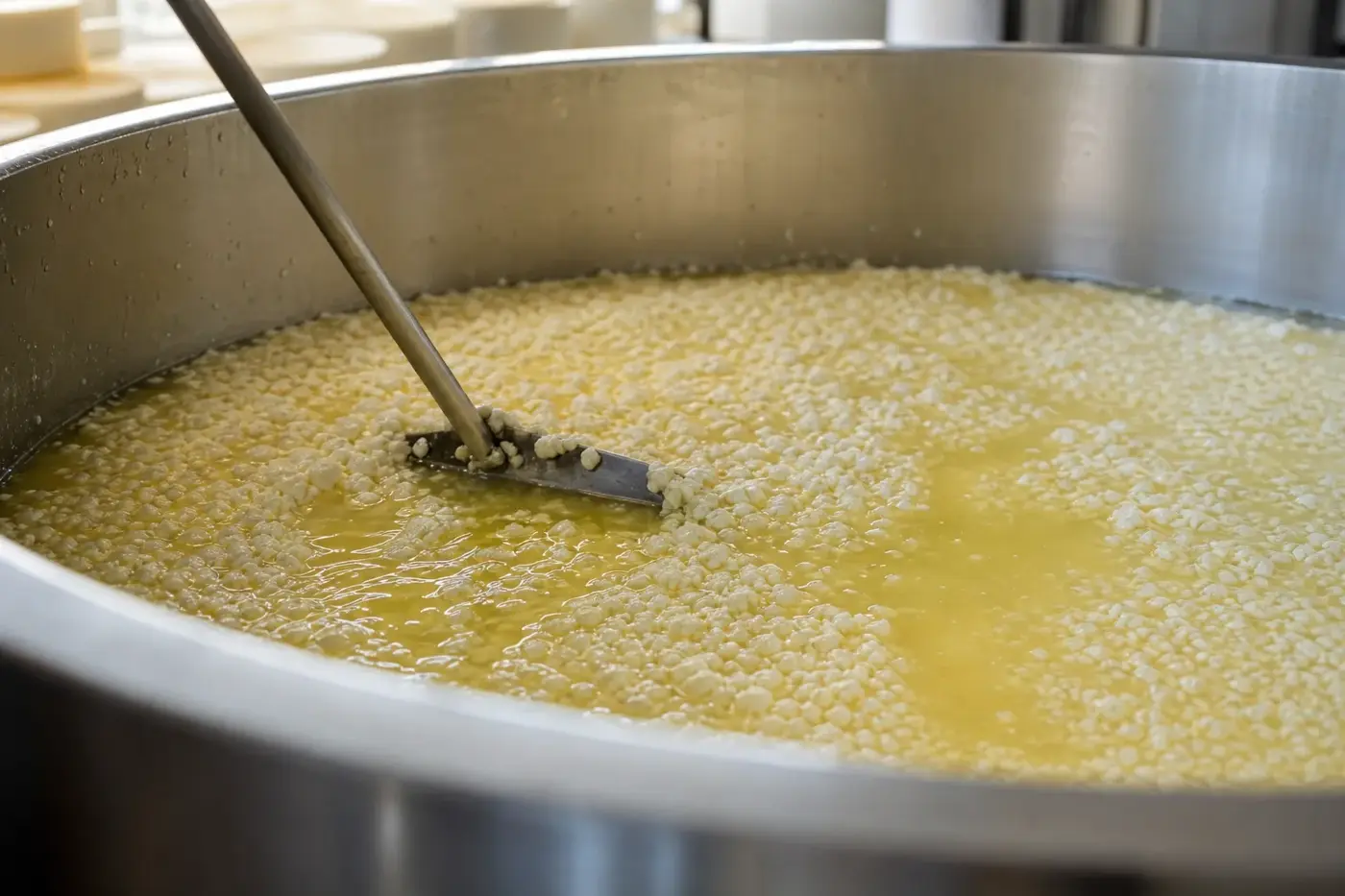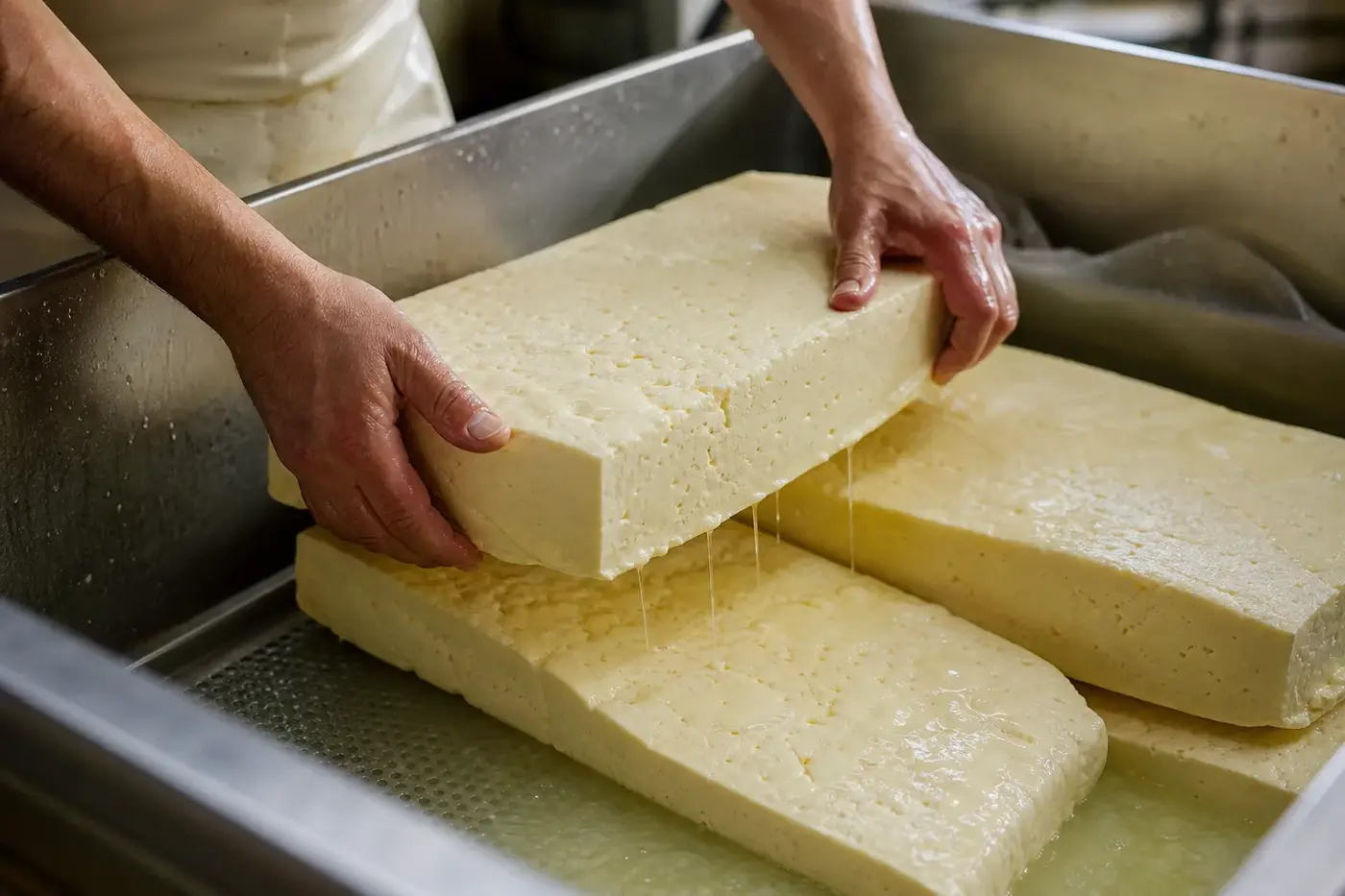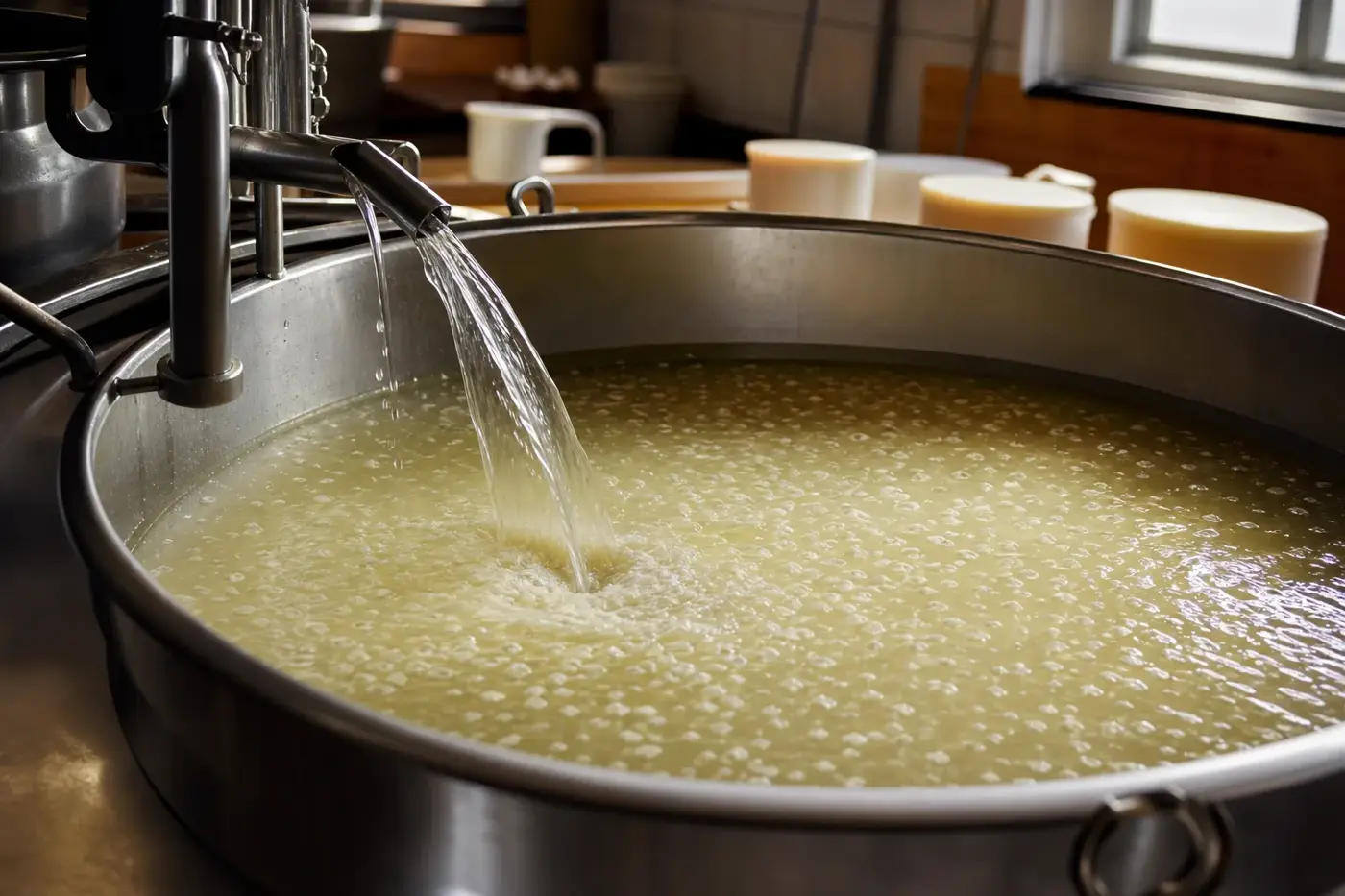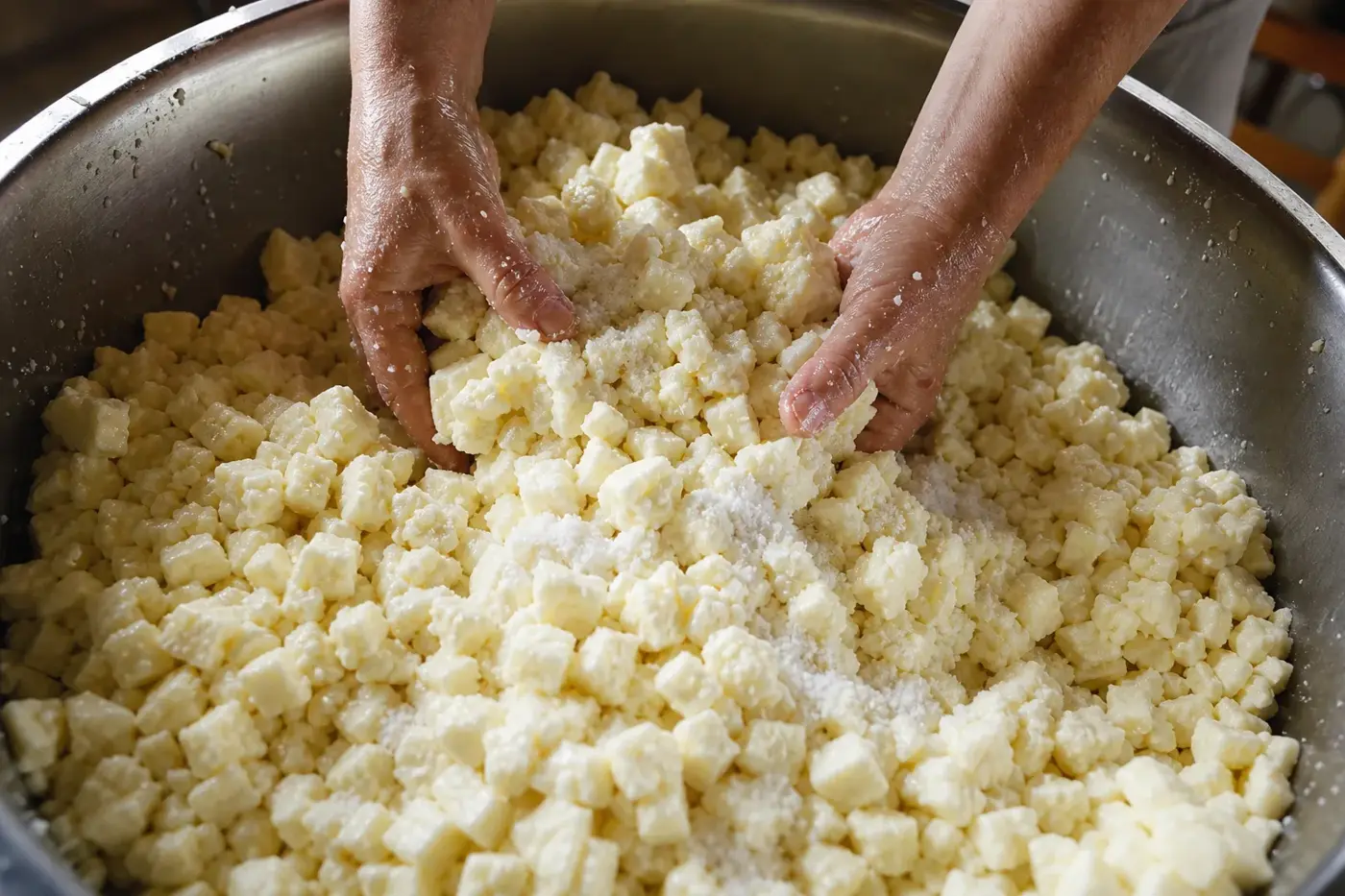
Scatter salt over milled curd. The crystals dissolve where they land. Lower a formed wheel into brine and you set a different journey in motion, from the outside in. Both methods shape moisture, fermentation, ripening and flavour, giving the cheesemaker control over where salt enters and how quickly it spreads. [1,2]
There is more to salt than the first bite
Saltiness is probably what you notice first. But salt also changes the balance of flavour, while its preserving role is a separate matter. It reduces water activity, meaning the water available for microbial growth, making conditions less favourable for some organisms. Acidity, temperature and the cheese itself help determine the outcome. [3,8,12]
A distinctly salty bite does not mean hazards have disappeared. In a controlled Cheddar study followed over 270 days, reducing salt increased moisture and water activity, while changing acid production and starter survival. Salt shapes the environment in which cheese develops, not simply the flavour you eventually taste. [3]
Dry salting: follow the disappearing crystals
“Dry salting” sounds straightforward. The small surprise is that salt actually travels as a solution, after crystals dissolve in moisture at the curd surface. Mix them thoroughly through milled curd and they sit among many small pieces. Apply them to a formed cheese and they must travel from the outside towards the centre. [1]
Rubbing salt onto a formed cheese also helps dry its outer layer. The American Cheese Society's manufacturing guide describes a relatively dry, salty surface that selects which microorganisms can develop there. Humidity and temperature during maturation shape the rind too. Salt does not get to take all the credit. [1]
Cheddar gets salted before the squeeze
For West Country Farmhouse Cheddar Cheese, salting comes before pressing. The specification linked from Great Britain's register begins this sequence with cheddaring: turning and stacking the drained curd. Next comes milling, which cuts the curd into small cubes. These are salted, mixed thoroughly and put into moulds for pressing. [4]
That puts salt throughout the future cheese before the pieces knit into one mass. Some leaves with the draining whey, the liquid separated from the curd, so the amount added is not the amount retained. You can follow the wider sequence in how cheese is made. [1,4]
Brining: the wheel meets the water
At the brine tank, a formed cheese meets a controlled salt solution. Rather than mixing crystals among curd pieces, the maker immerses the cheese in liquid. Salt concentration, acidity, minerals, temperature and time all influence what happens at that meeting of cheese and brine. [10,11]
Parmigiano Reggiano takes the plunge
Parmigiano Reggiano wheels enter brine after a few days, according to the EU specification published by its consortium. Article 3 specifies immersion as the salting method. It gives neither a numerical immersion period nor a brine concentration. [5]
Here you can see the clear difference from cheddar: salt must cross the surface of an already formed wheel, rather than being mixed through pieces of curd. For the production and maturation story beyond the bath, explore Parmigiano Reggiano. [4,5]
Salt moves in, moisture moves out
Inside the cheese's protein structure, water provides salt's main route in. This watery, or aqueous, phase allows diffusion: differences in concentration drive salt inwards, while moisture generally moves out into concentrated brine. The two movements are coupled. Together, they change the cheese's composition as salt arrives and water leaves. [2,6,14]
The outside gets its salt first, so the edge and centre can hold different concentrations immediately after brining. Redistribution carries on during ripening, after the wheel has left the tank. Experimental modelling of Emmental described salt movement better when it allowed for changing salt concentration and temperature, rather than assuming one constant diffusion rate. [1,6]
Shape matters as much as size
To understand salt uptake, you need to look beyond weight. Salt has a shorter journey to the centre of a thin cheese than a thick one. A higher surface area relative to volume also exposes more cheese to brine. Two cheeses of equal weight can therefore take up salt at different rates because their thicknesses differ. [10]
Moisture provides the route, but its percentage does not tell you everything. In experiments that changed cooking and pressing conditions, the way moisture was retained affected later salting. Even matching moisture percentages need not mean matching salt uptake. The protein structure matters alongside the amount of water it holds. [2]
The surface can become an obstacle, too. The University of Wisconsin's Center for Dairy Research identifies excessively strong brine as a cause of case hardening, a tough outer layer that makes salt uptake into the interior less efficient. Stronger brine is not simply weaker brine in a hurry. [10]
How salt shapes the cheese you taste
Salt influences the flavours a cheese develops, not just how salty it tastes. Starter cultures, the microorganisms added to begin fermentation, respond to their surroundings. In the Cheddar experiment followed for 270 days, lower salt led to more lactic acid and less residual lactose, the milk sugar on which fermentation depends. [3]
Protein breakdown changes too. In one experiment with reduced fat Cheddar, higher salt slowed proteolysis, the breakdown of proteins during ripening. It also produced harder cheese that fractured more readily, with less bitterness. Within that particular formulation, flavour and texture changed together. [8]
Bacteria do not respond with a simple on or off switch. Another Cheddar study used a commercial starter containing two strains and found no overall change in starter viability across its fat and salt treatments. Yet in full fat cheese, lower salt reduced starter autolysis, the breaking open of cells, and the release of intracellular enzymes. Counting living cells and measuring available enzymes can tell you different stories. [9]
Beside the brine tank, every detail counts
A brine tank changes with every use. Cheese takes up salt and releases moisture and other material into the liquid. The Dairy Practices Council's technical guidance therefore treats salt concentration, pH and temperature as measurements to check and adjust throughout use. Filling the tank is only the beginning of its care. [11]
| What makers manage | Why it matters | What they watch |
|---|---|---|
| Salt concentration | The concentration difference that drives salt uptake. | Brine strength, the basis used to measure it, and replenishment as cheese removes salt. [2,11] |
| Temperature | How quickly salt and moisture move. | Brine temperature and the temperature of cheese entering it. [11,14] |
| Acidity | Protein hydration and the condition of the surface. | Brine pH relative to cheese pH, measured with calibrated equipment. [10,11] |
| Calcium | Mineral exchange and the integrity of the surface. | Calcium balance, especially in fresh brine. [7,11] |
| Immersion time | How long the concentration difference has to act. | Entry and exit times for the cheese's size and shape. [6,11] |
Calcium can change the salting process itself. In a controlled Mozzarella brining experiment, researchers measured calcium and water in cylindrical cheese samples, using nuclear magnetic resonance to examine water distribution. Adding calcium chloride to the brine reduced calcium loss from the cheese, altered water distribution and hindered sodium diffusion. Alongside helping control a soft, pasty surface defect, it changed how the cheese took up salt. [7]
Warmer brine can change both salt uptake and moisture loss. An experiment with blocks of Ragusano cheese at five brine temperatures found that both increased as temperature rose. That establishes a processing relationship, not a temperature rule for every cheese. The operating temperature must still suit the particular cheese and its microbiological controls. [14]
Acidity deserves the same close attention. The Center for Dairy Research recommends bringing brine pH close to cheese pH, describing how a higher brine pH can leave surface proteins more hydrated and the rind softer. When managing the tank, calcium, acidity and temperature belong alongside salt concentration and immersion time. [10]
Clear brine still needs careful controls
Curd particles, fat and microorganisms enter brine from cheese and handling. The European sector hygiene guide identifies brines used for salting or storing cheese as possible contamination sources. It covers potable water, clean containers, removal of suspended particles and controls suited to the cheese technology. This is European sector guidance, not UK food safety agency advice. [13]
You cannot judge the microbiology by looking at clear liquid. The Dairy Practices Council records that Listeria monocytogenes and other organisms of public health concern can survive in cheese brines, and recommends microbial testing alongside maintenance. Removing visible solids, measuring salt concentration and testing for microorganisms each answer a different, useful question. [11]
For England, Wales and Northern Ireland, the Food Standards Agency's food safety management guidance, updated on 21 August 2026 and cited here as of November 2026, calls for hazard based procedures, current records and regular review. For salting, that means assessing brine within the whole production process. Contamination prevention and the conditions that control microbial growth both belong in that assessment. [12]
Salt works alongside acidity, temperature and hygiene in this control system. It cannot stand in for them. You can find the broader official guidance in cheese food safety. [12,13]
A brief bath or a longer stay?
A wheel's time in a salting bath is one stage of manufacture. It leaves the liquid and continues through production and maturation. Parmigiano Reggiano makes that sequence clear: moulding comes before brining, then maturation follows as the wheel develops. [5]
Storage brine has a different job. It stays around the cheese during holding, forming part of its immediate environment. The European hygiene guide distinguishes brine used for salting from brine used for storage, while applying contamination controls to both. Salt and moisture exchange continue to depend on the conditions maintained. [2,13]
Ask when the cheese meets brine, for how long and for what purpose. A salting bath controls a manufacturing stage; storage brine stays with the product. For practical handling once production is over, turn to how to store cheese at home. [5,13]
General information only, not medical advice: follow the official guidance where you live.
Questions people ask
What is the difference between dry salting and brining cheese?
Dry salting starts with crystals mixed into curd or applied to a cheese surface. Brining immerses a formed cheese in a salt solution, so salt enters from the outside.
How long is Parmigiano Reggiano kept in brine?
The EU specification published by its consortium says the wheels enter brine after a few days. It specifies immersion but does not give a numerical immersion period.
Why does salt make cheese lose moisture?
Salt travels into cheese through the water held in its protein structure. At the same time, moisture generally moves out into concentrated brine.
Does stronger brine salt cheese faster?
Not necessarily. The University of Wisconsin's Center for Dairy Research identifies excessively strong brine as a cause of case hardening, a tough outer layer that makes salt uptake into the interior less efficient.
Can bacteria survive in cheese brine?
The Dairy Practices Council records that Listeria monocytogenes and other organisms of public health concern can survive in cheese brines. It recommends microbial testing alongside brine maintenance.
Sources
-
American Cheese Society. Best Practices Guide for Cheesemakers, 2025. Sections on salting curd before pressing, surface dry salting and brining. Industry manufacturing guidance.
-
International Dairy Journal. “Effect of cheese composition and cheese-making conditions on salt and moisture transfer during brining”, 2022. Primary experimental research; publisher abstract and indexed extract retrieved.
-
University of Limerick research repository; Dairy Science and Technology. “Effect of salt and fat reduction on the composition, lactose metabolism, water activity and microbiology of Cheddar cheese”, volume 95, pages 587 to 611, 2015. Primary experimental research, institutional abstract.
-
Department for Environment, Food & Rural Affairs. West Country Farmhouse Cheddar Cheese register entry, published 2021, and linked product specification, section 4.5. Version served by the Great Britain register in November 2026.
-
Consorzio del Formaggio Parmigiano Reggiano. Parmigiano Reggiano product specification, English file dated July 2025, Article 3. The consortium's specifications page identifies this specification as in force from 24 April 2025.
-
Journal of Food Engineering. “Experimental study and modeling of effective NaCl diffusion coefficients values during Emmental cheese brining”, volume 60, pages 307 to 313, 2003. Primary experimental research; publisher abstract retrieved.
-
Journal of Dairy Science. “Effect of calcium in brine on salt diffusion and water distribution of Mozzarella cheese during brining”, volume 96, pages 824 to 831, 2013. Primary experimental research; publisher abstract retrieved.
-
Journal of Dairy Science, indexed by the US National Library of Medicine. “Influence of salt on the quality of reduced fat cheddar cheese”, volume 81, pages 1214 to 1221, 1998. Primary experimental research, PubMed abstract.
-
International Journal of Food Microbiology, indexed by the US National Library of Medicine. “Effect of varying the salt and fat content in Cheddar cheese on aspects of the performance of a commercial starter culture preparation during ripening”, volume 224, pages 7 to 15, 2016. Primary experimental research, PubMed abstract.
-
University of Wisconsin Center for Dairy Research. Keys to Managing Your Salt Brine, undated presentation, version retrieved November 2026. Institutional technical guidance.
-
Dairy Practices Council. Guidelines for Cheese Brine, DPC 55, June 2019. Sections on brine maintenance, solids removal and microbial load. Industry technical guidance.
-
Food Standards Agency. Managing food safety, updated 21 August 2026. Applies to England, Northern Ireland and Wales.
-
Farmhouse and Artisan Cheese and Dairy Producers European Network, hosted by the European Commission. European Guide for Good Hygiene Practices in the Production of Artisanal Cheese and Dairy Products, version retrieved November 2026. “Salting”, printed page 32, and salting hazard table, printed page 61. Sector hygiene guidance, distinguished here from UK agency guidance.
-
Journal of Dairy Science. “Influence of the Temperature of Salt Brine on Salt Uptake by Ragusano Cheese”, 2003. Primary experimental research; publisher abstract retrieved.
Researched through product specifications, primary experimental research, institutional dairy technology guidance and official food safety guidance, synthesised as desk research without a site production trial or tasting.
Last checked: November 2026
Last checked November 2026.
The editors suggest you read next
Cutting the Curd: Why the Size of the Pieces Matters
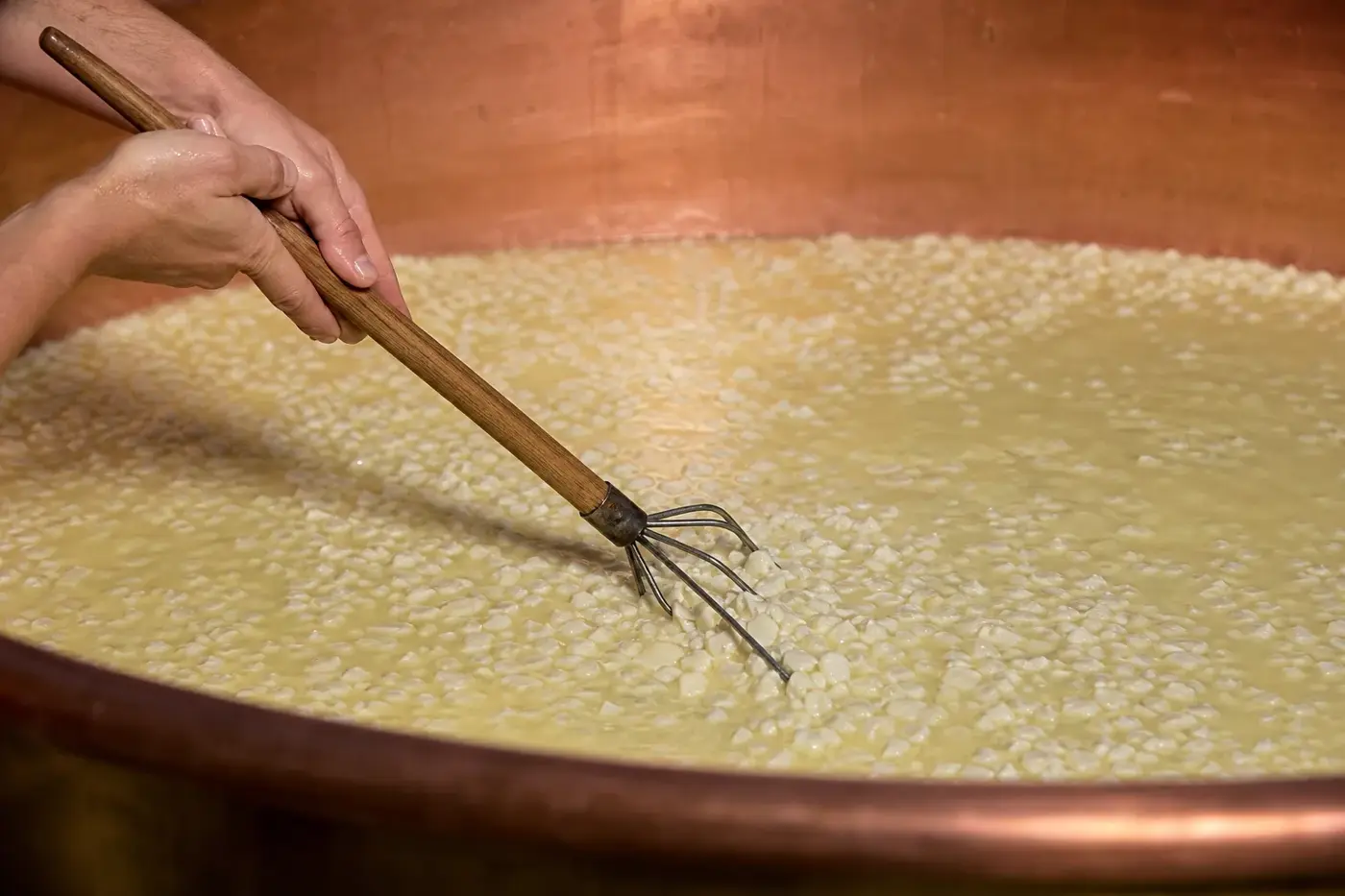
At dairy Boselli, a spino breaks the set milk for Parmigiano Reggiano into minute granules.