Squacquerone di Romagna
A warm piadina, a spoonful of Squacquerone di Romagna, and any ambition to cut a neat wedge quietly disappears.
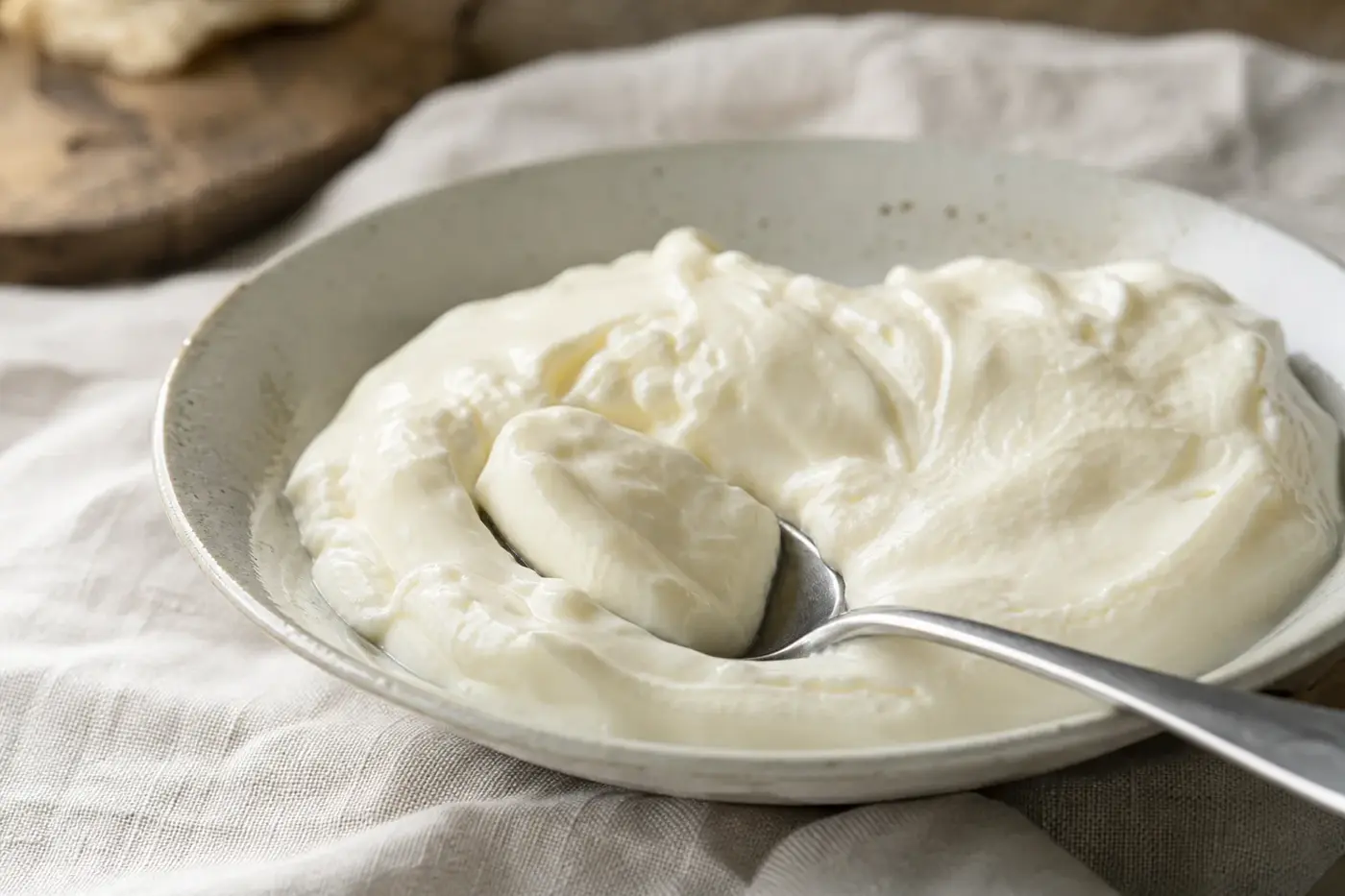
A warm piadina, a spoonful of Squacquerone di Romagna, and any ambition to cut a neat wedge quietly disappears. This fresh cows’ milk cheese is soft enough to take the shape of its container. You’ll find its home in Romagna, northern Italy, and its protected designation of origin, PDO, is registered in Great Britain. [3]
Meet your cheese at a glance
| Field | Details |
|---|---|
| Registered name | Squacquerone di Romagna. [3] |
| EU identity | Listed as a PDO cheese by Italy’s agriculture ministry; EU register status and ID: Unconfirmed. [1] |
| Great Britain | Registered PDO as at November 2026; UK scheme registration recorded as 31 December 2020, 23:00. [3] |
| Where it can be made | Ravenna, Forlì-Cesena, Rimini and Bologna provinces, plus the specified part of Ferrara province. [2] |
| Milk | Whole cows’ milk from the production area. [2] |
| Coagulant | Calf rennet. [2] |
| Cultures | Native lactic acid bacteria added through a natural starter. [2] |
| Rind | None. [2] |
Give the knife a rest
Think scoop and smear, not slice. Ravenna’s municipal tourism service describes a pearly white paste with no rind and a tender, very soft consistency. The producers’ association adds that it spreads readily and takes the shape of its container. This is not a cheese with ambitions towards straight edges. [2][4]
That pearly white colour is part of its published description, too. [4] Give it a bowl or shallow dish rather than trying to arrange slices on a board; a small spoon is often your best tool. Keep accompaniments alongside, so you can taste the cheese before stronger flavours enter the picture.
Listen for the quieter flavours
Sweet milk, a small acidic edge, barely perceptible salt and a light herbaceous note: that is how the producers’ association describes the flavour. Think milk sweetness, not sweetened spread. Acidity belongs in this delicate balance, but it should not take over. [2][11]
Try a little on its own first. Notice how readily it spreads and how the milk sweetness meets the acidity. Does the finish stay mainly lactic, or can you catch that faint grassy impression? These quiet details tell you more than a search for the stronger flavours of an older cheese.
If you have two examples to compare, give each the same plain bread. One may seem milkier, another tangier or more herbal to you. Explore the differences within that gentle character, rather than expecting the pungency of a rind-ripened cheese.
Travel beyond the Romagna coast
The protected area stretches further than the Romagna coast. The association names Ravenna, Forlì-Cesena, Rimini and Bologna, together with part of Ferrara province. In Ferrara, the specified area is bounded to the west by State Road 64, the Porrettana, and to the north by the River Po. [2]
The milk must come from that defined area too, according to the association’s account of the production rules. When you read a pack, distinguish between where the cheese was made and where its milk originated. Both places matter to the protected name. [2][11]
From winter kitchens to warm piadina
The producers’ association’s history includes correspondence dated 15 February 1800 and references in an 1879 Romagnol-Italian dictionary. It describes a countryside cheese once made during winter, when cooler weather helped it keep. You get a glimpse of a cheese shaped by the practical demands of its surroundings. [5]
Piadina is its traditional companion, according to Ravenna’s tourism service, which also records its use in local cappelletti fillings. Its everyday place at the table is easy to picture: spread inside bread or worked into a filling. You need not reserve it for a formal cheese course. [4]
Today, the producers’ association presents piadina and caramelised figs as familiar accompaniments. Each gives you a different way into the cheese. Piadina provides a savoury setting; caramelised figs take you towards the sweet end of a meal. [7]
Follow the short path from milk to spoon
The association’s production account starts with a short cast of ingredients: whole local cows’ milk, native lactic acid bacteria, calf rennet and salt. A natural starter brings the bacteria into the milk. There, they help develop acidity and aroma. [2]
Rennet turns the milk into curd, the soft solid portion surrounded by liquid whey. The curd is cut, rests beneath the whey, then goes into moulds. Turning helps the whey drain away, while salting can take place either in the milk or in brine. [2]
After a night in the cold, says the association, the cheese can be packed. Set that beside the months associated with many firm cheeses and you have a very different pace of maturation. For the broader journey from curd formation to draining, see how cheese is made. [2]
Look for the name in full
Look for every word: Squacquerone di Romagna. The name identifies a particular cheese, not just any soft Italian fresh cheese. DOP shortens the Italian denominazione di origine protetta, corresponding to PDO in English; Italy’s agriculture ministry lists Squacquerone di Romagna among its PDO cheeses. [1]
Behind that name is a traceability system, described by the producers’ association, that monitors ingredients and production. It connects the cheese to its delimited milk-producing area and method of manufacture. You learn rather more from that than from “soft” or “spreadable”. [5]
As at November 2026, Great Britain has its own registered PDO entry, with UK scheme registration recorded at 23:00 on 31 December 2020. See protected names for the differences between schemes. When you examine a pack, reading a cheese label helps you distinguish the food’s name from the maker’s address. [3]
Choose a cheese that yields to the spoon
Look for pearly white cheese with no rind, a very soft texture and a delicate milk aroma. Ravenna’s description emphasises tenderness and gentle acidity. A strongly developed rind or a texture firm enough for neat blocks would be at odds with that published character. [4]
Read the storage instructions and date before choosing your pack, and decide when you will open it. Buy an amount that fits the meals you have planned. A piadina lunch followed by a small serving with figs gives you two ways to enjoy it, without turning lunch into a cheeseboard committee meeting.
Bring out the piadina, rocket and figs
Caseificio Pascoli’s own cheese website pairs Squacquerone with piadina and rocket. Warm a ready-made piadina according to its pack instructions, spread in the cold cheese and add rocket. Fold and eat promptly; warming the bread, rather than leaving the cheese out beforehand, keeps the preparation straightforward. [6][8]
Keep your first piadina simple. A modest layer lets you taste the cheese’s milky acidity alongside the rocket and makes the folded bread easier to handle. Try that combination before adding anything else, so stronger flavours do not crowd out the cheese.
For a different finish, try the producers’ association’s suggestion of caramelised figs. Put a small amount beside a spoonful of cheese rather than mixing everything together. Taste the cheese first, then add a little fig until the sweetness suits you. [7]
Keep it cold, and know when to discard it
Keep Squacquerone refrigerated and take out only what you intend to serve. This handling guidance follows Food Standards Agency advice for England, Wales and Northern Ireland as at November 2026. The FSA recommends a home fridge between 0 and 5 °C (32 to 41 °F), alongside following the pack’s storage instructions. [8]
Once you open it, follow the manufacturer’s stated time limit and stay within the use-by date. Write the opening date on the container if that helps, and return the remaining cheese to refrigeration promptly. See storing cheese at home for the wider handling routine. [8]
If mould appears, discard the whole cheese. The FSA’s cheese recovery guidance says unexpected mould on soft cheese should not be removed for salvage because it penetrates further into the product. The advice differs for trimming certain hard cheeses; see mould on cheese. [9]
Follow any recall notice and its instructions for the affected product and batch. Keep the packaging details until you have finished the cheese. That keeps the date, storage directions and batch information available when you need them. [8][12]
Considering stracchino, crescenza or mascarpone?
Stracchino and crescenza are alternatives you could consider for a piadina filling, but compare textures rather than treating their names as interchangeable with Squacquerone di Romagna. Let the particular product guide you. If it holds together more firmly, spread a thinner layer; if it flows readily, use a spoon and keep the filling away from the fold’s edges.
Read the ingredients as well as judging the consistency before you swap. Then let the finished piadina answer a few practical questions: does the filling spread easily, how much acidity does it bring, and does it overwhelm the bread? Those differences matter more on your plate than a broad resemblance between soft cheeses.
Mascarpone starts with cream rather than milk. An Italian National Research Council account, based on observations at five producers, describes cows’ milk cream coagulated with heat and citric acid. The result is a spreadable paste with a predominantly sweet flavour, while Squacquerone’s association describes milk, starter cultures and calf rennet. [10][2]
Choose mascarpone when you want that cream-based character. Choose Squacquerone di Romagna when gentle lactic acidity and a loose, spreading texture are central to your dish. For piadina with rocket, start with the named cheese before exploring a substitute. [2][6][10]
General information only, not medical advice: follow the official guidance where you live.
Questions people ask
What is Squacquerone di Romagna?
It is a fresh cows’ milk cheese from Romagna in northern Italy. It is pearly white, has no rind and is soft enough to take the shape of its container.
What does Squacquerone di Romagna taste like?
The producers’ association describes milk sweetness, a small acidic edge, barely perceptible salt and a light herbaceous note. The cheese has a delicate milk aroma.
Is Squacquerone di Romagna suitable for vegetarians?
The producers’ association lists calf rennet among its ingredients. It also lists whole cows’ milk, a natural starter and salt.
How is Squacquerone di Romagna traditionally eaten?
Ravenna’s tourism service names piadina as its traditional companion and records its use in local cappelletti fillings. The producers’ association also suggests serving it with caramelised figs.
How should I store Squacquerone di Romagna, and what if it goes mouldy?
The Food Standards Agency recommends keeping the fridge between 0 and 5 °C and following the pack’s storage instructions. Its cheese recovery guidance says to discard the whole soft cheese if unexpected mould appears. See the Food Standards Agency’s storage and cheese recovery guidance.
Sources
[1] Ministero dell’agricoltura, della sovranità alimentare e delle foreste. Disciplinari DOP e IGP prodotti agricoli, 1.3 Formaggi. Undated listing, retrieved November 2026.
Read at masaf.gov.it
[2] Associazione Squacquerone di Romagna DOP. Squacquerone D.O.P. Undated producer-association account, retrieved November 2026.
Read at squacqueronediromagna.it
[3] Department for Environment, Food & Rural Affairs. Squacquerone di Romagna. Great Britain protected food name register entry, published 4 January 2021, retrieved November 2026.
Read at gov.uk
[4] Ravenna Tourism, municipal local editorial service. Squacquerone di Romagna. Updated 6 December 2022.
Read at turismo.ra.it
[5] Associazione Squacquerone di Romagna DOP. The Story. Undated historical account, retrieved November 2026.
Read at squacqueronediromagna.it
[6] Caseificio Pascoli. Squacquerone di Romagna DOP. Undated producer website, retrieved November 2026. Its serving suggestions are commercial producer material.
Read at squacqueronediromagna.com
[7] Associazione Squacquerone di Romagna DOP. Lo Squacquerone in Cucina. Undated introduction to the association’s recipe collection, retrieved November 2026.
Read at squacqueronediromagna.it
[8] Food Standards Agency. How to chill, freeze and defrost food safely. Published 18 December 2017; retrieved November 2026. Applies to England, Northern Ireland and Wales.
Food Standards Agency guidance
[9] Food Standards Agency. Cheese recovery guidance. First published 2007; current rendered document retrieved November 2026. Guidance for businesses and local authorities.
Read at food.gov.uk
[10] Consiglio Nazionale delle Ricerche, Istituto di Scienze dell’Alimentazione. Mascarpone. Undated regional product account, based on observations at five producers; retrieved November 2026.
Read at isa.cnr.it
[11] Italian agriculture ministry. Disciplinare di produzione Squacquerone di Romagna DOP. File dated 25 January 2011. Historical specification text; retrieved extract used for its product description, not as confirmation of the current operative specification.
Read at politicheagricole.it
[12] Food Standards Agency. Alerts. Live official alert listing, retrieved November 2026.
Read at alerts.food.gov.uk
This piece was researched from official listings, published product descriptions, producer-association accounts, a research-institute product record and FSA guidance, with serving suggestions identified as editorial advice.
Last checked: November 2026
Last checked November 2026.
The editors suggest you read next
Parmigiano Reggiano
Break into a wheel of Parmigiano Reggiano and flakes fall away, revealing a finely granular cheese, pale straw to straw in colour.