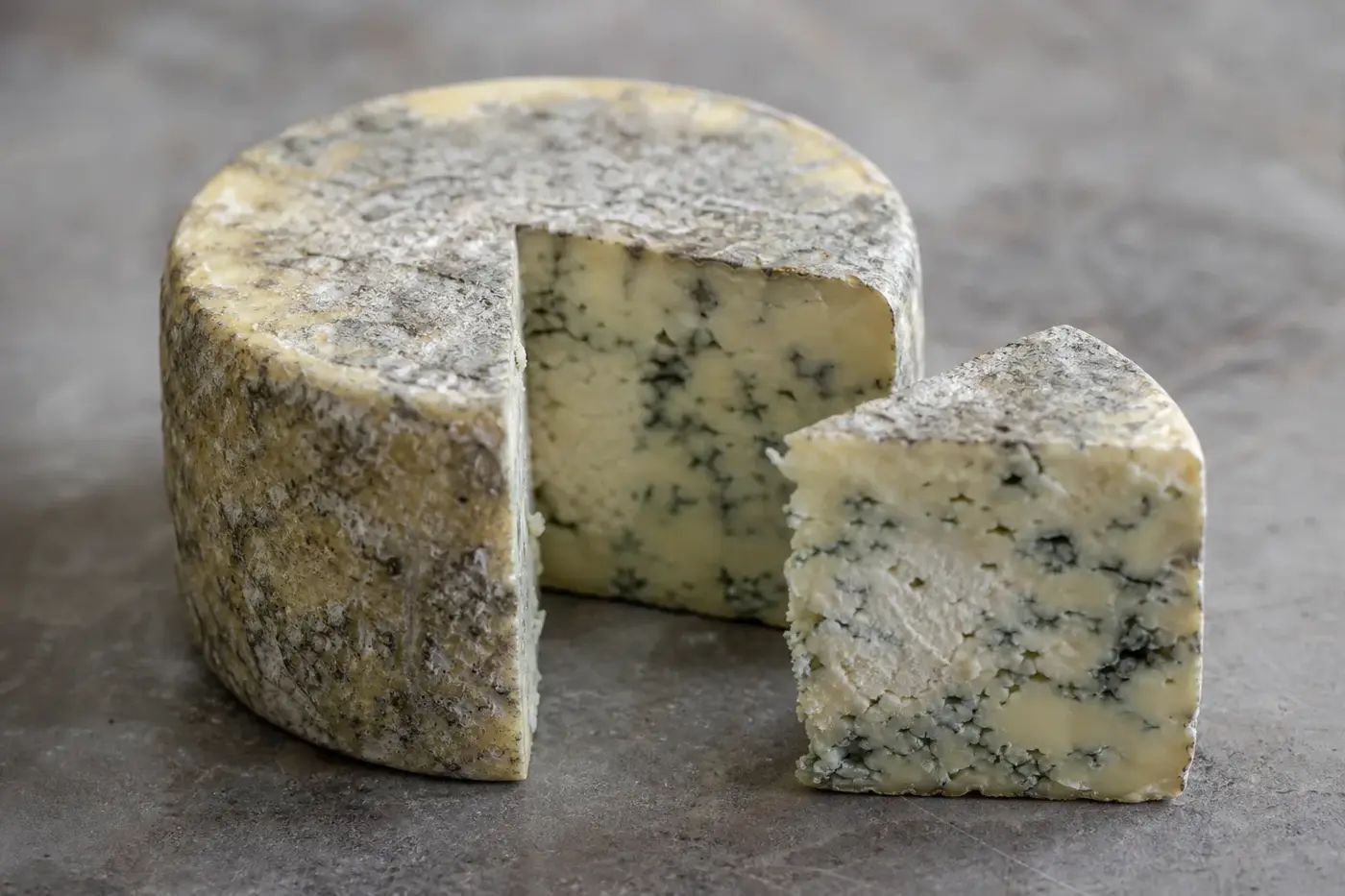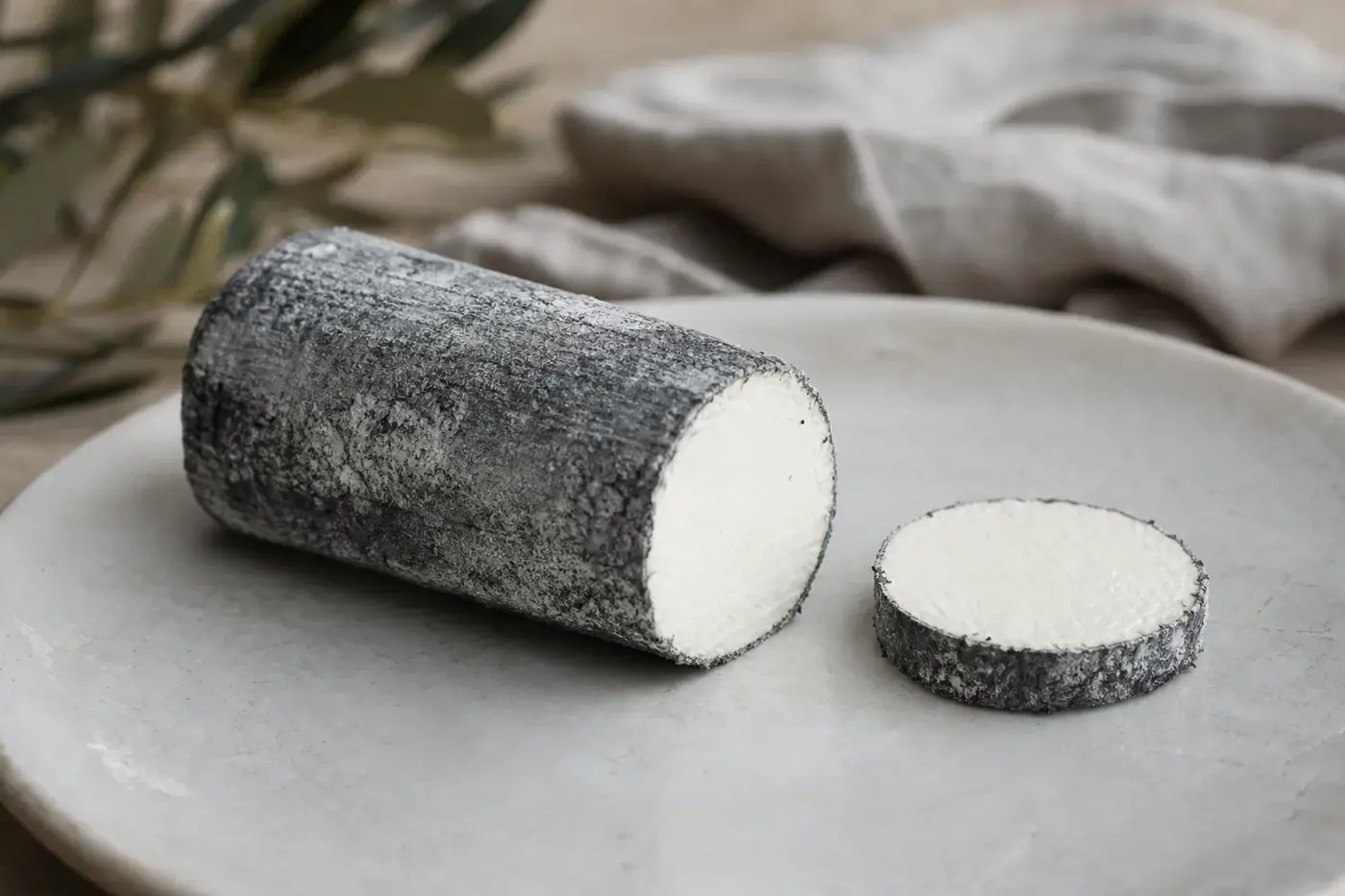
Cut through that dark coat and a soft white centre appears. St Tola Ash Log makes quite an entrance. At Inagh Farmhouse Cheese in County Clare, Ireland, a fresh goat cheese log is rolled in food-grade ash, then left to ripen. Beneath the dramatic exterior, the maker promises smooth texture and full flavour. [1]
Your Ash Log at a glance
| What you want to know | The details |
|---|---|
| Name | St Tola Ash Log [1] |
| Maker | Inagh Farmhouse Cheese Ltd [3] |
| Made in | Inagh, County Clare, Ireland [3] |
| Style | Soft, naturally ripened goat cheese log [1] |
| Milk treatment | Usually raw; pasteurised version available to order [1] |
| Rennet | Animal for raw milk; vegetarian for pasteurised milk [1] |
| Coating | Food-grade vegetable ash [1,2] |
| Ripening flora | Geotrichum on the maker's soft range [6] |
| Typical ripening | A few weeks, according to the maker [1] |
There's more beneath that dark coat
The ash catches your eye first, but give the cheese inside a little attention. Fine vegetable ash goes onto the fresh log; as it matures, the maker describes the interior as soft and silky. The dark coating is a surface treatment, quite distinct from the pale cheese it frames. [1,2]
For a revealing comparison, look at the unashed St Tola Log. Its product page distinguishes fresh and mature versions: the younger cheese has brighter flavours and a more delicate structure. Given time, it develops a golden natural rind and sweeter, floral notes. [4]
Two other names are worth getting to know. St Tola Divine is fresh and whipped in texture, with pasteurised milk and vegetarian rennet. St Tola Karst wears ash but follows a separate recipe, using milk from the maker's own raw-milk supply. Choose by the full product name: “St Tola” alone leaves quite a bit untold. [5,7]
Pull up a chair at the kitchen table
Inagh Farmhouse Cheese Ltd began as a cottage industry, making cheese at a kitchen table. A neighbour took over in 1999. The company's account follows its growth from there, with one point kept firmly in view: the cheese is still handmade in small batches. [3]
The kitchen table stayed in the story, too. When new premises were built in 1999, the maker says it moved from the original farmhouse, and the team continued gathering around it for shared meals. That is a pleasingly useful piece of company history: you can still sit at it. [8]
Look through the published team information and you find farm management, cheesemaking, quality control and sales. Your finished log depends on all of them. Someone must secure the milk supply, make the cheese and handle it carefully through maturation before it reaches your board. [9]
Meet the County Clare behind the cheese
St Tola's farm sits just south of the Burren, at Inagh in County Clare. The nearby limestone country is only part of its setting. The maker describes its own land as peaty, linking the milk to the grass, clover and wild herbs growing there. [9]
The farm's account names Saanen, Toggenburg and British Alpine goats, with a dairy herd that is mainly housed. In summer, freshly cut grass comes to them, supplemented with grain. When fresh grass is unavailable, they receive haylage; fresh straw bedding is part of the daily routine. [10]
Picture harvested feed and a cheese room, then, rather than goats permanently grazing bare limestone. The connection runs from local land through feed and goats to the cheese you cut. These everyday details give you a more particular picture than the broad Clare landscape, and show how the farm's conditions shape the maker's account of its milk. [9,10]
Ask what goes into your log
St Tola uses all the milk from its own farm and buys additional goat milk from a nearby farmer outside Ennistymon. The maker says the two supplies stay separate during cheesemaking. If you want to know which went into your Ash Log, ask the maker or cheesemonger. [9]
Check the milk treatment on the actual cheese, too. The maker's FAQ confirms that Ash Log can come with raw or pasteurised milk, and that choice determines the rennet. Raw-milk logs use animal rennet; pasteurised logs use vegetarian rennet, which helps the milk set into curd. [6]
Milk treatment, rennet and organic certification are three separate questions. Ask for the current label or product documentation for each, rather than treating one answer as an answer to all three. For useful background before you compare versions, explore raw and pasteurised milk and the different kinds of rennet.
Give that ash a few weeks
First comes the fresh goat cheese log, then its roll in food-grade ash. After that, careful handling accompanies a few weeks of maturation. The maker says the ash slows development and maturation, so that striking coat is not simply a matter of wardrobe. [1]
St Tola names Geotrichum as the natural rind organism on its soft range. Here, “naturally ripened” means a developing surface as well as an applied ash coating. The maker says these soft cheeses continue to mature over time, making their condition when you serve them worth noticing. [6]
For the bigger picture, from setting milk to separating curd from whey, visit how cheese is made. With Ash Log, think of making the fresh log and treating its surface as distinct stages, followed by maturation. Ask your cheesemonger about the condition of your particular cut, not just its delivery date. Both belong in that conversation.
Taste the velvet, mushroom and cream
Velvety, with a slight chew: that is how St Tola describes Ash Log's texture. The maker also names mushroom, cream and a mineral character among its flavours. Before you reach for anything else on the board, try a little alone and let those qualities register. [2]
The related unashed Log gives you a useful way into maturity. The maker describes the fresh cheese as brighter and more delicate, with depth and a developed rind emerging over time. For your Ash Log, begin with the slice in front of you: does the centre hold its shape or spread? Compare it with the paste, meaning the cheese's interior, nearer the edge. [4]
Give acidity as much attention as aroma and texture. Is your first impression a clean tang, and does it linger? Do the maker's mushroom-like notes become clearer as you taste? Try the centre alone, then a small piece from nearer the outside. [2,6]
Those questions are especially useful when you compare two purchases at different stages of maturity. They bring your attention back to this particular cheese, giving texture, aroma and flavour an equal say. The ash may catch your eye, but you need not let it decide the whole tasting. [2,6]
Bring it from fridge to board with care
Keep the wrapping and label with your cheese so you retain its milk treatment, date and handling instructions. St Tola recommends cheese paper or greaseproof paper for its soft cheeses, rather than cling film. Follow the pack instructions and the Food Safety Authority of Ireland's food-handler guidance: keep cold food refrigerated below 5 °C (41 °F). [6,11]
The maker suggests taking St Tola out of the fridge about 30 minutes before serving. Include that time within the Irish authority's guidance that food should not stay at room temperature for more than two hours. Take out only what you intend to serve, leaving the rest refrigerated. [2,11]
Start with a clean board and knife. Cut across the log into rounds or half-rounds, according to the size of your piece, so each portion shows the dark edge and white centre. Try cheese and plain bread first, then add fruit or a drink. You can judge more easily what each accompaniment changes.
For bread and fruit, the maker suggests dark rye and black grapes. Beetroot and hazelnut also appear among its Ash Log accompaniments. Build your plate around bread with grapes alongside, or try a little beetroot with chopped hazelnuts. Keep the additions separate at first, leaving yourself room to taste the cheese alone. [2]
If you want a drink without much distraction, try water or a mild, unsweetened tea. Either leaves room for the cheese's own flavour.
Let the texture guide your serving. A firmer slice can sit beside bread; a softer portion can be spread as you eat, without forcing both into the same arrangement. For wrapping and refrigeration, see how to store cheese at home. For more drinks to explore, turn to cheese and wine pairing.
Before you clear the board, keep any remaining cheese with its original identification. Follow the labelled use-by date and instructions for opened cheese: the Irish authority advises following manufacturers' instructions and never using food past its use-by date. Buying a cut portion? Ask your cheesemonger to include the relevant storage instructions, so your piece from a large log stays identifiable once you get it home. [11]
General information only, not medical advice: follow the official guidance where you live.
Questions people ask
What is the ash on St Tola Ash Log?
The coating is fine vegetable ash applied while the goat cheese is fresh. The maker says the ash slows development and maturation.
Is St Tola Ash Log vegetarian?
The pasteurised milk version uses vegetarian rennet. The raw milk version uses animal rennet, so check the milk treatment on the actual cheese.
Can you eat the rind of St Tola Ash Log?
The page does not verify whether the rind is edible. It identifies the coating as food grade vegetable ash and notes that Geotrichum is the natural rind organism on the maker’s soft range.
What does St Tola Ash Log taste like?
The maker describes flavours of mushroom, cream and a mineral character. Its texture is described as velvety, with a slight chew.
How should St Tola Ash Log be stored?
St Tola recommends cheese paper or greaseproof paper for its soft cheeses rather than cling film. The Food Safety Authority of Ireland advises keeping cold food refrigerated below 5 °C and following manufacturers’ instructions.
Sources
- Inagh Farmhouse Cheese Ltd, Ash Log, current product page, undated, retrieved November 2026. Maker's product information.
- Inagh Farmhouse Cheese Ltd, St Tola Irish Goat Cheese, current homepage, undated, retrieved November 2026. Ash Log tasting description, accompaniments and storage FAQ. Maker's range and guidance.
- Inagh Farmhouse Cheese Ltd, Company Profile, undated, retrieved November 2026. Company account.
- Inagh Farmhouse Cheese Ltd, St Tola Log, current product page, undated, retrieved November 2026. Fresh and mature Log descriptions.
- Inagh Farmhouse Cheese Ltd, St Tola Divine, current product page, undated, retrieved November 2026. Divine product information.
- Inagh Farmhouse Cheese Ltd, Frequently Asked Questions, undated, retrieved November 2026. Milk treatment, rennet, rind and wrapping information.
- Inagh Farmhouse Cheese Ltd, St Tola Karst, current product page, undated, retrieved November 2026. Karst product information.
- Inagh Farmhouse Cheese Ltd, Humble Beginnings at the Kitchen Table, undated account referring to events through 2022, retrieved November 2026. Maker's historical account.
- Inagh Farmhouse Cheese Ltd, Our Story, current page, undated, retrieved November 2026. Milk sourcing, farm and team information.
- Inagh Farmhouse Cheese Ltd, Sustainability, current page, undated, retrieved November 2026. Maker's description of herd management.
- Food Safety Authority of Ireland, Safe Food to Go, online PDF edition, publication year not stated in the retrieved text, retrieved November 2026. Pages 6, 7 and 9 cover refrigeration, room-temperature holding and handling instructions. Official food-handler guidance.
This piece was researched from the maker's retrieved product, farm and historical records, with Irish handling guidance checked separately against the Food Safety Authority of Ireland.
Last checked: November 2026
Last checked November 2026.
The editors suggest you read next