Valençay
Your knife slips through a grey, ash-coated rind to reveal a porcelain-white heart.
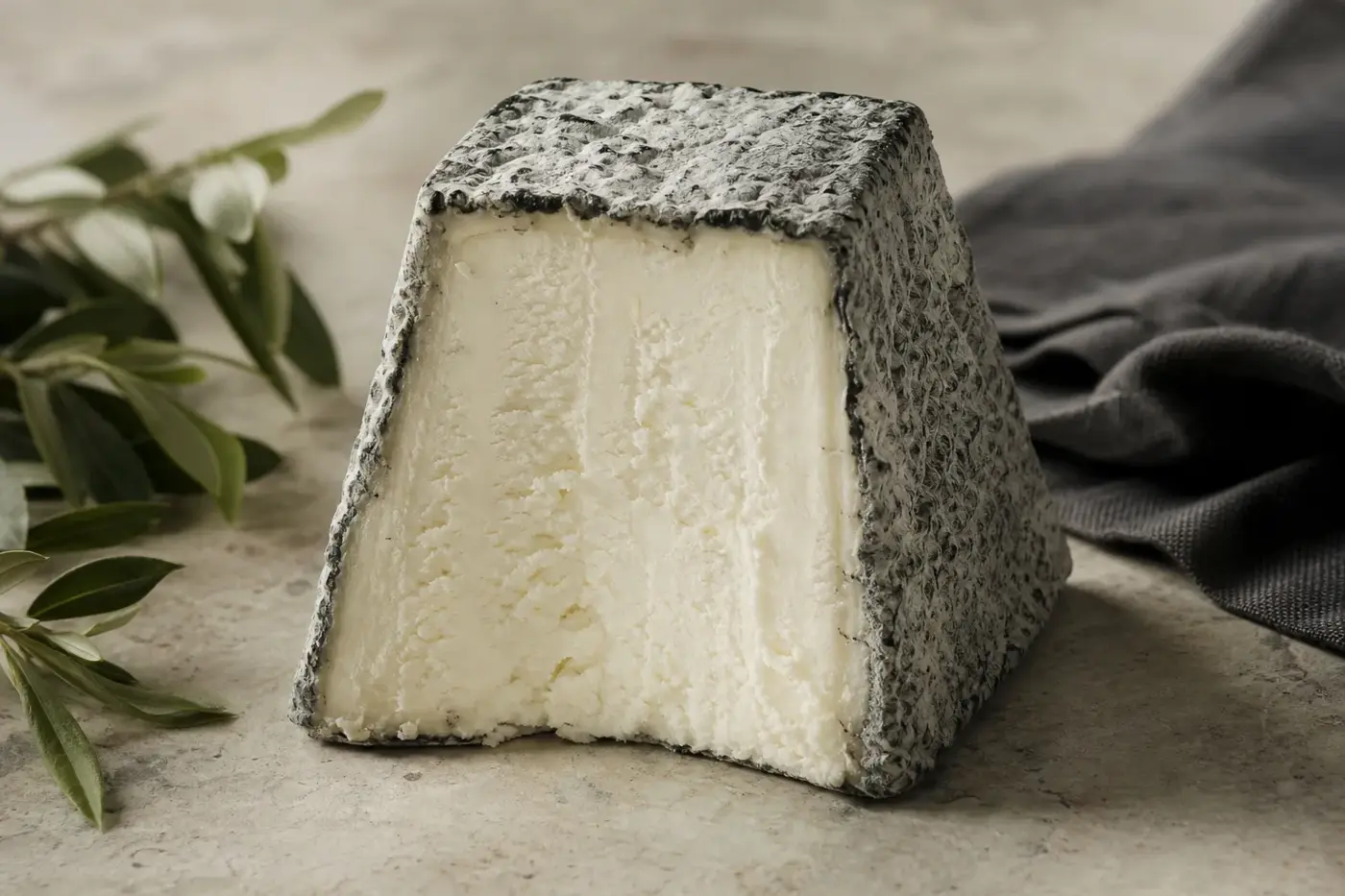
Your knife slips through a grey, ash-coated rind to reveal a porcelain-white heart. Even before the first bite, Valençay knows how to hold your attention. This flat-topped pyramid of raw goat milk cheese comes from central France, with rather more presence than its missing summit might suggest.[1,2]
The coat starts with food-grade vegetable charcoal, followed by a developing surface bloom. Beneath it, slow lactic cheesemaking creates a fine-textured paste. Give Valençay time and its flavour becomes more pronounced.[1,2]
| What to know | A closer look |
|---|---|
| Familiar and registered name | Valençay.[1,3] |
| Registration authorities | European Union; Defra’s Great Britain register. EU register identifier: not supplied here.[2,3] |
| Protection | EU PDO, originally registered 12 August 2004; Great Britain PDO, registered 31 December 2020 at 23:00. Register information: November 2026.[3] |
| Where it must be made | Listed communes in Indre, Cher, Indre-et-Loire and Loir-et-Cher, France.[1] |
| Milk | Raw whole goat milk.[1] |
| How the milk sets | Predominantly lactic coagulation, helped by a small addition of rennet.[1] |
| Rind | Surface-salted and coated with vegetable charcoal, then developed with visible ripening mould.[1] |
| Earliest marketing age | 11 days from rennet addition, with a formed, visibly bloomed rind.[1] |
| Typical ageing | No single representative range given here. |
| Product specification | French agriculture ministry specification associated with notice AGRT1413739V, published July 2014.[1] |
Get to know that grey coat and white heart
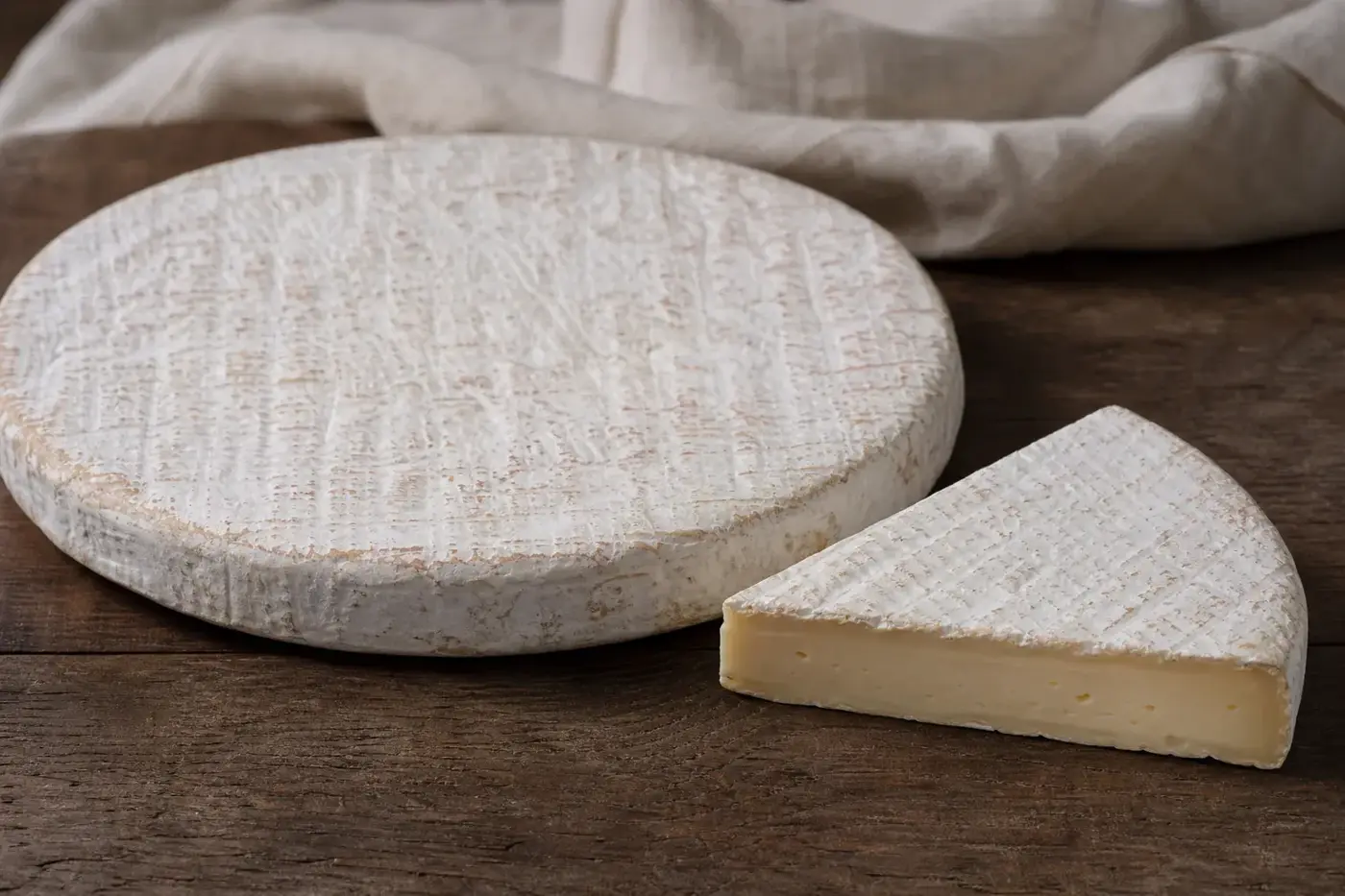
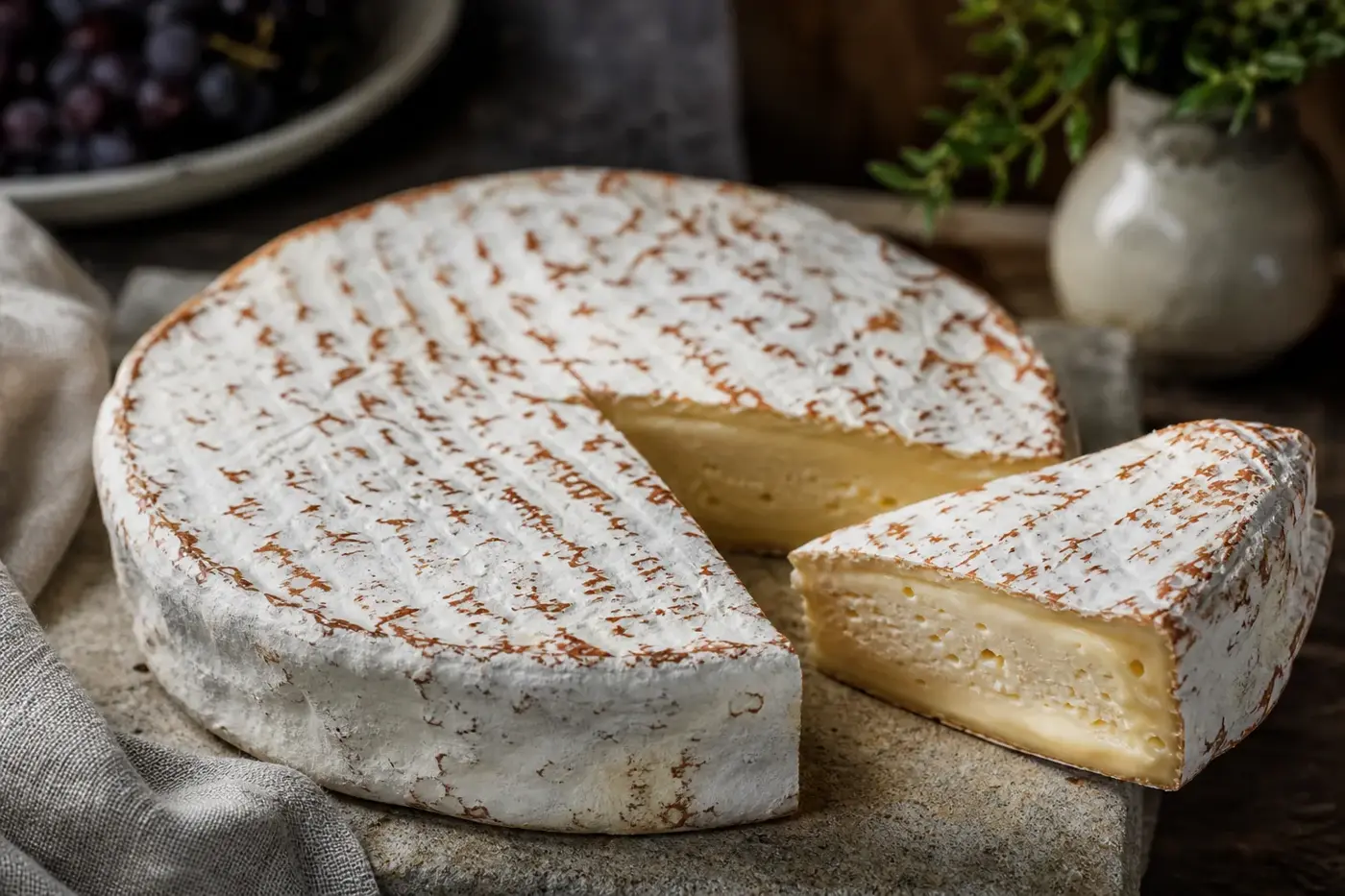
Look for a square base, sloping sides and a flat summit. Cut vertically and Valençay’s grey exterior gives way to white within. INAO, France’s national institute for origin and quality, describes a pale-grey to blue-grey rind and a texture that feels firm yet yielding in your mouth.[2]
The familiar “ash” is food-grade vegetable charcoal, as the appellation’s producers explain. After unmoulding, the cheese receives charcoal alongside salt, which gives it its first grey covering. The surface bloom develops during maturation.[4]
That finished rind is more than a decorative dusting. Charcoal provides the first coat; ripening develops the appearance you see later. Beneath it, INAO describes dried-fruit flavours, particularly hazelnut, alongside Valençay’s characteristic goat milk identity.[2]
Follow the cheese into its farming country
Valençay takes its name from the town, but its roots spread across a much bigger farming landscape. The protected area covers much of Indre and designated neighbouring communes in Cher, Indre-et-Loire and Loir-et-Cher, within Centre-Val de Loire. Milk production, cheesemaking and maturation must all take place inside the specification’s boundaries.[1,5]
The producers’ organisation names four natural regions: Boischaut Nord, Champagne Berrichonne, Brenne and Boischaut Sud. Boischaut Nord is the appellation’s historical centre. Across the wider territory, cereal-growing country meets grassland and livestock farming.[5]
To understand this cheese, look beyond a château or a single village. The producers place goat holdings particularly in the two Boischaut regions, where the land remains suited to grass-based farming. Those working fields belong in your picture of Valençay just as much as the pyramid does.[5]
Meet the goats behind the pyramid
Alpine and Saanen goats, and crosses between those breeds, provide Valençay’s milk. Their feeding system is forage-based, supplemented with cereals and other permitted feeds, according to the producers’ organisation. Grass may be grazed or brought to the animals, while hay also forms part of their ration.[6]
Behind that feed sits a precise local requirement. Each dairy goat must receive at least 820 kg of feed dry matter a year from within the geographical area. “Dry matter” is what remains when you exclude the feed’s water content.[1]
The protected name begins here, well before you see a cheese in its mould. The producers explain that a ration consisting exclusively of straw and concentrates is prohibited. Genetically modified feeds are also excluded under the appellation’s requirements.[6]
Valençay gained French AOC recognition in 1998 and EU PDO registration in 2004. AOP, Appellation d’Origine Protégée, is the French abbreviation for PDO; Great Britain records its protection separately.[3,7] For a closer look at those distinctions, explore protected names.
Give the milk time to find its shape
Valençay starts slowly, with lactic coagulation. As acidity develops in the milk, curd forms: the set portion that will become cheese. A small addition of rennet, a milk-coagulating enzyme preparation, helps the process along; the producers’ manufacturing account describes about 24 hours of setting.[4]
The fragile curd goes straight into moulds, without preliminary draining. Whey, the liquid released from the curd, drains away while the pyramid takes shape. In their account of customary manufacture, the producers describe at least 24 hours in those moulds.[4]
Unmoulding comes next, followed by salting and the food-grade vegetable charcoal coat. The cheeses dry further before entering the ripening room. Here, the grey-blue covering develops and the aromas become more pronounced.[4]
Alongside that customary account, the binding specification sets minimum controls. Coagulation must last at least 18 hours from rennet addition, and spontaneous draining at least 20 hours from the start of moulding. Pressing the curd is prohibited: this pyramid takes shape without a squeeze.[1]
If you would like to follow the stages Valençay shares with other cheeses, take a look at how cheese is made.
Watch the rind settle into character
Valençay’s surface carries on developing as the cheese ripens. The specification permits ripening flora from raw milk, cheesemaking whey and specified commercial cultures, including Geotrichum, Penicillium and several yeast genera. Salt, charcoal and the surface covering help regulate exchanges during maturation and contribute to aroma development.[1]
The producers describe a progression you can follow with your nose and palate. At the minimum marketing age, lactic aromas lead. Longer maturation brings stronger goat notes and vegetal associations, including mushrooms, woodland and flowers.[4]
Even the youngest marketable Valençay must have a developed rind. Its age is counted from rennet addition, not from the charcoal coating or its arrival at the shop.[1] Ask your cheesemonger how it is developing as well as how old it is; together, those answers give you a fuller picture.
Choose the bite you love
Would you like something yielding, or a firmer bite? In the producers’ tasting guidance, young Valençay has lactic aromas and a light goat milk character. As it matures, the paste firms; very mature examples can become brittle, with stronger goat notes and more evident woodland, floral and vegetal aromas.[8]
Older does not automatically mean better for your taste. Choose a younger cheese for a softer texture and a quieter expression of the milk. Choose a more mature one when you want a firmer bite and those more developed aromas.[8]
INAO offers a useful distinction: firm texture, yielding mouthfeel.[2] Firm need not mean hard or coarse. Ask the seller how the cheese feels today, because rind colour alone cannot give you that answer.
Napoleon, Talleyrand and the missing summit
A pyramid with its tip missing invites a story. Valençay has two, with Talleyrand, Napoleon and the Egyptian campaign all appearing in the legend. In the producers’ organisation’s version, Talleyrand ordered the moulds changed so pointed pyramids would not remind Napoleon of his Egyptian campaign.[2,9]
INAO records a related account in which the tips were cut from cheeses prepared for a banquet. Both versions keep the connection between Valençay, Talleyrand and Napoleon. They differ on the crucial detail: did someone alter the moulds or the cheeses?[2,9]
You can enjoy the legend without asking it to do the cheesemaking. For the present-day explanation, look to the mould. That is what gives Valençay its truncated shape.[1]
Let the label make the introduction
Start with the individual label, not just that handsome outline. The producers’ organisation explains that appellation cheeses carry individual identification. The protected name belongs to cheeses made by authorised operators following the specification; the label connects the pyramid in front of you to that appellation.[10]
Then tell the seller what you feel like eating. “Young and yielding” or “firmer and more developed” gives them a useful starting point. For appearance, the producers’ guidance identifies an even pale-grey to blue-grey covering as the expected coat.[8]
Keep the wrapper when you get home, so you still have the producer and product details to hand. For help untangling a food’s name, producer and origin information, see reading a cheese label.
Keep it cool and serve it thoughtfully
Keep Valençay in its original wrapping to preserve its sensory qualities, as the producers recommend.[8] Follow the product’s storage instructions and date marking. For households following Food Standards Agency guidance in England, Wales and Northern Ireland, the recommended fridge temperature is 5 °C (41 °F) or below.[11]
For flavour, the producers suggest taking your cheese out about 30 minutes before eating.[8] Fit that serving time within the FSA’s advice to minimise time outside refrigeration, with a maximum of four hours during preparation. This guidance applies to England, Wales and Northern Ireland, with November 2026 as the reference date here.[11]
Cut thin, elongated portions through the pyramid’s full height, following the producers’ recommendation.[8] Each portion will then contain both rind and paste. Put out only what you expect to serve, leaving the rest refrigerated under its labelled conditions.[11]
For more advice once your cheese reaches the kitchen, see storing cheese at home.
Make room for bread, fruit and Loire wine
Begin with crisp crust against yielding paste. The producers recommend a traditional baguette or a seeded baguette. Toasted seeds can echo Valençay’s hazelnut notes, so the bread deserves a little consideration too.[8]
For a simple serving, start with plain bread and offer a few slices of pear or apple separately. That leaves you free to find your own balance, while keeping the first taste of cheese uncluttered. Plain water makes a straightforward alcohol-free accompaniment.
If you would like wine, the producers recommend Valençay itself, in white, rosé or red.[8] White Valençay gives you a Loire Valley starting point grounded in their advice. Serve a small measure for adults of legal drinking age, with water alongside.
The cheese needs no alcoholic accompaniment. If you would like to explore matching the two more broadly, turn to cheese and wine pairing.
Look beyond the goat cheese silhouette
Once you know Valençay, you can recognise more than its shape. Its identity brings together raw whole goat milk, lactic manufacture, the specified production area, a truncated pyramid, charcoal treatment and a developed surface rind.[1] The French word chèvre means goat cheese broadly; Valençay names this particular appellation.
A fresh goat cheese and a ripened Valençay answer different appetites. A pyramid alone cannot tell you whether a maker follows Valençay’s production requirements. Look for the registered name and individual identification, then choose the maturity that suits your occasion.[1,10]
When an unfamiliar cheese catches your eye, look beyond its outline. Milk, rind, texture and method give you a more useful way to compare what is on offer. They help you move from admiring the shape to choosing the cheese you want to eat.
General information only, not medical advice: follow the official guidance where you live.
Questions people ask
What is Valençay cheese made from and where is it produced?
Valençay is made from raw whole goat milk. Milk production, cheesemaking and maturation must all take place in the defined area of central France.
Why is Valençay grey?
After unmoulding, the cheese is salted and coated with food grade vegetable charcoal. A surface bloom develops during maturation.
What does Valençay taste like?
Young Valençay has lactic aromas and a light goat milk character. As it matures, goat notes become stronger and aromas can recall mushrooms, woodland and flowers.
Why does Valençay have a flat top?
Valençay gets its truncated pyramid shape from its mould. Legends link the missing tip to Napoleon and Talleyrand, but differ on whether moulds or cheeses were altered.
How should I store and serve Valençay?
The producers recommend keeping its original wrapping and taking it out about 30 minutes before eating. The Food Standards Agency advises households in England, Wales and Northern Ireland to keep fridges at 5 °C or below and minimise time outside refrigeration, with a maximum of four hours during preparation.
Sources
- French Ministry of Agriculture, Cahier des charges de l’appellation d’origine « Valençay », associated with notice AGRT1413739V, Bulletin officiel No. 27, 3 July 2014. Sections 2, 3, 5, 6 and 8. Product specification.
- INAO, Valençay, undated product record, accessed November 2026. Official product record.
- Defra, Valençay (cheese), published 4 January 2021, register record accessed November 2026. Great Britain register entry.
- Syndicat AOP Valençay, Sa fabrication, undated producer organisation account, accessed November 2026. Manufacturing account.
- Syndicat AOP Valençay, Spécificité du terroir, undated, accessed November 2026. Production territory.
- Syndicat AOP Valençay, Les chèvres et leur alimentation, undated, accessed November 2026. Goats and feeding.
- Syndicat AOP Valençay, Les notions AOC et AOP, undated, accessed November 2026. Appellation chronology.
- Syndicat AOP Valençay, Le choisir, l’apprécier, le déguster, undated, accessed November 2026. Choosing, serving and pairing.
- Syndicat AOP Valençay, Histoire, undated, accessed November 2026. Recorded legend.
- Syndicat AOP Valençay, Comment le reconnaître ?, undated, accessed November 2026. Individual identification.
- Food Standards Agency, How to chill, freeze and defrost food safely, published 18 December 2017, current page accessed November 2026. Applies to England, Wales and Northern Ireland. Official household guidance.
This desk-researched article brings together the official specification, national product and register records, the appellation producers’ published accounts and official household storage guidance.
Last checked: November 2026
Last checked November 2026.
The editors suggest you read next