Alpine Cheeses Explained
Trace the inward curve of a Beaufort wheel.
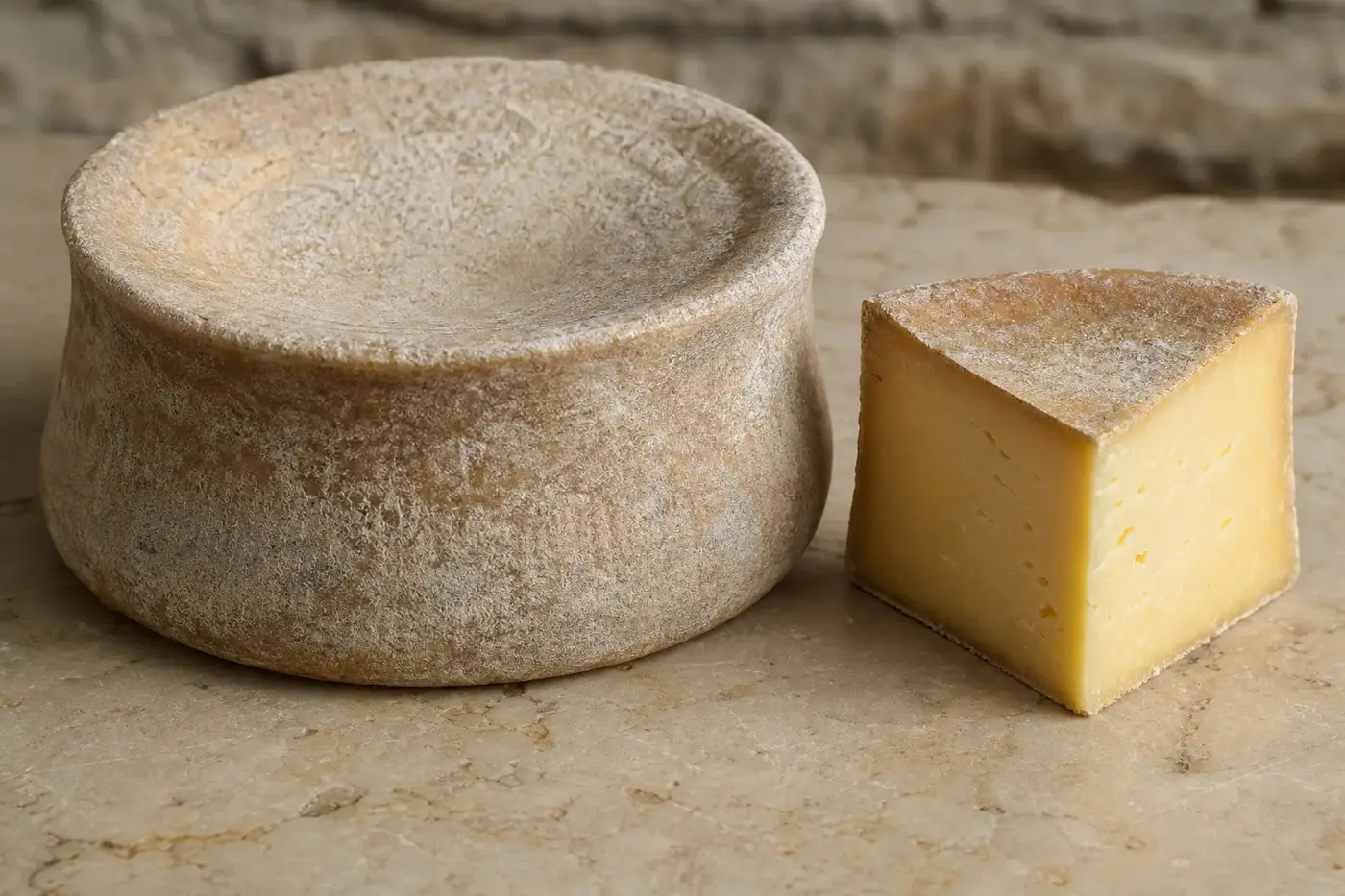
Trace the inward curve of a Beaufort wheel. That distinctive edge begins with a wooden hoop, whose inward bulge shapes the cheese.[3] Behind that handsome outline lies a mountain challenge: turning milk from grazing herds into something you can carry, store and eat long after milking.
Cutting, heating and pressing the curd helped solve it. The cheeses that emerged share related traditions, rather than one fixed recipe. You can taste just how much room that leaves for character in supple Fontina and firm Gruyère.[1][4][5][8]
Meet your mountain cheese family
| Your starting point | What to know |
|---|---|
| What the name tells you | A descriptive family linked to Alpine and neighbouring mountain dairying traditions.[1][2][3][5][6] |
| What makers do | Set milk with rennet, cut and heat the curds, then press and mature the cheese; each tradition has its own rules.[1][2][3][4][5][6] |
| Which milk you will find here | Cow’s milk; each designation sets its treatment requirements.[1][2][3][4][5][6] |
Start with the name, not the mountain view
The individual name tells you more than the word Alpine. This broad family belongs to the Alps, but it is not a single legally defined style. Each cheese’s specification sets out where its milk comes from, how makers work and what the finished wheel should be like.[1][2][3][5][6]
You will encounter AOP, PDO and DOP: the French, English and Italian abbreviations for protected designations of origin. The jurisdiction matters too. Give those letters a closer look than the mountain scenery on the label, however picturesque the peaks.[1][2][3][5][6]
The family also reaches beyond the Alps in the strict geographical sense. Comté comes from the Jura Massif, but its cooked, pressed curd tradition makes it a useful comparison here. Start with method and texture, then explore origin; cheese styles gives you the wider framework.[2]
Follow the herd towards the summer grass
Mountain dairying follows the grass. Across Switzerland, France, Italy and Austria, animals head to higher pastures for summer grazing, then return towards lower ground as the season closes. Cheesemaking stretches that short pasture season into a much longer period of eating and trading, creating distinct seasonal production systems.[1][3][5][6]
Milk from mountain pasture and cheese made on that pasture are not quite the same story. Swiss Gruyère d’Alpage requires both milk production and cheesemaking on an alpine summering holding, with its grass supplying the herd’s basic forage. Ordinary Gruyère has a broader production system and geographical area.[1]
Beaufort’s French specification distinguishes mountain chalet production. For Fontina and Vorarlberger Bergkäse, consult the current official pasture production requirements. Valley dairies belong to these traditions too: an Alpine name promises neither a wheel made high in the mountains nor one made in summer.[3][5][6]
Production season and maturation tell you different things. A high-pasture wheel can reach your plate months later; your summer purchase may have been made during winter feeding. If season matters to you, ask for the production date as well as the age.[1][3][5]
To explore maturation, taste a younger and an older cheese from the same maker. You will get a clearer comparison than if you change maker, cheese and age all at once.[1][3][5]
Inside the making of a lasting wheel
Making a firm mountain cheese starts with getting whey out. Rennet, the enzyme preparation that sets milk, produces a gel. Cutting separates it into curds, the solids, and whey, the liquid, opening more surface through which whey can escape.[7][8]
Stirring and heating encourage more whey to leave. Pressing then brings the grains together into a coherent wheel. Before long maturation even begins, makers have already removed substantial moisture.[7][8]
That helps explain the firm body of many mountain cheeses. Salt, acidity, cultures and cellar conditions also shape what you taste and feel. Firmness comes from the whole process, not simply from pressing harder.[7][8]
The details give each tradition its character. For Beaufort, makers heat the cut curd to 53 to 56 °C before that special wooden hoop shapes its concave side. Fontina follows a semi-cooked tradition, giving you a softer, elastic body; heating curd and treating milk before cheesemaking are separate stages.[3][5]
Get acquainted with six mountain cheeses
Shared techniques can take you to very different places, and very different textures. The regions below summarise the designated production areas; their specifications give the boundaries and exceptions. Maturation figures are specification minima, not the age of every cheese you will find for sale.[1][2][3][4][5][6]
| Cheese and its home | What to look for, inside and out | Minimum maturation |
|---|---|---|
| Gruyère AOP, Switzerland: western cantons and specified additional dairies | Supple, moderately firm paste; rubbed brown rind; holes optional | 5 months, average age per batch[1] |
| Comté, France: Jura Massif | Cooked, pressed paste, ivory to yellow; possible small openings | 120 days[2] |
| Beaufort, France: defined Savoie mountain area | Supple paste; rubbed rind; concave wheel edge | 5 months[3] |
| Emmentaler AOP, Switzerland: defined cantons and districts | Elastic paste; firm rind; prominent round or oval eyes | Consult the official specification[4] |
| Fontina, Italy: Valle d’Aosta | Soft, elastic, melting paste | 80 days[5] |
| Vorarlberger Bergkäse, Austria | Consult the current specification for details | Consult the current specification |
Milk treatment belongs to each cheese’s individual rules too. Gruyère, Comté, Beaufort and Emmentaler use raw cow’s milk under their cited specifications. For Fontina’s current milk treatment requirements, consult the official specification; when choosing between treatments, read the actual product’s declaration.[1][2][3][4][5]
Let the holes, rinds and flavours tell their stories
Emmentaler’s big eyes begin with fermentation. Propionic acid bacteria produce gas as they work inside the cheese, creating its characteristic openings. The Swiss specification describes eyes mostly 2 to 4 cm across.[4][7][8]
Gruyère offers a useful contrast: its specification allows cheese without holes. Large openings are not the Alpine family’s membership badge.[1]
Look at the surface as well as the cut face. Gruyère develops a rubbed rind, while Emmentaler has a firm rind that can darken in humid conditions. Fontina’s softer body and Vorarlberger Bergkäse’s smaller openings bring more variety to a family too often pictured as one yellow cheese with large holes.[1][4][5][6]
The differences begin before milk reaches the vat. Feed, season and the milk’s microorganisms influence the starting material. Starter cultures, bacteria deliberately used to guide fermentation, help set its direction.[7][8]
Then comes rind care and affinage, the managed work of maturation. Washing, rubbing, turning and cellar conditions all shape the cheese. These everyday working routines have consequences for every bite you take.[7][8]
As cheese ages, enzymes break down proteins and fats. Texture changes, along with the materials from which aroma develops. Swiss dairy research describes the importance of cultures and ripening conditions, including the nutty character associated with propionic fermentation; its measurements also show Emmentaler becoming less elastic and more friable with age.[8]
When you taste, use butter, nuts, broth and caramel as comparison words, not a checklist. Fresh butter or toasted nuts? Savoury broth or a sweet, browned note?
Write down what you find beside the maker and age. Another wheel with the same name may have something different to tell you.
Choose a good board and care for every piece
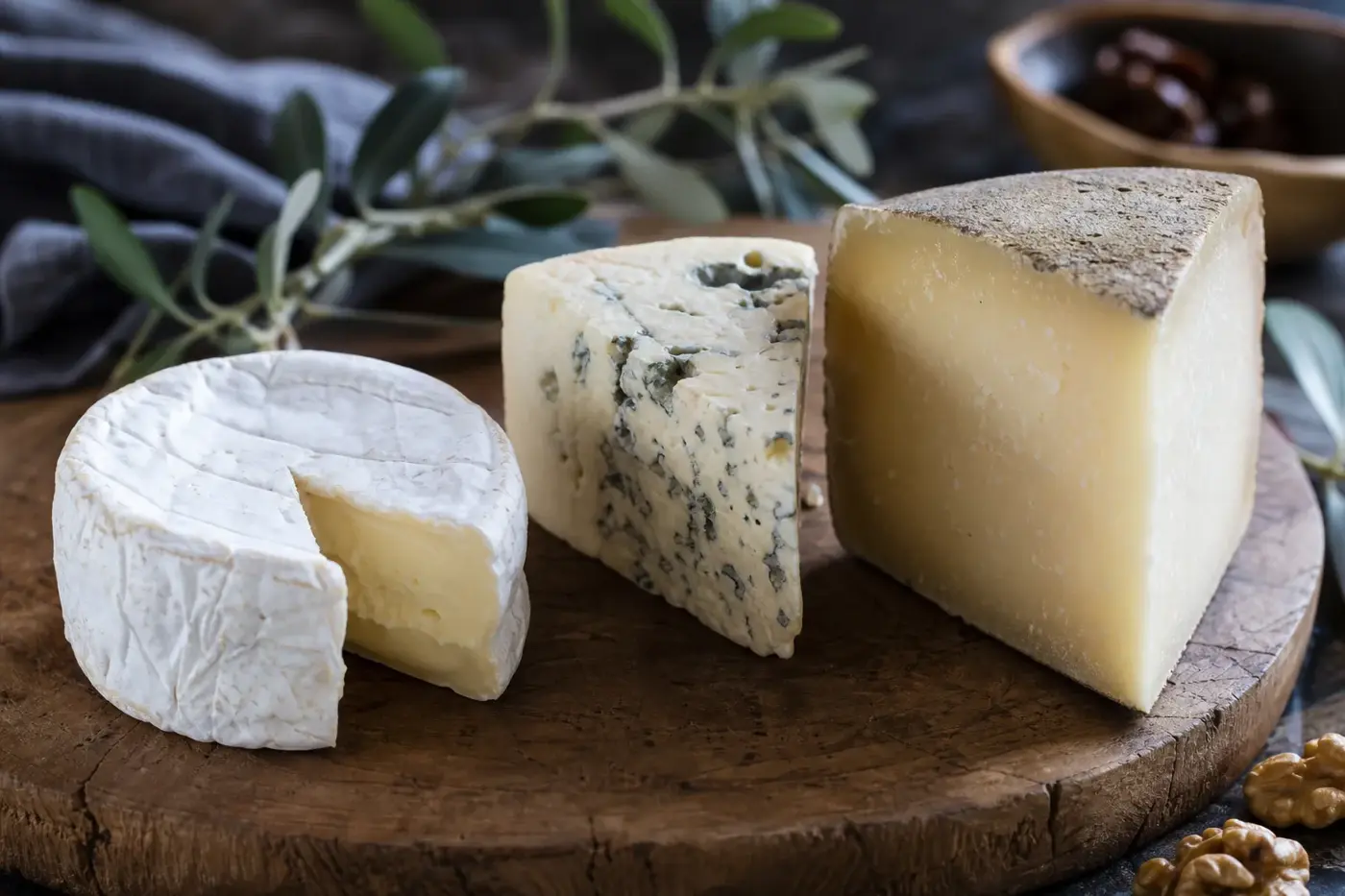
Start with contrasts: one supple cheese, one firmer matured example and one with a clearly different eye pattern. Ask your cheesemonger for the maker, age, milk treatment and production season. Those details reveal more than three labels saying “mountain cheese”.
Read the exact designation, especially if summer pasture production matters to you. Gruyère d’Alpage has specific requirements; a mountain scene on a wrapper tells you much less. Follow the individual traditions through Comté and Le Gruyère, or explore the schemes in protected names explained.[1][2]
Keep each piece’s storage instructions and follow its label. In the United States, FDA guidance advises refrigeration at 4 °C (40 °F) or below. Food requiring refrigeration should spend no more than two hours at room temperature, reduced to one hour above 32 °C (90 °F).[9]
Those are the agency’s rounded temperature equivalents, used here in November 2026. Follow these FDA limits when using US guidance; elsewhere, consult your national authority.[9]
Put out a modest portion and replenish your board, rather than displaying the whole supply. Cut comparable pieces and taste the less assertive cheese first. Keep bread and water nearby so you can notice the differences.
For wrapping and handling cut pieces, follow how to store cheese at home. Note when you opened each pack. Keep its batch details in case you need to check a recall.
From the first bite to fondue and gratins
Give the cheese a moment on its own. Taste a small bite before adding plain bread, an apple slice or a little cooked potato, changing one thing at a time. Save sweet preserves for last: they can make quieter savoury details harder to distinguish.
Water and unsweetened tea are straightforward starting points for drinks. Try each with a small bite of cheese. Notice how the combination changes the flavour.
For cooking, choose the particular cheese for its texture and intensity. Start a fondue with a recipe that names the cheeses and their proportions. An Alpine family resemblance tells you little about how a different mixture will behave: a firm, long-matured cheese and a softer, younger one need different consideration.[5][8]
For a gratin, decide whether you want cheese running through the dish or sitting mainly on top. Start with Fontina for a softer contribution; compare it with grated Comté or Gruyère when spreading cheese evenly through potato layers. Back at the board, keep the cheeses separate and label each with its maker and age.
General information only, not medical advice: follow the official guidance where you live.
Questions people ask
What makes a cheese Alpine?
Alpine is a broad family associated with the Alps, not a single legally defined style. Its traditions include rennet coagulation, cutting and heating curds, pressing and maturation.
What is special about Gruyère d’Alpage?
Its milk must be produced and the cheese made on an alpine summering holding. This must happen while the holding’s grass supplies the herd’s basic forage.
Are Alpine cheeses made with raw milk?
Gruyère, Comté, Beaufort and Emmentaler use raw cow’s milk under their cited specifications. Fontina’s current milk treatment requirements have not been verified against the official specification, so check the product’s declaration.
Which Alpine cheeses should I use for fondue?
Begin with a recipe that names the cheeses and their proportions. A shared Alpine family resemblance tells you little about how a different mixture will behave.
How should I store and serve Alpine cheese?
Follow the storage instructions on each piece’s label. In the United States, the FDA advises refrigeration at 4 °C or below and no more than two hours at room temperature, reduced to one hour above 32 °C. Consult FDA guidance in the US or your national authority elsewhere.
Sources
[1] Swiss Federal Office for Agriculture. Cahier des charges: Gruyère. Specification linked from the federal AOP and IGP register, incorporating the decisions listed in the document. Articles 3 to 5 and 30 to 36 cover the area, character, minimum age and alpine production. (blw.admin.ch)
[2] French Ministry of Agriculture and INAO. Cahier des charges de l’appellation d’origine « Comté ». Published in Bulletin officiel No. 02, 8 January 2026, following the order of 18 December 2025. Sections 2, 3 and 5 cover the cheese, area, manufacture and maturation.
[3] French Ministry of Agriculture and INAO. Cahier des charges de l’appellation d’origine « Beaufort ». Published in Bulletin officiel No. 15, 10 April 2025, following the order of 4 April 2025. Sections 2 and 5 cover character, manufacture and maturation.
[4] Swiss Federal Office for Agriculture. Cahier des charges: Emmentaler. Retrieved register-linked edition incorporating the federal decision of 4 November 2025. Articles 2, 3, 5 and 7 address the production area, raw milk, rind, eyes and manufacture.
[5] Italian Ministry of Agriculture, Food Sovereignty and Forestry. Disciplinare di produzione della DOP « Fontina », February 2026; decree of 18 February 2026, published in Gazzetta Ufficiale No. 48, 27 February 2026. Specification and Gazette copy retrieved through the Fontina consortium’s document library.
[6] European Commission. Publication of an application for approval of an amendment to a product specification: Vorarlberger Bergkäse. Official Journal C 156, 3 May 2023, document 2023/C 156/09, single document and accompanying amendment explanation. This is the dated published description used for the Austrian comparison.
[7] Switzerland Cheese Marketing. All cheese? Fascinating questions and answers. Undated industry explanation, accessed November 2026. Used for its account of flavour development and propionic fermentation, with its industry provenance retained.
[8] Swiss Federal Dairy Research Station. Swiss-Type Cheese. FAM Information, No. 424, August 2001. Research synthesis covering technology, cultures, eye formation, ripening, texture and flavour; Table 3 reports texture measurements during Emmentaler maturation.
[9] US Food and Drug Administration. Are You Storing Food Safely? Current retrieved consumer guidance, accessed November 2026, “Storage Basics”.
This piece was researched from designation specifications, government publications, Swiss dairy research and attributed industry explanations; serving combinations are editorial suggestions rather than a recorded tasting or recipe test.
Last checked: November 2026
Last checked November 2026.
The editors suggest you read next
How to Tell Cheese Styles Apart: Milk, Rind, Texture and Method
Watch mozzarella curd being worked and stretched in hot water.