Ashcombe
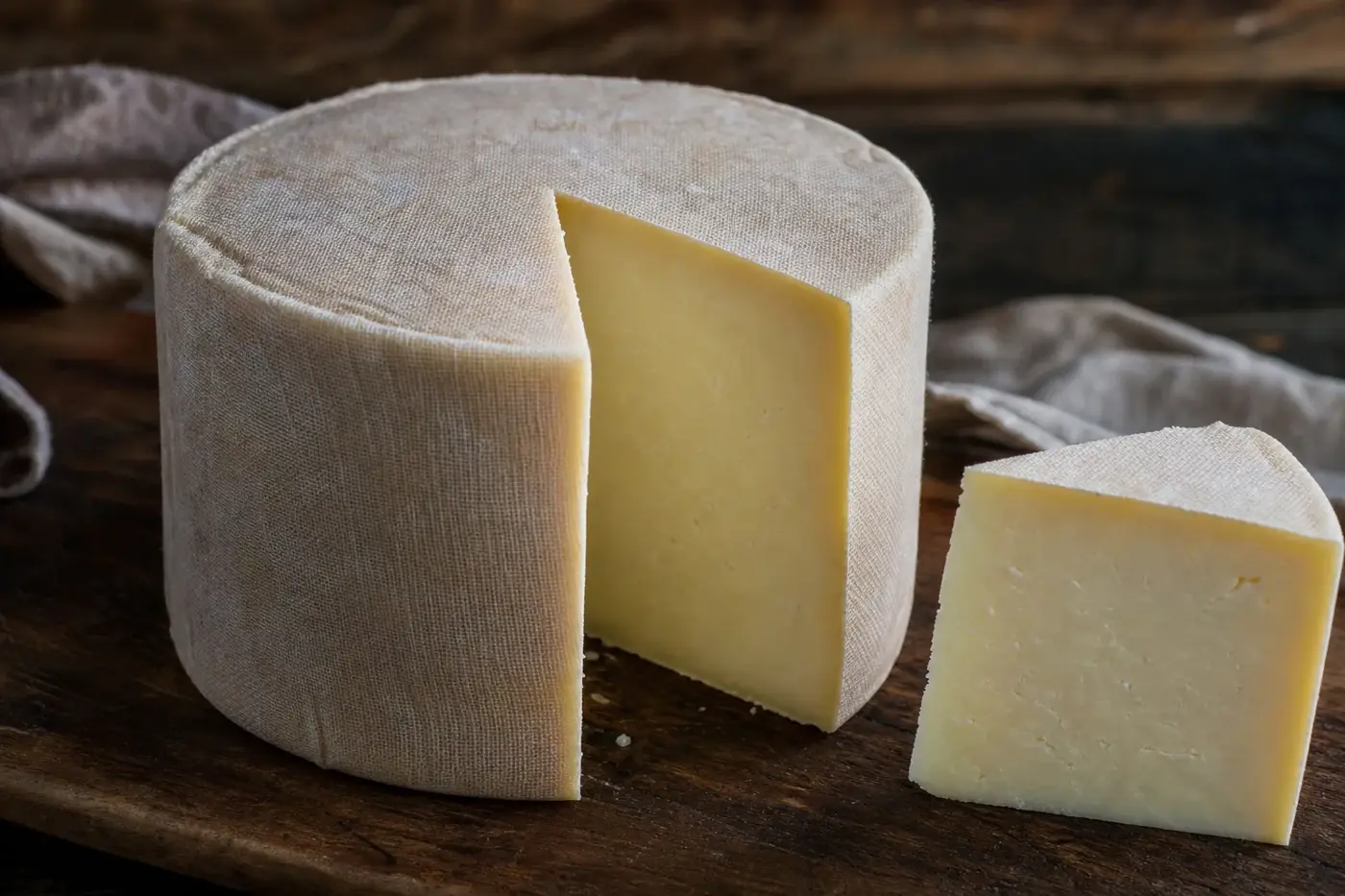
Cut into Ashcombe and a dark ash line wanders through the pale, supple interior beneath a terracotta washed rind.
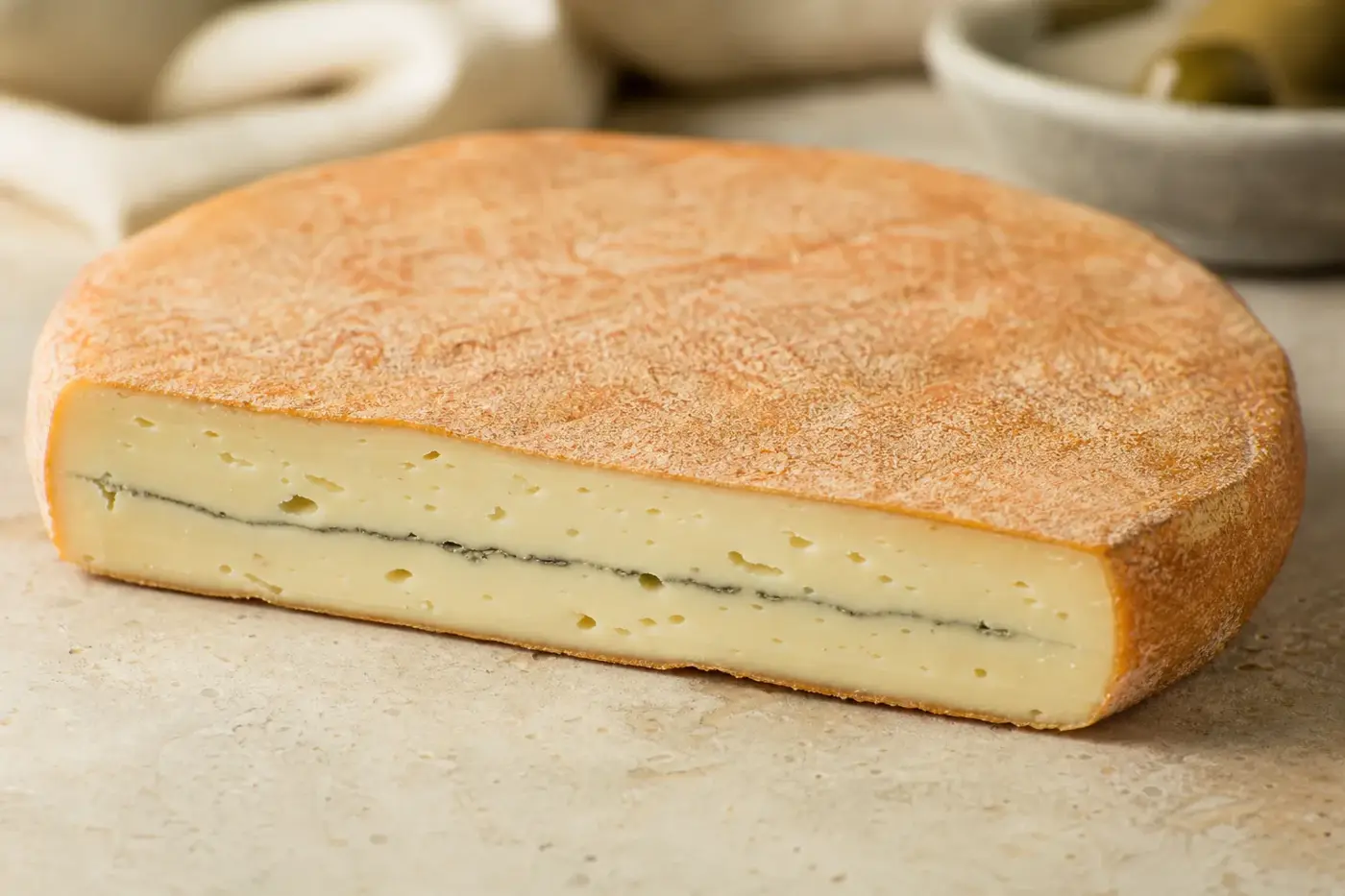
Cut into Ashcombe and a dark ash line wanders through the pale, supple interior beneath a terracotta washed rind. Before you take a bite, there is plenty to admire. Then come the maker’s flavour notes: warm milk, hay, melted butter and fresh hazelnuts. This cow’s milk cheese comes from King Stone Dairy at Manor Farm in Chedworth, Gloucestershire.[1][2]
| Get to know Ashcombe | Your at-a-glance details |
|---|---|
| Who makes it, and where | King Stone Dairy, Manor Farm, Chedworth, Gloucestershire, England.[2] |
| Milk and treatment | Pasteurised cow’s milk.[2] |
| Where the milk comes from | Organic milk from Manor Farm’s single herd, according to the dairy.[4] |
| Cheese style | Semi-hard, washed rind, with a central ash layer.[1] |
| The maker’s declared coagulant | Animal rennet.[2] |
| Ingredients to keep in mind | Milk and egg lysozyme appear on the maker’s illustrated label.[2] |
| A typical whole cheese | Flat disc, 6 to 7 kg.[1] |
| Time to mature | Cheese page: 2 to 4 months. Product resource age profile: 3 to 4 months.[1][2] |
| Registered name, authority and register ID | Not stated here |
| Legal minimum ageing | Not stated here |
Let that dark line lead you in
Even a small wedge gives Ashcombe away. Its dark line takes a slightly wandering path through the pale interior, framed in the maker’s photographs by an orange rind. Look closer and you can spot occasional small openings in the paste, the cheesemaking word for the cheese’s interior.[2]
That rind brings more than colour to your slice. King Stone Dairy describes it as meaty and savoury, while the paste carries aromas of warm milk and hay.[1] On your first tasting, give the edge and centre a moment separately, then bring them together.
You will see Ashcombe described as both “washed rind” and “semi-hard”. They tell you different things: one describes how the surface is treated, the other its broad texture category. Here, you get an orange exterior and a sliceable interior.[1] Find your bearings with how to tell cheese styles apart.
Pull up a chair at Easter lunch, 2020
Ashcombe’s story begins over Easter lunch in 2020, with lockdown disrupting the market for King Stone Dairy’s cheese. According to the dairy’s product resource, a larger cheese that could mature for longer offered another way to use Manor Farm’s milk.[2] That practical need gave a new cheese its opening.
There was already a cheesemaking practice to draw on. King Stone Dairy describes itself as a small-scale business making cheese by hand at Manor Farm in the Gloucestershire Cotswolds.[6] The creamery sits close to the milking parlour, and milk collected each morning travels less than a mile to the dairy.[4]
The maker’s route into cheese began with culinary training, followed by an internship at Ram Hall Farm and a dairying diploma at the School of Artisan Food. The dairy’s account also records experience in cheesemongering and cheesemaking, including two years as head cheesemaker at Gorsehill Abbey Farm. Work on Rollright began in 2015.[3]
Even Ashcombe’s name keeps you close to its home. The dairy explains it through the ash at the centre and the coombes, those steep-sided valleys around its Cotswold surroundings.[2] A little cheese, a little landscape, all in one name.
Meet the herd behind your wedge
Manor Farm’s single herd supplies King Stone Dairy’s cow’s milk. On the dairy’s current milk page, the breeds include Dairy Shorthorn, British Friesian, Fleckvieh, Normandie, Brown Swiss and Norwegian Red. They are selected for their suitability to the farm and for cheesemaking milk.[4]
The dairy describes its farming system as organic and low-input, with diverse herbal leys among its agricultural practices.[4] When you turn from the farm to Ashcombe itself, the product resource confirms that its milk is pasteurised.[2]
For a closer glimpse of the farming year, turn to the dairy’s seasonal account headed “May 2023”. It records grass, red clover, herbal leys, sainfoin and lucerne being conserved for winter forage. New cows were joining the herd, too, with the cheesemaker interested in how their milk would perform in longer-aged cheeses.[5]
Read that account beside the current herd description and you get two views of the same farm. The breed list captures a particular point; the seasonal writing brings you forage being gathered and animals arriving. Through those changes, Ashcombe stays connected to milk collected from this farm.
Curious about what happens to milk before cheesemaking begins? See raw, thermised and pasteurised milk for the wider differences between those treatments.
Follow the curd towards its terracotta coat
The illustrated label gives you Ashcombe’s ingredients: pasteurised cow’s milk, sea salt, starter cultures, animal rennet, vegetable carbon and egg lysozyme.[2] It is a short list to set beside such a distinctive cheese. You can see the finished result in its pale interior, dark line and coloured rind.
Rennet is the coagulant used to form the curd. If you would like to understand its different sources, rennet explained takes you through them.
See how the ash line finds its place
A photograph in the dairy’s product resource catches dark material being sprinkled across an exposed curd surface. Set beside photographs of the finished cheese, it lets you see how the internal ash layer becomes part of Ashcombe as the cheese is formed.[2]
The dairy calls the material wood ash in its description, while the illustrated ingredient label identifies vegetable carbon, E153.[2] Its clearest role in the finished cheese is visual: a fine dark division through the pale paste. Look at the photograph and you see a scattered application, rather than a thick, solid sheet.
A wash of brine, then time to mature
Ashcombe develops its bright terracotta colour as the rind is washed with a special brine solution, according to the dairy.[1] Brine is salt water. It is this treatment of the exterior that puts your wedge in the washed rind category.
The maker’s material describes maturation in two slightly different ways. The cheese page gives a window of 2 to 4 months; the product resource lists an age profile of 3 to 4 months.[1][2] Both describe usual maturation, and both give you a useful opening question at the cheese counter.
Ask when the cheese was made and how long the cut portion has been held. Those details help you choose between the pieces available. They are more useful than expecting every Ashcombe to have reached precisely the same stage.
Give the centre and rind their own moment
Melted butter and fresh hazelnuts are King Stone Dairy’s flavour references for Ashcombe. Its notes also distinguish the milk-and-hay-scented interior from the savoury, meaty rind.[1] You have more to explore here than a simple verdict of “mild” or “strong”.
Start with a piece from the centre, with nothing alongside it. Next, try a piece nearer the rind, then taste the two together. You are exploring the characters the maker describes, not sitting an exam in hazelnut detection.
At the counter, ask whether your piece falls towards the younger or older end of the dairy’s published maturation window.[1][2] Invite the cheesemonger to describe that particular cut, then compare firmness, aroma and the balance between interior and rind. Age gives you context, not a quality ranking.
If you fancy keeping a short tasting note, record three things. Notice how the paste yields when cut, which aromas arrive first, and how long the savoury impression stays after swallowing. Your words only need to capture the piece in front of you, not match the maker’s vocabulary.
Give that beautiful cross-section the spotlight
Keep the presentation plain: a wedge cut so each slice carries the ash line and some rind. Put bread and accompaniments alongside, rather than over it. Ashcombe has gone to some trouble with its appearance; you might as well let it show.
Serve a small portion cool instead of warming the whole supply for a long display. The Food Standards Agency guidance cited here applies to England, Northern Ireland and Wales. It advises keeping food out of the fridge for the shortest possible time during preparation, ideally no longer than four hours.[10] Follow the cheese’s storage instructions.
For your first serving, keep things simple:
- Cut only what you intend to serve.
- Slice through the full height of the wedge.
- Try a piece alone before adding bread or fruit.
- Compare the centre with a piece that includes rind.
- Keep the remaining cheese refrigerated.
Plain bread, a crisp apple or a firm pear are straightforward places to start. Give the milk, hay and savoury qualities in the maker’s description some room.[1] Several strong flavours at once can crowd the cheese you came to taste.
For an alcohol free accompaniment, try water or an unsweetened apple drink. These suggestions keep your serving simple. For a broader look at pairing principles, explore cheese and wine pairing.
Keep the label handy for the last slice
Start with the instructions and date on the piece you buy. That matters particularly when a cheesemonger has cut and rewrapped it. Food Standards Agency guidance for England, Northern Ireland and Wales recommends a home fridge temperature between 0 and 5 °C, and following packaging instructions for dairy products.[10]
Keep Ashcombe covered between servings, and hang on to its label. For more on wrapping and finding it a place in your fridge, see how to store cheese at home.
A small remaining piece still has a perfectly good place in a simple serving of bread and cheese. You could also tuck thin slices into a sandwich or serve them beside warm potatoes, adding other ingredients sparingly. These are serving ideas rather than tested recipes: let Ashcombe remain recognisable instead of mixing it with several other cheeses.
If you put it into a cooked dish, the same FSA guidance advises cooling leftovers as quickly as possible, ideally within one to two hours, before refrigerating them. Eat them within 48 hours or freeze them.[10] For an uncooked remainder, return to the cheese’s own label as your starting point for storage.
General information only, not medical advice: follow the official guidance where you live.
Questions people ask
What is the dark line in Ashcombe?
It is a central ash layer. The dairy calls the material wood ash, while its illustrated ingredient label identifies vegetable carbon, E153.
Does Ashcombe contain animal rennet or egg?
The maker declares animal rennet as its coagulant. Its illustrated label also lists egg lysozyme.
What does Ashcombe taste like?
King Stone Dairy describes flavours of melted butter and fresh hazelnuts. It describes the interior as scented with milk and hay, and the rind as savoury and meaty.
How long is Ashcombe matured?
The maker’s cheese page gives a maturation window of 2 to 4 months. Its product resource lists an age profile of 3 to 4 months.
How should Ashcombe be stored?
The Food Standards Agency recommends keeping a home fridge between 0 and 5 °C and following packaging instructions for dairy products. Consult its food storage guidance for England, Northern Ireland and Wales.
Sources
[1] King Stone Dairy. The Cheese, undated current web edition, Ashcombe section. Maker’s cheese descriptions.
[2] King Stone Dairy. Ashcombe, undated three-page product resource, including production photographs, tasting notes and illustrated ingredient label. Maker’s product resource.
[3] King Stone Dairy. The maker, undated current web edition. Maker’s career account.
[4] King Stone Dairy. The milk, undated current web edition. Milk supply and herd account.
[5] King Stone Dairy. May 2023, published 22 June 2023, reproduced on its blog index. Farm account.
[6] King Stone Dairy. King Stone Dairy, undated current homepage. Dairy’s description of its operation.
[7] British Cheese Awards. British Cheese Awards 2022: Champion and Special, 2022 results. Organiser’s championship record.
[8] Specialist Cheesemakers Association. Patron’s Award for Best Artisan Cheese, current winners list, 2022 entry. Award record.
[9] British and Irish Cheese Awards. British and Irish Cheese Awards: Non Retailers, results dated 20 March 2026, classes F39 and Q80. Organiser’s results.
[10] Food Standards Agency. How to chill, freeze and defrost food safely, published 18 December 2017, current GOV.UK edition, applying to England, Northern Ireland and Wales. Official refrigeration and leftovers guidance.
This article was researched from the maker’s published accounts and product photographs and official food storage guidance; serving suggestions are identified as editorial recommendations.
Last checked: November 2026
Last checked November 2026.
The editors suggest you read next
West Country Farmhouse Cheddar Cheese
Large pieces of curd turn and stack under the cheesemaker’s hands.