Rollright
Slip a spoon beneath Rollright's peachy-pink rind and feel the centre give way, its softening edges held snugly by a spruce collar.
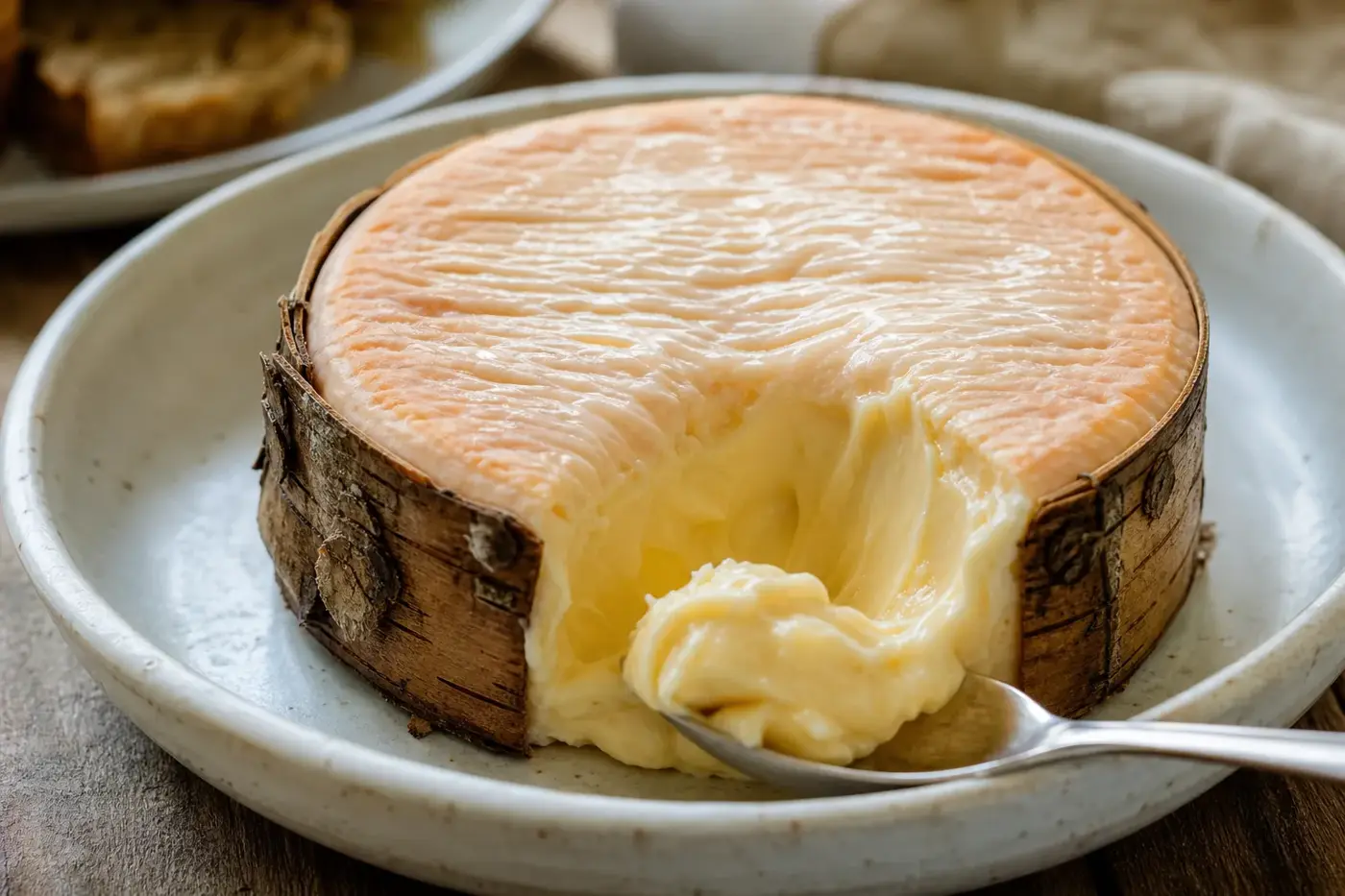
Slip a spoon beneath Rollright's peachy-pink rind and feel the centre give way, its softening edges held snugly by a spruce collar. Its maker describes smoky, woodsy aromas, followed by flavours of crème fraîche, cured ham and mustard seed. This British washed-rind cheese comes from King Stone Dairy at Manor Farm in Chedworth, Gloucestershire.[1][2]
| At a glance | Your quick guide |
|---|---|
| Name | Rollright.[2] |
| Maker | King Stone Dairy.[1] |
| Home | Manor Farm, Chedworth, Gloucestershire, England.[1] |
| Milk | Pasteurised cows' milk from Manor Farm's single herd.[3][4] |
| Coagulant | Animal rennet.[4] |
| Ingredients on the label | Milk, salt, rennet, cultures.[4] |
| Small wheel | 250 g.[2] |
| Typical age | 4 to 8 weeks.[2] |
| Rind | Washed; spruce-bark collar.[2] |
Follow the trail to the Rollright Stones
Rollright began in 2015, taking its name from the Rollright Stones near the dairy's original home outside Chipping Norton, on the Oxfordshire and Warwickshire border. Today, King Stone Dairy makes its cheeses by hand at Manor Farm in the Gloucestershire Cotswolds. The name carries a little of that first home with it, rather than directing you to the present creamery.[1][4][10]
The maker found inspiration in the spruce-banded cheeses of the Jura. Picture a shallow wheel with support around its edge, keeping everything together as the centre softens. Rollright brings that idea to the Cotswolds, with the farm's milk, a washed surface and the maker's particular flavours giving it its own character.[2][3][4]
Meet the herd behind your cheese
Six breeds supply Rollright's milk: Dairy Shorthorn, British Friesian, Fleckvieh, Normandie, Brown Swiss and Norwegian Red. Together, they make up the farm's mixed herd. Their milk is pasteurised, then set with animal rennet, which turns it into curd, the soft solid from which the cheese takes shape.[3][4][9]
Each morning, King Stone Dairy says, it collects milk from the farm's milking parlour and takes it less than a mile to the creamery. The dairy describes pastures with diverse herbal leys, grassland sown with grasses, legumes and herbs. It says the breeds are chosen to suit both cheesemaking and the conditions on the farm.[3]
Think of your wheel as the work of the whole herd, its feed and the cheesemaker handling the milk, rather than the contribution of any single breed. Curious about heat treatments? Turn to raw and pasteurised milk, while the separate guide to rennet explains the different coagulants.[3]
Three weeks of washing, then a little patience
A washed rind needs regular attention. Neal's Yard Dairy, which matures and sells Rollright, records washing it with brine, a salt-and-water solution, for three weeks. Before that routine begins, rennet sets the milk into curd; the published ingredient list is simply milk, salt, rennet and cultures.[4][5][9]
Those washes help develop the thin, orange-toned surface described by the affineur, the specialist who matures cheese. King Stone Dairy gives a typical finished age of 4 to 8 weeks. The timings describe different stages, with three weeks of rind treatment forming part of the longer maturation.[2][5]
At Neal's Yard Dairy, Little Rollright stays wrapped in a cooler maturing room until it is ready for sale. Here is where a chat at the counter earns its keep. Two wheels can be at different points within the maker's age range, so ask about the one in front of you and say when you hope to eat it.[6]
The spruce collar earns its place
As the interior softens, spruce bark keeps the wheel's edge in place. It contributes aroma too: Neal's Yard Dairy attributes a pine note to the band. That handsome collar has a proper job, beyond making your cheese look well dressed.[6]
Put the wheel on a plate before opening it, and leave the band in place while you portion the soft interior. A particularly yielding whole wheel is easier to serve in a shallow dish. Set the collar aside afterwards; it supports the cheese but is not part of lunch.[5][6]
Get to know the rind beneath the collar
The rind is the cheese's ripened surface; the collar is spruce bark. For the rind, follow the instructions supplied with your wheel and ask the maker or cheesemonger whether it is intended to be eaten. Neal's Yard Dairy advises asking whenever rind edibility is uncertain, so keep the two parts distinct when serving.[2][9]
Find the cream, woodland and savoury flavours
King Stone Dairy describes crème fraîche, cured ham and mustard seed beneath smoky, woodland aromas. Neal's Yard Dairy finds milky flavour, woody notes and a soft, glossy texture. Together, those descriptions suggest fresh dairy tang and a savoury, aromatic finish, giving you rather more to look forward to than the word “strong”.[2][6]
The maker describes a delicate peachy-pink rind and an interior that ripens towards spoonable consistency. Beneath that coloured surface, Neal's Yard Dairy describes soft, buttery paste. Choose a wheel with more structure if you want neat portions, or a more yielding one if your spoon is already hovering.[2][5]
Choose your wheel with supper in mind
Tell your cheesemonger when you plan to eat Rollright and the texture you enjoy. Ask whether the wheel is ready now or needs time to soften, and whether a small whole cheese or cut portion best suits your plans. The producer's 250 g format gives you a complete wheel without committing to a larger cheese.[2]
Read the label for milk, ingredients, storage instructions and any use-by date. Rollright's declared animal rennet matters if you are choosing cheese for vegetarians. For help separating the food's name, maker details and handling instructions, turn to reading cheese labels.[4][8]
Make room in the fridge, then bring out the spoon
Keep Rollright refrigerated and follow its pack instructions. The Food Standards Agency's household guidance for England, Wales and Northern Ireland recommends a fridge temperature between 0 and 5 °C (32 to 41 °F). Neal's Yard Dairy suggests cheese paper inside a box in the fridge, protecting the cheese from drying out and picking up other food aromas.[9][11]
Neal's Yard Dairy suggests taking cheese out about two hours before serving, keeping it wrapped as it warms. Include that warming period in its total time outside the fridge: UK NHS guidance says ready-to-eat foods should be eaten within four hours of leaving it. Bring out only what you intend to serve and keep the rest chilled.[8][9]
Use a small knife while the cheese holds its shape, or a serving spoon once it yields. Taste a little by itself before adding bread or pickles. The NHS advises using opened food within two days unless the packaging says otherwise, and following the use-by date; find broader handling advice in storing cheese at home.[2][8]
Set the table with bread, cornichons and a glass
Plain sourdough or a baguette gives the cheese room to lead. Put cornichons alongside rather than on top, so you can adjust each mouthful; the maker suggests both cornichons and charcuterie. Begin with bread and cheese, then try a little acidity against the soft paste, keeping strongly sweet chutneys as an optional extra.[4]
For wine, King Stone Dairy suggests sparkling white or Chardonnay with a little oak. If you would like an alcohol-free alternative, try sparkling water with slices of fresh apple, a restrained starting point that leaves the woody aroma clear. The bread and alcohol-free combinations are serving suggestions alongside the maker's recommendations.[4]
Alcoholic pairings are for adults of legal drinking age, in small servings. The NHS advises avoiding alcohol during pregnancy. You can find more pairing principles and alcohol-free alternatives in cheese and wine pairing.[7]
Meet Rollright's neighbours: Tunworth and Baron Bigod
Look at the surfaces of these three British soft cheeses and their differences begin to show. Rollright has its washed, peach-toned rind and supporting spruce band. Tunworth's producer describes a white, thin, wrinkled rind and mushroom aroma; Fen Farm Dairy describes Baron Bigod as a Brie-style cheese with a mushroomy rind, softened outer paste and a fresh, citrussy centre.[2][12][13]
Rollright's appeal lies in that combination of washed rind, wood and spoonable texture. Choose it for the maker's savoury mustard-seed and cured-ham notes, and the distinctive sight of the collared wheel on your plate. For the broader distinction between washed and white-mould surfaces, see how cheese styles differ.[2]
This page summarises published guidance from the official sources it cites. It is not medical advice. Guidance differs between countries and changes over time, so check the current source for where you live, and ask your doctor, midwife, pharmacist or dietitian about your own circumstances.
Find the right guidance if you are at higher risk
UK NHS pregnancy guidance distinguishes pasteurised soft cheeses from mould-ripened soft cheeses with a white coating, and from soft blue-veined cheeses. The latter two groups must be thoroughly cooked, whether their milk is pasteurised or not. Cheese cooked until steaming hot is among the foods the guidance lists as suitable to eat.[7]
The NHS identifies pregnant people, newborn babies, older people and people with weakened immunity as groups at higher risk of serious listeriosis. Consult its current pregnancy and listeriosis guidance, with November 2026 as the reference date, and ask your healthcare professional about your circumstances and the particular product. Rollright's declared ingredients include milk.[4][7][8]
Questions people ask
Where is Rollright made?
King Stone Dairy makes Rollright by hand at Manor Farm in Chedworth, Gloucestershire. Its name comes from the Rollright Stones near the dairy’s original home.
Is Rollright suitable for vegetarians?
Rollright is made with animal rennet. Its declared ingredients are milk, salt, rennet and cultures.
Can you eat the spruce collar and rind?
The spruce collar is wooden support and should be set aside after serving. For the rind, follow the instructions supplied with your wheel and ask the maker or cheesemonger if you are unsure.
What does Rollright taste like?
King Stone Dairy describes flavours of crème fraîche, cured ham and mustard seed, with smoky, woodland aromas. Neal’s Yard Dairy notes a milky flavour and woody notes.
How should Rollright be stored and served?
Keep it refrigerated and follow the pack instructions. Neal’s Yard Dairy suggests taking cheese out about two hours before serving and leaving it wrapped while it warms.
Sources
-
King Stone Dairy, King Stone Dairy, undated live producer statement, checked November 2026.
Read at kingstonedairy.com -
King Stone Dairy, The Cheese, Rollright section, undated live product description, checked November 2026.
Read at kingstonedairy.com -
King Stone Dairy, The milk, undated live producer statement, checked November 2026.
Read at kingstonedairy.com -
King Stone Dairy, Rollright, producer resource sheet, undated edition retrieved November 2026.
Read at static1.squarespace.com -
Neal's Yard Dairy, Rollright, undated live product and maturation account, checked November 2026. Commercial source describing cheese it selects and sells.
Read at nealsyarddairy.co.uk -
Neal's Yard Dairy, Little Rollright, undated live product and maturation account, checked November 2026. Commercial source describing cheese it selects and sells.
Read at nealsyarddairy.co.uk -
NHS, Foods to avoid in pregnancy, live guidance retrieved November 2026.
Read at nhs.uk -
NHS, Listeriosis, page last reviewed 10 November 2023, live guidance retrieved November 2026.
Read at nhs.uk -
Neal's Yard Dairy, FAQs, storage, serving, rind and rennet sections, undated live edition, checked November 2026. Commercial source; its medical commentary was not used.
Read at nealsyarddairy.co.uk -
King Stone Dairy, The maker, undated producer history, checked November 2026.
Read at kingstonedairy.com -
Food Standards Agency, How to chill, freeze and defrost food safely, published 18 December 2017, live edition checked November 2026; applies to England, Northern Ireland and Wales.
Read at gov.uk -
Butlers Farmhouse Cheeses, Tunworth, undated live producer description, checked November 2026.
Read at butlerscheeses.co.uk -
Fen Farm Dairy, Baron Bigod, undated live producer description, checked November 2026.
Read at fenfarmdairy.co.uk -
Food Standards Agency, Alerts, live official food and allergy alert index, inspected November 2026.
Read at alerts.food.gov.uk
This piece was researched from the maker's published material, its affineur's handling accounts, comparison cheeses' producer descriptions and official UK food guidance.
Last checked: November 2026
Last checked November 2026.
The editors suggest you read next
West Country Farmhouse Cheddar Cheese
Large pieces of curd turn and stack under the cheesemaker’s hands.