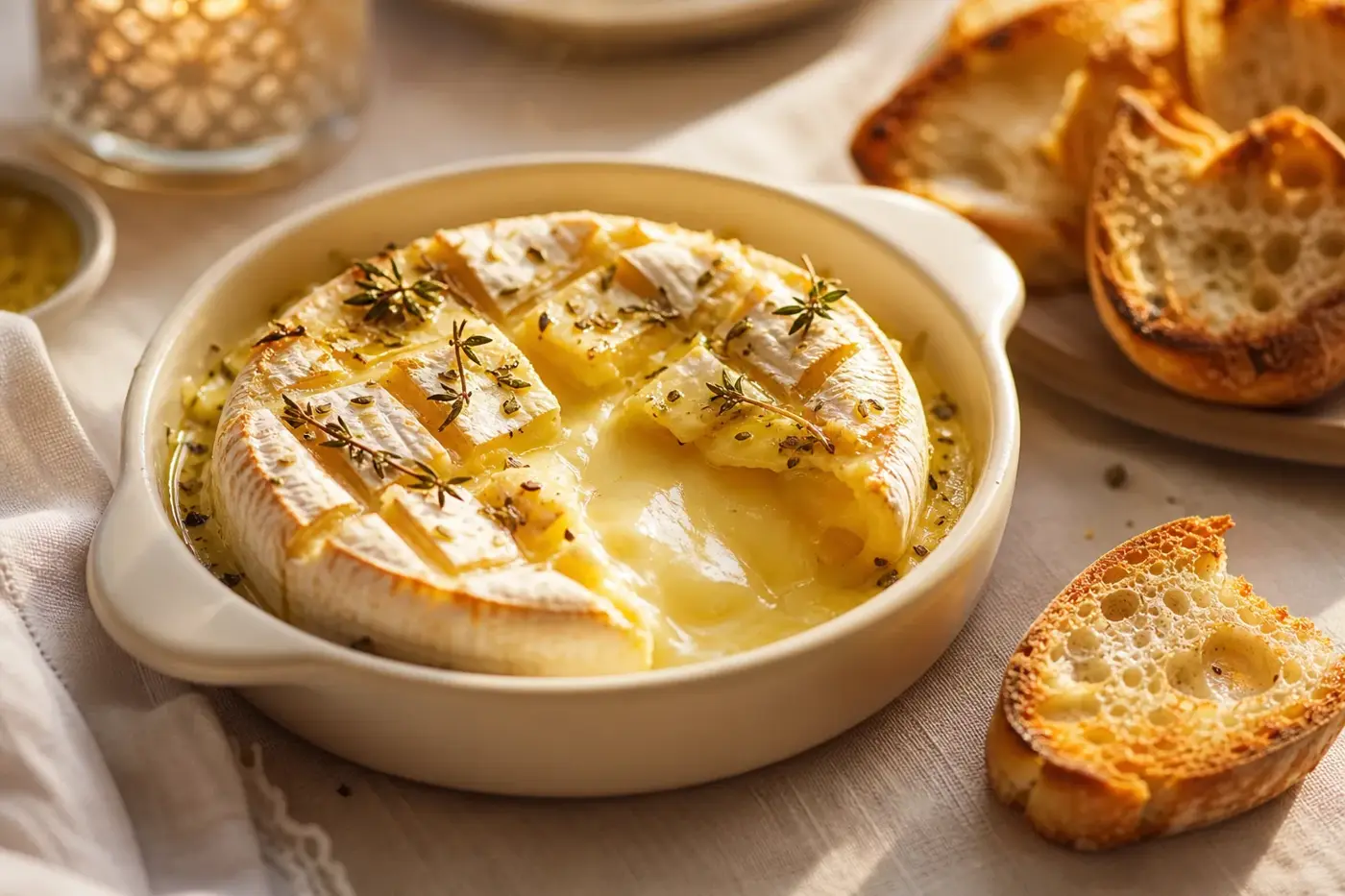
Your spoon breaks through the opened rind. Inside, the cheese gives way, hot and soft, ready for a piece of bread. That is the moment you want from a whole 250 g Camembert: completely unwrapped, tucked into a snug ovenproof dish and baked for about 20 minutes at 200 °C, or 180 °C fan. Let the centre, not the timer, have the final say. [2,4,8]
One warm cheese, four waiting spoons
The pleasure is in the contrast. The rind holds the whole soft cheese together as it heats, while the centre becomes a dip that yields to your spoon. A little structure outside, glorious softness within. [2,3]
A 250 g cheese serves four as a starter with bread and other dippers, giving you 62.5 g each. Good Food suggests four to six servings; choose six for a small appetiser before a substantial meal. For a larger gathering, bake separate rounds in individual dishes. It saves everyone forming a rather hopeful queue around one cheese. [1]
Find a Camembert with its rind intact
Choose a whole, intact round, not a wedge. You need the rind around the sides and underneath to hold everything together. Read the weight, storage instructions and use-by date, then the milk treatment and vegetarian information on the pack. For more about the cheese itself, dip into the camembert guide. [2,4,5]
You will find both pasteurised and raw milk versions. Président, for example, describes its UK 250 g Camembert as made with pasteurised cow's milk and unsuitable for vegetarians. Milk treatment and rennet suitability are separate questions: pasteurised does not mean vegetarian. [4,6]
Cooking for someone pregnant? NHS advice covers both pasteurised and unpasteurised Camembert: cook it thoroughly until steaming hot throughout. Soft alone is not enough, so read the country-specific guidance below before choosing for your guests. [6]
Off with the wrapping, into the dish
Remove everything: the outer box, paper, plastic film, labels and any other wrapping. Set your cheese in a small ovenproof ceramic dish or ramekin that supports its sides, leaving some room for escaping cheese. Put the dish on a baking tray. [2]
A wooden box belongs in the oven only if the maker explicitly confirms that particular box is suitable for baking and supplies instructions. Otherwise, use the ovenproof dish. That is the method here, without guesswork about staples, glue or how convincing the box looks.
Your 250 g baked Camembert recipe
Serves: 4 as a starter. Preparation: about 5 minutes. Baking: about 20 minutes; check the centre before serving. Oven: 200 °C conventional (392 °F), or 180 °C fan (356 °F). [1,2]
Recipe status: adapted from Good Food's baked Camembert. Packaging removal and oven settings follow Lactalis's published method. Independent fromage.co.uk testing: none. The producer sources cited here promote their own products. [1,2]
Gather your cheese and dipping supplies
- 1 whole 250 g (about 8.8 oz) Camembert
- 2 small thyme sprigs
- 15 ml (about 0.5 US fl oz) dry white wine, optional
- 1 small garlic clove, optional, peeled and thinly sliced
- Bread and prepared accompaniments, to serve
- Small ovenproof dish, baking tray, sharp knife, spoon and oven gloves; a clean food thermometer for checking the centre
The thyme and wine come from the source recipe; garlic is an optional editorial adaptation. If you are avoiding alcohol, leave out the wine. Cooking reduces alcohol but does not reliably remove it, as USDA retention data show. [1,7]
Score the top, then follow the centre
- Heat your oven to the temperature above. Prepare the bread and other accompaniments before the cheese goes in.
- Unwrap the cheese completely and place it in the ovenproof dish on the tray. Keep the side and bottom rind intact. [2]
- Use a sharp knife to score a cross through the top rind. Tuck a few thin garlic slices into the cuts, if using, and lay the thyme on top. Pour the optional wine over the scored surface. [1,2]
- Bake for about 20 minutes. Open the scored rind with a clean spoon: the centre should be soft enough to scoop and steaming hot throughout. Following FSA consumer guidance for England, Wales and Northern Ireland, use a clean probe to confirm 70 °C (158 °F) for two minutes, or 75 °C (167 °F) for 30 seconds. Continue cooking if needed. [2,8]
- Use oven gloves to remove the dish, set it on a heatproof surface and serve promptly. Warn everyone that the dish stays hot.
Let the cheese lead, with garlic and herbs
One small garlic clove is enough, rather than a whole layer of chopped garlic. Choose thyme or a small rosemary sprig, not a committee of strong herbs all demanding attention. Président publishes a rosemary-topped version; this recipe keeps things simple with thyme. [3]
For this adapted recipe, there is no established substitute. If you choose another cheese, follow its own baking instructions rather than expecting the same result.
Watch the centre, not just the clock
Check texture and heat before you serve, especially for someone at higher risk. Cheeses and appliances differ, so baking time is a guide, not a promise. Good Food specifies about 20 minutes at this oven setting and describes the finished centre as liquid; Lactalis gives the same setting and time for its own Camembert. [1,2,8]
| What you notice | Your next step |
|---|---|
| Texture issue: the centre is still firm | Check the centre temperature. If it is insufficiently heated, continue baking, following the pack's instructions. [8] |
| Texture issue: oil is pooling | Do not keep baking just to make it runnier. Good Food warns that overbaking dries the cheese irreversibly. [1] |
Choose your container before you turn on the heat. Use the ovenproof dish, not a box without explicit baking approval or a serving bowl whose oven suitability is uncertain.
Set out bread, fruit and vegetables
Start with toasted baguette, sourdough fingers or sturdy crackers. Cut them into pieces small enough for you to dip or spread. Lactalis suggests carrot, cucumber, celery and pepper sticks with baked Camembert; Président also suggests apples, pears, grapes and dried fruit with its cheese. [2,9]
For a more substantial plate, try cooked new potatoes alongside the bread, with tender broccoli florets or roasted carrots. Set these on separate plates so your guests can put together a meal without jostling around the cheese. Add a spoon for transferring cheese to individual plates.
Wash fruit and vegetables thoroughly before preparing them, following NHS advice. Keep sweet accompaniments separate: apple slices or a little chutney for anyone who wants sweetness. Leave plenty of plain bread for those who prefer it. [6,9]
Pour a fresh contrast to the cheese
Président suggests cider and Champagne with Camembert. In the suggestions below, acidity contrasts with the soft cheese; keep sweetness restrained if you already have fruit or chutney on the table. These are serving suggestions rather than tested pairings. [9]
| Your drink | What to choose | What it brings to the table |
|---|---|---|
| Wine | Dry sparkling wine | A crisp contrast, especially with bread and vegetables. |
| Cider | Dry or medium-dry cider | Apple character alongside fresh apple dippers. |
| Alcohol free | Sparkling water with apple slices | A fresh alternative that keeps the cheese and toppings in focus. |
Offer alcohol free choices alongside any wine or cider. Alcoholic suggestions are for adults of legal drinking age, in small servings; for pregnancy, the NHS advises avoiding alcohol. For broader choices, explore cheese and wine pairing. [6]
Gather everyone before the cheese is ready
Have everyone at the table before the cheese leaves the oven. Serve promptly, rather than leaving the dish on display while you prepare the rest of the meal. The FSA guidance below is for England, Wales and Northern Ireland, as of November 2026. [8,10]
Start cooling leftovers promptly and refrigerate within one to two hours. Divide them into smaller portions to help cooling, cover for storage and keep your fridge at 5 °C (41 °F) or below. Eat within 48 hours or freeze, following the pack's freezing instructions. [10]
Reheat only once, until steaming hot throughout. Check the middle, not just the edges, and heat only the portion you intend to eat. Use an ovenproof dish and follow any instructions on the pack. For the unbaked cheese, turn to storing cheese at home. [8]
Take care of everyone at your table
For pregnancy, the centre must be steaming hot all the way through. UK NHS guidance, as of November 2026, advises avoiding soft mould ripened cheeses such as Camembert, whether made with pasteurised or unpasteurised milk, unless cooked to that point. An opened rind tells you little on its own: look inside before serving. [6]
The NHS identifies newborn babies, older people and people with weakened immunity as groups at higher risk of serious listeriosis. Follow official guidance and any advice from the healthcare team for the person eating. You can find the background in the listeria and cheese guide. [5]
Camembert contains milk, and toppings and accompaniments need attention too. Check for allergens in bread, crackers and wine as well as anything else you serve. Keep the packaging so guests can inspect it. [4]
General information only, not medical advice: follow the official guidance where you live.
Questions people ask
How long should I bake Camembert?
Bake a 250 g round for about 20 minutes at 200 °C, or 180 °C fan. Check that the centre is soft enough to scoop and steaming hot throughout. FSA consumer guidance for England, Wales and Northern Ireland says a clean probe can confirm 70 °C for two minutes or 75 °C for 30 seconds.
Can I bake Camembert in its wooden box?
Only use the wooden box if the maker explicitly confirms that it is suitable for baking and supplies instructions. Otherwise, unwrap the cheese completely and use a small ovenproof dish that supports its sides.
Can I eat baked Camembert when pregnant?
The NHS advises avoiding Camembert during pregnancy, whether made with pasteurised or unpasteurised milk, unless it is cooked until steaming hot throughout. Check the current NHS guidance and ask your midwife or doctor about your own circumstances.
Can I keep and reheat leftover baked Camembert?
The FSA advises cooling leftovers promptly, refrigerating them within one to two hours and eating them within 48 hours or freezing them. Reheat only once, until steaming hot throughout, checking the middle. See the FSA guidance for England, Wales and Northern Ireland.
What can I serve with baked Camembert?
Try toasted baguette, sourdough fingers or sturdy crackers. Lactalis suggests carrot, cucumber, celery and pepper sticks, while Président suggests apples, pears, grapes and dried fruit.
Sources
- Good Food, Baked camembert, recipe originally published in Good Food magazine, December 2011; current online version retrieved November 2026. Source for the 250 g quantity, four to six servings, thyme, optional wine, substitutions and overbaking warning. Recipe and method.
- Lactalis UK & Ireland, Président Camembert, undated online publication, retrieved November 2026, “Veggie-Packed Baked Camembert” section. Source for removing all packaging, scoring, oven settings, baking time and vegetable dippers. Producer's method.
- Président, Baked Président® Camembert with Honey & Rosemary Sprigs, undated online recipe, retrieved November 2026. Source for rosemary as an alternative topping. Its different recipe and timing have not been substituted into the main method. Producer's recipe.
- Président UK, Camembert 250g, undated product information, retrieved November 2026. Declares pasteurised cow's milk, an edible rind and that this particular product is unsuitable for vegetarians. Product information.
- NHS, Listeriosis, reviewed 10 November 2023; retrieved November 2026. Sections on higher risk groups, refrigeration, use-by dates and cooking instructions. Official guidance.
- NHS, Foods to avoid in pregnancy, reviewed 15 June 2026; retrieved November 2026. Sections on cheese, alcohol, and washing fruit and vegetables. Official pregnancy guidance.
- US Department of Agriculture, Agricultural Research Service, USDA Table of Nutrient Retention Factors, Release 6, December 2007. Methods and alcohol retention entries support the limited statement that cooking does not reliably remove all alcohol. Published retention tables.
- Food Standards Agency, Cooking your food, GOV.UK publication dated 18 December 2017; current text retrieved November 2026. Applies to England, Northern Ireland and Wales. Sections 2, 3 and 7 cover centre checks, temperature and time combinations, and reheating. Official cooking guidance.
- Président Professionnel, Camembert, undated product publication, retrieved November 2026. Producer suggestions for bread, fruit, cider and Champagne. Food and drink suggestions.
- Food Standards Agency, How to chill, freeze and defrost food safely, GOV.UK publication dated 18 December 2017; current text retrieved November 2026. Applies to England, Northern Ireland and Wales. Section 1 covers refrigeration, cooling and leftovers. Official chilling guidance.
- Food Standards Agency, Alerts, live official listing retrieved November 2026. Consulted for the editorial recall check described in the evidence log. Official alerts listing.
Researched through published recipes, producer product information and official food safety guidance, with editorial serving suggestions distinguished from independently tested results.
Last checked: November 2026
Last checked November 2026.
The editors suggest you read next