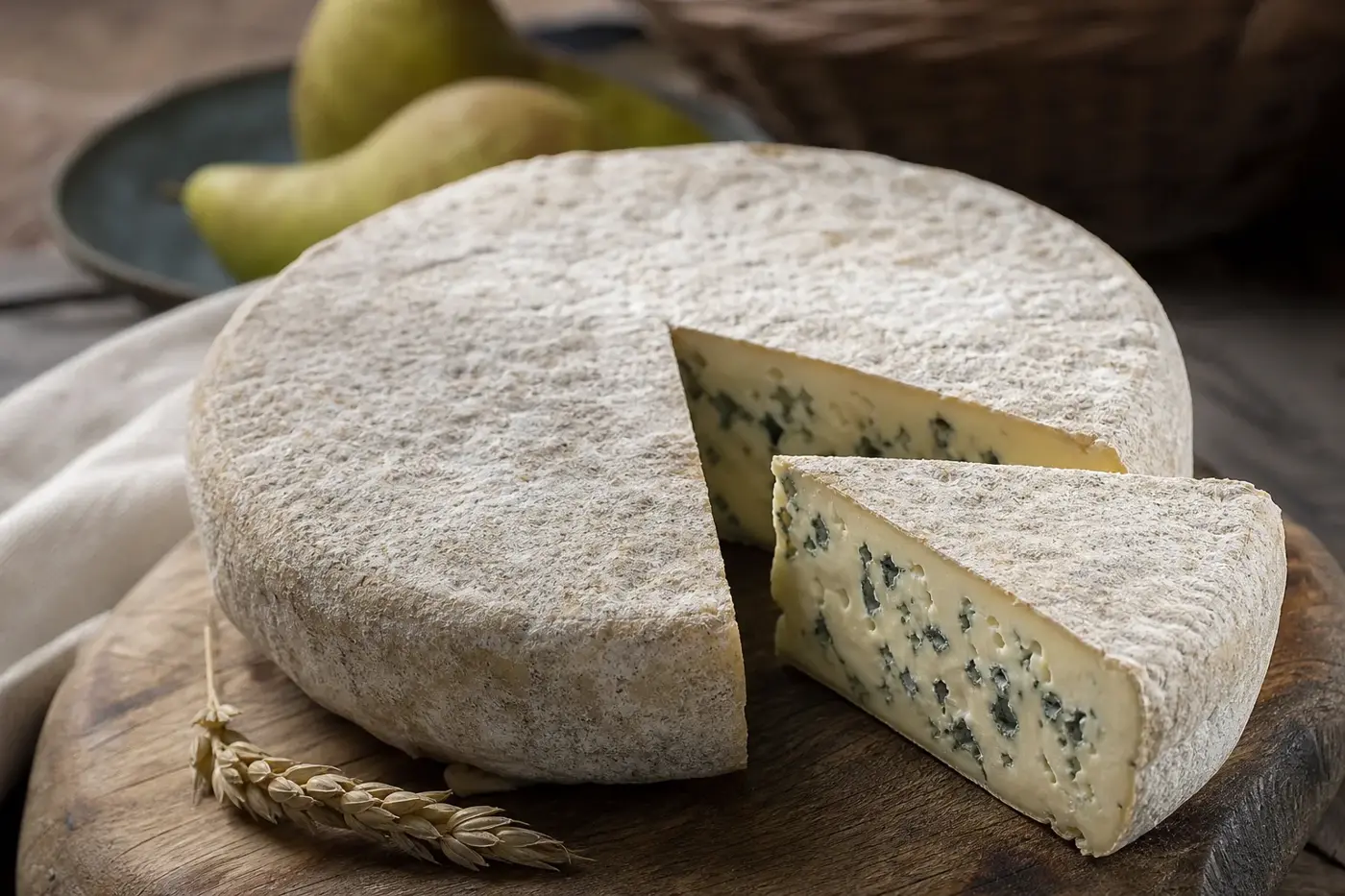
Picture your tax payment arriving as cheese. In the fourteenth century, the lord of Sassenage collected it from the mountain parishes and sold it at Sassenage.[5] Today, Bleu du Vercors-Sassenage brings the grazing and cheesemaking traditions of France’s Vercors plateau to your plate. A rather more welcome delivery.
Cut into this approachable cow’s milk blue and you find a supple, yielding paste. Its official description promises gentle blue flavour, a little hazelnut and the scent of woodland undergrowth.[1][4] You have plenty to explore without a blue cheese shouting match.
| Your quick introduction | What to know |
|---|---|
| Familiar and registered name | Bleu du Vercors-Sassenage.[1][3] |
| Cheese style | Unpressed, uncooked blue-veined cheese.[1] |
| EU designation | PDO; dossier reference PDO-FR-0077. Approved standard amendment published on 16 April 2026.[1] |
| Great Britain | Registered PDO; UK scheme registration dated 31 December 2020, 23:00. Record information: November 2026.[3] |
| Original EU registration date | 16 March 2001, as recorded by Defra.[3] |
| Legally defined production area | Specified parts of the Vercors massif in Drôme and Isère, France.[1] |
| Milk | Cow’s milk, raw or thermised; farm production uses raw milk exclusively.[1] |
| Minimum maturation | 21 days from renneting.[2] |
| Wheel shape and size | Flat cylinder, 27 to 30 cm across and 7 to 9 cm high.[1][2] Current permitted weight: Unconfirmed. |
Follow the grass up into the Vercors
West of Grenoble, the Vercors rises in a high limestone massif. Picture an undulating plateau, enclosed valleys and routes threading through gorges. Its grassland supports the mountain farming that supplies this cheese’s milk. In the designation’s account, that landscape is part of production, not merely the view from the dairy.[1]
The double name gives you geography and history in one mouthful. Vercors identifies the massif. Sassenage recalls the older name associated with its northern mountains, and the place through which the cheese became known beyond the farms.[1][5]
If you are finding your way into blue cheese, this is an inviting place to start. INAO, France’s national origin and quality institute, describes a mild blue taste without excessive bitterness, acidity or saltiness. That describes the balance in your mouth, not a low salt content.[4]
Take a good look at your slice
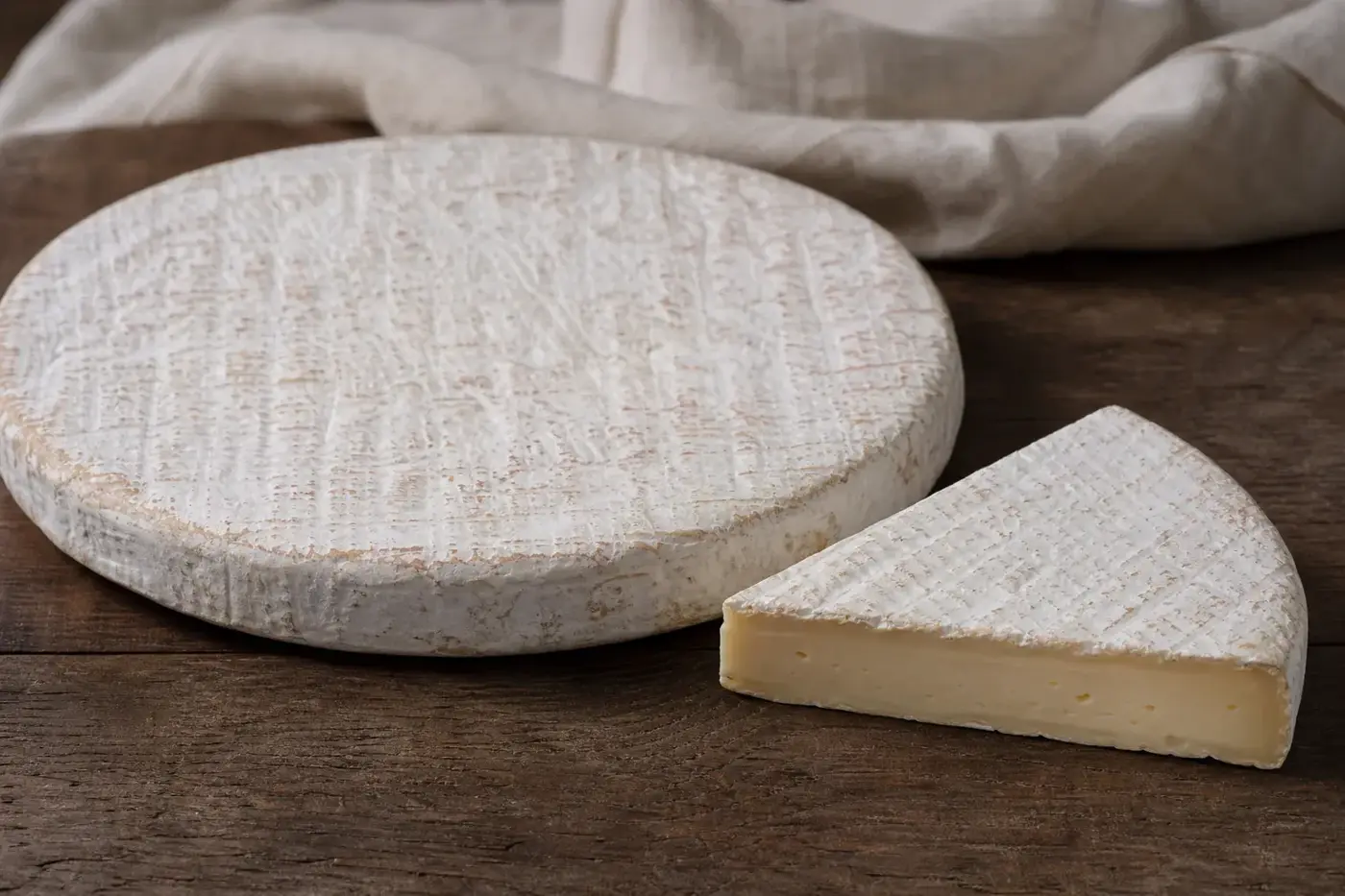
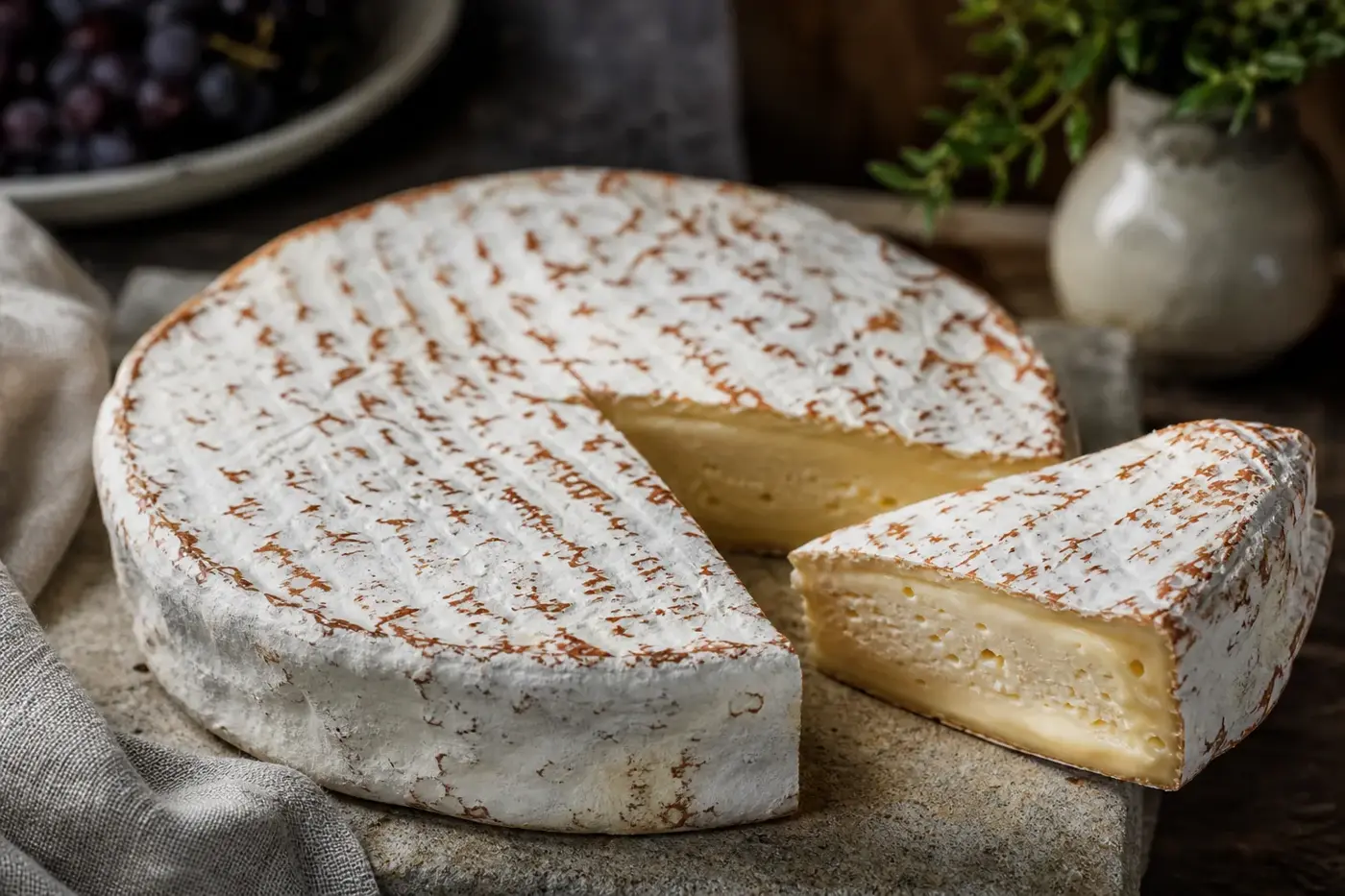
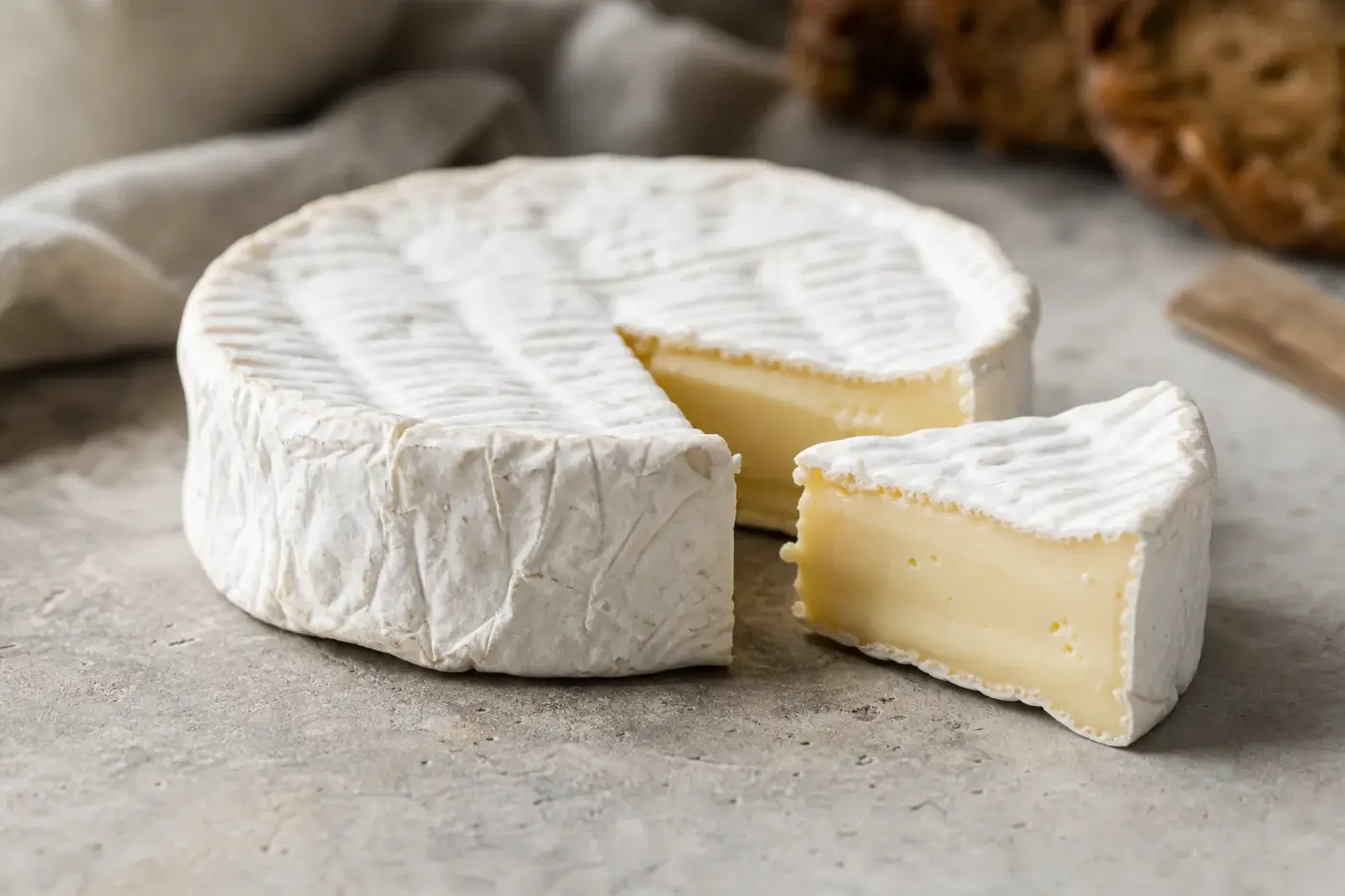
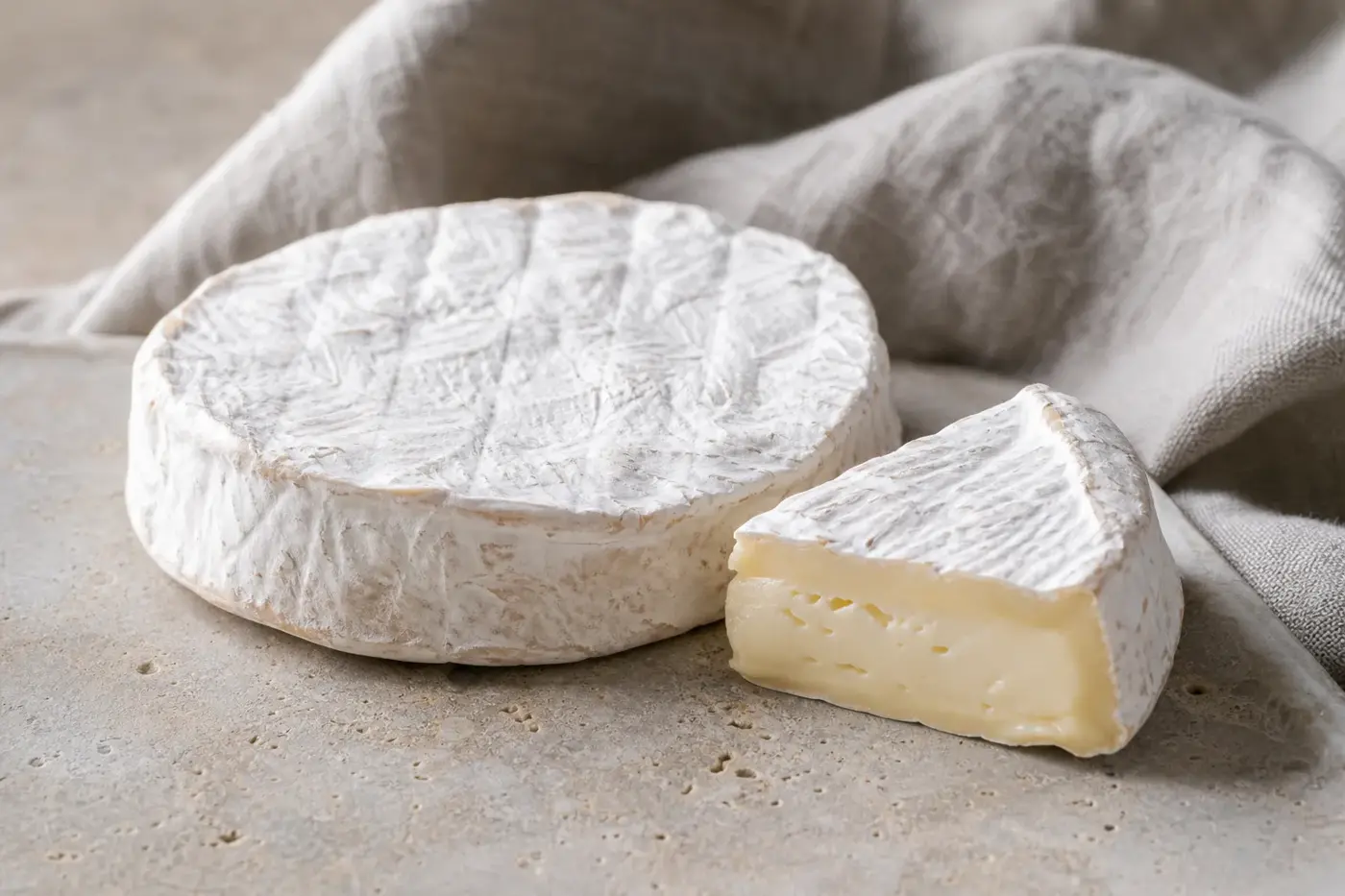
The wheel is broad and relatively shallow, with gently convex sides. Its natural rind carries a fine white to grey-blue bloom, sometimes marbled orange to ivory by ripening yeasts and bacteria. Inside, you find ivory to pale yellow paste, with blue running through small, irregular openings.[1]
Give that cut face a moment of your attention. The openings, pale paste and blue marbling offer more to explore than a solid block of colour. They also give you something specific to discuss at the counter: the designation describes the recognisable cheese, while your slice reveals the particular wheel in front of you.
An amendment published in April 2026 describes a change in the permitted wheel weight. The range moves from 4 to 4.5 kg to 3.8 to 5 kg.[1]
Find the hazelnut and woodland notes
A slight hazelnut taste, woodland undergrowth on the nose and paste that yields readily in your mouth sit at the heart of INAO’s description. Those sensory details come from the institute’s published account.[4] They give you a useful starting point when you take your first bite.
Blue character need not mean blue intensity. Here, the official description allows the mould’s flavour to emerge without sharpness, bitterness or an emphatically salty impression taking over. Try a little pale paste first, then a piece with blue marbling, and notice what changes.[4]
Editorial addition before publication: include a sourced account of how aroma and flavour can change with maturity. Avoid suggesting that older cheese is necessarily better.
Choosing between two wheels? Ask for a sample rather than assuming the older one will suit you. Tell the cheesemonger what matters to you: the strength of the blue, how readily the paste yields and the finish you enjoy.
When the lord of Sassenage collected cheese
Difficult journeys helped shape this cheese. The producers’ interprofessional organisation traces it to medieval farming on the massif. Turning milk into cheese close to the farm was a practical answer to the difficulty of moving it elsewhere.[5]
In the fourteenth century, the lord of Sassenage collected cheese as a tax from the mountain parishes and sold it at Sassenage. Later came the coquetiers. These collectors gathered farm products for shops, Grenoble markets and merchants trading further afield.[5]
The organisation’s history follows farm cheesemaking as it declined with the development of dairy production, then returned. Producers began seeking an appellation in 1993. In the following years, work with a dairy training school and the recollections of older makers helped restore farm production.[5]
Both farm and dairy methods therefore belong to the cheese you find today. This is not simply a tale of an old method making way for a new one. The two strands remain part of its identity.
Let the full name guide you
The protected area governs milk production, cheesemaking and maturation. PDO means protected designation of origin, called AOP in French. For Bleu du Vercors-Sassenage, the current geographical description lists municipalities in Drôme and Isère, some included wholly and others only partly.[1]
Among the named places, you will find Villard-de-Lans, Lans-en-Vercors, Autrans-Méaudre-en-Vercors and La Chapelle-en-Vercors. An address in either department is not enough by itself. The farm or dairy must fall within the designation’s boundaries.[1]
Great Britain has a separate registered entry for the name. Defra records a registered PDO, with UK scheme registration on 31 December 2020 and original EU registration on 16 March 2001.[3]
At the counter, look for the complete designation, not simply Vercors. If you want to untangle geographical names, production specifications and registration, turn to protected names explained.
Meet the cows behind your cheese
Every dairy herd must include at least one Villard de Lans cow. At least 3% of its dairy cows must belong to that local breed. Alongside Villard de Lans, the French production specification permits Montbéliarde and Abondance cattle.[2]
Grazing is compulsory when grass and weather allow. The standing specification requires at least 150 days annually, within a feeding system of grazed grass, hay and wrapped grass forage. A temporary feeding amendment was published in August 2026; its operative provisions and application period are not detailed here.[10]
The milk may be raw or thermised, but farm production uses raw milk exclusively. Thermisation is a heat treatment distinct from pasteurisation, so ask which treatment your chosen producer uses. You can explore the differences in raw, thermised and pasteurised milk.[1]
Watch the cheesemaker make room for blue
Piercing gives the blue mould room to develop inside the cheese. Before that decisive moment, the cheesemaker adds cultures, including Penicillium roqueforti, the mould responsible for the internal blue. Rennet, the coagulating preparation, turns milk into curd. The curd is then cut, stirred and drained before moulding.[2][6]
Vercors Lait describes cutting its curd in two passes, then moulding it and turning the young cheeses by hand. Each face is dry-salted individually. These details belong to the cooperative’s own production method, rather than serving as instructions for every maker.[6]
The cooperative pierces each face to encourage the internal blue. The specification requires piercing and turning during maturation, in rooms at 9 to 14 °C with relative humidity above 90%.[2][6]
Those are controlled cheesemaking conditions, not a guide to your fridge. The minimum maturation period starts at renneting. It does not start when the cheese first enters the cellar.[2]
Farm or dairy? Three questions worth asking
Both farm and dairy production are permitted. The milk distinction is straightforward: farm production must use raw milk, while dairy production may use raw or thermised milk.[1]
At the counter, ask who made the cheese, whether it is farm or dairy production, and which milk treatment the producer declares. Those are three separate questions. One answer does not automatically supply the others.
Farm-made cheese may appeal because it connects you directly with a particular holding. Dairy-made cheese offers another expression of the same designation. Compare the cheeses themselves, their condition and their documented production details. Neither category alone promises your favourite flavour.
Choose your piece, then keep it cool
Start with the complete name, then ask about the maker, milk treatment and maturity. If you are offered a taste, say whether you prefer restrained blue flavour or something more pronounced. Keep the wrapper or label for the cheese’s identity and handling instructions; reading a cheese label explains what to look for.
Refrigerate your cheese according to its packaging instructions. Cut the portion you intend to serve and keep the rest refrigerated. A larger piece only makes sense if it fits the way you plan to eat it.[8]
For more practical help once you get it home, see how to store cheese at home. Keep the packaging instructions to hand.
Make room at the table and in the kitchen
Begin with plain bread, the cheese and a few slices of pear or apple. This suggested first plate gives you room to discover what you enjoy alongside it. Stronger flavours can wait their turn.
Next, try walnut bread or a few walnuts with the fruit. These are possibilities, not fixed rules: your cheese plate does not need a committee. Keep anything sweet separate at first, so you can compare a mouthful with it against one without it.
Vercors Lait recommends wines from the Diois and certain Rhône reds with its cheese.[6] If you are an adult of legal drinking age and choose wine, keep the serving small. Do not drink if you are pregnant, driving, taking medicines that interact with alcohol, or recovering from alcohol dependence.
Water or an alcohol-free apple drink are suggested editorial alternatives. For the principles behind matching a glass to your cheese, explore the broader cheese and wine pairing guide.
In the kitchen, start with Vercouline. INAO describes this local dish as Bleu du Vercors-Sassenage melted over potatoes and accompanied by charcuterie.[4] Vercors Lait also suggests sauces, gratins and savoury baking.[6]
That potato dish makes a useful first experiment. After that, try a little cheese in a vegetable gratin. Taste before deciding how much to add, especially when other ingredients already bring strong flavours.
Invite Roquefort along for a comparison
Set a small piece of Roquefort beside Bleu du Vercors-Sassenage for a contrasting French blue tasting. Try each alone before reaching for bread. Compare the blue aroma, the impression of salt, the texture and how long each flavour lasts.
Editorial replacement before publication: include a sourced comparison of the cheeses. Add a link using the approved Roquefort content ID.
General information only, not medical advice: follow the official guidance where you live.
Questions people ask
What does Vercors blue cheese taste like?
INAO describes a mild blue taste, a slight hazelnut flavour and an aroma of woodland undergrowth. The paste yields readily in the mouth.
Is Vercors blue made with raw milk?
It can be made with raw or thermised cow’s milk. Farm production uses raw milk exclusively.
Where is Vercors blue cheese made?
Milk production, cheesemaking and maturation must take place within specified parts of the Vercors massif in Drôme and Isère, France. Some municipalities are included wholly and others only partly.
How does Vercors blue cheese develop its blue marbling?
The cheesemaker adds cultures including Penicillium roqueforti, the mould responsible for the internal blue. Piercing the cheese allows the mould to develop inside.
What is Vercouline?
INAO describes Vercouline as a local dish of Vercors blue cheese melted over potatoes. It is accompanied by charcuterie.
Sources
[1] European Commission, Publication of the communication of an approved standard amendment to a product specification of a geographical indication, C/2026/2145, 16 April 2026, including the single document for Bleu du Vercors-Sassenage. Official document.
[2] French Ministry of Agriculture, Cahier des charges de l’appellation d’origine « Bleu du Vercors-Sassenage », approved by order of 5 December 2025, published 18 December 2025. Specification.
[3] Department for Environment, Food & Rural Affairs, Bleu du Vercors-Sassenage, protected food name register entry, published 4 January 2021, accessed November 2026. Register entry.
[4] INAO, Bleu du Vercors-Sassenage, product and sensory account, undated, accessed November 2026. Its older wheel-weight summary is superseded by the current specification. Product account.
[5] Bleu du Vercors-Sassenage interprofessional organisation, Une histoire d’hommes, undated, accessed November 2026. An industry account of the cheese’s history. Historical account.
[6] Vercors Lait, Le Bleu du Vercors-Sassenage AOP, product sheet, 2025 file edition. A producer’s commercially interested account of its manufacture, serving suggestions and cooking uses. Product sheet.
[7] Food Standards Agency, How to chill, freeze and defrost food safely, published 18 December 2017, accessed November 2026. Official guidance. The detailed household controls require passage-level verification before publication.
[8] RappelConso, BLEU DU VERCORS SASSENAGE, notice 2021-12-0292, version 1, 17 December 2021. Used only for its refrigeration statement and historical recall identification. Official notice.
[10] INAO, Sécheresse : des modifications temporaires de cahiers des charges accordées par l’INAO, 2026. Lists the order of 21 August 2026, published 27 August 2026, concerning this designation. Official announcement. The operative order was not retrieved.
Researched through official specification and designation documents, attributed industry history and a producer’s published technical account; no visit or tasting was undertaken.
Last checked: November 2026
Last checked November 2026.
The editors suggest you read next