Cacio e Pepe
Black pepper warms in the pan, and its fragrance tells you dinner is getting close.
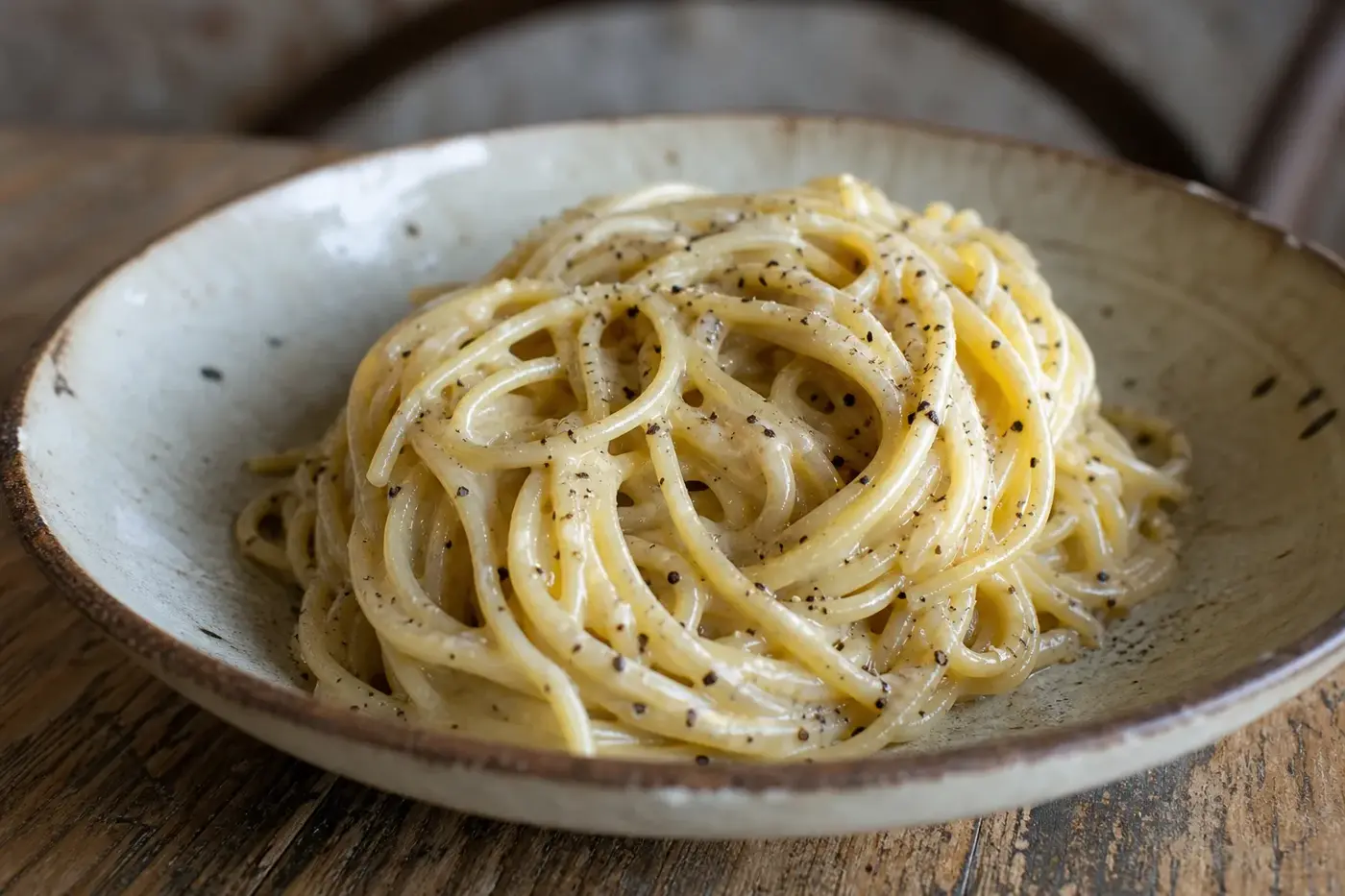
Black pepper warms in the pan, and its fragrance tells you dinner is getting close. Finely grated Pecorino Romano waits in the bowl. Add pasta and its cooking water, and one of Rome’s characteristic dishes is within reach: a silky sauce that rewards attention, not a vigorous boil. Bring it together away from the burner, giving the cheese a chance to coat your pasta rather than form a committee of clumps. [1][2]
That cloudy pasta water has a job to do
Before you tip away the cooking water, save some. Its starch helps keep your cheese sauce together. In a 2025 experimental study, researchers heated mixtures of cheese, water and starch, then photographed the aggregates that formed. More starch pushed clumping towards higher temperatures and reduced the size of those aggregates. [2]
Here is why that matters at your hob: cheese proteins gather into clumps when the mixture gets too hot. Temperature and concentration work together, so a spoonful of cloudy water helps, although its starch content varies with your pasta and cooking conditions. Reserve the water, grate the cheese finely and combine everything off the heat. The research explains why; the published recipes below show you how. [2][3][4]
A Roman favourite with an elusive beginning
In Rome, cacio e pepe belongs at the table. The city’s municipal tourism service lists it among Rome’s characteristic pasta dishes, with a recipe of spaghetti, Pecorino Romano, black pepper and cooking water. The local Pro Loco association places it firmly within Roman cooking too, describing a rural background and a connection with tonnarelli. [1][5]
Then come the travelling shepherds. The familiar story of shepherds carrying durable cheese, pepper and pasta appears in modern writing, including the introduction to the sauce research. It gives the dish a pastoral origin story, but does not establish when those ingredients first became this particular dish. [2]
A longstanding combination is not quite the same thing as a dated recipe. These contemporary accounts document the dish’s Roman identity, while a precise inventor or first appearance remains unestablished. You can enjoy that connection with Rome without asking your bowl for a birth certificate. [1][5]
Get to know the Pecorino in your bowl
Pecorino Romano brings the concentrated cheese flavour. Under the Italian production specification, it is a hard, cooked-curd cheese made exclusively from fresh whole sheep’s milk. Its production and maturation territory reaches beyond Rome, taking in Sardinia, Lazio and the province of Grosseto. [6]
After extended maturation, the specification describes the grating cheese’s flavour as intense and piquant. Its salting process, savoury character and firm texture make it well suited to pepper and pasta water. It gives your sauce both body and much of its seasoning, so taste the finished pasta before reaching for salt. [3][6]
Pecorino Romano has an EU protected designation of origin, or PDO. The European Commission published an approved specification amendment in September 2026. When you shop, look for this named cheese rather than treating it as interchangeable with a generic hard grating cheese. [7]
Pick your pasta and leave room to concentrate
Spaghetti is a straightforward place to start: Rome’s tourism recipe uses 400 g for four people. Tonnarelli is another established choice, linked to the dish by Pro Loco Roma. Municipal guidance also records rigatoni and egg pasta such as tagliolini or spaghetti alla chitarra. [1][5]
For your first attempt, dried spaghetti keeps things simple. Follow the packet cooking time and give your attention to the sauce, without the extra variable of handling fresh pasta. If tossing long strands feels awkward, rigatoni offers an accessible alternative from the same published guidance. [1]
Using fresh pasta? Follow its own packet instructions, not the timing for dried spaghetti. Wheat pasta contains gluten, Pecorino Romano contains milk, and egg pasta also contains egg. Check every ingredient label and any cross contact warning, including those on substitutes.
Bring cacio e pepe to the table for four
Recipe status: adapted from Rome’s municipal recipe, with pepper preparation and fine-grating guidance from published cookery sources. [1][3][4]
Serves: four
Preparation: allow about 5 minutes
Cooking: allow about 15 minutes, depending on the pasta and water heating
Equipment: saucepan, wide mixing bowl, fine grater, tongs, ladle, heatproof jug, small frying pan and pepper mill or mortar
Oven: not used. [3]
Get everything ready before the spaghetti goes in
- 400 g dried spaghetti, approximately 14 oz. [1]
- 100 g Pecorino Romano, approximately 3½ oz, finely grated. [1]
- 1½ teaspoons freshly ground black pepper, approximately 3 g, adjusted to taste. [3]
- Water for cooking your pasta.
- Salt for the cooking water, used sparingly. [3]
- Reserved pasta cooking water, added gradually as needed. [1]
Grate your cheese before you start cooking the pasta. Aim for small, even particles rather than long shreds, and put them straight into the mixing bowl. Set out your jug and tongs too, ready for the moment the pasta needs draining. Fine grating and keeping cooking water close by recur throughout the published methods. [3][4]
Make the sauce away from the heat
-
Get your spaghetti cooking. Bring the cooking water to the boil, salt lightly and add the spaghetti. Stir to separate the strands. Follow the packet timing until al dente: cooked through, with some firmness remaining. [1][3]
-
Let the pepper become fragrant. Freshly grind or crush it, then warm it briefly in a dry frying pan, moving it around until fragrant. The source method allows about a minute. Remove promptly from the heat, keeping the pepper moving rather than leaving it against one hot patch. [3]
-
Save your cooking water. Before draining, ladle some into your heatproof jug and keep it beside the mixing bowl. The municipal method begins with a ladleful, then adds more as needed. You are adjusting the coating, not aiming for a fixed final volume of sauce. [1]
-
Move away from the burner. Lift the cooked spaghetti into the mixing bowl with the cheese and pepper. Work away from the hob. Using a separate bowl means you are not relying on a frying pan’s residual heat to provide a controlled sauce temperature. [1][4]
-
Toss, stir and watch the texture. Add a little reserved water and immediately toss and stir. Add more gradually, working the strands through the cheese until the mixture coats them. Pause to look between additions rather than emptying the jug into the bowl at once. [1][4]
-
Take it straight to the table. Divide between warm bowls and finish with more freshly ground pepper if you fancy it. Taste the coated pasta before making any final seasoning adjustment. Serve immediately. [1][3]
Follow the pepper’s fragrance, not its colour
Your nose is the useful guide here. Stop warming the pepper when it smells fragrant, rather than waiting for visible darkening. The published dry-pan method toasts ground pepper for about a minute. Treat that as a guide, and have it ready before the pasta needs your full attention. [3]
Fresh crushing lets you choose the texture, too. Rome’s municipal recipe specifically recommends a mortar. Aim for fine particles with a few small fragments for an even coating, rather than large pieces that dominate a mouthful. If tastes around your table differ, let everyone add their final pepper at the table. [1]
Give your Pecorino a gentle landing
Taking a pan off the burner does not instantly cool its contents. One published cookery method advises removing the pan completely if overheating threatens the cheese. Another adds Pecorino Romano only after the pan has been removed from the heat. [3][8]
With this bowl method, keep the bubbling cooking water separate. Add it in small amounts while you mix, looking for a coating that moves with the pasta. If you see watery liquid beneath the strands and cheese stuck together above, the mixture has not yet come together. [1][4]
The research makes the heat problem clear. A mixture of cheese and water without starch showed substantial aggregation around 65 °C (149 °F). Different starch and cheese concentrations change how the mixture behaves. Even so, that result gives you good reason to handle the heat gently. [2]
A little help when the sauce misbehaves
Thick coating or sticking strands? Add water slowly
Add a small splash of reserved water, then toss before deciding whether you need more. Published methods repeatedly use gradual additions to adjust consistency. Work the water through the whole bowl, rather than just wetting the surface, so you loosen the coating evenly. [1][4]
Watery sauce? Give your tossing a moment
Stop adding water and keep tossing. The Cook’s Illustrated method published by the James Beard Foundation allows a brief rest while tossing so the sauce can thicken. That recipe also contains cream and oil, so treat the observation cautiously when you are working with this different formulation. [4]
Firm cheese clumps? Leave the heat alone
Stop applying heat and try working a little water through the mixture away from the burner. The experimental work shows that heating can create large protein aggregates, so more boiling takes you in the wrong direction. Firm clumps may remain. Concentrate on preventing further overheating rather than forcing a complete reversal. [2][3]
Too salty? Change course before adding anything else
Do not add more cheese or salted cooking water. Plain water can loosen the coating, although dilution changes its consistency too. For a badly oversalted batch, one practical option is separately cooked, unsalted pasta, accepting a larger quantity and a lighter cheese coating. Better still, salt the cooking water modestly and leave your final seasoning decision until after tasting. [3]
Cooking for vegetarians? Look at the rennet first
Pecorino Romano’s specification requires lamb rennet, the enzyme preparation that sets the milk. That means it does not suit a vegetarian version of this recipe. The deciding factor is the coagulant, not whether the milk comes from sheep or cows. [6]
Choose a hard grating cheese explicitly labelled suitable for vegetarians, checking the product rather than trusting a cheese-style name. Start with the same cheese weight and adjust the water gradually as you mix. A moister cheese may need less water; a less salty one may need more final seasoning. Expect a different flavour from Pecorino Romano.
For more on that choice, the rennet guide explains animal, microbial and fermentation-produced coagulants. You can use the cheese label guide to check your substitute’s ingredients and declarations.
Set your table before that final toss
Warm bowls and immediate serving are part of the municipal recipe. Set your table before the pasta finishes, leaving a clear path from mixing to eating. Once the coating comes together, this is not a dish that enjoys waiting while you look for the forks. [1]
Keep any accompaniment simple: perhaps a plain green salad with a restrained dressing, leaving cheese and pepper at the centre of your meal. Still or sparkling water avoids introducing another strong flavour. These are serving suggestions, not elements of the published recipe.
For broader pairing principles and alcohol-free alternatives, explore cheese and wine pairing.
This page summarises published guidance from the official sources it cites. It is not medical advice. Guidance differs between countries and changes over time, so check the current source for where you live, and ask your doctor, midwife, pharmacist or dietitian about your own circumstances.
Keep leftovers safe, even if the silkiness goes
For home food handling in England, Northern Ireland and Wales, the UK Food Standards Agency advises cooling cooked food quickly, dividing it into smaller portions if needed. Refrigerate it ideally within one to two hours, and keep your fridge between 0 and 5 °C (32 and 41 °F). Eat refrigerated leftovers within 48 hours or freeze them. This guidance is dated November 2026. [9][10]
When reheating, add a little water to loosen the pasta and stir frequently. The FSA advises reheating leftovers only once, until steaming hot throughout, not merely warm. Reach that point even if your cheese coating loses some smoothness. If you use a microwave, follow the appliance’s stirring and standing instructions too. [10]
The original technique away from the heat and reheating have different jobs. One controls your freshly made cheese coating; the other follows official food-handling guidance for leftovers. For the wider reference, see cheese food safety.
Questions people ask
What ingredients are in cacio e pepe?
Rome’s municipal recipe uses spaghetti, Pecorino Romano, black pepper and cooking water. Its recipe uses 400 g of spaghetti and 100 g of Pecorino Romano for four people.
Why does cacio e pepe cheese clump?
Cheese proteins gather into clumps when the mixture becomes too hot. Starch helps keep the sauce together, so the page recommends finely grating the cheese and mixing it with reserved pasta water away from the heat.
What pasta can I use for cacio e pepe?
Rome’s tourism recipe uses spaghetti, while Pro Loco Roma associates the dish with tonnarelli. Municipal guidance also records rigatoni and egg pasta such as tagliolini or spaghetti alla chitarra.
Is cacio e pepe vegetarian?
Pecorino Romano does not suit a vegetarian version because its specification requires lamb rennet. The page suggests choosing a hard grating cheese explicitly labelled suitable for vegetarians.
How should I store and reheat cacio e pepe leftovers?
For home food handling in England, Northern Ireland and Wales, the UK Food Standards Agency advises cooling cooked food quickly and refrigerating it ideally within one to two hours. It advises eating refrigerated leftovers within 48 hours or freezing them, and reheating leftovers only once until steaming hot throughout. See the Food Standards Agency’s current guidance.
Sources
[1] Roma Capitale, Turismo Roma. Spaghetti with cacio cheese and pepper. Undated web edition, retrieved November 2026. Recipe, four-person quantities, bowl method, pasta alternatives and serving instructions. Official recipe.
[2] Physics of Fluids. Phase behavior of Cacio e Pepe sauce. Volume 37, article 044122, published 29 April 2025. Experimental sections II and III and recipe discussion in section VI. Published paper.
[3] Laura in the Kitchen. Cacio e Pepe. Recipe 1489, undated printable edition, retrieved November 2026. Commercial cookery publisher; cited for its own method. Recipe document.
[4] James Beard Foundation. Cacio e Pepe. Excerpt from Cook’s Science, 2016, web edition retrieved November 2026. Fine grating, bowl mixing, water adjustment and resting technique. Published recipe.
[5] Pro Loco di Roma. Primi piatti romani. Undated web edition, retrieved November 2026. Contemporary local account of Roman culinary traditions. Local association account.
[6] Italian Ministry of Agriculture, Food Sovereignty and Forestry. Disciplinare di Produzione della DOP Pecorino Romano. Ministry-hosted specification, retrieved November 2026; file carries no visible revision date. Articles 1 and 2. Specification.
[7] European Commission. Publication of the communication of an approved standard amendment to a product specification of a geographical indication in accordance with Article 5(4) of Commission Delegated Regulation (EU) 2025/27. C/2026/4125, published 2 September 2026. Official Journal document.
[8] Bon Appétit. Cacio e Pepe. Updated 18 March 2026. Commercial cookery publisher; cited for its own off-heat cheese addition. Published method.
[9] Food Standards Agency. How to chill, freeze and defrost food safely. Published 18 December 2017, current retrieved edition, November 2026. Applies to England, Northern Ireland and Wales. Official guidance.
[10] Food Standards Agency. Cooking your food. Current retrieved edition, November 2026, sections 7.1 and 7.2. Official guidance.
This piece combines desk research into published recipes, experimental sauce research, official cheese documents and food-handling guidance.
Last checked: November 2026
Last checked November 2026.
The editors suggest you read next