Caciocavallo Silano
Look up: pairs of cheeses hang over poles, their smooth bodies held by cords.
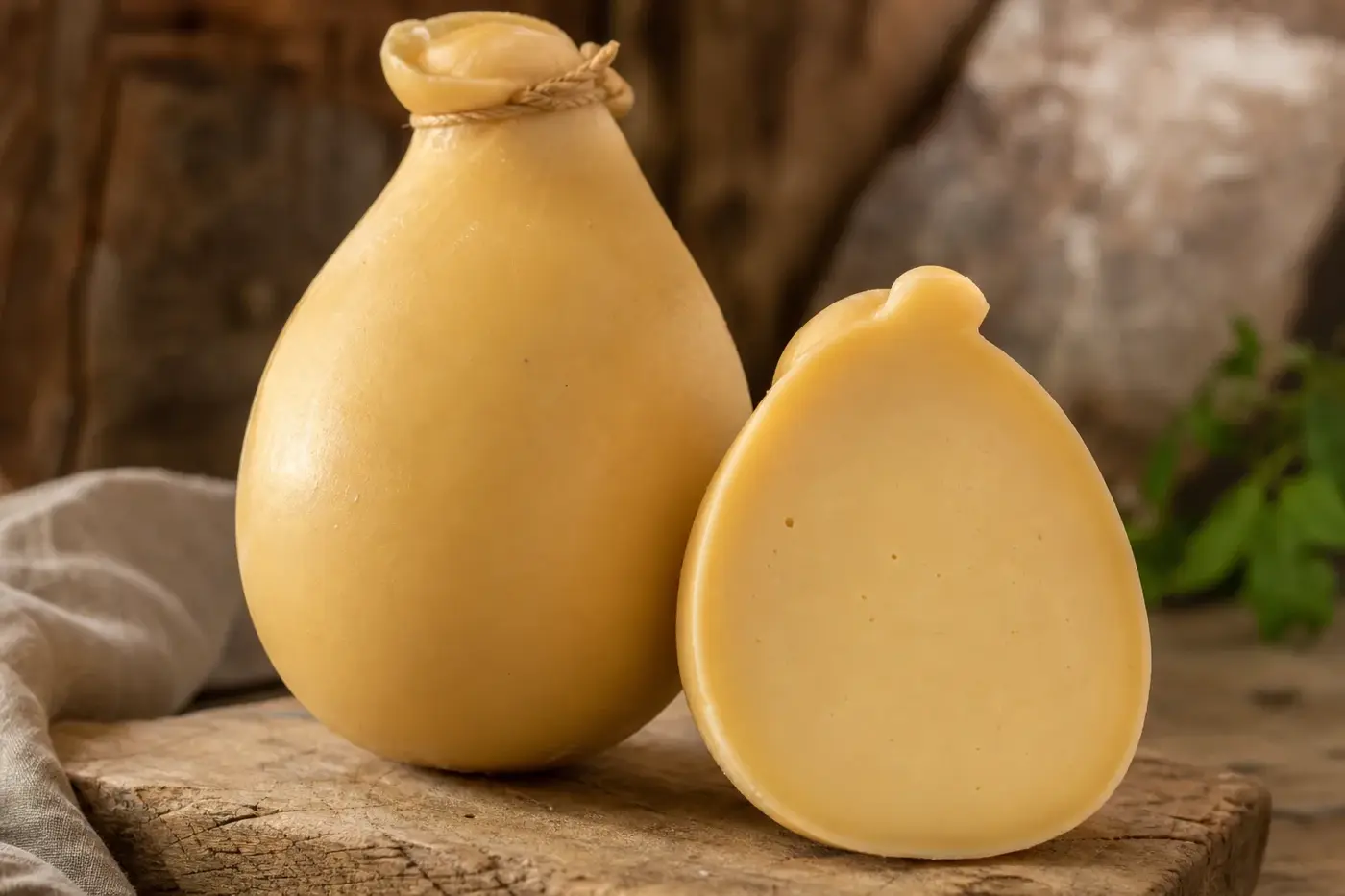
Look up: pairs of cheeses hang over poles, their smooth bodies held by cords. Before you see that silhouette, cow’s milk curd has been stretched into a smooth cord and shaped by hand. The tied neck is doing rather more than looking distinguished.
Get to know Caciocavallo Silano
| What you want to know | The detail |
|---|---|
| Familiar and registered name | Caciocavallo Silano.[1,2] |
| EU authority and document reference | European Commission; amendment reference PDO-IT-0003-AM01, dated 25 January 2024. Current register ID: unspecified.[2] |
| EU protection | PDO documented in the official publication of 12 April 2024. Current register status: unspecified.[2] |
| Great Britain protection | Registered PDO; scheme registration 31 December 2020. Reference date: November 2026.[3] |
| Milk permitted | Cow’s milk, raw or thermised up to 58 °C (136 °F) for 30 seconds at the dairy.[1] |
| Coagulant permitted | Calf or kid rennet paste.[1] |
| Cultures | Natural whey starter prepared at the dairy is permitted.[1] |
| Minimum maturation | 30 days.[2] |
| Longer-aged choices | Extra: at least 4 months. Gran Riserva: at least 9 months.[2] |
| Fat requirement | At least 38% fat in dry matter.[2] |
| Weight | Unspecified. |
Follow the cheese into southern Italy
Silano points you towards Calabria’s Sila plateau. The authorised production area, though, reaches across five southern Italian regions. It follows a detailed list of municipalities, rather than taking in those regions whole. Milk production, cheesemaking and maturation must all happen within that defined area.[1,2]
| Region | Places included in the authorised area |
|---|---|
| Calabria | San Giovanni in Fiore and Spezzano della Sila |
| Campania | Montella and Agerola |
| Molise | The whole province of Isernia; specified municipalities in Campobasso province |
| Puglia | Noci and Martina Franca |
| Basilicata | Matera and Potenza |
These examples come from Article 3 of the Italian specification. For eligibility, it is the full municipal list that counts, not this shortlist.[1]
DOP protection ties the name to documented origin and prescribed production requirements. Production records and registered operators subject to checks give you a traceable route through the supply chain.[1] To see how origin protection differs from other schemes, visit protected names explained.
Look closely at that tied neck
You may recognise an oval or pear-like cheese, with a small head above its tied neck. Calabria offers a different silhouette: the consortium describes truncated-cone shapes without a head as customary there. Elsewhere, oval forms with a head are used.[4]
The rind is thin, smooth and straw-yellow, sometimes bearing marks from the cords. Cut inside and you find a compact, nearly closed paste, the cheesemaker’s word for the interior, with only slight openings. The consortium describes a deeper straw colour towards the outside.[5]
Give those cords a second look. They belong to the cheese’s maturation, rather than simply its packaging. There is a practical reason for the arrangement you see.[5]
Watch the curd find its stretch
First, liquid milk must become a gel. The cheesemaker adds rennet, the enzyme preparation that sets it, at 36 to 38 °C. Once firm enough, the curd is cut into pieces approximately the size of hazelnuts.[1,6]
Then the cheesemaker waits for lactic fermentation to develop the acidity needed for stretching. The technical account held by the University of Turin describes this curd maturation as generally taking 4 to 10 hours. Depending on the milk and conditions, it sometimes takes longer.[6]
Small samples go into hot water. The cheesemaker is looking for a continuous, elastic strand, rather than curd that breaks apart. This is pasta filata, meaning stretched curd. If you know mozzarella, you have already met another member of this cheesemaking family.[6,7]
The ready curd is stretched, gathered into a cord and worked into its final outline. Hand movements compress the interior and smooth the surface before the top is closed. That shaping gives you both the recognisable silhouette and the compact body.[1,6]
Into the brine, then up onto the poles
After shaping, the cheeses cool in water before going into brine. Salting lasts at least six hours, with the duration adjusted to the cheese’s weight. Then they are tied in pairs and suspended over poles to mature.[6]
The minimum maturation is 30 days. If you want a longer-aged cheese, the specification offers two optional descriptions: Extra after at least four months and Gran Riserva after at least nine months.[2]
At the counter, ask for the actual age as well as the name. A cheese just past its minimum maturation and one kept for several months offer different experiences. Those extra words on the label can help you choose what suits you.[2,7]
Find your flavour, from delicate to assertive
Young Caciocavallo Silano is sweet and delicate, according to the consortium. As it matures, it becomes increasingly piquant. Think more assertive and pungent, rather than added chilli or another seasoning.[4]
Producer Caseificio Paese describes its younger cheese as firm and smooth, with a mild, slightly salty flavour. Ageing, it says, brings stronger flavour and a more granular texture suited to grating. Take these as the producer’s descriptions when choosing your piece.[7]
Caseificio Di Pasquo also describes a harder texture developing with age. Its account adds savoury, meaty notes and hints of almond.[8] Your choice starts with a simple question: do you want clean slices to eat, or something more assertive to grate?
A name with a story, and a little mystery
Picture those paired cheeses sitting astride a beam. The consortium cautiously suggests that caciocavallo probably comes from this arrangement, described as a cavallo. It fits a documented production practice still used for the cheese.[4]
Another possibility comes from Caseificio Paese. It records a hypothesis connecting the name with mare’s milk, presenting it as a possibility rather than a documented origin.[7] Neither explanation establishes where the name began.
Silano gives you a more direct connection: the Sila. The specification’s historical account places the cheese within the pastoral traditions of that Calabrian plateau.[1]
Look beyond the family resemblance
Caciocavallo is a broader name than Caciocavallo Silano DOP. In Caseificio Paese’s range, for instance, fresh caciocavallo and caciocavallo podolico appear separately from its Caciocavallo Silano PDO.[7]
Provolone belongs in the same stretched-curd conversation, but it is a different cheese name. The shared method explains the family resemblance. It does not make the names interchangeable.[7]
When you shop, start with the complete name on the label, not the outline alone. A tied neck tells you about form and handling. The Caciocavallo Silano name, identification and accompanying label provide the evidence of the specified product.[2,5]
Make the cheese counter work for you
Buying a whole cheese? Look for the product’s heat-stamped logo and producer identification number. The specification also requires identifying information on the label, including the EU symbol, operator details and a serial number.[2,5]
For a cut portion, keep the labelled packaging or ask your cheesemonger to identify the original cheese. That is particularly useful when several similar-looking stretched-curd cheeses share the counter.
Then let your plans guide the age. As an editorial recommendation, start younger for an antipasto plate and explore longer maturation for a stronger finishing cheese. Ask about age and producer rather than trying to read maturity from rind colour alone.[4,7]
From your fridge to the table
Follow the storage instructions supplied with your particular cheese. For household refrigeration in England, Wales and Northern Ireland, the Food Standards Agency advises keeping the fridge at 5 °C (41 °F) or below and refrigerating dairy products. Use a fridge thermometer to check the temperature.[9]
Cut only what you expect to eat and return the rest to refrigeration. Consult the current FSA guidance for England, Wales and Northern Ireland on keeping chilled food out of refrigeration.[9]
Keep that limit in mind if your cheeseboard stays on the table through a long meal. For the wider handling routine, see storing cheese at home.
Give it company, not competition
Start with a plain piece. Tempting as it is to assemble an entire supporting cast, let the cheese have the first word. Then decide how much contrast you want from everything alongside it.
These editorial suggestions follow the younger cheese’s reported delicacy and the stronger character that develops with age.[4,7] Use them as starting points for your own plate.
| Your cheese | Try it with | Why it could suit |
|---|---|---|
| Younger | Plain bread and ripe pear | A restrained starting point for the delicate character described by the consortium |
| More mature | Bread, walnuts and a little pear | A firmer accompaniment to the stronger cheese described by Paese |
| Younger | Still or sparkling water | A neutral drink alongside the delicate cheese |
| More mature | Unsweetened black tea | An editorial suggestion alongside the more assertive flavour |
Treat these pairings as editorial judgements based on the cited flavour descriptions. Your first plain bite gives you a starting point for choosing what belongs beside your particular piece.
For a broader approach to matching intensity and accompaniments, see cheese and wine pairing.
Let its age guide your cooking
The consortium describes Caciocavallo Silano as suitable for eating both uncooked and cooked. Paese specifically recommends older cheese for grating.[4,7] That gives you two useful directions, rather than one compulsory recipe.
As editorial cooking suggestions, try younger cheese in a toasted bread filling, scattered through baked pasta or layered with cooked vegetables. Grate a more mature piece over pasta or vegetable dishes when you want its stronger character to remain noticeable.
Taste before seasoning the dish. Decide whether you want the cheese to lead or support another ingredient. Treat these as cooking ideas, and let the age and character of the piece you buy guide your choice.
General information only, not medical advice: follow the official guidance where you live.
Sources
- Italian Ministry of Agriculture, Food Sovereignty and Forestry, Disciplinare di produzione della Denominazione d’Origine Protetta “Caciocavallo Silano”, January 2024 version, Articles 2 to 6. Official specification.
- European Commission, Publication of an approved standard amendment to a product specification of a protected designation of origin or protected geographical indication in the agricultural products and foodstuffs sector, C/2024/2490, published 12 April 2024, including the Caciocavallo Silano single document. Official publication.
- Department for Environment, Food & Rural Affairs, Caciocavallo Silano, Great Britain protected food names register entry, published 4 January 2021, accessed November 2026. Register entry.
- Consorzio di Tutela Formaggio Caciocavallo Silano, Il Caciocavallo, undated industry-body account, accessed November 2026. Product account.
- Consorzio di Tutela Formaggio Caciocavallo Silano, homepage sections on rind, paste and identification, undated, accessed November 2026. Consortium website.
- University of Turin institutional repository, manuscript containing the Caciocavallo Silano entry in Chapter PDO Cheeses final, undated repository copy, production paragraphs. Repository manuscript.
- Caseificio Artigianale Paese, Caciocavallo Silano PDO, undated producer account, accessed November 2026. Commercial producer’s descriptions and recorded name hypotheses. Producer account.
- Caseificio Di Pasquo, Caciocavallo Silano DOP, undated producer account, accessed November 2026. Used for attributed sensory descriptions only. Producer account.
- Food Standards Agency, How to chill, freeze and defrost food safely, current retrieved guidance, accessed November 2026. Official guidance.
Researched through official specification and register material, supported by attributed consortium, producer and technical accounts; serving and cooking suggestions are desk-researched editorial judgements.
Last checked: November 2026
Last checked November 2026.
The editors suggest you read next
Parmigiano Reggiano
Break into a wheel of Parmigiano Reggiano and flakes fall away, revealing a finely granular cheese, pale straw to straw in colour.