Exmoor Blue Cheese
A piece of bread, a buttery yellow paste, a thread of blue.
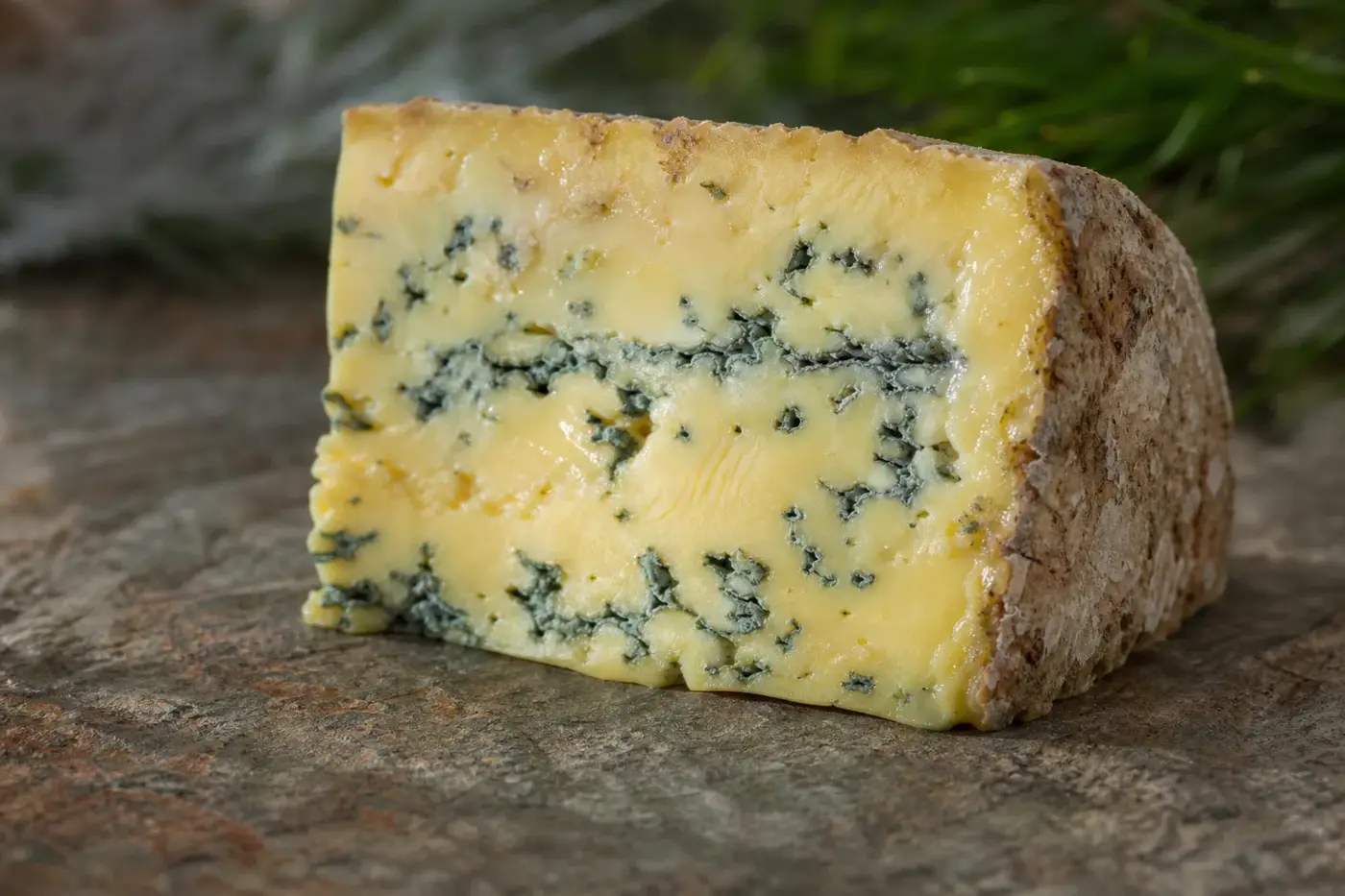
A piece of bread, a buttery yellow paste, a thread of blue. Exmoor Blue makes an inviting picture before you have taken a bite. Its registered specification describes a cheese made from unpasteurised Jersey cows’ milk, named for the Devon and Somerset country around Exmoor. Its documented home was Willett Farm at Lydeard St Lawrence, near Taunton.[1][2]
| What you might want to know | The details to hand |
|---|---|
| Familiar and registered name | Exmoor Blue Cheese.[1] |
| Great Britain protection | Registered PGI; status recorded November 2026. UK scheme registration: 31 December 2020 at 23:00.[1] |
| Original EU registration | 28 April 1999, under Commission Regulation (EC) No 872/1999.[1][2] |
| Current EU register status and identifier | Current details unavailable here. |
| Documented production location | Willett Farm, Lydeard St Lawrence, Somerset.[2] |
| Current producer and availability | Current details unavailable here. |
| Milk in the specification | Unpasteurised Jersey cows’ milk.[2] |
| Rennet in the recipe | Vegetarian rennet.[2] |
| Ripening organisms specified | Penicillium roqueforti internally; Penicillium candidum applied to the surface.[2] |
| Time in the maturing room | Three to six weeks, with regular turning.[2] |
| Current whole-cheese dimensions and weight | Current details unavailable here. |
Come for the blue, notice the butteriness
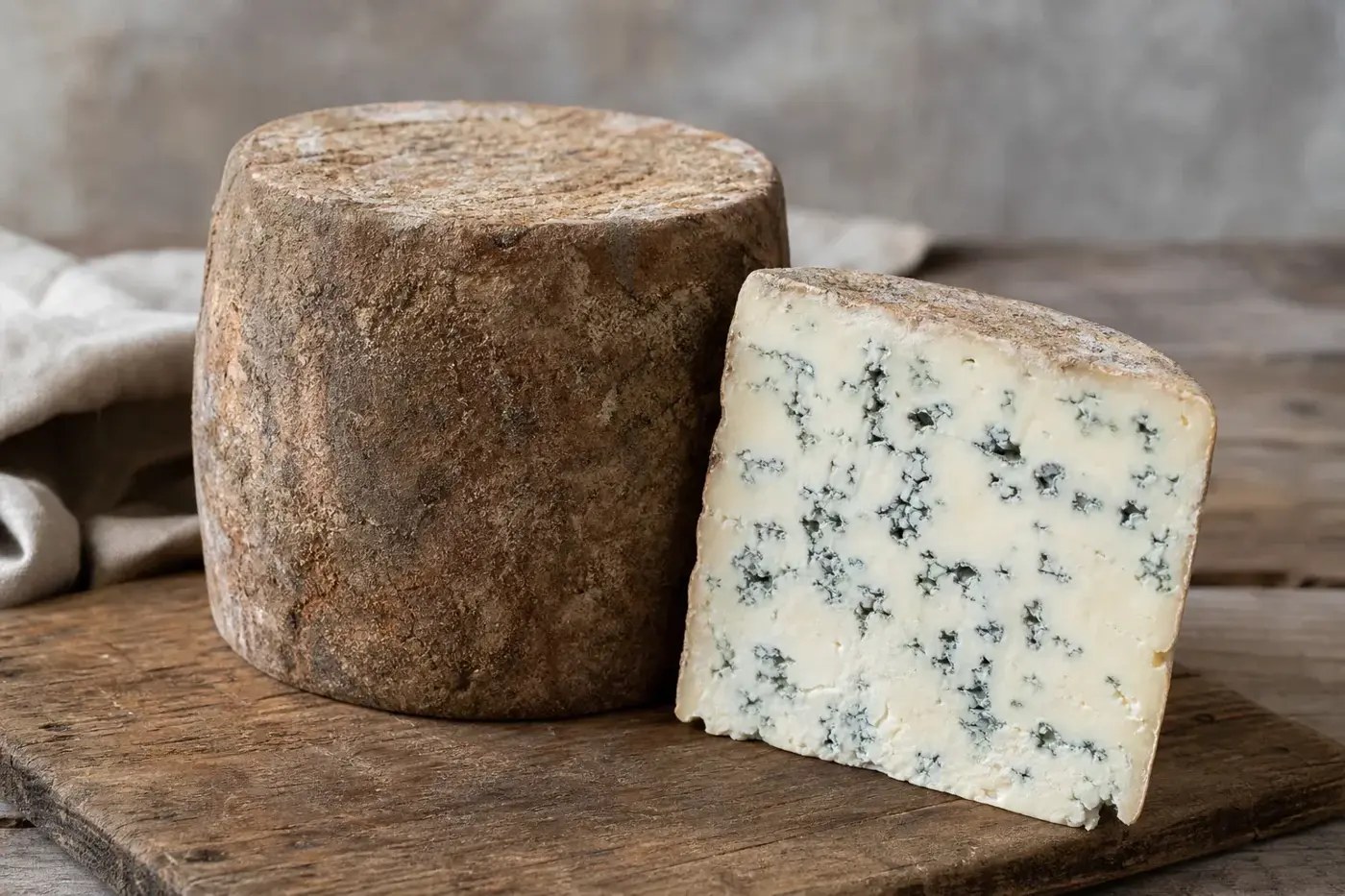
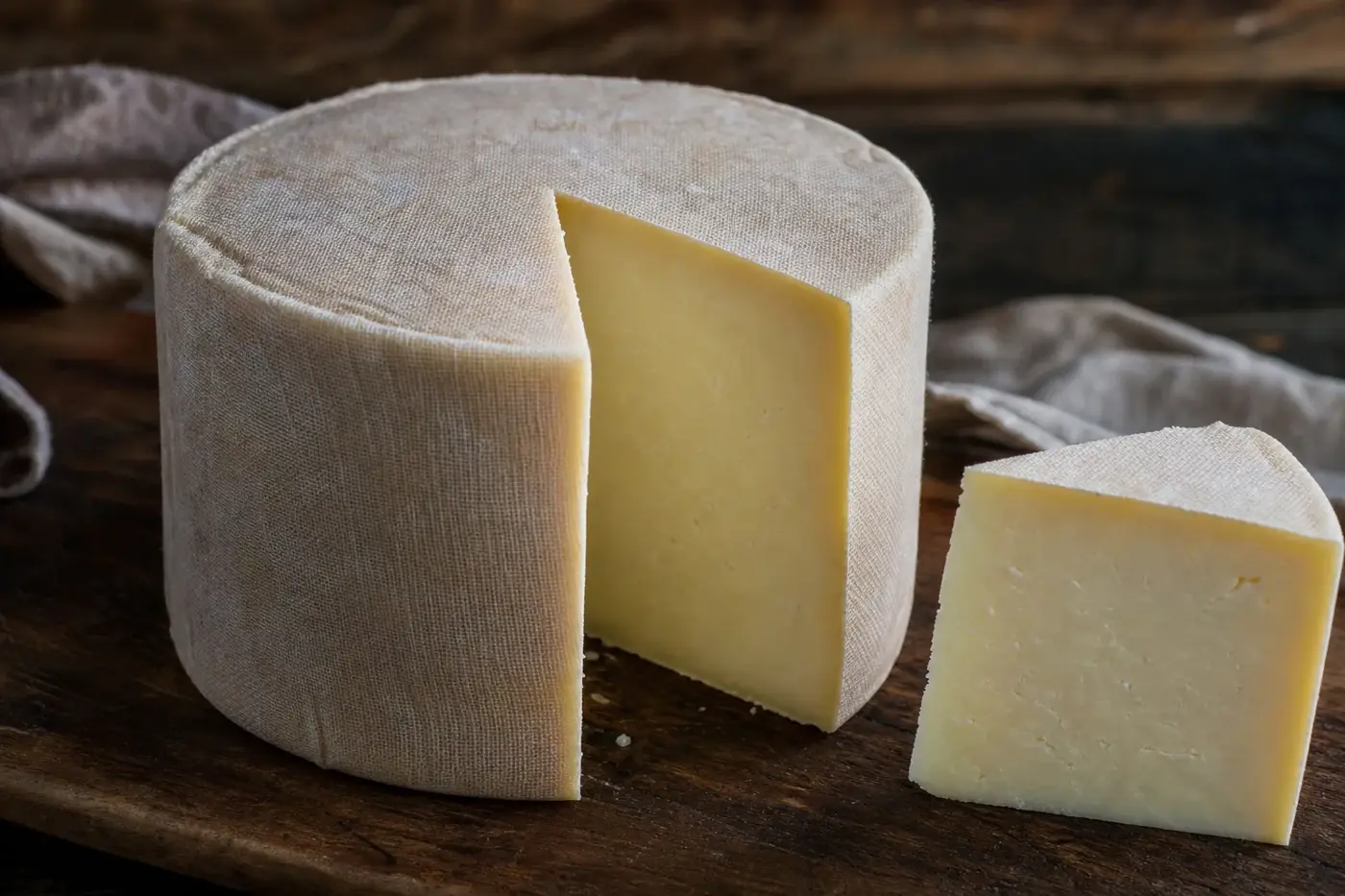
Before you taste anything, notice the contrast: blue veins against a yellow body. The official description calls Exmoor Blue a full-fat, blue-veined soft cheese, highlighting its yellow colour and buttery texture. Cheese.com, a secondary cheese reference, adds tangy flavour and a natural rind to that picture.[2][5]
Those descriptions give you a starting point at the table. Try something crisp or crusty beneath the soft paste, with fresh fruit alongside the blue tang. These suggestions draw on the published descriptions; they are not a fromage.co.uk tasting.
Keep that word “soft” in mind when you serve it. Think of a piece to spread or place on bread, rather than the neat crumbs you might expect from some other British blues. For more on texture, rind and manufacture, explore how to tell cheese styles apart.
At the counter, ask whether the paste is yielding or firmer, how developed the blue character is, and when the cheese was made. Those answers tell you more about your piece than “Is it strong?” Cheese deserves a slightly more searching interview than a mustard.
Follow the name through Exmoor country
Trace the registered area and you follow the coast from Barnstaple to Watchet, then turn inland along railway and road boundaries. This is a particular part of Devon and Somerset. It does not simply borrow the boundary of Exmoor National Park.[2]
Warm, wet weather, sandstone-derived soils and a long grazing season underpin the registration’s geographical story. The specification credits the pasture supported by those conditions with shaping the milk’s character. That is its account of the landscape’s influence, not a measured comparison of milk from different landscapes.[3]
A place-name opens a conversation, but it cannot answer everything. Where was the cheese made, what area does its name describe, and where did this batch’s milk originate? If milk provenance matters to you, ask the seller to identify the supplying dairy.
The history takes you into the modern development of British regional cheesemaking. The registration records hand production on the applicant’s farm from 1986. From 1990, the milk was exclusively Jersey.[3]
Willett Farm, and the search for a piece
Willett Farm appears as the applicant’s address in the official registration. You will also find it in a separate Companies House record for Exmoor Blue Cheese Limited, company number 04554839. That company was dissolved on 18 April 2017.[2][4]
The records tell different parts of the story. The specification preserves the documented cheesemaking method and historical production address; Companies House records the legal company’s dissolution. Neither gives you a current producer or confirms present retail availability.
If you spot Exmoor Blue for sale, ask for a photograph of the current label and confirmation of the producer before arranging a purchase. An undated cheese-directory entry may offer a lead, but it is not enough for your buying decision. Look for a current label, batch identification and the seller’s account of who supplies it.
Read the full name, milk treatment, storage instructions and date marking together. Each tells you something useful about the cheese in front of you. The guide to reading a cheese label explains how those details fit together and what to look for on the product itself.
Jersey milk meets vegetarian rennet
The documented recipe calls for unpasteurised Jersey cows’ milk and vegetarian rennet. Rennet is the milk-clotting ingredient that forms the curd. It occupies very little space in the recipe, but has a substantial job to do.[2]
If you choose cheese on vegetarian grounds, the specified rennet is useful information. Ask the seller to confirm the current product’s vegetarian declaration, along with its producer and batch details. That connects the recorded recipe to the cheese you actually intend to eat.
Milk treatment and rennet answer different questions. “Unpasteurised” describes how the milk has been treated; “vegetarian rennet” identifies the coagulant. Neither stands in for the other, so consider both where they matter to your choice, and turn to rennet explained for more on the clotting ingredient and its role.
A little piercing, a lot of patience
The blue story begins while the cheese is being made. In the recorded method, the milk is warmed and starter culture added, followed by rennet and Penicillium roqueforti, the blue mould. The curd is then cut, transferred into moulds and left to drain.[2]
Next come turning, brining and another draining. The cheeses are pierced by hand through both faces. Once they reach the maturing room, their surfaces receive Penicillium candidum.[3]
Those pierced openings have a purpose. The Stilton Cheesemakers’ Association likewise describes adding blue mould at the curd-forming stage, then piercing later to help the blue develop. The culture supplies the organism; the openings help create the conditions for visible growth.[6]
Blue cheese, then, is not simply white cheese with mould stirred through it. Curd management, drainage and ripening are connected, each stage shaping the next. That helps explain why adding culture and piercing are separate operations; for the earlier journey from milk to curd and whey, see how cheese is made.
Get to know the centre and the rind
Exmoor Blue’s recorded ripening brings together blue development inside and deliberate treatment of the surface. The specification allows three to six weeks in the maturing room. During that time, the cheeses are turned every other day.[3]
That range belongs to the registered method; it does not tell you the age of any particular piece. Ask the maker or seller how old yours is. They are also the people to ask for batch-specific details of rind and maturation.
When choosing, look beyond the blue veins. Ask about the centre and rind, and request a current cut-face photograph if you are buying remotely, so you can assess the portion’s appearance. Ask whether the seller recommends eating the rind, then follow the product’s rind-handling instructions.
At the table, try a little paste from near the centre, then a piece nearer the edge. Notice the firmness, the distribution of blue and how long the flavour stays with you. You are getting to know this particular piece, not testing whether every batch follows a fixed progression from centre to rind.
Give Stilton and Beenleigh Blue a seat
If Stilton is your familiar blue, start the comparison with texture. The Stilton association describes curd drainage, moulding, surface sealing, ripening, piercing and grading. Its serving guidance also points out how readily Stilton crumbles into salads and other dishes.[6][8]
Exmoor Blue’s official description leads instead with softness and buttery texture. Your knowledge of Stilton gives you a reference point, not a promise that the two will behave alike. Ask how this cheese cuts or spreads, and begin there.[2]
Beenleigh Blue brings a different milk to the table. Ticklemore Cheese Dairy identifies it as an ewes’ milk cheese, describing a smooth body, earthy blue notes, gentle sharpness and a slightly sweet finish. Those are the maker’s tasting descriptions.[7]
For a side-by-side tasting, notice how each paste breaks or spreads. When does the blue character emerge, and what remains after you swallow? Give each cheese room to answer, rather than lining them up for the usual mild-to-strong beauty parade.
Bread, pear and a glass beside your plate
Start with bread and one fruit. Several preserves or drinks at once make comparison harder, while a simple plate keeps your attention on the cheese. These suggestions adapt published blue-cheese serving principles to Exmoor Blue’s documented texture.
| What to put alongside | Give it a try | Where the idea comes from |
|---|---|---|
| Crusty bread | Place the soft paste on small pieces. | Ticklemore recommends crusty bread with Beenleigh Blue.[7] |
| Ripe pear | Alternate a bite of cheese with a bite of fruit. | Pear is another Ticklemore blue-cheese suggestion.[7] |
| Plain crackers | Start here if you want fewer competing flavours. | The Stilton association recommends crackers.[8] |
| Sweet wine or Port | If you drink alcohol, try a small serving alongside. | The Stilton association recommends sweet wine with blue cheese.[8] |
| Water or alcohol-free pear drink | Choose water for a neutral comparison, or pear to extend the fruit pairing. | Editorial suggestions, not tested pairings. |
Alcoholic pairings are for adults of legal drinking age. If you are pregnant, driving, taking medicines that interact with alcohol, or recovering from alcohol dependence, you should not drink. An alcohol-free choice belongs at the table just as much as anything else.
For your first serving, bread, pear and water make a straightforward starting point. They leave you free to concentrate on the cheese’s texture. You can decide from there whether something sweeter would improve the combination.
Bring it home and give it good care
Buy the cheese described by a current product listing, not the reputation of its name alone. Confirm the maker, milk treatment, vegetarian declaration, date marking and storage instructions. Choose an amount that fits your plans, taking the seller’s handling guidance into account.
For England, Wales and Northern Ireland, the Food Standards Agency advises keeping your home fridge at 0 to 5 °C and refrigerating dairy products. Follow the cheese’s own storage instructions and date marking. Keep those practical details close to hand.[9]
Bring out only the portion you intend to eat and leave the rest refrigerated. For how long chilled food can remain out of refrigeration, consult the Food Standards Agency’s current advice.[9]
Use a clean knife and plate. A modest piece, a chosen accompaniment and time to notice the texture are enough for a considered serving. For the household habits that help you care for cheese between servings, read how to store cheese at home.
General information only, not medical advice: follow the official guidance where you live.
Questions people ask
What does Exmoor Blue taste and look like?
It is described as a soft cheese with yellow paste, blue veins and a buttery texture. Cheese.com also describes a tangy flavour and a natural rind.
Is Exmoor Blue vegetarian and is it made with pasteurised milk?
The documented recipe specifies vegetarian rennet and unpasteurised Jersey cows’ milk. Ask the seller to confirm the current product’s vegetarian declaration and milk treatment.
How is Exmoor Blue made?
Blue mould is added during cheesemaking, and the cheeses are later pierced by hand through both faces. They spend three to six weeks in the maturing room, where they are turned every other day.
Where is Exmoor Blue made, and can I buy it now?
Its documented production location was Willett Farm in Lydeard St Lawrence, Somerset. Current production and retail availability have not been verified.
How should Exmoor Blue be stored?
For England, Wales and Northern Ireland, the Food Standards Agency advises keeping a home fridge at 0 to 5 °C and refrigerating dairy products. Follow the cheese’s storage instructions and date marking, and check the agency’s current advice on how long chilled food can remain out of refrigeration.
Sources
[1] Department for Environment, Food & Rural Affairs. Exmoor Blue Cheese. Great Britain protected food name register entry, published 2021, retrieved November 2026. Registered name, status and registration dates.
[2] European Commission. Commission Regulation (EC) No 872/1999 of 27 April 1999, Articles 1 and 2 and Annexes I and II. Official Journal L 110, 28 April 1999. Registration, historical applicant, description, geographical boundary and production method.
[3] Department for Environment, Food & Rural Affairs. Exmoor Blue Cheese product specification. Undated document linked from the current GB register, retrieved November 2026. Sections 4.4 to 4.6 cover history, maturation and the stated geographical link.
[5] Cheese.com. Exmoor Blue. Undated secondary reference, retrieved November 2026. Attributed flavour and rind descriptions; its present-tense production and availability statements were not adopted.
[6] Stilton Cheesemakers’ Association. Making Stilton. Undated industry account, retrieved November 2026. Curd formation, mould addition, drainage, piercing and grading.
[7] Ticklemore Cheese Dairy. Beenleigh Blue. Maker’s product account, retrieved November 2026. Milk species, attributed tasting notes and serving suggestions.
[8] Stilton Cheesemakers’ Association. Enjoying Stilton. Undated industry guidance, retrieved November 2026. Crumbling, crackers and wine-pairing principles. Its storage durations were not transferred to Exmoor Blue.
[9] Food Standards Agency. How to chill, freeze and defrost food safely. Published 18 December 2017, current retrieved text November 2026. Applies to England, Northern Ireland and Wales; section 1 covers refrigeration, date marking and time outside refrigeration.
This desk-researched article brings together the official registration, published specification, company record, attributed cheese descriptions and official household storage guidance.
Last checked: November 2026
Last checked November 2026.
The editors suggest you read next
West Country Farmhouse Cheddar Cheese
Large pieces of curd turn and stack under the cheesemaker’s hands.