Formaggella del Luinese
Above the valley meadows around Luino, goats graze the wooded slopes of northern Lombardy.
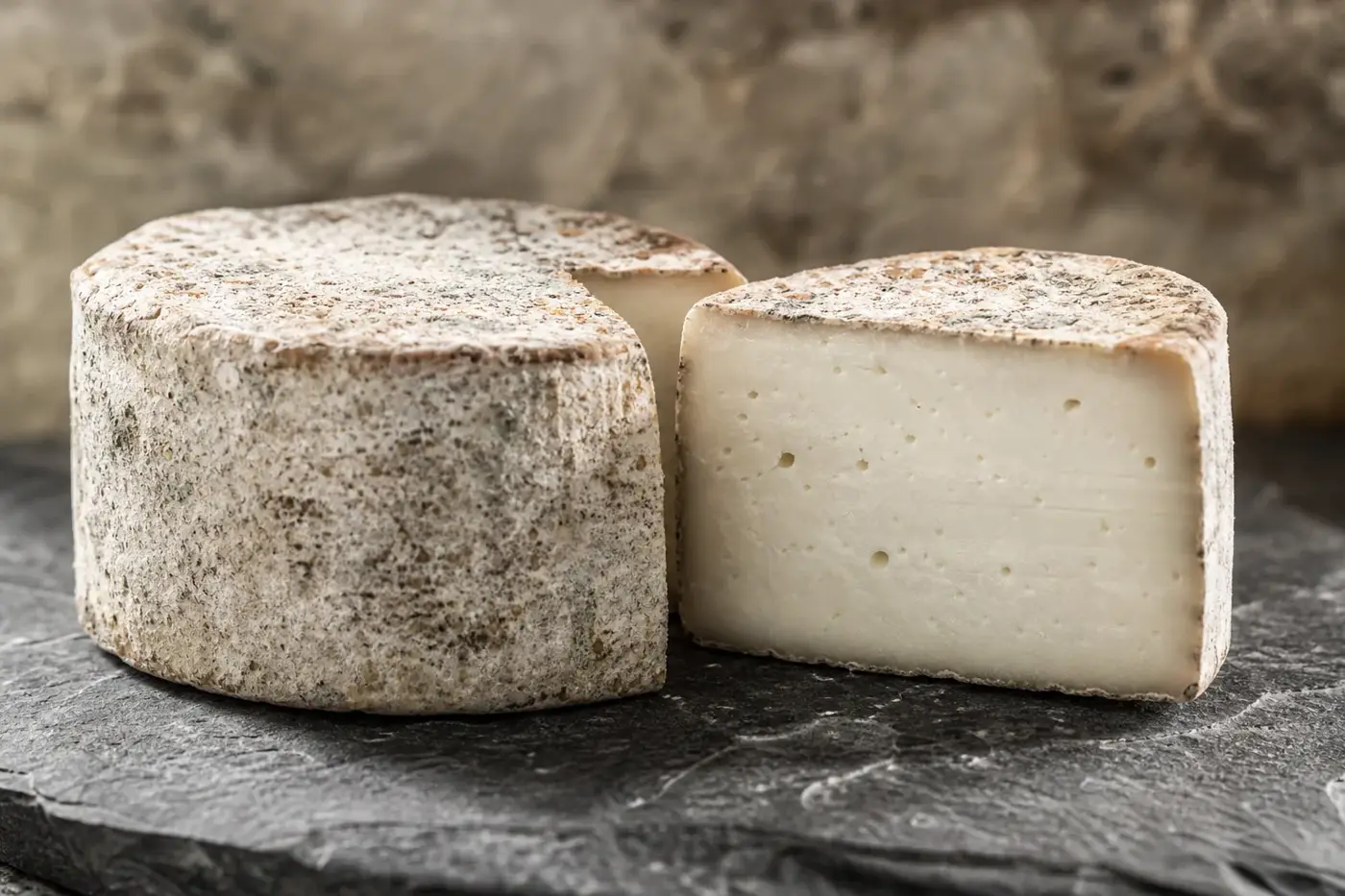
Above the valley meadows around Luino, goats graze the wooded slopes of northern Lombardy. Picture yourself cutting into a small wheel from this landscape: a tender white interior, made from raw goat’s milk and matured for at least 20 days. This is Formaggella del Luinese, from Varese province, with an EU protected designation of origin and a distinctly local story. [1,2,3]
Get to know your little wheel
| What you want to know | The detail |
|---|---|
| Registered name | Formaggella del Luinese. [1] |
| EU designation | Protected designation of origin (PDO), Regulation (EU) No 375/2011. [1] |
| EU register ID | Not stated |
| Great Britain | Registered PDO; UK scheme registration 31 December 2020; register information November 2026. [7] |
| Northern Ireland | Not stated |
| Switzerland | Not stated |
| United States | Not stated; other rights may apply. |
| Pregnancy guidance | UK NHS guidance, November 2026. [9] |
| Where it is made | Defined municipalities in northern Varese province, Italy. [2] |
| Milk and coagulant | Whole raw goat’s milk; natural calf rennet. [2] |
| Minimum maturation | 20 days. [2] |
| Shape and size | Cylinder, 13 to 15 cm across, 4 to 6 cm high; 700 to 900 g. [4] |
| Rind and interior | Natural rind; soft, compact, predominantly white interior, sometimes with small holes. [4] |
| Typical ageing beyond the minimum | Not stated |
Follow the goats into the Varese valleys
To find this cheese’s home, look to the Prealpi Varesine, the hills and mountains of northern Varese province. Its defined territory includes Luino, Dumenza, Valganna and municipalities across Valcuvia and Valtravaglia. Goat rearing, milk production, cheesemaking and maturation must all happen inside that boundary. [2]
The consortium describes steep ground, woodland and pasture, with production principally within the Valli del Verbano and Piambello mountain communities. Valley meadows supply hay, while goats graze and browse the slopes. You can picture the division of labour: each part of the landscape helps sustain the cheese’s local production system. [3,5]
A cardinal at the table, goats in the hills
In August 1596, cheese appeared at the table during a cardinal’s visit to Val Travaglia. The consortium’s historical account includes that record alongside a 1603 account of mountain cheese and numerous goatherds around Lake Maggiore. It identifies that mountain cheese as an ancestor of today’s Formaggella del Luinese. [6]
These are glimpses of a cheese culture, rather than one conveniently tidy origin story. Set them beside today’s farming rules and you begin to see the connection. The modern designation binds the cheese to a particular territory, its goats and a specific way of making and ripening it. [2,3]
What the protected name tells you
On an Italian label, you may see DOP: it corresponds to PDO, protected designation of origin. The EU registered Formaggella del Luinese through Commission Implementing Regulation (EU) No 375/2011, adopted on 11 April 2011 and published on 16 April 2011. Its Great Britain register entry separately records UK scheme registration on 31 December 2020. [1,7]
Lombardy gives you the broad regional setting, but the specification’s named area within Varese is the boundary that matters. Being made elsewhere in Lombardy is not enough to qualify. You can explore the distinction in protected names explained. [2]
Meet the goats and browse their menu
The milk must be whole, raw and exclusively from Camosciata delle Alpi, Nera di Verzasca and Saanen goats and their crosses. The specification describes grazing for 7 to 8 months, alongside hay from local mixed meadows and supplementary concentrates. Silage is excluded. [2,3]
The browsing menu includes heather, wild plants and spring branches of hazel, ash and chestnut. It is rather more varied than the contents of most salad drawers. During the housed period, hay and concentrates take the lead: this is pasture, browse and stored forage, not a requirement for grass alone. [2,3]
Before processing, the milk may be held for no more than 30 hours at no more than 4 °C. Those limits form part of the rules behind the wheel you buy. [2,3]
Watch raw milk become small, salted wheels
The making begins with starter cultures, mainly thermophilic lactic acid bacteria, which favour warmer conditions. Natural calf rennet is compulsory: it is the coagulant that sets the milk. Coagulation takes 30 to 40 minutes at 32 to 34 °C; you can explore the differences between coagulants in the rennet guide. [2]
Next, the cheesemaker cuts the curd, the newly formed milk gel, into fine grains approaching maize size. In particularly cold conditions, optional warming may reach no more than 38 °C. After stirring and resting, the curd goes into moulds, where the small cheeses drain and are turned before dry salting or brining. [2,3]
After drying comes at least 20 days of maturation. The specification allows controlled rooms at 85 to 95% relative humidity and a maximum of 15 °C, or cellars with natural conditions. These are commercial production parameters, not instructions for your kitchen: home storage needs the chilled handling described below. [3]
Expect a tender bite and a growing aroma
The official description calls this cheese semi-hard, yet its paste is soft, moist, elastic and fairly soluble in the mouth. If that leaves you wondering what to expect, think tender and sliceable, not dry and ready for grating. The predominantly white interior is compact, with small holes permitted; the natural rind is not hard and may carry mould. [4]
The consortium describes a moderately sweet, delicate and pleasant flavour. Flavour and aroma grow more pronounced as maturation continues, giving you a useful question for the counter: how old is this wheel? Choose younger for a gentler expression, or discuss a longer matured cheese if you want greater aromatic intensity. [4]
Have a good conversation at the cheese counter
Start with the full name, Formaggella del Luinese, and its PDO or DOP identification. Ask who made it, how long it has matured and how the seller recommends keeping that particular wheel. The specification provides for traceability from milk through production and marking, so the producer’s identity is a useful detail to ask for. [2,7]
If a wheel is already open, ask to see the cut surface. Look for a predominantly white, compact interior, perhaps with fine holes. Ask about the rind too, especially if it looks unfamiliar: a natural rind can carry ripening mould, but appearance alone cannot establish food safety. [4,8]
Make room for it in your fridge
Follow the storage instructions supplied with your cheese. For England, Wales and Northern Ireland, the UK Food Standards Agency recommends a fridge between 0 and 5 °C. Use a fridge thermometer rather than trusting the dial alone, and keep dairy products refrigerated. [10]
Keep the label or the seller’s written instructions with the cheese, so its date and storage advice stay close at hand. Follow any instructions for use after opening, and keep it separate from raw foods. For wrapping and fridge organisation, turn to how to store cheese at home. [8,10]
Give the first mouthful your attention
My suggestion is to cut only what you plan to eat and leave the rest chilled. Let that portion briefly lose its refrigerator chill, rather than repeatedly warming the whole wheel. In England, Wales and Northern Ireland, the FSA advises keeping chilled food outside refrigeration for the shortest possible time, with a maximum of four hours. [10]
Cut wedges from the centre towards the rind, giving each piece both middle and outer edge. Try a small piece alone before adding bread or fruit. You give the delicate character described by the consortium a chance to register before other flavours join the conversation. [4]
Bring bread, fruit and a thoughtful glass
Take your cue from the consortium’s description of a delicate, moderately sweet cheese. My suggestions are plain bread, ripe pear or apple, with stronger accompaniments kept separate. A little mild honey is another option, but taste the cheese without it first; it deserves a moment before the supporting cast arrives. [4]
On a mixed cheeseboard, serve it before more forceful cheeses so you can appreciate its gentler aromas. For a regional wine pairing, I would ask for a dry white from Lombardy, favouring restraint over pronounced oak, or a light regional rosé. [4]
A more mature wheel may suit a slightly fuller example. Let the cheese’s actual intensity guide your conversation with the wine merchant. The cheese and wine pairing guide covers the broader principles.
Still water or lightly brewed, unsweetened tea offers an alcohol free alternative. Wine suggestions are for adults of legal drinking age who choose to drink; offer only a small serving. People who are pregnant, driving, taking medicines that interact with alcohol or recovering from alcohol dependence should not drink. Consult current NHS alcohol guidance.
This page summarises published guidance from the official sources it cites. It is not medical advice. Guidance differs between countries and changes over time, so check the current source for where you live, and ask your doctor, midwife, pharmacist or dietitian about your own circumstances.
Keep the raw milk safety advice close
The UK NHS publishes guidance on cheeses and unpasteurised milk during pregnancy. If you are pregnant, check the current NHS advice and speak to your midwife about your own circumstances. [9]
The NHS identifies pregnant people, newborn babies and people with weakened immunity as groups at higher risk of serious listeriosis. Older people also face greater risk, increasing with age, and its listeriosis guidance includes unpasteurised dairy among foods that can carry the bacteria. If you are in one of these groups, check the official advice and discuss individual choices with your healthcare professional. [8]
Keep the milk treatment in mind when buying, and retain the label for anyone sharing your cheese. For an explanation of the production distinctions, see raw milk, thermised and pasteurised cheese. [3]
Follow your curiosity to the next label
- How to Read a Cheese Label: get to know the information supplied with your cheese.
- Cheese Food Safety: The Complete Guide: explore the wider handling and risk guidance.
Questions people ask
Where is Formaggella del Luinese made?
It is made in a defined area of northern Varese province in Lombardy, Italy. Goat rearing, milk production, cheesemaking and maturation must all take place within that boundary.
What milk is used to make Formaggella del Luinese?
It is made from whole raw goat’s milk. The specification permits milk exclusively from Camosciata delle Alpi, Nera di Verzasca and Saanen goats and their crosses.
What rennet does Formaggella del Luinese use?
Natural calf rennet is compulsory. It is the coagulant used to set the milk.
What does Formaggella del Luinese taste like?
The consortium describes its flavour as moderately sweet, delicate and pleasant. Its flavour and aroma become more pronounced with maturation, which lasts at least 20 days.
Can I eat Formaggella del Luinese during pregnancy?
The cheese is made from raw goat’s milk. The UK NHS publishes guidance on cheese and unpasteurised milk during pregnancy; check its current advice and speak to your midwife about your circumstances.
Sources
- European Commission, Commission Implementing Regulation (EU) No 375/2011 of 11 April 2011 entering a name in the register of protected designations of origin and protected geographical indications (Formaggella del Luinese (PDO)), Official Journal L 102, 16 April 2011, pp. 15 to 16. Official legal text.
- Italian Ministry of Agricultural, Food and Forestry Policies, Provvedimento 20 aprile 2011: Iscrizione della denominazione «Formaggella del Luinese» nel registro delle denominazioni di origine protette e delle indicazioni geografiche protette, with production specification, Gazzetta Ufficiale, Serie Generale No 107, 10 May 2011. Official publication.
- Consorzio per la Tutela della Formaggella del Luinese, D.O.P.: Disciplinare di produzione, undated online transcription, retrieved November 2026. Specification transcription.
- Consorzio per la Tutela della Formaggella del Luinese, Caratteristiche, undated online product description, retrieved November 2026. The consortium represents and promotes the cheese’s producers. Characteristics.
- Consorzio per la Tutela della Formaggella del Luinese, Zone di produzione, undated geographical account, retrieved November 2026. Production area.
- Consorzio per la Tutela della Formaggella del Luinese, Origini, undated historical account, retrieved November 2026. Historical account.
- Department for Environment, Food & Rural Affairs, Formaggella del Luinese, Great Britain protected food names register, published 4 January 2021, retrieved November 2026. Register entry.
- NHS, Listeriosis, last reviewed 10 November 2023, retrieved November 2026. Current NHS guidance.
- NHS, Foods to avoid in pregnancy, online guidance retrieved November 2026. Current NHS pregnancy guidance.
- Food Standards Agency, How to chill, freeze and defrost food safely, published 18 December 2017, online version retrieved November 2026; applies to England, Northern Ireland and Wales. Current chilling guidance.
This desk-researched article compares the officially published specification with the consortium’s descriptions, the Great Britain register and current UK public food safety guidance.
Last checked: November 2026
Last checked November 2026.
The editors suggest you read next
Parmigiano Reggiano
Break into a wheel of Parmigiano Reggiano and flakes fall away, revealing a finely granular cheese, pale straw to straw in colour.