French Onion Soup
Your spoon cracks through golden, bubbling cheese, catches toasted baguette and sinks into hot broth.
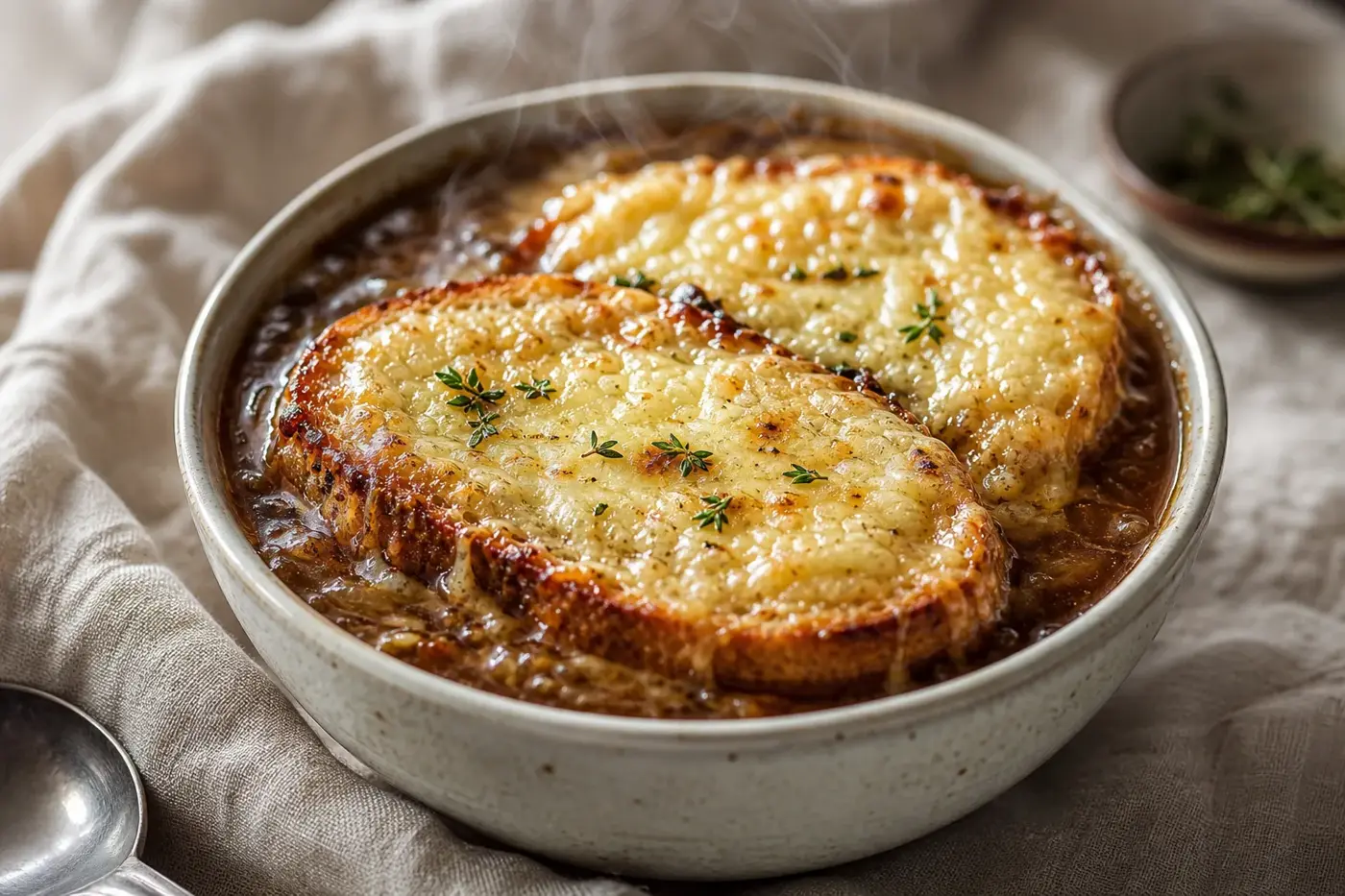
Your spoon cracks through golden, bubbling cheese, catches toasted baguette and sinks into hot broth. This is French onion soup’s finest little ritual. The depth beneath that crust begins long before the grill, with onions cooked slowly to deep gold, then simmered in savoury stock.[1,2]
The golden crust is part of the pleasure
Bread and browned cheese turn onion soup into soupe à l’oignon gratinée. They belong on the soup, not politely beside it. That final topping separates this version from a plain bowl of onion soup.[1]
Think of it as three jobs: onions, broth, topping. Brown the onions thoroughly before adding liquid, then taste the simmered broth before reaching for salt. Save the toast until serving time, so you can assemble everything quickly without leaving the bread soaking longer than necessary.[1,2]
Your French onion soup recipe for four
Recipe status: not independently tested. This adaptation draws on the methods published by Good Food and Borough Market. The quantities below are set for this recipe.[1,2]
Serves: 4. Preparation: allow about 20 minutes. Cooking: allow about 70 to 100 minutes, plus the final grilling. Grill: high, following your appliance instructions. Fan oven temperature: not applicable.
Gather your ingredients
- 1 kg onions (35.3 oz), weighed after peeling
- 40 g butter (1.4 oz)
- 15 ml oil, equivalent to 1 tablespoon
- 1.2 litres beef stock, or vegetable stock
- 100 ml dry white wine, optional; otherwise use 100 ml extra stock
- 8 baguette slices, cut to fit your bowls
- 200 g Gruyère, Comté or a suitable alternative (7.1 oz), grated
- Salt and freshly ground black pepper, to taste
Choose stock you would happily drink on its own. Beef stock makes this a meat-based soup; vegetable stock starts the vegetarian version below. Hold back the salt until after simmering, when you can judge what both stock and cheese bring to your bowl.[1,2]
Find your biggest pan and the right bowls
You need a large, wide, heavy-based saucepan, a wooden spoon, a grater, a ladle, a grill-safe metal tray and four bowls. To grill the topping directly on the soup, every bowl needs its manufacturer’s approval for use under a grill. Without that approval, use the separate-toast method below.[3]
Take your onions from pan to golden crust
-
Slice the onions. Halve them from top to root, peel, then place each half flat-side down. Slice thinly and evenly, discarding the root ends. Separate the slices as you add them to the pan, breaking apart any large, tightly packed clumps.[1,2]
-
Start gently. Melt the butter with the oil over a medium-low heat. Add the onions and turn them through the fat. Cook gently, stirring regularly and scraping across the base, until the heap has collapsed and the onions are soft.[1,2]
-
Give them time to brown. Continue cooking, uncovered, until the onions are deeply golden throughout, allowing roughly 40 to 60 minutes altogether. Stir more often towards the end. If they catch before colouring evenly, lower the heat and loosen the pan with a splash of the measured stock.[2]
-
Gather up the flavour. Add the wine, or the extra stock, and scrape up the brown residue with your wooden spoon. Let the liquid bubble briefly while you stir. You want those browned bits dissolved among the onions, not left clinging to the base.[1,2]
-
Let it simmer. Pour in the 1.2 litres of stock, bring to a gentle simmer and cook for 20 to 30 minutes. Taste, then add black pepper and salt as needed. Keep the soup hot while you prepare its topping.[1,2]
-
Toast before topping. Heat the grill and toast the baguette on both sides until golden and dry on the surface. Divide the hot soup between four bowls. Leave enough space for the topping.[1]
-
Grill, then serve. For bowls approved by their manufacturer for use under the grill, top each serving with two slices of toast and 50 g of cheese. Set the bowls on a tray suitable for the grill, then grill until the cheese bubbles and turns golden. Remove with dry oven gloves and warn everyone that the bowls are hot. Otherwise, put the toast on a tray suitable for the grill, divide the cheese over it and grill until bubbling and golden, then float two cheese toasts on each bowl just before serving.[1,2,3]
Let the onions take their time
Look for a panful of soft, evenly coloured onions, not pale strands with a few dark edges. Borough Market allows 45 minutes to an hour for this stage and explicitly calls for deep gold. Watch your onions as closely as your clock: they are not taking appointments.[2]
A broad pan gives you room to turn the slices and see what is happening across the base. Work your spoon into the corners, especially as the onions reduce. If the pan colours faster than the onions, lower the heat before the residue catches.[1,2]
Deglazing draws that brown cooking residue into your broth, so stir until it dissolves into the liquid. Leaving out wine? Stock does the job. Cooking reduces alcohol but does not reliably remove it, so choose stock if you want to avoid adding alcohol.[4]
Choose a cheese worth waiting for
Gruyère and Comté are your first choices here. Grate your cheese into an even layer: both suit a melted covering rather than a thick sauce. Choose the flavour you want above the onion broth, keeping the total at 200 g.
The Swiss Gruyère interprofession describes its younger cheese as gentle and fine. Its Réserve has a more forceful, aromatic character. Choose the younger version if you want the onion broth to lead, or the stronger version for a topping with more to say.[5]
With Comté, flavour tells a story of place, season, cheesemakers, maturers and time in the cellar. Its interprofessional body traces the cheese’s changing flavours to all these influences. Ask about the particular piece: you want a character that complements the cooked onions’ sweetness, not simply more cheese for the sake of it. Tempting, admittedly.[6]
Cheddar is another option, including a product whose producer confirms it is suitable for vegetarians. Keep the same weight. Taste your soup before adding salt.
Before publication: add a sourced comparison of Gruyère and Comté’s flavour and melting. Explain the relevant differences in moisture, salt, melting and flavour for each recommended substitute.
Making it vegetarian? Look beyond the stock
Use vegetable stock and cheese whose producer explicitly confirms vegetarian rennet. Rennet is the ingredient that sets milk into curd. Swiss Gruyère’s production account describes rennet extracted from a calf’s stomach, so you need a different, vegetarian-confirmed cheese for this version.[2,7]
A vegetarian-labelled Cheddar is a practical choice. Look at the particular pack or ask the maker, rather than relying on the cheese’s name alone. The guide to rennet explains its different sources; reading a cheese label helps you assess the product you will actually use.
Two routes to that bubbling cheese crust
Toast your bread before it meets the soup. Its dry surface carries the cheese while the underside softens in the broth as the topping browns. Add it at the last moment, covering much of the bowl without wedging the slices tightly against the rim.[1]
Read your bowl manufacturer’s grilling instructions, including the clearance needed from the element. Le Creuset’s UK instructions, for example, specify at least 6.5 cm for its stoneware. Follow the instructions for your own bowls and grill; that figure is not a rule for other products.[3]
Rather keep your bowls out of the grill? Arrange toasted baguette on a grill-safe metal tray, divide the cheese over it and grill until bubbling and golden. Ladle hot soup into ordinary serving bowls, then float two cheese toasts on each portion. Borough Market uses this approach in its published recipe.[2]
Make the soup ahead, leave the crust until last
You can prepare the onion and stock base ahead. Keep bread and cheese separate until you are ready to serve. The storage instructions here follow Food Standards Agency guidance for England, Northern Ireland and Wales, as of November 2026.[8,9]
Divide the soup between smaller containers to cool it as quickly as possible, ideally within one to two hours, before refrigerating. The FSA advises a fridge temperature between 0 °C and 5 °C. Eat refrigerated leftovers within 48 hours, or freeze them if you cannot.[8,9]
Reheat only the amount you need, stirring frequently on the hob until steaming hot throughout. The FSA advises reheating leftovers only once. Get the soup hot before adding fresh toast and cheese, then finish under the grill just before serving.[9]
Keep the company crisp and simple
A crisp green salad, lightly dressed with oil and vinegar, makes a simple companion. Your soup already brings bread, cheese and a substantial broth to the table. Serve the salad separately, so the leaves stay crisp rather than warming beside the bowl.
For adults of legal drinking age who choose alcohol, a small serving of dry white wine is an option. Sparkling water with lemon offers an alcohol free alternative. To avoid adding alcohol to the recipe itself, use stock instead of wine.
People who are pregnant, driving, taking medicines that interact with alcohol or recovering from alcohol dependence should not drink. Check the current official guidance for where you live.
Before publication: the editor must add a dated link to the current official alcohol guidance.
Read every ingredient label, including stock, wine, bread, butter, cheese and any substitutions. Before publication, add the applicable official allergen guidance, its date and a link to that guidance. Have the whole recipe reviewed.
General information only, not medical advice: follow the official guidance where you live.
Questions people ask
What makes French onion soup gratinée?
Bread and a browned cheese topping turn onion soup into soupe à l’oignon gratinée. The topping belongs in every serving, not alongside it.
Can I make French onion soup vegetarian?
Use vegetable stock and cheese whose producer explicitly confirms vegetarian rennet. A vegetarian labelled Cheddar is one option, but check the particular pack or ask the maker.
Can I make French onion soup without wine?
Yes, use 100 ml extra stock instead of the wine. Cooking reduces alcohol but does not reliably remove it.
What if my bowls are not suitable for grilling?
Toast the baguette, add the cheese and grill it on a tray suitable for the grill until bubbling and golden. Float two cheese toasts on each bowl of hot soup just before serving.
How should I store and reheat French onion soup?
The Food Standards Agency advises cooling soup as quickly as possible, ideally within one to two hours, and keeping the fridge between 0 °C and 5 °C. It advises eating refrigerated leftovers within 48 hours or freezing them, and reheating leftovers only once until steaming hot throughout. Check the current Food Standards Agency guidance for England, Northern Ireland and Wales.
Sources
-
Good Food. French onion soup. Recipe published in Good Food magazine, April 2013; online version retrieved November 2026. Supports the onion, stock, baguette and grilled cheese method. Source.
-
Borough Market. French onion soup. Undated online recipe, retrieved November 2026. Supports slow browning, alternative stocks and grilling cheese toasts separately. Borough Market also promotes its traders alongside the recipe. Source.
-
Le Creuset UK. Care & Use, stoneware section. Undated manufacturer instructions, retrieved November 2026. Its clearance instruction applies to its own specified products. Source.
-
United States Department of Agriculture, Agricultural Research Service. USDA Table of Nutrient Retention Factors, Release 6, December 2007. Published alcohol-retention data support the limited statement that cooking does not reliably remove all alcohol. Source.
-
Interprofession du Gruyère. Le Gruyère AOP, “Nos 4 variétés”. Undated online account, retrieved November 2026. The flavour descriptions are the interprofession’s own. Source.
-
Comité Interprofessionnel de Gestion du Comté. Questions de goût. Undated online account, retrieved November 2026. Explains the industry body’s account of seasonal, geographical and maturation-related variation. Source.
-
Interprofession du Gruyère. La fabrication du Gruyère AOP. Undated online production account, retrieved November 2026. The section on coagulation identifies calf-stomach rennet. Source.
-
Food Standards Agency. How to chill, freeze and defrost food safely. Published 18 December 2017; current online text retrieved November 2026. Applies to England, Northern Ireland and Wales. Source.
-
Food Standards Agency. Cooking your food. Published 18 December 2017; current online text retrieved November 2026. Section 7 covers leftovers and reheating. Applies to England, Northern Ireland and Wales. Source.
Research combined published recipe methods, cheese interprofessional accounts, manufacturer instructions and official food-handling guidance, with editorial choices distinguished from recorded kitchen testing.
Last checked: November 2026
Last checked November 2026.
The editors suggest you read next