Fresh vs Low Moisture Mozzarella
Lift a slice of hot pizza and watch what happens.
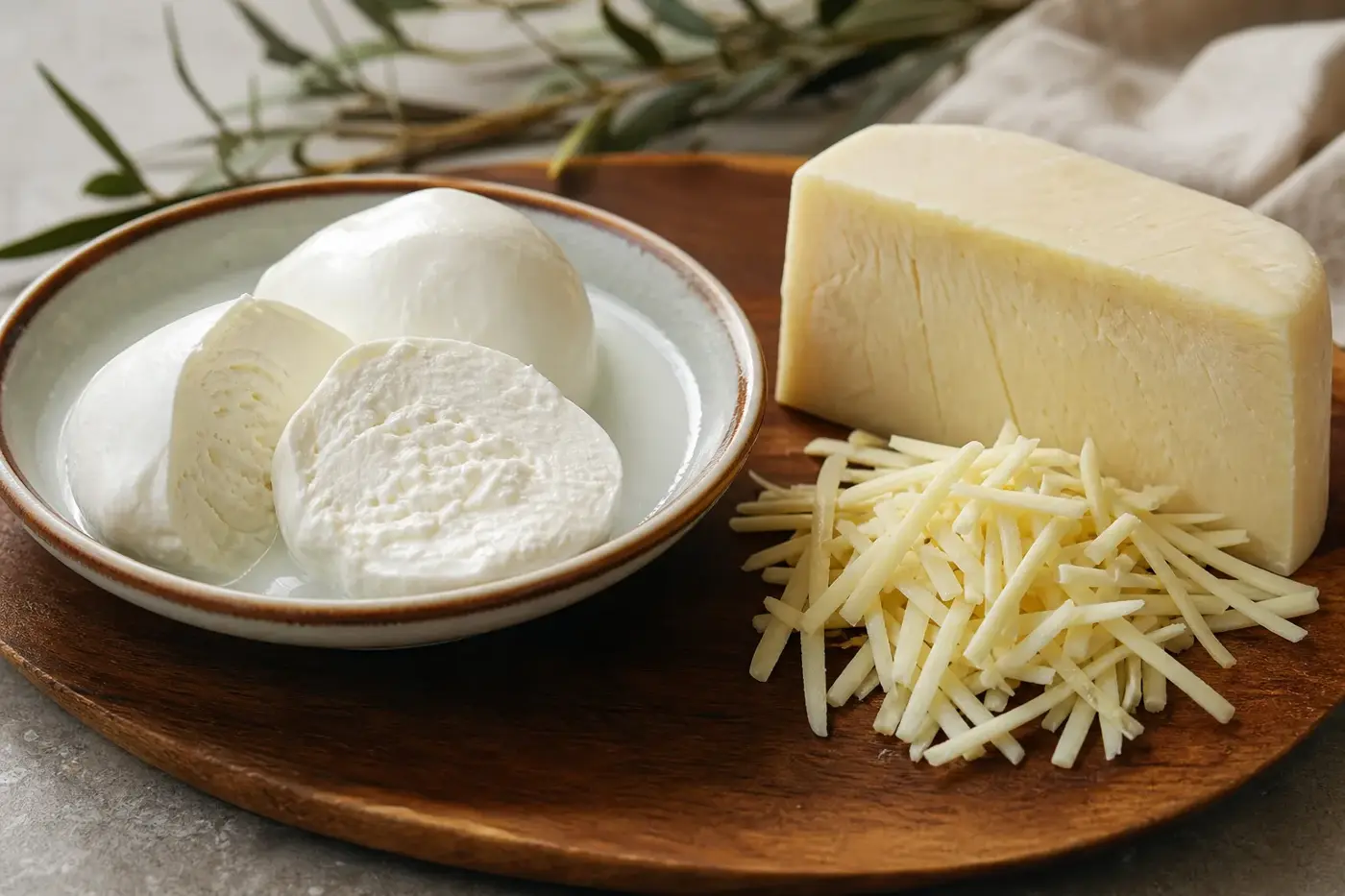
Lift a slice of hot pizza and watch what happens. Fresh mozzarella settles into soft white pools, sometimes with liquid gathering around them. Low moisture mozzarella more readily stretches into a continuous covering, the sort that makes you pause halfway to your plate. Your choice begins with that contrast: a moist, milky bite, or a firmer cheese that grates neatly and brings less water along. [3,4]
Meet the soft ball and the tidy block
Your first clue comes before you open the packet. A soft ball sitting in liquid has a different kitchen role from a firm block ready for slicing or grating. Look at these typical forms and you will have a good idea of what you are taking home. [3,4,5]
| What you notice | Fresh mozzarella | Low moisture mozzarella |
|---|---|---|
| Appearance | Smooth white balls or small pieces [3,5] | Uniform block, slices or shreds [3,4] |
| Texture | Soft, moist and yielding [3,5] | Firmer and easier to grate [4] |
| Usual packaging | Sitting in covering liquid [3,5] | Block or grated cheese in a sealed pack [3,4] |
| Flavour | Mild and milky [3] | Mild, often more concentrated in the bite [2,4] |
| Where to start | Salads; separate pieces on pizza [3] | Toasties, even pizza coverage, pasta bake toppings [4,7] |
First comes the stretch
Both styles begin with pasta filata, or stretched curd. Milk is coagulated so its proteins form a gel, then the solid curd is separated from the liquid whey. Heat and kneading prepare that curd for stretching and shaping. The US standards describe treatment with hot water or steam for both mozzarella and low moisture mozzarella. [1,2]
The moisture difference develops long before you reach for a packet. Cutting, stirring, reheating and draining all help whey leave the curd. The US low moisture standard specifically describes piling the cut curd to encourage more whey separation. After stretching and shaping come cooling, salting and packing. [1,2]
That is why kitchen paper cannot turn a fresh ball into low moisture mozzarella. Blotting removes surface liquid; it cannot reproduce a different sequence of curd handling. Kitchen paper is useful, but it has its limits. To follow the process further, explore how cheese is made. [1,2]
Reading an American recipe? Here are the numbers
American recipes become easier to navigate when you know the legal categories behind them. US federal standards measure moisture as water’s percentage of the whole cheese by weight, not on a fat free basis. The boundaries are precise. [1,2]
| United States standard | Water in the whole cheese | Where the rule appears |
|---|---|---|
| Mozzarella cheese | More than 52%; no more than 60% | 21 CFR 133.155 [1] |
| Low moisture mozzarella cheese | More than 45%; no more than 52% | 21 CFR 133.156 [2] |
Notice that “mozzarella cheese” does not include “fresh” in its legal title. These American categories help with American recipes, but for a UK product, turn to the pack description and producer’s information. Galbani, for example, describes its Cucina block as low in water without publishing a moisture percentage on that product page. [1,2,4]
Low moisture does not mean low fat, either. It describes less water within the relevant category, not the cheese’s fat content. US standards regulate moisture and milkfat separately, with milkfat expressed on a dry matter basis. Keep those measurements separate and the label becomes rather easier to read. [1,2]
Cow or buffalo? That is another choice
The animal cannot tell you the moisture style. Fresh mozzarella can use cow’s milk or buffalo milk, while the US low moisture standard also permits dairy ingredients from either species, kept separate. Think of milk source and moisture as two separate decisions for your dish. [2,3]
Mozzarella di Bufala Campana has its own protected identity. Its status in the Great Britain register as of November 2026 is registered PDO, or protected designation of origin. The European Commission describes production using fresh water buffalo milk and calf rennet, followed by stretching, shaping and packing in a protective liquid. [5,6]
Start with the moisture style your dish needs, then choose the milk character you prefer. For a broader introduction to the cheese, dip into the mozzarella guide.
Taste a piece before the cooking starts
Fresh mozzarella’s appeal is right there in the first bite: mild milk flavour and a soft, moist texture. Galbani calls its cow’s milk mozzarella delicate and milky. The Commission’s description of the protected buffalo cheese gives you a lovely picture: porcelain white, with a thin outer skin around a soft centre. Leave yourself substantial pieces rather than fine gratings to enjoy those qualities. [3,5]
Low moisture mozzarella has a firmer bite and can seem more concentrated beside its wetter relative. Less water means more cheese solids in the same weight. Seasoning and recipe still count, though: Lactalis describes its cooking block as fresh and milky too. Expect the clearest difference in firmness and moisture, not necessarily a strong or sharply aged flavour. [1,2,7]
Pizza: soft pools or an even blanket?
If you want an even covering, grate low moisture mozzarella and spread it across the sauce. Galbani recommends its low water block for shredding over pizza and melting over lasagne. Fresh mozzarella gives you separate, soft pieces instead. Its excess liquid is best dealt with before it reaches the dough. [3,4]
Drain fresh mozzarella, cut or tear it, then blot the exposed surfaces with clean kitchen paper. During extended draining, keep it refrigerated and follow the pack’s storage instructions. Leave gaps between pieces rather than overlapping wet slices across the base. You are controlling the water going onto your pizza as well as arranging the topping. [1,2,9]
Browning is not simply a contest that the drier cheese wins. A 2022 experimental study compared untreated fat free mozzarella shreds with shreds soaked in water, measuring moisture loss, surface temperature and colour during pizza baking. In that particular cheese, added water delayed browning and improved melt and stretch. Moisture, fat and cheese structure work together. [8]
As you judge your pizza, ask three separate questions: does the cheese spread, does it stretch when lifted, and does it leave unwanted liquid? Plenty of stretch can still accompany a wet centre. Decide which result matters before changing the amount of cheese. A longer cheese pull is not, on its own, a qualification for a better pizza. [4,8]
Find your bite in salads, toasties and bakes
Picture the texture you want on your fork or inside your sandwich. That is a more useful starting point than choosing a favourite packet out of habit. These recommendations draw on the documented forms and uses of both styles. [3,4,7]
- Salads: choose fresh mozzarella for soft pieces alongside tomatoes, leaves or roasted vegetables. Drain the packing liquid so you stay in charge of the dressing. [3,5]
- Cold sandwiches: choose fresh mozzarella when the cheese plays a substantial part in the filling, and blot it first. For neat, evenly sliced layers, reach for a low moisture block. [3,4]
- Toasties and panini: use low moisture mozzarella for a manageable melted layer. Lactalis lists toasted sandwiches and panini among its cooking block’s uses. [7]
- Pasta bakes and stuffed vegetables: choose low moisture mozzarella for grated toppings or fillings. If you want distinct pockets of softer cheese rather than a uniform layer, use drained fresh pieces. [3,4]
Swapping styles? Make room for the water
You can usually substitute one style for the other in cooked dishes if you adjust the preparation. Water and texture are the main differences, not merely the words on your packet. A few practical changes help you account for both. [1,2,4]
Fresh instead of low moisture: drain and blot, then cut into small pieces rather than wrestling a wet ball against a grater. Expect less even coverage and more moisture reaching the sauce or bread. Keep a pasta bake’s sauce thick enough to accommodate that extra liquid. On pizza, avoid crowding the centre with cheese. [1,2]
Low moisture instead of fresh: slice or dice it for salad, knowing that your bite will be firmer and less juicy. Grate it for an evenly distributed cooked topping. If fresh mozzarella is the main uncooked ingredient, consider whether another dish would satisfy you more. You are changing the central texture, not simply exchanging one mild cheese for another. [3,7]
Let the label tell you more than the picture
The product description is more useful than the photograph on the front. Look for the milk species, the cheese’s form and whether it sits in liquid. “Cucina”, “pizza” and a grated format can suggest a cooking product, but the maker’s description tells you more than shape alone. For other useful details, turn to the guide to reading a cheese label. [3,4]
Vegetarian suitability depends on the particular product and its coagulant, the ingredient that sets the milk. Galbani’s UK Cucina page lists non-animal rennet and declares that product suitable for vegetarians. The Commission’s account of Mozzarella di Bufala Campana production, by contrast, specifies calf rennet. Check the current pack or ask the producer, especially when the label says only “enzymes”. [4,5]
If you would like to understand those choices, the rennet guide explains animal, microbial and fermentation produced coagulants.
Keep it cold, then follow the opened pack
Keep both styles refrigerated as their packaging directs, with as little time out as possible during preparation. For home storage in England, Wales and Northern Ireland, the Food Standards Agency’s published chilling guidance recommends a fridge between 0 and 5 °C. November 2026 is the reference point for this guidance. [9]
Once you open the pack, follow its instructions on storage and how soon to use the cheese. If fresh mozzarella is to stay in its liquid, keep that liquid and drain only the portion you need. For blocks and grated cheese, follow any directions for resealing or using a container. [9,10]
A use by date concerns safety; a best before date concerns quality. UK Government guidance makes that distinction clear, so use the cheese by its use by date and follow the opened pack’s instructions. Incorrect storage can make food unsafe before the printed date. Read the date and storage directions together. [10]
For help with wrapping, containers or fridge organisation, turn to how to store cheese at home.
General information only, not medical advice: follow the official guidance where you live.
Questions people ask
Which mozzarella is better for pizza?
Low moisture mozzarella can be grated and spread for an even covering. Fresh mozzarella forms separate soft pieces and can bring more liquid to the pizza.
Does low moisture mozzarella mean low fat?
No. Low moisture describes the water content, not the fat content.
Can I substitute fresh mozzarella for low moisture mozzarella?
In cooked dishes, you can usually substitute one for the other if you adjust the preparation. Drain and blot fresh mozzarella and cut it into small pieces, expecting a less even covering and more moisture.
Is mozzarella suitable for vegetarians?
It depends on the product and its coagulant. Galbani's UK Cucina product lists rennet that is not from animals and is declared suitable for vegetarians, while the Commission specifies calf rennet for Mozzarella di Bufala Campana.
How should I store mozzarella?
For homes in England, Wales and Northern Ireland, the Food Standards Agency recommends a fridge between 0 and 5 °C in its published chilling guidance. Follow the pack instructions for storage and how soon to use the cheese once opened.
Sources
- US Food and Drug Administration, 21 CFR 133.155: Mozzarella cheese and scamorza cheese. Current eCFR text retrieved November 2026, particularly paragraphs (a), (b) and (d).
- US Food and Drug Administration, 21 CFR 133.156: Low-moisture mozzarella and scamorza cheese. Current eCFR text retrieved November 2026, particularly paragraphs (a), (b) and (d).
- Galbani, Mozzarella. UK product range and producer descriptions, undated, retrieved November 2026. Commercial primary source for its products, descriptions and suggested uses.
- Galbani, Galbani Mozzarella Cucina 400g. UK product information, ingredients and vegetarian declaration, undated, retrieved November 2026. Commercial primary source.
- European Commission, Directorate-General for Agriculture and Rural Development, Mozzarella di Bufala Campana PDO. Production and product description, undated, retrieved November 2026.
- Department for Environment, Food & Rural Affairs, Mozzarella di Bufala Campana. Great Britain protected food name register entry, published 2021, current entry retrieved November 2026.
- Lactalis Professional, Galbani Mozzarella Cucina Block 1kg. Product description and uses, undated, retrieved November 2026. Commercial primary source.
- American Dairy Science Association, An approach to improve the baking properties and determine the onset of browning in fat-free mozzarella cheese. Original experimental research, Journal of Dairy Science, 2022. Published abstract retrieved through PubMed.
- Food Standards Agency, How to chill, freeze and defrost food safely. Published 2017, current GOV.UK edition retrieved November 2026; stated scope: England, Northern Ireland and Wales.
- UK Government, Understanding food labelling: Best before and use-by dates. Current guidance retrieved November 2026 through the FSA’s redirected date guidance link.
Researched from US standards of identity, official British guidance and register information, European Commission production information, producer declarations and an original pizza baking study; cooking recommendations are desk research synthesis.
Last checked: November 2026
Last checked November 2026.
The editors suggest you read next
Cheddar vs Gouda: Taste, Texture and How to Use Each
Bite into a long-aged Gouda and, beneath your teeth, something crunches.