Gougères
In a Burgundy cellar, you might find a plate of cold gougères beside your wine glass.
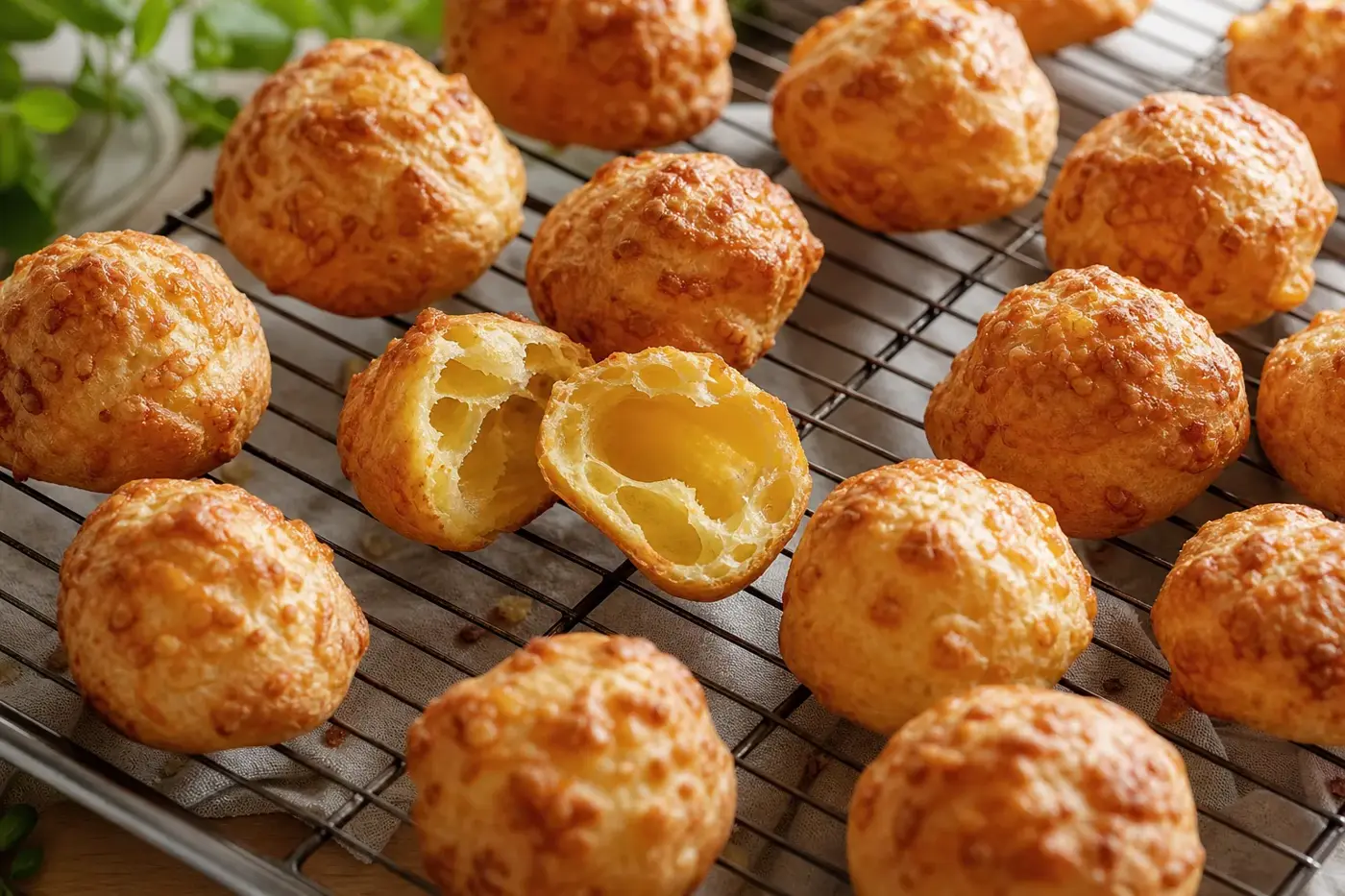
In a Burgundy cellar, you might find a plate of cold gougères beside your wine glass. Catch them warm and the pleasure changes: a golden shell gives way to an airy centre, with cheese running through the pastry. There is no hidden filling. The lightness comes from choux pastry and three crucial steps: cook the flour thoroughly, add the eggs gradually and bake until the pastry can hold its shape.[1][3][7]
Meet the magic inside the shell
The cheese seasons the dough itself, rather than waiting in the middle. King Arthur Baking describes freshly baked cheese puffs as crisp outside with soft interiors. That crispness gradually softens as they cool, giving you a respectable reason to remain within arm’s reach of the tray.[4]
Steam does the lifting. In the saucepan, flour absorbs hot liquid and becomes a thick paste. In the oven, moisture turns to steam and expands the pastry, while flour and eggs build the structure that holds its hollow shape.[3]
A golden surface cannot tell you everything, though. Your puffs can brown before their inner walls are dry enough to support them. King Arthur’s technical guidance recommends opening a sample shell to inspect the interior before taking out the whole batch.[5]
Follow the trail to Burgundy’s cellars
Gougères have a firm place in Burgundy’s food traditions. The encyclopaedic account records them at cellar wine tastings, sometimes cold, and as warm appetisers. It also records a particular connection with Tonnerre in the Yonne.[7]
That Tonnerre connection is a local tradition, not an established invention story. A regional association, an early written recipe and the first person to make a dish are separate historical questions. At your table, the arrangement is simpler: a small savoury puff beside an apéritif, with no filling or elaborate garnish required.
Make your own golden gougères
Recipe status: adapted from King Arthur Baking’s published Gougères and Pâte à Choux recipes; no independent fromage.co.uk recipe testing. The ingredient proportions and baking schedule follow those sources, with gradual egg addition informed by their cheese puff guidance.[1][2][4]
Yield: about 30 puffs.
Preparation: approximately 15 minutes of active work, plus cooling the paste.
Baking: 35 to 40 minutes.
Total: allow about 1 hour.
Serves: divide the batch to suit your menu; use the yield to plan portions.[1]
Gather your ingredients and clear a little space
- 227 ml water
- 113 g unsalted butter, cut into pieces
- ⅜ teaspoon table salt
- 150 g plain wheat flour
- 4 large eggs, with the final egg beaten separately for gradual addition
- 113 g grated Gruyère or mature Cheddar, reserving approximately 2 tablespoons for the tops.[1][2]
Set out digital scales, a large saucepan, a sturdy spoon or stiff spatula, two baking sheets, baking parchment and a cooling rack. You can use a mixer, but it is optional. For piping, choose a bag with a plain nozzle approximately 13 to 19 mm wide. Otherwise, two spoons will do nicely.[1][2]
Allergens: wheat in the flour, eggs, and milk in the butter and cheese. The FSA’s published allergen guidance identifies wheat among cereals containing gluten, alongside eggs and milk. Read every ingredient and substitution label, including precautionary allergen information.[8]
Bring the flour and butter together
Heat your oven to 220 °C conventional (425 °F). For a fan oven, 200 °C is the proposed adaptation. Line your baking sheets with parchment.[1]
Put the water, butter and salt in the saucepan. Heat until the butter melts and the liquid boils. Take the pan off the heat, add all the flour at once and stir vigorously. Reach right into the corners so no flour stays behind.[2]
Return the pan briefly to medium heat, stirring and turning until the mixture is smooth, thick and cohesive. King Arthur’s base recipe gives less than a minute for this stage; its illustrated technique guide supplies the visual cues. You are looking for paste that pulls away from the pan and leaves a thin film on the bottom.[2][3]
This is your panade, the cooked paste. It should be an even mass, without pockets of dry flour. Transfer it to a mixing bowl, or leave it in the saucepan if you are mixing by hand.
Let the dough tell you when to stop adding egg
Cool the panade for 5 to 10 minutes, stirring occasionally. King Arthur specifies a temperature below approximately 52 °C (125 °F) before you add the eggs. Hotter paste can scramble them, which is a different breakfast altogether.[2][3]
Beat in three eggs, one at a time. Incorporate each fully before adding the next. The mixture may look slippery or separated at first. Keep beating and it will come together again.[2]
Beat the fourth egg separately, then add it a little at a time, assessing the dough after each addition. You want a smooth, glossy paste that you can pipe, but that still holds a mound. King Arthur’s cheese puff guidance advises assessing the dough after three eggs, rather than automatically adding the fourth.[4]
Another published gougères method offers a useful visual cue: dough falling from the mixer paddle should leave a V-shaped trail. Use that alongside the mound test. Shine alone is not the goal.[6]
Fold in the cheese, keeping the reserved portion aside for the tops. Your dough is ready to shape.
Give your puffs space to rise
Spoon heaped tablespoonfuls onto the trays, or pipe mounds approximately 4 cm across, leaving about 5 cm between them. Keep the portions similar in size so they finish baking together. Sprinkle over the reserved cheese.[1]
Bake for 15 minutes, then reduce the oven to 180 °C conventional (350 °F), or the proposed 160 °C fan adaptation. Bake for another 20 to 25 minutes, until medium golden brown. Keep the oven door closed while the puffs are rising.[1]
At the end of baking, open one sample puff. Look for an airy centre and set walls, with no thick seam of wet paste; if necessary, bake longer and inspect again. Damp inner walls can contract and collapse as the steam inside cools. This final drying matters as much as the rise.[5]
Move your puffs to a rack and serve when comfortably warm. For any you plan to keep, follow the cooling and storage instructions below.
Choose a cheese worth tasting
Gruyère and mature Cheddar are the published recipe’s suggested cheeses. Comté is also commonly recorded in gougères. Get to know those named cheeses in the guides to Comté and Le Gruyère.[1][7]
If you choose Cheddar, keep the cheese weight at 113 g. It brings its own flavour and salt contribution, rather than reproducing Gruyère exactly. King Arthur recommends a strongly flavoured hard cheese for this recipe.[1]
Grate your cheese finely enough to spread evenly through the paste and pass through the piping nozzle. Fine particles mix more easily than long, coarse shreds, which can obstruct piping. The aim is easier preparation and even distribution, not a measured improvement in rise.
A runny soft cheese is not a direct substitute. King Arthur’s separate cheese puff recipe warns that wetter cheeses can reduce expansion and specifically advises against runny soft varieties. Changing the cheese can change moisture, salt, melting behaviour and flavour all at once.[4]
Give a troublesome batch a helping hand
Think back to when the trouble began. Dough spreading before baking points towards its consistency. Puffs that rise and then sink point towards a structure that has not dried sufficiently.[3][5]
| What you notice | What may be happening | Your next move |
|---|---|---|
| Dough spreads into puddles: a quality problem | Too much egg for the paste | Stop adding egg earlier next time; trust the mound test, not egg count alone.[4] |
| Puffs rise, then collapse: a quality problem | Inner walls are still damp | Open a sample before taking out the batch; bake longer if needed.[5] |
| Heavy, damp centres: a quality problem | The interior has not finished drying | Inspect the opened centre, not just the golden surface.[5] |
| Paste separates after adding egg: a normal mixing stage | The egg is not yet incorporated | Keep beating until smooth before adding more.[2] |
For your first attempt, note how much egg you actually use and photograph the paste before piping. Those records will help you adjust the next batch. They are more useful than changing several ingredients at once.
If your dough turns loose, stop before adding anything else. Check your ingredient weights and the order of egg addition. This method depends on cooked flour and controlled hydration. An improvised correction adds another variable.
Pour something lovely beside them
Serve your gougères unfilled, so you can enjoy the baked cheese flavour and crisp shell. Serving them warm follows one recorded Burgundian custom. Cold service also belongs to the wine tasting tradition.[7]
These pairing suggestions are editorial choices, rather than the results of a recorded tasting. Choose whichever suits your table:
- Dry white Burgundy: a regional starting point for pairing with wine.
- Dry sparkling wine: choose this if you fancy a sparkling accompaniment rather than a still one.
- Sparkling water with lemon peel: an alcohol free option with a restrained citrus aroma.
- Unsweetened iced black tea: another alcohol free choice; serve without strongly flavoured additions.
Alcoholic suggestions are for adults of legal drinking age, in small servings. Offer the alcohol free choices alongside them. For broader principles, see cheese and wine pairing.
Bring out manageable batches rather than putting your entire supply on the table. The FSA handling limits below apply to the advance preparation plan used here.
Plan ahead, from cooling rack to freezer
If you are baking ahead, cook the gougères fully and cool them on a rack before packing. King Arthur recommends serving freshly baked gougères the same day. It recommends freezing tightly wrapped leftovers for up to one month.[1]
For your advance batch, follow the handling advice below. It follows FSA guidance for England, Northern Ireland and Wales, November 2026:
- Cool cooked food and refrigerate within 1 to 2 hours.
- Keep the fridge between 0 and 5 °C.
- Eat refrigerated leftovers within 48 hours, or freeze them.
- Keep the freezer around -18 °C.
- Defrost in the fridge and use within 24 hours of complete thawing.[9]
Pack cooled puffs in a sealed freezer container, labelled with the dish and date. Freeze them in individual portions. You can then take out only what you need.[9]
To reheat, spread thawed puffs on a baking sheet. King Arthur gives an oven range of approximately 150 to 180 °C conventional (300 to 350 °F). Follow the FSA endpoint, rather than relying on a brief warming time: reheated leftovers must be steaming hot throughout, and should be reheated only once.[1][10]
Check the middle of a sample puff, not merely its surface, then serve promptly. Follow the current official guidance where you live. For the cheese left after baking, see storing cheese at home.
General information only, not medical advice: follow the official guidance where you live.
Questions people ask
What are gougères made from?
Gougères are savoury cheese puffs made with choux pastry. The cheese runs through the dough rather than forming a separate filling.
What makes gougères rise?
In the oven, moisture in the pastry turns to steam and expands it. Flour and eggs build the structure that holds the hollow shape.
Which cheese can I use for gougères?
The published recipe suggests Gruyère or mature Cheddar, and Comté is also commonly recorded in gougères. King Arthur advises against runny soft cheeses because wetter cheeses can reduce expansion.
Why do my gougères collapse after rising?
The inner walls may still be damp and unable to hold their shape as the steam cools. Open a sample puff to check for set walls and bake longer if needed.
Can I freeze and reheat gougères?
King Arthur recommends freezing tightly wrapped leftovers for up to one month. For England, Northern Ireland and Wales, the FSA advises defrosting in the fridge, using the puffs within 24 hours of complete thawing and reheating them only once until steaming hot throughout. See the FSA’s current guidance on leftovers and reheating [9][10].
Sources
- King Arthur Baking, Gougères, updated 31 January 2025. Published recipe, yield, cheese choices, shaping, baking and freezing guidance. Source.
- King Arthur Baking, Pâte à Choux, updated 24 October 2022. Base proportions, panade method, cooling and egg incorporation. Source.
- King Arthur Baking, Pâte à choux perfected, 12 June 2018. Illustrated consistency cues and explanation of steam expansion and structure. Source.
- King Arthur Baking, Lighter Than Air Parmesan Puffs, updated 1 July 2022. Gradual egg guidance, mound consistency, texture and cheese moisture considerations. Source.
- King Arthur Baking, What is pâte à choux? Why we love this versatile French dough, 24 October 2022. Dryness, sample-shell checks and collapse. Source.
- Alton Brown recipe website, Gougeres, undated published edition retrieved November 2026. Paddle consistency cue. Source.
- Wikipedia contributors, Gougère, live edition retrieved November 2026. Secondary reference for the Burgundy association, serving traditions and commonly used cheeses.
- Food Standards Agency, Allergen guidance for food businesses, retrieved PDF edition, 2026. Section “14 allergens”. Source.
- Food Standards Agency, How to chill, freeze and defrost food safely, published 18 December 2017, live edition retrieved November 2026. Applies to England, Northern Ireland and Wales. Source.
- Food Standards Agency, Cooking your food, published 18 December 2017, live edition retrieved November 2026. Section 7, “Using your leftovers”. Applies to England, Northern Ireland and Wales. Source.
Researched through published culinary methods and official food handling guidance, with the historical association checked against a secondary reference; publication checks remain recorded below.
Last checked: November 2026
Last checked November 2026.
The editors suggest you read next