Hard Cheeses Explained
Run a grater over a wedge and watch the fine crumbs gather.
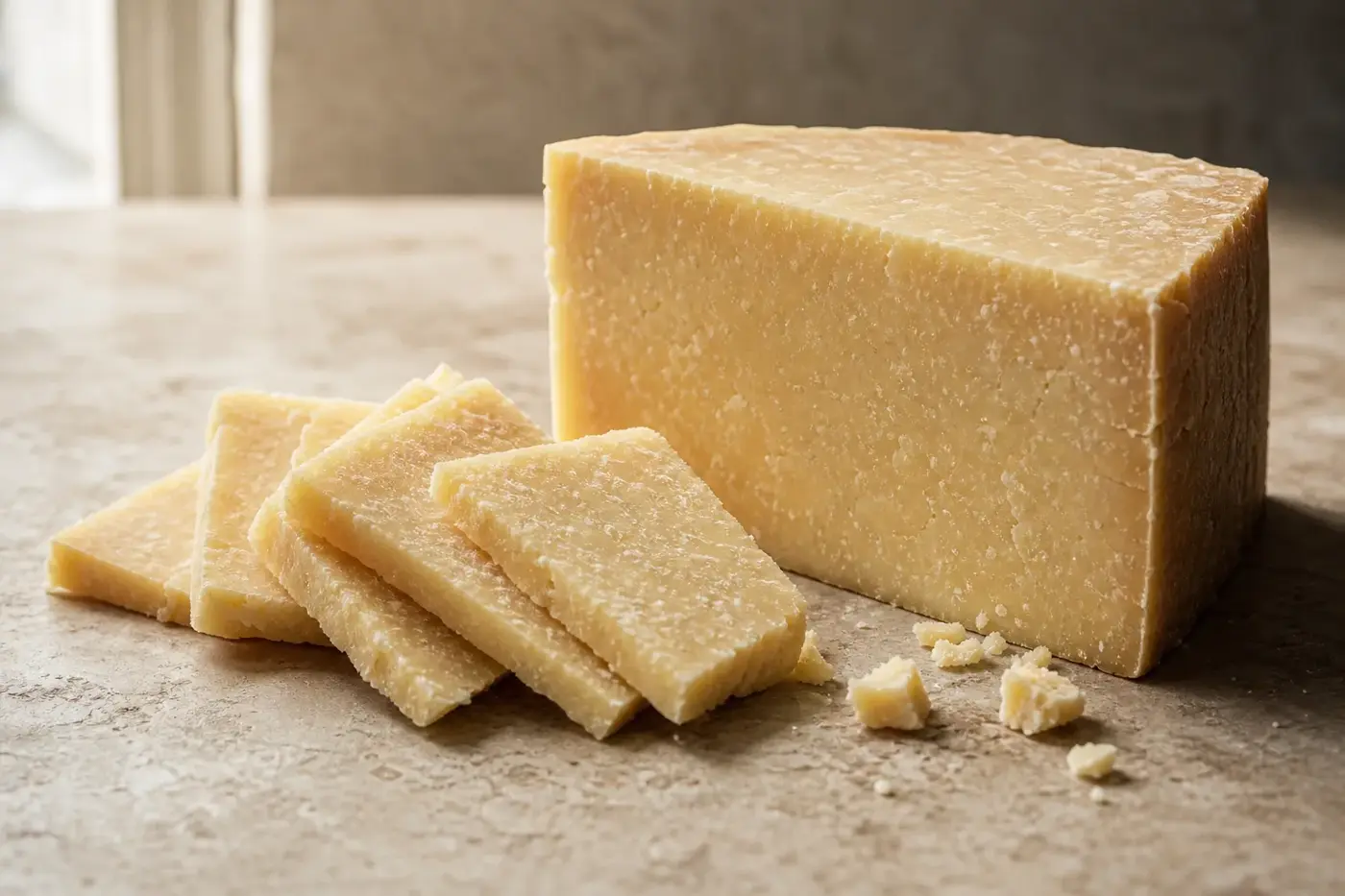
Run a grater over a wedge and watch the fine crumbs gather. Try another piece and you might get neat slices or brittle flakes, with white grains scattered through Parmigiano Reggiano that its consortium identifies as tyrosine crystals.[7] Behind those different textures lie three things: moisture left in the curd, the structure of its milk proteins and the changes maturation brings.[1,3]
Meet a family with plenty of character
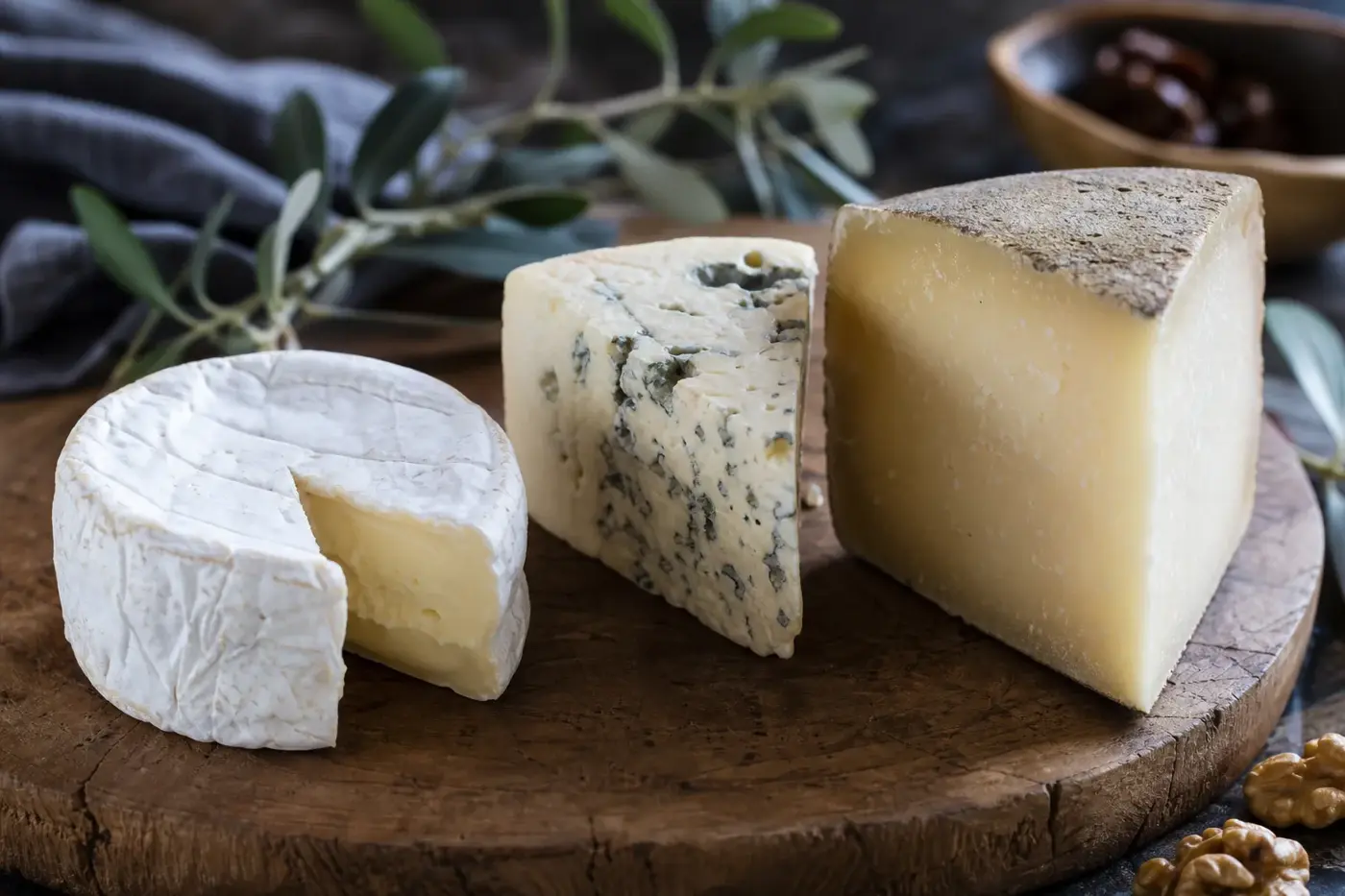
Hard cheese gives you a family of textures, not one recipe. Different milks, methods and maturation practices belong here, without a single universally fixed legal category. For the wider picture, explore how to tell cheese styles apart.[1]
Even the official boundaries overlap. Codex, the international food standards body, measures firmness by moisture on a fat-free basis: water as a percentage of everything except fat. Hard is 49 to 56%, firm or semi-hard is 54 to 69%, and extra hard is below 51%. These international reference descriptions have legal effect wherever a jurisdiction incorporates them into its rules.[1]
At the counter, semi-hard usually means something you can slice relatively easily. Very hard grating cheeses tend towards brittleness, but age is no simple guide: it can make cheese firmer or more crumbly, while protein breakdown during ripening can weaken its structure. Months alone cannot tell you how that wedge will cut.[3,19]
Follow the curd and watch the whey go
Cutting the curd gets water moving. Curd is the protein-rich gel formed when milk coagulates, or sets; whey is the liquid that separates from it. Smaller curd particles give whey more surface to escape from, while stirring and heating encourage further contraction and drainage. That process has a name: syneresis.[2]
Draining separates those particles from the surrounding whey. Pressing helps them knit together and can squeeze out more liquid, though cutting, cooking and acid development have already settled much of the final moisture. A heavily pressed cheese and a carefully cooked cheese reach their textures through different combinations of these steps.[2]
Acidity plays its part, too. It changes how much calcium stays associated with the protein network, helping determine whether your cheese is resilient or breaks more readily. Follow the whole journey in how cheese is made.[4]
Give salt, temperature and time their moment
Salt does more than season your cheese. It helps control the microbial community, and its concentration in the moisture influences enzyme activity and the pace of ripening. Alongside acidity and moisture, it sets the conditions in which cheese matures and keeps.[2,3]
Ripening temperature changes how quickly things happen. Enzymes break proteins into smaller peptides and amino acids, altering texture and supplying building blocks for flavour. Controlled maturation balances those processes; leaving your cut wedge on a kitchen shelf is quite another matter.[2,3]
When you choose a cheese, ask its actual age, if available. Then ask the more interesting question: what has that age done to this particular cheese? The oldest wedge does not automatically win, however impressive its credentials.
Make room for five hard cheeses
Put these five examples alongside one another and you have a starting point for exploring milk, maturation and ways to eat cheese. The ages below come from producer organisations; publication requires reference to the current binding specifications. Your individual wedge may be older.[7,9,10]
| Cheese to try | What to know about its age | Ways to enjoy it |
|---|---|---|
| Mature Cheddar | Look for the maker's stated age | Slice, crumble or grate |
| Parmigiano Reggiano | At least 12 months.[7] | Break into chunks or grate finely |
| Pecorino Romano | At least 5 months for table cheese, 8 for grating.[9] | Grate over pasta or serve small pieces |
| Queso Manchego | 30 days for pasteurised cheeses up to 1.5 kg; 60 days for other formats.[10] | Cut into wedges or thin slices |
| Aged Gouda | Look for the maker's stated age | Slice or break into bite-sized pieces |
Cheddar and Gouda are styles in this comparison. Parmigiano Reggiano, Pecorino Romano and Queso Manchego are individually named cheeses. Their milk and production requirements call for reference to the current official specifications before publication.[9,10,18]
Pecorino Romano makes the connection between age and use especially clear. Its consortium describes the table cheese as aromatic, savoury and mildly piquant; the grating version has a more intensely piquant flavour. You are tasting different expressions of the cheese, not interchangeable examples of hardness.[9]
Taste the character, then listen for crunch
Intensity tells you how forcefully cheese tastes, not what it tastes of. Look for savouriness, sharpness, tang, sweetness or something reminiscent of toasted nuts, and consider how milk, method and age have shaped that character. Publication also calls for sourced flavour descriptions of the named examples.
Then comes the crunch. The American Cheese Society’s technical lexicon records crunchy tyrosine crystals in aged cheeses, including Italian, Gouda, Alpine and Cheddar styles.[6] The Parmigiano Reggiano consortium identifies the white grains in its cheese as tyrosine crystals.[7]
Calcium lactate crystals are something different. An experimental Cheddar study found that higher protein concentrations in cheesemilk and lower cheese pH encouraged their formation by increasing calcium and lactate in the cheese’s liquid phase. That crunchy grain need not be salt, and you cannot establish its chemical identity just by looking.[5]
Get acquainted with the rind
A natural rind develops from the cheese itself as its outside loses moisture and changes during ripening. Codex distinguishes that layer from an applied surface coating. Remove wax, plastic and cloth coverings before eating, then read the label or ask the seller about what lies underneath.[1,2]
Whether you should eat a rind depends on the cheese, not how natural it looks. The Parmigiano Reggiano consortium says its rind is edible because it receives no preservative treatment, and recommends cleaning it before use. Its 2026 guidance also says to remove any casein identification plate. Follow the instructions for your particular cheese.[8]
Let dinner decide which texture you need
What job have you got in mind: sandwich slices, pieces for a board, a grated finish or an ingredient for cooking? Look at the milk, actual age where given and the maker’s texture description. Tell the seller whether you want cheese that bends into a sandwich or breaks into brittle shards.
For serving, try thin slices from a firm wedge with bread, or small broken pieces of brittle cheese on a board. A fine grating distributes cheese through a dish. Use a stable board and a tool suited to the piece’s size, keeping your fingers clear of the cutting edge.
For cooking, decide whether cheese should supply the main texture or finish things with flavour. Try grated mature Cheddar in a sauce, shavings over vegetables or a little grated Pecorino Romano over pasta. Taste before adding more salt. Buy for the texture your dish needs, rather than age alone.
Let bread, fruit and drinks play their part
Start with plain bread and water, then bring in one accompaniment at a time. Try apple or pear with savoury cheese, dried fruit beside a sharper piece, or an unsalted cracker when you want less distraction. Taste the cheese alone, then the combined mouthful: that difference is what you are exploring.
For drinks, sparkling water, unsweetened tea and an alcohol-free apple drink offer different starting points. Choose something you already enjoy, then notice whether it leaves the cheese’s flavour clear or overwhelms it. Your cheese need not compete for attention at its own party.
Keep accompaniments separate so everyone can choose what they enjoy. Read their ingredients when catering for an allergy.[16]
Wrap your wedge and mind the fridge
Your cut wedge needs protection from drying out. Follow the maker’s wrapping instructions: for cut Parmigiano Reggiano, its consortium recommends a glass or plastic container, or food-grade plastic film, to limit contact with air. Use your particular pack’s storage instructions and opening guidance, rather than giving every hard cheese the same shelf life.[7,11]
For households in England, Wales and Northern Ireland, the Food Standards Agency recommends a fridge between 0 and 5 °C (32 to 41 °F), with a thermometer to monitor it. Refrigerate dairy products and follow their labels. During preparation, the agency advises keeping chilled food out for the shortest possible time, with a maximum of four hours.[11]
Take out only the portion you expect to eat. Leave the rest refrigerated, and find the fuller routine in how to store cheese at home. For publication, serving time guidance must reflect current official advice.[11]
This page summarises published guidance from the official sources it cites. It is not medical advice. Guidance differs between countries and changes over time, so check the current source for where you live, and ask your doctor, midwife, pharmacist or dietitian about your own circumstances.
Know when mould needs caution
Unwanted mould is different from growth intended as part of a cheese. The FSA’s home food fact checker gives advice on mould affecting fruit. Publication requires current official advice specifically covering unwanted mould on cheese.[12]
For unwanted mould on cheese bought without it, take that cautious approach and discard the affected food. Follow recall instructions separately. If you need help distinguishing intended rind growth from spoilage, see mould on cheese.[12,17]
The November 2026 review of UK NHS pregnancy guidance includes pasteurised and unpasteurised hard cheeses, such as Cheddar, Gruyère and Parmesan, among foods that can be eaten during pregnancy. Its separate advice for soft, mould-ripened and blue cheeses matters when your board holds several styles. Consult that guidance for its current categories and exceptions.[13]
The NHS also identifies infants and young children, older people, pregnant people and those with certain health conditions or weakened immunity as groups needing particular care with specified cheeses. If you follow a medically prescribed diet, ask your clinical team about the particular product.[14]
Understand lactose intolerance and milk allergy separately
A hard wedge cannot tell you its lactose content. Lactose is milk sugar, and removing whey and bacterial fermentation help reduce what remains in cheese. The amount depends on the product and process: neither hard texture nor long maturation gives you a measured figure.[2,4]
The UK NHS distinguishes lactose intolerance, difficulty digesting that sugar, from food allergy, an immune reaction. Its advice for lactose intolerance includes reducing or avoiding lactose according to symptoms, with professional advice where needed. For the separate question of measured amounts, see lactose in cheese.[15,16]
For milk allergy or lactose intolerance, consult the relevant NHS guidance and ask a doctor or dietitian about suitable foods. Read the ingredients of both your cheese and every accompaniment.[15,16]
Questions people ask
How does cheese become hard?
Cutting curd releases whey, while stirring and heating encourage further drainage. Pressing helps the curd particles knit together and can squeeze out more liquid.
Does older cheese always become harder?
Age can make cheese firmer or more crumbly, but protein breakdown during ripening can also weaken its structure. Months alone do not tell you how a wedge will cut.
How should hard cheese be stored?
Follow the maker's wrapping and opening instructions. For cut Parmigiano Reggiano, its consortium recommends a glass or plastic container, or food grade plastic film, to limit contact with air.
Can you eat hard cheese during pregnancy?
The NHS includes pasteurised and unpasteurised hard cheeses, such as Cheddar, Gruyère and Parmesan, among foods that can be eaten during pregnancy. Check the current NHS pregnancy guidance for its categories and exceptions.
Is hard cheese lactose free?
The amount of lactose depends on the product and process, so a hard texture or long maturation does not give you a measured amount. The NHS advises reducing or avoiding lactose according to symptoms, with professional advice where needed; consult its lactose intolerance guidance and ask a doctor or dietitian about suitable foods.
Sources
- FAO and WHO, Codex Alimentarius. General Standard for Cheese, CXS 283-1978, retrieved edition. Section 7.1, Table B, and appendix on cheese rind, surface and coatings. International reference standard.
- American Society for Microbiology, Microbiology Spectrum. The Basics of Cheesemaking, 2013. Sections on cutting, cooking, draining, pressing, salting and ripening.
- Journal of Dairy Science. Texture Development During Cheese Ripening, 1987. Published summary concerning casein breakdown, salt-to-moisture ratio and storage temperature.
- Critical Reviews in Food Science and Nutrition. Glycolysis and related reactions during cheese manufacture and ripening, volume 29, issue 4, 1990. Published summary concerning acidification, calcium retention, syneresis and lactose metabolism.
- Journal of Dairy Science. Cheese pH, Protein Concentration, and Formation of Calcium Lactate Crystals, 2006. Experimental findings reported in the retrieved abstract.
- American Cheese Society. Cheese and Dairy Product Lexicon and Glossary, May 2025 update. Entry on tyrosine crystals.
- Consorzio del Formaggio Parmigiano Reggiano. FAQ, undated current webpage, retrieved November 2026. Answers on minimum maturation, crystals and storage. Producer organisation's account.
- Consorzio del Formaggio Parmigiano Reggiano. Parmigiano Reggiano Guidelines, revision 02, 2026. Guidance on edible rind, cleaning and removal of the casein plate. Producer organisation's account.
- Consorzio per la Tutela del Formaggio Pecorino Romano. Caratteristiche, undated current webpage, retrieved November 2026. Milk, sensory description, coatings and maturation categories. Producer organisation's account.
- Fundación Consejo Regulador de la Denominación de Origen Queso Manchego. Queso Manchego and official homepage, undated current webpages, retrieved November 2026. Manchega sheep's milk, permitted milk treatments and stated maturation periods.
- Food Standards Agency. How to chill, freeze and defrost food safely, 2017, current retrieved guidance. Applies to England, Northern Ireland and Wales. Sections on chilling and refrigeration.
- Food Standards Agency. Home food fact checker, updated 21 August 2026. Applies to England, Northern Ireland and Wales. Answer on removing mouldy parts of food.
- NHS. Foods to avoid in pregnancy, current webpage retrieved November 2026. Cheese, milk and other dairy section. UK pregnancy guidance.
- NHS. Dairy and alternatives in your diet, current webpage retrieved November 2026. Cheese, vulnerable groups and dairy intolerance or allergy sections.
- NHS. Lactose intolerance, current webpage retrieved November 2026. Definition and dietary management guidance.
- NHS. Food allergy, current webpage retrieved November 2026. Immune reactions, diagnosis and avoidance of relevant ingredients.
- Food Standards Agency. Alerts, live official portal, retrieved November 2026. Source for product-specific recall instructions.
- International Dairy Journal. A novel approach based on enzymatic hydrolysis for the valorisation of edible Parmigiano Reggiano cheese rinds, 2022. Retrieved publication summary identifying raw bovine milk as the starting material.
- FAO and WHO, Codex Alimentarius. Standard for Extra Hard Grating Cheese, CXS 278-1978, retrieved edition. Description of granular, slightly brittle texture. International reference standard.
This desk-researched article brings together dairy science, producer organisations' published descriptions and official UK consumer guidance.
Last checked: November 2026
Last checked November 2026.
The editors suggest you read next
How to Tell Cheese Styles Apart: Milk, Rind, Texture and Method
Watch mozzarella curd being worked and stretched in hot water.