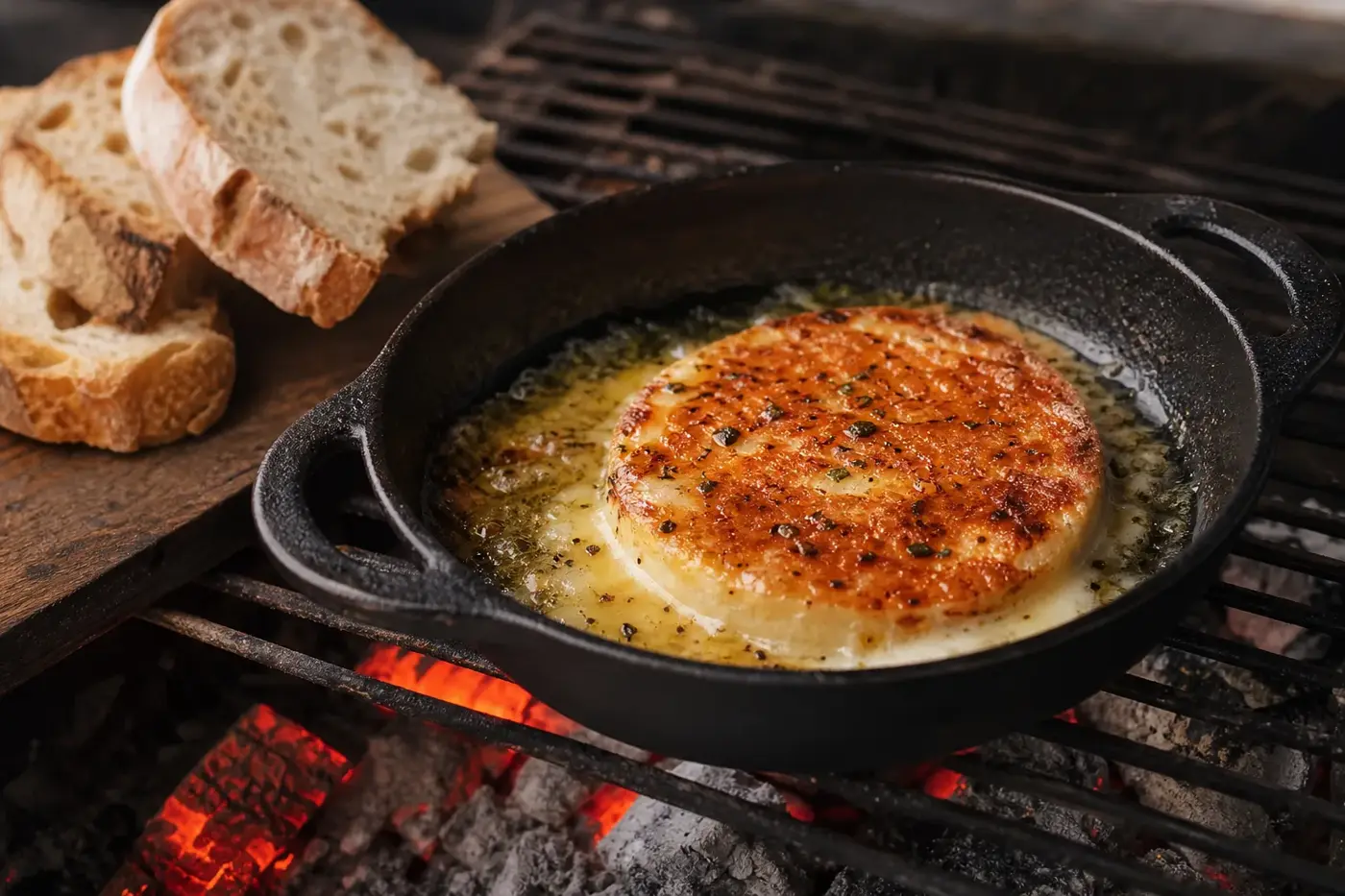
A browned edge, a melting centre, bread poised nearby. Over the embers of an Argentine asado, a thick round of cheese softens in an iron dish beside the beef, a temptation captured by Cocineros Argentinos.[2] You can bring that contrast home with a heavy frying pan or a small cast-iron dish on the barbecue.[1][2] Best have the bread ready: this is no time to be looking for the bread knife.
Meet your barbecue’s cheese companion
Provoleta is the name of the prepared grilled cheese dish, though you may find the cheese itself sold under that name too. Argentine producers also use provolone hilado and parrillero for grilling cheeses.[3][4] Hilado means stretched, a clue to how the cheese is made.
This provolone-style cheese has a documented place beside the barbecue. Cocineros Argentinos cooks it in an iron dish over embers alongside grilled beef; elGourmet features it in Maestros del Asado.[1][2] Bring it to your table as a shared starter, with bread and accompaniments ready before the hot cheese arrives.
Choose a round ready for the heat
Look for a thick, intact round whose producer recommends it for provoleta, grilling or pan cooking. Lácteos CDS describes its provolone as compact and suitable for slices browned on the grill or in a frying pan.[3] Savencia’s Argentine provoleta comes in a tubular format, promising a crisp outside and very soft inside when cooked.[4]
These descriptions tell you about the producers’ own cheeses, but they offer useful buying clues. You want a substantial slice, a compact body and a stated cooking use. Ask your cheesemonger for a round about 1.5 cm thick, as used in elGourmet’s iron-griddle recipe.[1]
Read the producer’s instructions for any outer covering before you cook. Keep the slice whole rather than cutting it into little pieces. Choose a pan that gives it a comfortable fit.
Choosing a substitute? Start with the melt
Do you want a melting centre, or a cheese that keeps its shape? Arla’s cooking guide describes provolone as stretchy when melted, with good browning, while halloumi holds its shape.[5] That choice changes both the equipment you need and what lands on your plate.
| Your cheese | How to cook it | What to expect |
|---|---|---|
| Provolone with grilling instructions | Follow the producer’s instructions; choose a pan if unsure | Your closest starting point for a melting centre.[3][5] |
| Halloumi | Grill or griddle following its own recipe | A saltier, springier bite that keeps its shape, without a flowing centre.[6] |
| Firm paneer | Lightly oil it and handle carefully on a griddle | A milder, less salty result, with gentler browning and no stretchy melt.[7] |
For halloumi, Arla specifies 1 cm slices and 2 to 3 minutes per side on a grill or griddle.[6] Follow those instructions rather than borrowing provoleta timings. Paneer gives you another cooked-cheese starter, particularly if you want oregano and chilli to take the lead.[7]
Make provoleta for two to share
Recipe status: Adapted from elGourmet’s iron-griddle method, with seasonings informed by Argentine producer information and the Smithsonian’s published recipe. Independent testing by fromage.co.uk: none.[1][8][9]
Serves: 2 to share as a starter.
Preparation: Allow about 10 minutes to assemble ingredients and equipment, excluding lighting the barbecue.
Cooking: Let the first side’s appearance guide you; elGourmet specifies approximately 2 minutes after turning. Its published recipe gives an overall time of 15 minutes.[1]
Heat: Gentle hob heat, or a controllable area of the barbecue with a solid cooking surface. You do not need an oven.
Gather the cheese, bread and seasonings
- 1 intact slice of grilling provolone, approximately 200 to 250 g, about 1.5 cm thick.[1][10]
- 10 ml olive oil, divided between cooking and finishing.
- 1 g dried oregano.
- 0.5 g chilli flakes, optional.
- 150 g crusty bread, sliced, to serve.
- 200 g sliced tomatoes or a small green salad, optional.
The oil, seasoning and accompaniment quantities are this adaptation’s measures. Published provoleta recipes use oregano and olive oil. Chilli also appears in an Argentine producer’s seasoned version.[1][8][9]
Set up your pan and serving spot
Have a heavy frying pan or flat iron griddle, a broad thin spatula, oven gloves and a heatproof serving surface ready. If you are cooking on the barbecue, make sure the pan’s manufacturer permits it. Prepare a small heatproof serving dish too, if you plan to transfer the cheese.
Cook, turn and take it straight to the table
- Prepare your bread and accompaniments first.
- Add half the oil to the pan and set it over gentle heat, following elGourmet’s approach.[1]
- Lay in the cheese. Leave it alone while the underside colours and the body begins to soften.
- When melting begins, check underneath with your spatula. Turn carefully, supporting the full width of the slice.
- Add the oregano and optional chilli. Cook for approximately 2 minutes more, following the source method, then remove from the heat.[1]
- Finish with the remaining oil and serve immediately, with bread alongside.
At the barbecue, give the cheese a solid base
A heavy pan or iron dish gives you more control when you are cooking an unfamiliar cheese. Put it on the barbecue rather than laying the slice directly across the bars. Cocineros Argentinos uses an iron dish over embers, catching the softening cheese on a solid base instead of losing it through the grate.[2]
Choose a spot where you can move the pan away from stronger heat. Keep the handle accessible and use equipment intended for barbecue temperatures. Follow the recipe’s turning cues: a hotter fire does not mean the same timing will work.
Direct grate cooking depends on the particular cheese and its producer’s instructions. If the pack specifies only pan or oven cooking, follow that advice. A wide spatula supports a softened slice, but a solid pan is your better precaution while you get to know the cheese.[2][3]
On the hob, take the gentle approach
Start gently and watch what happens in the pan. ElGourmet oils an iron griddle, turns the cheese when it begins to melt, then cooks the second side for another two minutes.[1] Follow the method above, watching the cheese as well as the clock.
If you care more about keeping everything contained than lifting out a neat round, consider a small ovenproof dish. The Smithsonian publishes a separate oven method using thick provolone slices, olive oil, oregano and chilli.[9] Treat that as its own contained method, not an oven-finishing step for this pan recipe, and use only a dish approved for your chosen heat source.
Look for a crust and a softened centre
Look underneath for colour and through the slice for softening. Savencia describes its cooked provoleta as crisp outside and very soft inside.[4] That is the contrast you are after. A browned bottom tells only half the story.
Slip your spatula under an edge to check, rather than repeatedly lifting the whole round. Support the full slice before turning. If it becomes too fluid to lift, leave it in its cooking vessel and serve that on a heatproof surface.
Your best defence against an uncontrolled puddle comes before cooking: choose cheese sold for the job and give it a solid cooking surface. Cheese choice matters here. Arla distinguishes provolone’s stretchy melt from the shape-holding behaviour of grilling cheeses such as halloumi.[5][6]
Give oregano and chilli their turn
Oregano and olive oil are a simple place to start. ElGourmet uses fresh oregano, while the Uruguayan Association of Asadores specifies dried oregano in the neighbouring Río de la Plata tradition.[1][10] Both have a documented place here. The recipe above measures the dried version.
Chilli flakes are optional, but they belong in this company. The Smithsonian includes them, and Argentine producer Esperanza Blanca seasons its provoleta with crushed chilli, oregano and parsley.[8][9] Look at your cheese before reaching for the seasoning: those flavours may already be there.
For a change, bring chimichurri, salsa criolla or fresh basil to the table alongside the cheese. The Uruguayan association lists all three as variations.[10] Serve them alongside rather than covering the cheese before cooking.
Bring bread, something fresh and a glass
Serve your provoleta straight from the heat, with bread within easy reach. Give everyone some browned edge as well as softened cheese; even the most generous cheese lover notices the distribution of crust. The Uruguayan Association of Asadores specifies bread or baguette, and the Smithsonian serves its version with bread too.[9][10]
For a fresh contrast, try sliced ripe tomato or a lightly dressed green salad, served separately. That is an editorial suggestion, not a traditional requirement. Shared cheese, bread and one fresh accompaniment make a more manageable starter than a crowded plate.
The Uruguayan association suggests red wine or beer.[10] A young, fruit-led red is another editorial pairing suggestion, alongside alcohol-free options such as sparkling water with lemon or unsweetened chilled tea. These are suggestions, not recorded tasting results; alcoholic pairings are for adults of legal drinking age, in small servings.
If you would like more pairing principles, explore cheese and wine pairing. You can use that guide to think about what to pour alongside your cheese.
This page summarises published guidance from the official sources it cites. It is not medical advice. Guidance differs between countries and changes over time, so check the current source for where you live, and ask your doctor, midwife, pharmacist or dietitian about your own circumstances.
Before sharing, read up on rennet and allergens
Vegetarian suitability depends on the cheese you buy. The Argentine producer pages list cuajo, meaning rennet, without identifying its origin.[3][4] Choose a product explicitly confirmed as suitable for vegetarians. Ask about the coagulant and other animal-derived enzymes where necessary.
For help understanding those distinctions, turn to the guide to rennet types. The cheese’s name alone does not settle the question.
This recipe contains milk because it contains cheese. Check every ingredient, including bread and sauces, and read precautionary allergen statements. Savencia’s published provoleta information also carries an egg warning.[4]
For England, Northern Ireland and Wales, the Food Standards Agency advises checking ingredient and allergen information and considering cross-contamination when preparing food for someone with an allergy.[11] November 2026 is the guidance reference date for this page. See cheese allergy and lactose intolerance for the separate questions involved.
Keep your cheese chilled and store leftovers safely
Keep your cheese refrigerated while you get everything else ready. The FSA guidance for England, Northern Ireland and Wales recommends a fridge temperature of 0 to 5 °C (32 to 41 °F) and following the pack’s storage instructions.[12] November 2026 is the guidance reference date for this page.
If you have cooked cheese left over, the FSA advises cooling it as quickly as possible, ideally within one to two hours, then refrigerating it. Eat refrigerated leftovers within 48 hours or freeze them.[12] Reheat only once, until steaming hot throughout.[13]
For uncooked cheese, follow its label. For more storage guidance, turn to storing cheese at home.
Questions people ask
What is provoleta?
Provoleta is a grilled cheese dish, although the cheese sold to make it may have the same name. It is a provolone style cheese with a documented place beside the Argentine barbecue.
How do you cook provoleta in a frying pan?
Use a thick, intact round of cheese recommended for grilling or pan cooking, and start it in an oiled heavy pan over gentle heat. Turn it when it begins to melt, add oregano and optional chilli, then cook for approximately two minutes more.
Can halloumi or paneer be used instead of provoleta?
Both offer alternatives, but neither gives the same stretchy melt. Halloumi holds its shape and has a saltier, springier bite, while firm paneer is milder and less salty, with gentler browning.
Is provoleta suitable for vegetarians?
That depends on the cheese. The Argentine producer pages consulted list rennet without identifying its origin, so choose a product explicitly confirmed as suitable for vegetarians.
How should leftover provoleta be stored?
For England, Northern Ireland and Wales, the Food Standards Agency advises cooling cooked leftovers as quickly as possible, ideally within one to two hours, then refrigerating them. It advises eating refrigerated leftovers within 48 hours or freezing them, and reheating only once until steaming hot throughout. See the Food Standards Agency’s guidance for current advice.
Sources
- elGourmet, Provoleta, undated online recipe, Maestros del Asado. Thickness, iron-griddle method, gentle heat, turning cue, second-side timing and seasonings. Source.
- Cocineros Argentinos, Entraña a la parrilla, undated online recipe. Provoleta cooked in an iron dish over embers alongside grilled beef. Source.
- Lácteos CDS, Queso provolone hilado semiduro, undated product information. Producer description, grilling and pan uses, ingredients. Source.
- Savencia Food Service Argentina, Queso Provoleta, Santa Rosa, undated product information. Format, producer’s texture description, ingredients and allergen statement. Source.
- Arla, A guide to cooking with cheese, undated online guide. Producer-published comparison of cooking behaviour. Source.
- Arla, Grilled halloumi, undated online recipe. Slice thickness, cooking times and shape-retaining behaviour. Source.
- Arla Apetina, Paneer vs halloumi, undated online guide. Producer-published comparison of seasoning, texture and grilling behaviour. Source.
- Esperanza Blanca, Duros, section Provoleta Saborizada, undated product information. Published ingredients include crushed chilli, oregano and parsley. Source.
- Smithsonian Science Education Center, Libro de Recetas Mundial, undated PDF, section Provoleta. Argentine dish designation, oven method, ingredients and bread accompaniment. Source.
- Asociación Uruguaya de Asadores, Revista AUA, edition 4, 2023, provoleta ingredient and accompaniment section. Used explicitly for the neighbouring Uruguayan tradition. Source.
- Food Standards Agency, Food allergy and intolerance advice for consumers, updated 7 August 2026. Guidance applying to England, Northern Ireland and Wales. Source.
- Food Standards Agency, How to chill, freeze and defrost food safely, published 18 December 2017, live text checked November 2026. Sections 1 and 4. Source.
- Food Standards Agency, Cooking your food, published 18 December 2017, live text checked November 2026. Section 7, using leftovers. Source.
This piece was researched from published culinary methods, Argentine producer information and official food-handling guidance; the recipe is a desk-researched adaptation.
Last checked: November 2026
Last checked November 2026.
The editors suggest you read next